Showing posts with label bloom. Show all posts

10 April 2025

What I know for certain

Cardinal Thomas Lawrence (played by Ralph Fiennes) giving his homily on certainty in the film Conclave.
Cardinal Thomas Lawrence (played by Ralph Fiennes) giving his homily on certainty in the film Conclave. Screenshot from source.

Conclave's fictional Cardinal Lawrence, addressing his fellow cardinals as they prepare to elect a new pope, warns them of a dangerous attitude: certainty.

There is one sin which I have come to fear above all others: certainty. Certainty is the great enemy of unity. Certainty is the deadly enemy of tolerance. … Our faith is a living thing precisely because it walks hand in hand with doubt. If there was only certainty and no doubt, there would be no mystery and, therefore, no need for faith. Let us pray that God grants us a pope who doubts. [Source.]

I don't totally agree. A personal sense of certainty can be a source of strength and courage. A few years ago, in a blog post inspired by Chris Hedges' When Atheism Becomes Religion, I made a distinction between personal certainty, on the one hand, and assertions of certainty in the social arena—particularly as categorical and coercive action.

I also admitted that ...

Certainty is a slippery quality. In my experience, it comes and goes—and returns. More importantly, it is relational rather than operational: I can be certain that God wants the best for you and me, and that God will be with you and me as we work for that best, but I'm hardly ever certain about what concrete steps to take next. For that decision, I need a mix of intuition, prayer, plain secular fact-checking, the wisdom of others, and a willingness to risk being wrong.

In the film Conclave, part of the context of Lawrence's homily on certainty is his understanding that the late pope, toward his end, had doubts—not about God, but about the church. It is institutionalized certainty that is the greater danger, and the cardinals would be wise to choose a pope who understands this.

This balancing act between personal certainty and socio-political uncertainty seems to me to be the way God set things up in the first place. I'm recalling the words of Anthony Bloom on God's powerlessness that I've quoted several times before. The context: In response to an interviewer's question, Bloom is commenting on the history of church/state relationships in Russia.

No party at all should be able to claim the Church as its own, but at the same time the Church is not non-party, or above parties. She must be the voice of a conscience illuminated by the Light of God. In the ideal state, the Church must be in a condition to speak to any party, any movement: "This is worthy of humanity and of God, and that is not." Of course, this can be done from either of two positions: either from a position of strength, or from a position of complete helplessness. It seems to me—and I'm deeply convinced of this—that the Church must never speak from a position of strength. The Church must not be one of the powers operating in this or that government; she must be, if you like, just as powerless as God, Who does not coerce, Who only calls us and reveals the beauty and truth of things, but doesn't enforce them on us; Who, similarly to the way our consciences work, points out the truth, but leaves us free to listen to truth and beauty—or to refuse them. It seems to me that this is how the Church should be. If the Church takes its place among those organizations that have power, that are able to force and direct events, then there will always be the risk that she would find power desirable; and as soon as the Church begins to dominate, she loses the most profound thing, the love of God, and an understanding of those who need salvation rather than the works of destruction and rebuilding.

(A lengthier extract is here, toward the end.)

For me, it follows that the work of evangelism is to encourage and draw out people's capacity to respond to God's call, God's offer of relationship, which would be reflected in our own offer of relationship, and our truthful testimony of how we have experienced that relationship in our faith community. This work does not depend on a convincing string of logical propositions, because no such string exists objectively apart from relationship. Just as with the turtles, it's relationships all the way down.

Photo: Judy Maurer, April 5.
Maybe God could have designed a more internally consistent and self-interpreting Bible and left manuscripts for it in perfect condition. Maybe God could have given us the ideal template for church government, along with sinless leaders to occupy perfectly-designed roles. And maybe God could have intervened more frequently and forcefully when we humans treated each other with gleeful cruelty. But as Eugene Peterson commented on the "nearly unrelieved mayhem" of the Book of Judges, 

Twice in Judges (17:6 and 21:25) there is the telling refrain: “At that time there was no king in Israel. People did whatever they felt like doing.” But we readers know that there was a king in Israel: God was king. And so, while the lack of an earthly king accounts for the moral and political anarchy, the presence of the sovereign God, however obscurely realized, means that the reality of the kingdom is never in doubt.

However strong our faith, no human being ever has the whole picture—and we just make things worse when we pretend otherwise. God has, for reasons that may always remain obscure, chosen to fulfill the promises of God through us and our fractious, fragile communities. In the short run, even if our faith is strong, failure is an option, but then we dust each other off and once again wait for God's pull on our hearts. The next steps might not be clear all at once, and we may disagree any number of ways. But the certainty of God's love shared among us motivates us to keep praying for unity, discernment, perspective, and courage. There are no shortcuts; weaponized certainty and coercion are just dead ends.


Tim Gee with more on the police raid on Westminster Friends' meetinghouse.

Tom Gates considers the Rwandan genocide of 1994, "...one of recent history’s most extraordinary cases of mass scapegoating."

David Roberts speaks to Spokane Friends on the dark side of community.

Have you seen the second season of the television drama Severance? Beth Felker Jones gives us a theological commentary. (Spoilers. I have just started watching the second season, so I didn't read her commentary to the end....)

Jeff Sharlet and the eroticization of cruelty: what did we see when Kristi Noem went to El Salvador?


My favorite Canadian blues guitarist, "The Ice Queen," Sue Foley.

13 January 2022

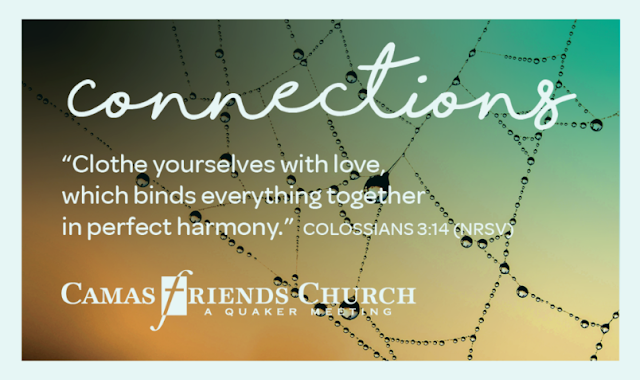
Restoring connections

Source.  

For our Quaker congregation, a new year means a new "word of the year." For this year of 2022 the word is connections.

The announcement of our word of the year came with a whole list of queries. They're all substantial and worthwhile, and it would probably take a whole year to get through them all, but one query jumped out at me right away.

How can I strengthen my connection to myself?

Does this strike you as another example of churches that pander to our culture's individualism by  emphasizing self-regard over self-abandonment? Not guilty! There can be no genuine connection to self, no healthy self-regard, that doesn't include repentance. This was one of my concerns last week, when I urged us to reset our shame and self-recriminations to zero for the new year, but not at the expense of being truthful before God and those we've harmed. "Self-regard" means regard for our actual selves, not our conceits, nor our self-deceptions.

When we want to strengthen our connection with ourselves, one approach might be to ask ourselves honestly, "Do I spend time simply enjoying my own company? When does this happen, and what might get in the way?" Many of the challenges that we might encounter in the quiet waiting worship of a Friends meeting might also apply to the simple (?) occupation of spending time with ourselves: distractions, addictions, boredom, a deadened sense of curiosity about what is going on right around -- and inside -- us.

The Russian Orthodox physician and bishop Anthony Bloom spoke very helpfully about this connection in a comment he made on the Jesus prayer, Lord Jesus Christ, Son of God, have mercy on me, a sinner. (This is from the same chapter of Conversations about Prayer that I quoted last week. Emphasis in original.)

How can every single person call himself or herself a sinner? Can anyone honestly do this? Would it be true? Wouldn't it be hypocritical?

This would not always be true if the concept of sin related only to the moral categories of righteousness, honesty, goodness in a moral sense. But there is a deeper and more basic meaning of the word "sin."

Sin is, before all else, a person's loss of contact with their own deepest place. Every person is deep -- but so often lives superficially, through superficial feelings and understandings. Instead of living from their depth, acting from the core of their being, people live reactive lives, simply reflecting those rays that fall on them.

This is the first and principal sin: superficiality, loss of inner depth, loss of contact with this depth. As a result, a person loses contact with that which is present at this depth -- that is, with God.

In one of our first conversations, I referred to the words of Michael Ramsey, the Archbishop of Canterbury, who said that in each person there is a bottomless depth that only God can fill. See what happens when a person lives only on their own personal surface: that person loses their connection with God. And having lost that connection with God, they also grow distant from their neighbors, their surroundings, their whole life.

Anthony Bloom invites us to reconnect with ourselves by seeking reconnection with God, who already waits within us with love and mercy. And, conversely, in restoring this connection with God, we're once again living as our true selves -- utterly worth connecting with, spending time with.


Related: 


When I first heard that word "connections" proposed as our word of the year, I said to myself, "Now why does that word sound so familiar here in our Pacific Northwest Quaker context?" I quickly remembered -- Connection is the name of the Northwest Yearly Meeting of Friends newsletter. Ironically, that is the family of Friends churches that disconnected our church, and others like us, from the body we once belonged to. As the name of their newsletter, it sounds a bit ironic -- but as our word of the year (plural form), it bears the promise of healing.


Text (Russian) of Anthony Bloom's conversation on prayer quoted above. (Also available as part of this booklet.) The first site has many talks and sermons of Anthony Bloom in English.

The wonderful documentary film Sweet Home Monteverde, which I reviewed in June 2020, is now available for viewing on the Web site of Rocky Mountain Public Broadcasting.

In America, a child is shot every hour.... Read these portraits of thirteen children we lost to guns in 2021. Of course I can't help reaching back to 1970 and adding my own sister Ellen to this tragic catalog.

Kazakhstan: a disinformation case study?

Living "as if the things Jesus taught were actually true" -- Philip Yancey on Desmond Tutu. And Russell P. Johnson on the revolutionary joy of Desmond Tutu.

Paul Anderson on Quakers and the Nobel Peace Prize.

Nancy Thomas may be my favorite list-maker of favorite books.


Virtuoso guitarist Christone "Kingfish" Ingram with a B.B. King classic:

24 July 2019

Anthony Bloom speaks to Friends (repost and update)

Raymond Village Library
Hello from Raymond, Maine, where our Internet access is mostly limited to our visits to the Raymond Village Library, a wonderful library which is open to the general public three days of the week. (Hence another Wednesday entry instead of my usual Thursday schedule). I may use a similar dodge next week, as our time in Maine draws to a close.

As I write, the former special counsel Robert Mueller is testifying to committees of the U.S. Congress. I'm resisting getting caught in the political and emotional swirl surrounding these much-anticipated appearances by Mueller. His report really does speak for itself, and could easily form the basis of Judiciary Committee impeachment hearings if there were any sort of political leadership for that obvious step in our struggle to preserve what's left of republican democracy. As for today's appearances, it's hard for me to put any hope that, in the absence of such leadership, the political mudwrestling on offer today will result in anything edifying. Maybe I'm wrong, but please forgive my lack of investment in being among the first to know.

Instead, I'm remembering Anthony Bloom again. A few weeks ago I brought you a few of my favorite paragraphs from his book On Meeting. It left me with a desire to put up another scoop of his words. Today's unappetizing political spectacles, and Christians' mixed record in standing up for higher values, brought to mind this Bible study we did at Moscow Friends Meeting....

(Startling realization: this was nearly eight years ago!)


This month [August 2011], I'm helping with a Bible study at Moscow Friends. Rather than plunging directly into a biblical theme, we're going to explore how we understand the Bible and its role in forming us as individuals and a community. I remember a very helpful Wednesday evening discussion along these lines at North Valley Friends in Newberg, Oregon, USA, and I'm eager to see how a similar discussion might go here. A new translation of the Old Testament has recently been published and has been widely discussed (see this item for a bit of an introduction to the discussion), making now a perfect time to choose this theme.

Source.  
For our first discussion, I chose several scriptures on God speaking to us, through the Bible and through Jesus--including the well-known passage from 2 Timothy. On a hunch, I also went to a book of sermons by one of my favorite Russian Orthodox writers, Anthony Bloom (the bishop of Great Britain and Ireland at the time he died). There I found a sermon specifically addressing what it means to be a biblical people. I was struck by how close his sermon on the Bible is to the classic Friends view. Anthony Bloom is consistent: he teaches honesty in prayer, in our relationships with each other, and in our relationship with the Bible:
The Gospel was born in the Church. Both the congregation of Israel and the church existed before there was Scripture. It was from within that community that the awareness of God emerged--and with it, an awareness of God's love, a vision of God's ineffable beauty, and a vision, as well, of our own status and fate, formation and calling. The community of the People of God is the kind of community that knows for sure that they have something vital to witness about -- namely about the One who is their new life, the object of their love and joy. A genuinely godly people -- a genuinely New Testament people -- must be the kind of community that could write the Bible themselves, giving it birth and preaching it from personal experience. If we're not that kind of fellowship, we don't really belong either to the Gospel or the people of God.

Often we comfort ourselves with the thought that we are a community of prayer where the word of God is preached and proclaimed, and where we seek, one way or another, to live by that word. But if we look around ourselves, everything we see indicates just the opposite. If we were a community where the divine word is being born from the very depths of our experience, it would be a two-fold revelation for all who hear us: a revelation of the word that is being proclaimed, and a revelation that the proclamation has become flesh and blood, a living reality for people. The community that preaches the divine word would by its very life serve as proof of what it is proclaiming.

Is this what we see? Can we really say that the community we constitute whether large or small, is a full-bodied confirmation of the news we carry, the good news that Jesus brings to the world?
One of George Fox's biographers said that if the Bible disappeared, it could be reconstructed from his writings. Anthony Bloom's sermon seems to be asking us: if the Bible somehow disappeared today, could it be reconstructed from the testimonies and experiences of our communities? Of your church, or mine?

As usual, Anthony Bloom does not mince words. What will our little fellowship do with his challenge? What first steps can we make to become the kind of people of God who don't just read the Bible as an old document, or one that makes us individually "wise unto salvation," but begin to incarnate its meaning and message--not just for ourselves but for those around us? If I'm not mistaken, Wess Daniels and his community are considering similar questions--see "Reading the Bible for transformation" (including the comments) and "The company we keep."


Re-reading the end of this post from 2011, I remembered that at the time Wess Daniels wrote the items I referenced from his blog, he was pastor at Camas Friends Church. When we returned to the USA from Russia, and eventually resettled in Portland, Oregon, the church we've ended up at is … Camas Friends Church. We love it! (Wess is now at Guilford College's Friends Center -- but his writings continue to be available to us all.)

Follow-up: Anthony Bloom speaks and we listen. Here's what I wrote the following week about the first session of that planned Bible study series.


Mike Farley on craving and prayer.

A story in captions: What does Leonardo DiCaprio have to do with Lake Baikal?

Gregory Osmolov: Why HBO's Chernobyl series resonates in Russia today.
For the Russian audience, perhaps not always consciously, the main theme of Chernobyl was not the events of the past, but the forces of invisibility that are still at work today. In a risk society whose contours – just like the spread of the Chernobyl radiation cloud – have begun to appear in our everyday lives, the main factor is not just a loss of security, but a fundamental need to come to terms with life in a world of growing uncertainty, where we are increasingly losing control over what is happening.
The new book Adventists and Military Service: some Quaker comments. (By the way, are Quakers "naively optimistic"? And which Quakers?)


A set from Steve Guyger and band:

04 July 2019

Anthony Bloom: "And so, we stand accused in this world"

Anthony Bloom, On Meeting
This morning I'm starting my annual four-day experience of unapologetic self-indulgence, namely the Waterfront Blues Festival. Compared to that exercise in prolonged ecstasy and nostalgia for my teenage years (the years I discovered this incomparable music), the deep spiritual and political maturity that you no doubt associate with me temporarily fade into the background.

However, just the other day I was reviewing some earlier posts with the idea I could sub one of them for the blog post due today. (When you're as obsessive as I am about a publishing schedule, the idea of skipping a week is almost out of the question.) I was stopped dead in my tracks by one of my posts that quoted the famous Russian Orthodox priest, Metropolitan Anthony Bloom. I decided to use that quotation this week -- with no commentary from me. Bloom speaks for himself. (I do take credit, or blame, for the translation into English.) See if you agree with me that his observations have not lost their relevance.

I ended up drawing upon two passages from him -- both are drawn from interviews, both from the same book. The first quotation was used in my post Can evangelicals reproduce?, and the second in Exceptional pride: USA and Russia.

A week from today I plan to be in Wilmington, North Carolina, USA, attending the annual sessions of North Carolina Yearly Meeting (Conservative). Depending on the schedule and jetlag, I may be finding more worthy quotations from other writers for that edition of my blog.

Over to Metropolitan Anthony Bloom:


An interviewer asked Anthony Bloom, "...How do you assess the position of Christianity in the contemporary world with all that is going on in it?" His answer:
It's a difficult question because what I want to say will be hurtful to many. It seems to me that today the whole Christian world, including the Eastern Orthodox world, has distanced itself terribly from the simplicity, integrity, and joyful beauty of the Gospel. Christ and his group of disciples created a Church that was so deep and wide and complete that it could contain the universe. Over the centuries we've made the church into one human social group among many. We're now something less than the world we live in, and when we talk about that world coming to Christ, we are talking about everyone, as many as possible, becoming members of that limited social group.

That's our sin, it seems to me. We need to understand that in the Christian church, believers should become believers not only in terms of their worldview, but in terms of all of life, of their inner experience, and our role is to bring light to this world, even in places where it's dark and at times terrifying. In one place the prophet Isaiah says, "Comfort, comfort My people" -- that was God's word to him, and, of course, to us. "Comfort My people" means get an understanding of the kind of sorrow gripping the whole world, both materially, in its confusion, and spiritually, in its lack of knowledge of God. It means bring the comforting touch of God, the love of God, the attentive concern of God, which must take hold of the whole person. It's meaningless to talk to someone about spirituality when they're hungry; feed them. It's pointless to talk about a person's mistaken perceptions when we don't bring to that person a living experience of God.

And so, we stand accused in this world. In its rejection of God and the Church, the world says, "You Christians cannot give us anything we need. You don't offer us God, you offer us a worldview. And it's a moot point if God is not at its core. You give us instructions on how to live, but they're just as arbitrary as the ones other people give us." We ourselves must become Christian -- Christians according to the example of Christ himself, and his disciples. Only then will the Church obtain, not power, that is the capacity to coerce, but authority, the capacity to say words that make the soul tremble and that open up the eternal depths within any soul. It seems to me that this is our current situation and condition.

Maybe I'm coming at this situation pessimistically, but, really, we're not Christians. We confess faith in Christ, but we've reduced everything to symbols. So, for example, I'm always struck by our Good Friday service: instead of the cross on which a living young Man dies, we have a wonderful service that can move us but that actually stands between us and that rude and ghastly tragedy. In place of the cross we've substituted an icon of the cross. In place of the crucifixion, we've substituted an image. In place of a retelling of the actual horror of what happened, we substitute a poetic/musical reworking of the story.

Of course that reworking does reach us, but we so easily begin to get a taste for that horror, even deeply experiencing it, being shaken and then regaining our calm, whereas the vision of a living person who is murdered is something quite different. That remains as a wound in the soul, you don't forget it; having seen it, you'll never again be the same as you were. And that is what dismays me. In some sense, the beauty and depth of our worship must break it open, and must lead every believer through that opening to the terrible and majestic secret of what is actually happening.
The interviewer: "Yes, that's a very deep thought. Of course the contemporary world is oriented in such a way that, in principle, it could exist apparently without God, without spirituality. It rolls along obliviously, and you could comfortably slumber your life away and die." Anthony responds:
But what seems even more terrifying to me is that you can call yourself a Christian and live your whole life studying theology and never meet God. You can participate in the beauty of the worship, being a member of the choir or a participant in the service, and never break through to the reality of things. That's what is terrible. The nonbeliever still has a chance to gain faith, but this possibility becomes distant and indistinct for pseudo-believers because they have everything: they can explain every detail of the service, of the symbols of faith, and of dogmatics, but suddenly it turns out that they haven't actually met God.


The interviewer (speaking with Bloom toward the end of the Gorbachev era): "Father, maybe from your vantage point at some remove from Russia [namely in England], you have a better view of the processes going on in our homeland's Church."
... Political conformism has long been one of the scourges of the Russian Church. Already before the Revolution, the Church and the state formed a sort of harmonious whole, which by the way didn't always work out to the benefit of the church. After the Revolution the church kept quiet. During the time of extreme repression and persecution, political expression was out of the question for everyone. And so now it will take an extended course of study -- actually more like an education by immersion -- before we'll learn how to think politically, speak politically, from inside the Church.

No party at all should be able to claim the Church as its own, but at the same time the Church is not non-party, or above parties. She must be the voice of a conscience illuminated by the Light of God. In the ideal state, the Church must be in a condition to speak to any party, any movement: "This is worthy of humanity and of God, and that is not." Of course, this can be done from either of two positions: either from a position of strength, or from a position of complete helplessness. It seems to me -- and I'm deeply convinced of this -- that the Church must never speak from a position of strength. The Church must not be one of the powers operating in this or that government; she must be, if you like, just as powerless as God, Who does not coerce, Who only calls us and reveals the beauty and truth of things, but doesn't enforce them on us; Who, similarly to the way our consciences work, points out the truth, but leaves us free to listen to truth and beauty -- or to refuse them. It seems to me that this is how the Church should be. If the Church takes its place among those organizations that have power, that are able to force and direct events, then there will always be the risk that she would find power desirable; and as soon as the Church begins to dominate, she loses the most profound thing, the love of God, and an understanding of those who need salvation rather than the works of destruction and rebuilding.
The interviewer: "Now in the West as well as here [in Russia] we're hearing voices asserting that Russian Orthodoxy is once again becoming the state religion. What do you make of this assertion?"
I think that, thank God, we're a long way from that. It's one thing for the state to become convinced that a Christian, or in a wider sense believers generally (here I'm thinking about Muslims and Buddhists as well) can also be a loyal son of the motherland.  But whenever any church represents the vast majority of believers, the relationship of this church and the state become, of course, more enmeshed and more complicated. And once again one of the tasks of the church -- whether we're talking about East or West--consists of not allowing itself to become part of the political or social system, but rather the opposite. While remaining fully loyal (in other words, wanting the best for the nation), warning society as a whole that there is another dimension to life, that there's not just the social-political dimension but that life has depth.
Interviewer: "By whose will, divine or diabolical, was Holy Russia almost destroyed? As we all know, Russia was called Holy Russia, Moscow was the city of forty times forty churches, the land was permeated with grace that shone out from believers...."
Every country chooses some kind of expression to characterize itself, but this expression doesn't necessarily describe what is true now, but instead its ideals and aspirations. So France called itself la France très chrétienne; Germany insisted on deutsche Treue, German faithfulness; Russia constantly talked about Святая Русь, Holy Rus'. But here's the thing: if we ask to what extent Russia was actually holy, and to what extent was it in combat; if we ask whether Russia was entirely dedicated to achieving this holiness -- the answer is right there in Russian history, which provides a rare spectacle of inseparably mixed holiness and horror. Leskov's story "Deliverance" is a short, clear, vivid depiction of how things were: we see a man, a godly believer, but "the Devil only knows" what's in him -- I mean this literally, I'm not using swearwords. This man goes on raging benders, he's off to sow his wild oats, then suddenly returns to God before turning right around in the old direction. For Russian history, this is completely normal; it runs through our past like a red thread.


Source: Митрополит Антоний Сурожский, О встрече. Санкт-Петербург, Сатисъ, 2002.


Brother Yusef plans to be with us at the Waterfront Festival this year.


26 July 2018

Moving shorts -- and Anthony Bloom on breaking open the circle of silence

We're in the middle of yet another move. We're moving from temporary quarters in Eugene, Oregon, back to the house in Portland where we lived until we joined the faculty at Elektrostal's New Humanities Institute.

In October 2007, I went alone to Elektrostal to teach the fall semester. But it was exactly ten years ago this week that Judy and I, together, moved into the apartment on Yalagin Street that would be home for the remainder of our ten-year Russian adventure.

The following is my blog post (original here) from that move -- but first, some words about the photos. The first photo was taken before we knew we were going to have to move. It shows a concert in the courtyard of our housing quadrangle. See the couples on the benches in the lower middle of the photo? The windows just above their heads are the windows of the apartment we did not yet know would become ours.

The next two photos give a glimpse of the apartment's raw state when we moved in. The last picture (Judy trying out the new food processor, gift of Friends Women) shows a bit of how we fixed it up. How I miss that place!


Back to July 30, 2008:

Today is moving day.

The landlord needs this place for his son, so we found out with nine days' warning that we needed to leave at the end of this month.

Looking for a new place was interesting. Elektrostal is a city of 150,000 but the rental market is tight, especially since we needed enough space to store our colleagues' possessions along with our own. We thought this would be a chance to move to one of the older buildings near the center of town, but we soon found out that those apartments can be both more expensive and less desirable than we had guessed from their external appearance. (And, concerning pollution in the northern half of town, one friend advised, "Carry a Geiger counter.")

Literally by process of elimination, we ended up choosing a place that turned out to be extremely close to where we live now--in fact, right across the courtyard. Much of the moving process will simply (although tediously!) consist of getting stuff down seven floors and walking them less than 100 meters across the yard.

Our new apartment is unfurnished--in fact, it's brand new; we're the first tenants. Thanks to thoughtful purchasing by our Northwest Yearly Meeting Friends who've already lived in Elektrostal, we have the basics already secured. Later this morning, I'm going to a warehouse in Moscow to retrieve some of those purchases, including a refrigerator and (we hope) kitchen cabinets. Our new apartment here is a bare shell, with nothing but wallpaper and light switches, so we've also been on the hunt for modestly-priced light fixtures, shower curtains, mirrors, toilet seat, towel racks, and other necessary items, which we'll buy and install as time and money permit. (Well, some things go in immediately!)

The building is not yet equipped with the Ethernet connections for Internet access that most large apartment buildings in Elektrostal seem to have. Nor is it set up for cable television, another (inferior) way to connect to the Internet, and we don't have a land line for traditional phone service, so we can't use our modems, either. We're assured that it's just a matter of time before this building is wired, but in the meantime we have to go back to borrowing and buying Internet time elsewhere, starting tomorrow.

One place we can do that is about halfway across the city--a small computer game club with about sixteen computers lining both sides of a room in a building they share with a dentist and travel agency, among other businesses. We found out about it from a local representative of the Noginsk-based Flex company, our current Internet provider. When he heard that the Internet was our primary way of staying in touch with our sons, he took us in hand, grabbed a wireless router and cable from his store's stock, and led us to this club's premises, where he proceeded to introduce us to the young people running the facility and (without my ever having asked for this!) to set up a wireless access point for our own equipment. For every story someone might tell about Soviet-style customer service here in Russia, I can tell another about someone going above and beyond.

So, if at all possible, I should be back next Thursday.


[From the same post, July 30, 2008.]

On our long bus and train trips between Moscow and Elektrostal, I've been reading and re-reading Anthony Bloom's О встрече (On Meeting), from which I've quoted before. (Posts are grouped under the label bloom.) One of his most inspiring chapters is on the theme of the Christian/atheist dialogue. Here's a small sample on the need to cultivate the ability to listen deeply:
Years ago I was a doctor, and often observed how sick people are visited by their friends. A person comes into the patient who is dying; but it's terrifying to the visitor to talk about death, and the possibility that the patient might raise the subject is equally terrifying. So the person carefully asks, "And so, how are you feeling today?" The dying person, seriously ill, can see that fear in the visitor's eyes, can tell that the visitor doesn't want to hear the truth, and so answers evasively or untruthfully, "Can't complain, better today than yesterday." And the one to whom the truth is terrifying grabs onto these words and says, "Oh, I'm so glad that you're better," and brings the visit to a hasty end to avoid the possibility of the truth surfacing. Maybe this hasn't happened to you, but I have a lot of experience in this connection; I was a doctor for fifteen years--five in wartime--and saw many dying people, and saw that awful scene--a person being left alone because others don't want to hear and see what terrifies them. What is required is self-renunciation, readiness to look at another person, to hear not only words but the voice's intonation, the voice's sound, weak and sometimes shaky, to see the eyes that say at times the opposite of what the lips are saying; and not to panic but to say tenderly and lovingly: "Let's not deceive ourselves or each other; I know thing aren't 'better'--let's talk, let's break open this circle of silence, let's break down the wall that isolates you and hopelessly isolates me, that separates us so that our mutual love can't unite us any longer."

You might say to me that often this kind of love doesn't exist between ideological opponents--that's even more terrifying, that's no comfort, to say that I can't speak with a person who is my ideological opponent, because a priori I've already excluded them from the realm of that love! Have I really already subjected them to the final judgment? Is there really not a place for them either in this world or in eternity, where I hope to be? That's an awful thought! But that's what is going on when we refuse to engage in a human encounter.


Going back to July 2008 was a nice escape (until we reached the posts about the Russian-Georgian conflict!) Now back to 2018....

James Tower on prayer: how being a pastor and a parent has changed things.

What happened to the protesters at the World Cup final? RFERL brings us up to date. (Russian.)

Why don't news outlets connect extreme weather with climate change? Should they?

Bobby Ross tries to figure out why he didn't like the Washington Post piece on that mostly pro-Trump Alabama congregation.
I feel like I'm seeing these people through the lens of a Beltway publication with a certain position on Trump as opposed to an unfiltered lens that would present a more complicated picture of these "rural rubes," as the one Twitter user described them.

That's not to suggest that the church members quoted don't offer some kookie outlooks on immigration, race and other biblical matters. But I never got the feeling reading the piece that I was seeing a full portrait of these people.
(He invites further discussion.)


Janiva Magness can tell ...

05 January 2017

Grace and mercy

The Last Judgment (Rublev); Jesus' second coming, and the scroll is partly unrolled... Dormition Cathedral at Vladimir.
The Last Judgment, view of left and right sides. Sources--top; bottom.
St. Demetrius Cathedral
Detail from St. Demetrius Cathedral
St. Demetrius Cathedral
Dormition Cathedral
I bought two Anthony Bloom books in Dormition Cathedral:
Awakening to New Life: Conversations on Mark's Gospel
(left) and Spiritual Life.
On the first full day of our New Year's retreat in Vladimir, we went to the St. Demetrius Cathedral; on the second day we went to the other cathedral about a hundred meters away, the Dormition Cathedral, which had been built about three decades earlier.

The Demetrius Cathedral is, aside from a few major holiday events, maintained as a museum. The external surfaces are decorated with a fantastic riot of carvings of saints and animals; while there's been a lot of preservation and restoration of the building, most of the reliefs are still original. The inside, however, is starkly simple and is gloriously devoid of state-church grandiosity. It is simply and wonderfully a place to pray. I think we could have stayed there for hours. I slipped into a zone of timelessness very similar to the sense I had visiting the Old Aker Church in Oslo, whose interior (even older, though thoroughly restored after several disasters) is almost equally stark.

The Dormition Cathedral is very different, having served for several centuries as one of the central churches of medieval Russian Christianity, and one of the repositories of graves and relics of rulers and saints. The Russian Orthodox Church shares this building with the government; during the day, the state museum aspect is paramount (and you pay to get in), but in the evening, the building's liturgical function takes over.

After the deep impression made by the St. Demetrius church the previous day, I thought that the elaborate, cavernous Dormition Cathedral might be a letdown. That was not to be. It all started when I began browsing through the books at the cathedral's sales tables near the entrance. I chose books by Anthony Bloom; they are wonderful devotional reading and make good gifts, too. A woman about our age, and similarly wrapped in winter garb, noticed me choosing the books. We fell into a conversation about the differences between Russian Orthodox and Protestant believers, and what we have in common. She told me about her American Pentecostal acquaintance and their promise to pray for each other.

I asked her whether she was familiar with this cathedral -- or was this, as with us, her first visit? "Am I familiar? I work here!" she smiled. "Let me put my coat away, and I will show you something." For the next hour, she gave us a wonderful exclusive tour of the cathedral from one end to the other, literally -- from the grave of Gleb Bogoliubsky to the wall dedicated to the wife and family of Yuri II of Vladimir, all victims of the invasion of Batu Khan's forces in 1237-38. Every step of our tour took us past the signs and scars of a bloody epoch.

My favorite part of the tour was the vault and archway with Andrei Rublev's fresco of the Last Judgment. Our new friend pointed out details that I would never have noticed on my own. The running theme of her descriptions and interpretations were grace and mercy.

"Look at Christ descending toward his throne," she said. "Look how his arms are open to receive us. He doesn't push anyone away. It's our decision to accept his invitation or not." Furthermore, "See how the scroll is being opened by the angels at the top of the fresco. It's not open all the way. History doesn't trap us without hope -- it doesn't close without us. Even at the end we can respond." She contrasted this Last Judgment with Michelangelo's: "There you see an apocalyptic finality that isn't in Rublev."

"Look at the bishops, saints, and evangelists," she continued, pointing at the lower panels on either side of the arch. "They're almost at our level. They are people, just like us, and their faces show different levels of faith and uncertainty. There's Paul, urging them forward. Here we stand among them, experiencing the coming of Christ along with them. That's what we mean by 'church'."

There was more. "See those women to the left of the left-hand panel? We call them the 'righteous wives.' Some of them are in fancy dress, others in ordinary clothes." (In the photo above, you see a bit of that section in the bottom left corner.) "See how confidently they look at Christ. They live in certainty that they will be welcomed."

In the warmth of our guide's spontaneous offer to show us her beloved cathedral, I felt a confirmation of her gracious interpretation of the frescoes. Thanks to her lively spirit, the six centuries separating Rublev's work from our visit simply collapsed, and his art ministered directly to us.

"There's NO happiness in life!" "There IS!" "There IS!"
"There IS, there IS!" Aleksei Merinov, Moskovskii
Komsomolets, via vk.com.
In those moments ("That's what we mean by 'church'") and in that specific part of the cathedral, I felt I was experiencing the warm heart of the Orthodox heritage. It was a complex joy, because I felt surrounded by evidence of the spiritual paradox that is Russia: an ancient Christian faith that preaches mercy and grace, simplicity and avoidance of judgment, contrasting with centuries of relentless violence, conspiracy, invasion, aggression, suspicion, and mass-scale cruelty. Furthermore, that impulse to cruelty sometimes even tries to cover itself with the terms and symbols of Christian faith.

To practice a spiritual discipline of grace and mercy while remaining aware of the violence and lies that the principalities and powers practice (in league with our own inner fears and addictions) is not just a peculiarly Russian imperative. I'm sure it applies equally to my own country, and as we enter the strange year 2017, I'm sure its importance is only growing. I'm sure I'll be returning to this theme in future blog posts, if only for my own sake.


Source: LinkedIn  
Khalil Mahshi was appointed director of the Ramallah Friends Schools in 1986, shortly after my first period of work for Friends United Meeting. About a year after I became general secretary of FUM in 1993, he left his position at the Friends Schools, to my regret. Even so, he was very willing to help me understand the mission and context of the schools when I made my first visit there in 1994. He and his wife Suheir gave freely of their time and hospitality as I tried to make sense of the very complex situation we faced in our stewardship of the schools.

After leaving the schools, he went on to play an important role in the development of Palestine's ministry of education, and later worked for UNESCO in Paris, directing their International Institute for Educational Planning. I was very sad to hear that he died of cancer on January 1, in Amman. I'm very grateful for his leadership of our Friends schools in those years, and for his encouragement to me and my colleagues at FUM.

The memorial page at the IIEP Web site includes an e-mail address for sending condolences.

The Ramallah Friends Schools site also has a memorial page and a link to an invitation to post your photos and memories of Khalil on Facebook.


Terry Mattingly on Hollywood's rediscovery of God as reported by the New York Times.

Tom Engelhardt, someone I consider an ally in resisting the principalities and powers, on the real face of Washington (and America).


Remembering Junior Wells as I listen to this song.


15 September 2016

Pokémon GO to church!

Source.  
A video blogger in Yekaterinburg, Ruslan Sokolovsky, is under house arrest, awaiting trial for catching Pokémons in a church and posting a video of his activity. Church representatives told the press that if he had just kept his exploits to himself, it would have been spiritually risky for him but no harm to anyone else. It was the fact that he posted the video online that required a severe response.

Church authorities charged Sokolovsky with, among other things, cynically insulting the memory of martyrs in the service of self-promotion. He now faces the possibility of up to five years in prison for insulting the feelings of believers and stirring up social hatred.

In Poltava, Ukraine, a local Orthodox priest responded to the news about Sokolovsky's arrest by announcing on his parish's Facebook page that Pokémon hunters were welcome to enter the church, as long as they don't go behind the altar. The archbishop commented that players can ask the priest to catch Pokémons hiding there.

Yes, I'm a stranger in these parts. It's a good idea to observe tact and good sense before presuming to comment on the legal issues involved, a tension and caution I also felt during the Pussy Riot controversy. After all, my American experience includes full-throated campaigns against Madonna and others perceived as insulting religion, controversies over public prayer, Nativity scenes, tablets of the Ten Commandments, and attempts to block the construction of mosques. So, as an American, I can't judge from some higher-than-thee platform.

As a member of the Body of Christ, however, I do have a voice. I do get to comment on the church demanding that this young atheist lose his freedom because he trespassed on the church's sacred territory with his game. The very fact that, thanks to his video, all this is so very public (a supposedly aggravating circumstance), gave the church's evangelists a free chance to demonstrate what grace is all about. Instead, the world sees church authorities adopting a very different priority. As one YouTube commenter wrote, "... they should hang him until he understands the essence of the forgiving and humble nature of christianity."

I can't help returning to the words of the Russian Orthodox priest, Anthony Bloom, who said (as I quoted in this earlier post), 
It seems to me -- and I'm deeply convinced of this -- that the Church must never speak from a position of strength. The Church must not be one of the powers operating in this or that government; she must be, if you like, just as powerless as God, Who does not coerce, Who only calls us and reveals the beauty and truth of things, but doesn't enforce them on us; Who, similarly to the way our consciences work, points out the truth, but leaves us free to listen to truth and beauty -- or to refuse them. It seems to me that this is how the Church should be. If the Church takes its place among those organizations that have power, that are able to force and direct events, then there will always be the risk that she would find power desirable; and as soon as the Church begins to dominate, she loses the most profound thing, the love of God, and an understanding of those who need salvation rather than the works of destruction and rebuilding.
As for the Poltava priest, one prominent Orthodox commentator here in Russia, with whom I usually agree, criticized the announcement concerning permission to hunt those creatures in the church. He said that there were actually no Pokémon hunters visiting the church, so the announcement was just "showmanship." (He might be right about the lack of activity; at the moment, I see only two creatures in Poltava, according to this map.) What I cherish about the announcement is its implicit kindness and humor and confidence.

I do not play this Pokémon GO game personally, nor do I exalt the freedom to be silly and trivial, or even insulting, in places that are precious in the minds of believers. What I want -- what I (with my puny voice) demand -- is that the church remember WHO it claims to represent in the world. In the short run, church authorities can win turf wars: they can call the police, they can unleash the rhetoric of pious outrage; they can show the young atheist who's boss. Many will cheer them on. And then, yet another beloved child of God walks away utterly confirmed in their cynicism, that much farther from the Good Shepherd's tender invitation to repent and believe the Good News.

I just rechecked the map. Now there apparently are no creatures at all in downtown Poltava. The church is safe.


(The same map site revealed ONE creature in Elektrostal.)

Christianity Today: The best way for churches to 'capitalize' on the game...play it!

UPDATE: Russian blogger jailed for receiving birthday visit from girlfriend.


Meanwhile, in the U.K., the government treats religion as just fairies, goblins, and imaginary friends.

And in the USA, Getreligion wonders why a reporter covering an outreach to Millennials in Washington, DC, didn't ask more questions.

Novels aren't necessarily political -- but they're not apolitical, either.
Is Shriver a refreshing voice of reason, calling out the anti-free-speech excesses of the literary left? Or is she just the latest novelist-provocateur whose attack on political correctness is a thinly veiled defense of her privilege?
Bringing Studs Terkel (one of my heroes in my high school years) into the 21st century, asking those "Terkelish" questions, "What do you do all day?" and "How do you feel about it?"

During my walks to the Institute and back, and on the fitness center's treadmill, I listen to a variety of podcasts, including Slate's Culture Gabfest. Just after the one-hour point on the most recent Gabfest, the program's regulars began their weekly round of "endorsements." Dana Stevens endorsed the recent addition of the Beauty Is Everywhere series by Bob Ross to the Netflix catalog. The group's comments on Bob Ross (and the brief clip they played of his familiar voice as he began a painting) brought back wonderful memories from our early years of parenting -- including a family trip to Muncie, Indiana, to meet Bob Ross in person.


More from James Harman -- not from Chicago this time but from Frederikshavn, Denmark.

05 November 2015

Short prayers

My relationship with prayer began before I became a Christian. A few years ago I told the story (towards the end of this post) of how, in my mid-teen years, I used to listen to the radio broadcasts of the First Church of Deliverance in Chicago. Growing up in an atheist family, I had no exposure of any kind to church culture before listening to these Sunday evening broadcasts, which happened to be on the radio station that played my Top 40 hits the rest of the week.

My mother was especially allergic to any mention of religion, so I kept my mouth shut about my Sunday evening habit. I certainly could not have explained to her or anyone else how my heart was warmed by these broadcasts and specifically by pastor Clarence H. Cobbs' weekly prayer for the sick, the shut-ins, and "all those who love the Lord."

Source: Brother Sun, Sister Moon
This sheet was what I posted on my factory workspace. Source.
A scene from my daily walk to work.
Shortly after I arrived at Carleton University, Franco Zeffirelli's semi-fictional biography of St. Francis of Assisi, Brother Sun, Sister Moon was released, and a college friend invited me to see the film with him. I was extraordinarily shaken by that experience, which confirmed my desire to live a simple and contemplative life.

After my first year of college, I went back to the USA, to the Western Electric telephone factory assembly line in King of Prussia, Pennsylvania, where I'd worked during the year between high school and university to earn my tuition money. At my work station, where I spent all day taking apart old touch-tone phones to be refurbished further down the line, I pasted a copy of the prayer attributed to St. Francis, "Make me an instrument of your peace." I know that this added to my reputation as a somewhat strange factory worker, but I often found comfort in repeating those seven words.

I had to walk eight miles a day, through beautiful rolling Pennsylvania countryside, to and from the point where I had a ride between East Brandywine Township, where I was living, and King of Prussia, so I had plenty of time to repeat those words, "make me an instrument of your peace." Though I had not yet made a Christian commitment, I think those seven words qualify as my first prayer.

Not long afterwards, at age 21, I did make that explicit commitment, as a result of an encounter with Jesus in the gospel of Matthew. (Details here.) Not long after that, I came upon the place in Paul's second letter to the Corinthians, where he basically says "Jesus is the Yes to all of God's promises." (That's my paraphrase of 2 Corinthians 1:20; context.) From that comment of Paul's I drew the one-word prayer, "Yes." For years, that one word was the prayer I used to center myself whenever I felt distracted or uncertain.

(That "yes" prayer perhaps inevitably led me to think about what we needed to say "no" to. Those thoughts, along with the example and support of a dear colleague, Gordon Browne, started me on the path to war tax resistance -- the refusal to pay taxes for the military part of the national budget.)

For years, I had heard about the so-called Jesus Prayer, but hadn't paid much attention. Then, on one of my earliest trips to Russia, I found copies of Anthony Bloom's amazing collections of radio talks on prayer, entitled О встрече (On Meeting) and Беседы о молитве (Conversations on Prayer). I've quoted from these books several times over the years. Bloom was one of the first writers to open up the Jesus prayer and help me apply it to my life. The shortest version of that prayer ("Lord Jesus, have mercy") became my next short prayer, and I cherish it to this day. I've found that the classic writers on this prayer are right; after you've been using this prayer for a while, it begins to pray itself, and you can actually imagine coming closer to that place where you begin to "pray without ceasing" (1 Thessalonians 5:17; context.)

One of Bloom's discussions of the Jesus Prayer is here.

Finally, just a couple of weeks ago I was revisiting a post I wrote some time ago about introducing Quaker open worship to newcomers. A quotation from Psalm 90 leaped out at me with fresh power: "Lord, you have been our dwelling place in all generations." I'd just been thinking about what it meant for us to claim God's constant care and provision for us. I don't think an honest believer can pretend that the "dwelling place" mentioned in the Psalm is some kind of bunker or lifeboat in any normal sense, protecting believers from the hazards of life. As Emmanuel Charles McCarthy says, history is a butcher's bench, and believers are no safer than anyone else from natural disasters, ruthless tyrants, or bombs on airplanes. I've converted the first verse of this psalm into a prayer of honest desire: "I want to dwell in you." Just in the last week or so, I find myself constantly resorting to this simple prayer when confronting despair or distraction.

As always, when I write about prayer, I don't want you to be fooled: I'm absolutely no more pious or spiritually accomplished than anyone else you're likely to run into in the Christian life. I write not to show off but because I find it helpful to learn how others pray, and would like to return the favor. Today I wanted specifically to focus on short prayers we can resort to at any conscious moment when we might need a Godward reorientation, which for me happens more often than I'd like to admit.

Make me an instrument of your peace.

Yes.

Lord Jesus, have mercy.

I want to dwell in you.


Here's a Guardian article that links directly in with last week's point about "disaster evangelism": Giles Fraser writes about the fact that not all asylum seekers may be describing themselves totally honestly ... but should this awkward fact change our response to asylum seekers?
I sought out a friend, himself a refugee from Iran. And what he told me I really didn’t want to hear. Claiming Christianity, he said, is the No 1 justification for dodgy asylum applications from Iran. It’s the best way of getting into Britain.
U.S. political candidate Ben Carson and the Bible: Pete Enns thinks that maybe Dr. Carson should get a second opinion.

The U.S. public seems to be becoming less religious, according to the Pew Research Center.

The Archbishop of Canterbury congratulates and thanks the Elim Pentecostal Church on the occasion of their centenary. (I remember the Elim Christian Life center about half a block from Selly Oak Quaker Meeting in Birmingham, UK. I loved attending worship at the Quaker meeting during my Woodbrooke year, and also loved visiting the Elim church, whose actual social and ethnic diversity seemed to embody the ideals of inclusivity that Friends theorize about so well.)

Katie Comfort of our church talks with Yazan Meqbil on the documentary Detaining Dreams.

Confession of a Russian Internet provider.


Here's a blues to make me truly homesick!

16 July 2015

Quakers' best-fit market

I've always resisted the idea that Friends faith and practice are for special people. Since we welcome anyone who yearns to live with Jesus at the center of the community and learn with the rest of us how to live that way (including its ethical consequences), there is no limit on what "kinds" of people -- sophisticated or unsophisticated (who's to say!?), calm or emotional, of whatever race or nation or culture or even religion -- could potentially feel at home among us.

But I also like the challenge of marketing, or to put it another way, the challenge of communicating our welcome and making sure that there is actual fair access to our community. Ethical marketing communicates its invitations in the form of honest presentations of the host community's deepest values in ways that help those who find those values attractive to try out our community. Creativity in marketing involves making those values shine in the midst of the world's noise, but it never involves pretending something that isn't true. Why set our audience up for disillusionment or regret -- and furthermore, wasting our valuable time and resources to do so?

Furthermore, the marketing process -- if it is to be truly ethical -- also involves self-examination, to see whether we actually hold and manifest the values we claim. Are we making promises that we can't fulfill? On the other hand, does our marketing mainly consist of "mating calls" designed to attract only those already just like us in social/cultural/ethnic terms, or are we genuinely accessible to all who identify with our values and seek a trustworthy community that practices them? Are we centered on Jesus, or are we simply parroting someone else's scripts? Do we treat each other peacefully, and deal peacefully and honestly with those who disagree with us, or do we gossip and mock with the rest of the world? (In the USA, how do we treat the visitor who dresses up -- or down -- for church, or who clearly doesn't share the majority's politics?) Do we truly govern ourselves through the Holy Spirit's leading, learned through prayer-driven group discernment, or does persuasive offstage politicking play a role?

When conflict arises, do we fight fair, remembering that we love those we're in conflict with, and desire their well-being just as much as our own? Do we remember that not every conflict needs to be settled immediately, but must always be described honestly in terms that all would recognize? (Anything else is false witness.) Or is it easiest just to settle into the world's tired and boring old ways of polarization and false heroism?

My idealistic definition of church -- people who yearn to live with Jesus at the center of the community -- could theoretically describe any Christian body, so ... what are the likely values that shape Quaker marketing? Here are my suggestions ... what would you add or subtract?
  • We love honesty and therefore take care not to exaggerate or slander.
  • We present the Gospel to all with honesty and urgency, hiding neither its challenge nor its loving invitation: "Repent and believe the good news!"
  • We also believe people should make sober and thoughtful faith decisions, therefore we avoid manipulation, theatricality, or pressure.
  • We cherish the Bible, and therefore treat it with integrity, rather than using it to proof-text for political advantage or ascribe to it magical powers that the Bible itself never claims.
  • We base our leadership on spiritual gifts rather than social status. We love to see the spiritual gifts of men, women, and children flourish, and to emerge in powerful service to the community.
  • We know that the dialogue between faithful liberals and faithful conservatives, while sometimes contentious, is a precious resource for community discernment, and we will not cut it off, however attractive the prospect of a false peace might be. Likewise for the dialogue between generations.
  • Our worship services never marginalize the rank-and-file participant, and we ensure that there is space for the spirit of prophecy or interpretation to be expressed through anyone present.
  • We reject any principality or power that tries to tell us who our enemies are, or to prevent us from praying for our actual enemies.
  • We remember the difference between hosts and guests, and explain transparently how a newcomer can eventually move into the host role.
If you're reading this on your way to Northwest Yearly Meeting sessions starting this weekend, and you suspect that I have my own beloved community in mind, you might be right.


Benigno Sanchez-Eppler explains (video) why he worships with other kinds of Quakers.

Metropolitan Kallistos gives a candid and fascinating appreciation of Anthony Bloom: "...no other Orthodox has had that extent of influence on the popular level. Somehow his particular message spoke to people’s hearts." (Thanks to Jim Forest for the link.)

The most important thing that Benjamin L. Corey thinks we can learn from Christian agitator Bree Newsome.

Frederica Mathewes-Green considers the verse, "God desires all to be saved." (1 Timothy 2:4.) Do you agree with her that nowadays "God's mercy is emphasized to the near exclusion of any other characteristic"?

Speaking of mercy, journalist Natalia Antonova (reminding us that, by its very nature, mercy is not "deserved") advocates that mercy be shown to singer Iosif Kobzon.


Mercy may not be the central theme in Rick Estrin's "You Can't Come Back," one of the songs he and the Nightcats included in their too-short set at the Waterfront Blues Festival earlier this month. Toward the end you can see his rather hands-off approach to harp-playing.