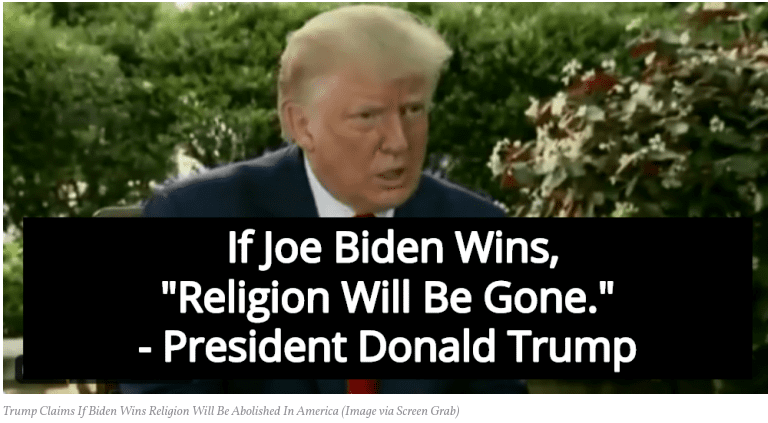
I have no idea whether my target audience for this post will ever actually see it. That audience: people who look at the "Christianity" typically portrayed by white USA evangelicalism, and reject it. Sometimes, this skeptical audience seems to account for half of the Twitter comments on almost any religion-and-politics thread.
If by any chance you are among those who look at the graphic above and say, "Religion will be gone? Great -- who needs it?", I'm trying to connect with you. I'd like to make just a few points.
You already know that Jesus is central to Christianity, and you might have some positive thoughts about him and his ethical imperatives, whatever your sense of his existence beyond his historical time and place. Hold on to that!
Christianity, stripped to its bare essentials, identifies a way of gathering and organizing the people who follow Jesus.
Whenever people try gathering and organizing themselves -- and each other -- they seem inevitably to screw it up much of the time. This is as true for any affinity group anywhere, except perhaps temporarily for some tiny group somewhere that I've never encountered. We are not immune -- sometimes this social dimension of Christianity fails miserably, but failure of this kind is not unique to us.
Over and over in the history of Christianity, corruption prompts reforms and rebellions -- people who insist on returning to first principles, to a purer intention of following Jesus. They reject coercive gathering, coercive organizing, coercive enmeshment with secular empires. They throw out compulsory ceremonies and formulas that don't contribute to a life of following Jesus. (This was the rebellion chosen by the founders of the Quaker movement I belong to -- but we're not the only example, by far!)
My challenge to you: look again at a Christianity stripped of authoritarianism, a Christianity that actually lets Jesus get a word in edgewise, and then consider whether the "Christianity" you've been presented is a credible representation of the followers of the Prince of Peace.
You may not find this argument convincing at all! For example, you might say, "What good is a God-figure who seems unable to convince his own movement to avoid power-and-control tangents that he himself warned about?" Fair enough, but consider that the social movement itself, and its flags and symbols, are not Jesus' main priorities. His main priorities might be loving you, and giving you an intuition of him that is not controlled by the religion industry, an intuition that might draw you into a trust relationship that no external authority could ever adequately promise or describe.
You have every right to be skeptical, even disgusted, by the pretensions of public religion that trades on the Christian brand to maintain its hold on power, leading you to decide, "Who needs it?" You might also not be persuaded that its Founder is exactly who he says he is, and who those of us who owe our lives to him say he is. But these are two separate decisions, and I ask, respectfully, that the first decision should not automatically lead to the second.
If you'd like to talk with people who already have some experience with these dilemmas and decisions, we'd love to meet you!
Today's American conservatives often point to secularism and to attacks on Christian morality as the causes of countless instances of social decay. U.S. attorney general William Barr's recent speech to that effect drew the attention of Washington Post columnist, Max Boot, who responded in a column entitled "William Barr's America vs reality in 2020."
Boot's first response is a direct challenge to Barr's assertion that (in Barr's words) "Virtually every measure of social pathology continues to gain ground." Boot counters:
Consider some of the improvements since 1960. Real per capita gross domestic product has increased 216 percent, from $18,268 in the first quarter of 1960 to $57,719 in the first quarter of 2019, driven in part by a 230 percent increase in output per hour for non-farm workers as of 2015. The share of 25- to 34-year-olds who have graduated from college has tripled as of 2016. Infant mortality has fallen nearly 80 percent as of 2018. The homicide rate was unchanged as of 2018 — five murders per 100,000 people — but that disguises a vast improvement since the homicide rate peaked at 10.4 per 100,000 in 1980. While the number of out-of-wedlock births was more than seven times higher in 2018, the share of single mothers has declined since 1997 because more unmarried parents live together. The abortion rate soared after Roe v. Wade in 1973 but has fallen more than 50 percent since 1980. How does Barr account for these improvements if the United States is on the road to ruin?
Next, Boot challenges Barr's central argument -- that religion is an essential factor in maintaining social health -- and that's when I really took notice. Boot describes how his colleague Sherry Cho assembled evidence that the opposite might be true. Cho listed the ten "most religious" and ten "least religious" nations (using data from this 2017 survey) and then compared various measures of social well-being between the two lists. Boot summarizes:
Indicators suggest that the less religious nations are much better off. Average GDP per capita in the least religious countries is more than five times higher, while the unemployment rate is more than twice as low and the poverty rate is one and a half times lower. The homicide rate is five times lower. Life expectancy is 22 percent higher, and infant mortality is 1,000 percent lower — in part because the least religious nations spend 50 percent more per capita on health care. The least religious countries are also better educated, with a mean 12 years of schooling per capita vs. 7½ years in the most religious countries. Income inequality is 24 percent lower in the least religious countries, and gender inequality (as measured by the World Bank) is more than 400 percent lower. Finally, the least religious countries are freer, with an average score of 87.6 from Freedom House, compared to 56.5 for the most religious countries.
I don't agree 100% with either Barr or Boot. Barr first: whether or not moral values are weakening as he asserts, his descriptions of the causes include absurd exaggerations. He says that in previous eras, moral decay was just one end of a pendulum-swing cycle that eventually self-corrected ... but now it's different:
First is the force, fervor, and comprehensiveness of the assault on religion we are experiencing today. This is not decay; it is organized destruction. Secularists, and their allies among the “progressives,” have marshaled all the force of mass communications, popular culture, the entertainment industry, and academia in an unremitting assault on religion and traditional values.
These instruments are used not only to affirmatively promote secular orthodoxy, but also drown out and silence opposing voices, and to attack viciously and hold up to ridicule any dissenters.
One of the ironies, as some have observed, is that the secular project has itself become a religion, pursued with religious fervor. It is taking on all the trappings of a religion, including inquisitions and excommunication.
Those who defy the creed risk a figurative burning at the stake – social, educational, and professional ostracism and exclusion waged through lawsuits and savage social media campaigns.
I am sure there are militant atheists and secularists among us; I run into their abrasive rhetoric all the time. But sociologists tell us that the USA remains uniquely religious among the world's wealthiest countries. Surely if a militant anti-religious movement were effectively neutralizing our religious majority population, we would see more evidence of their vicious attacks, inquisitions, excommunications, and savage social media campaigns. Honestly, I don't. Actually, it seems as if most politicians at the national level still feel they need to wear their religion on their sleeves.
(Remember Hillary Clinton's campaign advisor suggesting an attack on Bernie Sanders' supposed atheism? One such example does not prove a trend, but when have we heard of any campaign trying to make a negative out of someone's Christian faith?)
I would also like to know whether America's conservative religious communities have better social outcomes than the country at large. Have things improved among evangelical Christians, for example, since Ron Sider wrote his sobering book The Scandal of the Evangelical Conscience?
Maybe I'm too judgmental, but Barr's overdramatization of the secularists' "organized destruction" does not seem like a genuine argument -- it is simply that same tired old rhetorical scare tactic that Richard Hofstadter described as the "paranoid style in American politics."
Boot correctly points out that Barr completely disregards advances in morality in the same years during which the USA has supposedly been decaying. For example, racial segregation was legal when Barr was born (1950). We could go on to list all the crimes and social sins that were routinely hushed up in pre-#MeToo, pre-#ChurchToo, and pre-Black Lives Matter times.
Here's what I'd like to discuss with both Barr and Boot: the usefulness of the word "religion" as a meaningful category. Barr says that religion makes all the difference -- and at various points he shifts from "classic Christian" to "Judeo-Christian" to the role of religion in general in the full 50,000 years of human development. Boot and Cho refer to the full variety of religions in the ten most religious and ten least religious countries they studied.
Here's the problem. A couple of years ago anthropologist Dimitris Xygalatas wrote about the influence of religion in general to their ethical behavior: "No matter how we define morality, religious people do not behave more morally than atheists, although they often say (and likely believe) that they do."
In his article, "Are religious people more moral?", Xygalatas points to several devices that contribute to this divide between faith and practice. One very important corruption occurs when ethical behavior is only applied to fellow believers within the group, not necessarily to outsiders. Another is the common tendency for religious people to produce a folk variant -- or as Xygalatas puts it,
... the beliefs and behaviors of religious people are not always in accordance with official religious doctrines. Instead, popular religiosity tends to be much more practical and intuitive. This is what religious studies scholars call "theological incorrectness."
Is it possible that both Barr and Boot don't pay enough attention to this "popular religiosity"? Barr wants to argue that the transcendent claims of religion impose limits on human waywardness that no laws or secular ideals can match. Is this in fact true? And maybe Boot's charts of religious and nonreligious nations also can't take into account whether the religions being cited all have comparable claims on the hearts and consciences of their adherents, or are often simply identity markers along with all other features of their cultures.
Cutting across all these arguments -- and especially Boot's and Cho's analysis -- is Robert Woodberry's research on the worldwide influence of those he calls "conversionary Protestants." His claim, documented in his paper "The Missionary Roots of Liberal Democracy," is that these missionaries "heavily influenced the rise and spread of stable democracy around the world."
The resulting questions I have for both Barr and Boot are these: how can we argue these controversies based on vague and selective definitions of religion? Is there some factor that we ought to be paying more attention to, that might animate more actual, practical love of neighbor, and how might that factor guide the way we describe today's social pathologies and social improvements?
I'm intrigued by William Barr's reference to the secular values he compares unfavorably to our Judeo-Christian legacy. "What we call 'values' today are really nothing more than mere sentimentality, still drawing on the vapor trails of Christianity." I'd like to challenge the "really nothing more" part of this charge, but it's true that the "vapor trails" of Jewish and Christian influence are evident everywhere in our definitions of private and public good.
Maybe Robert Woodberry's study documents a similar phenomenon. Is it possible that in the "least religious countries," the powerful legacy of "conversionist Protestants" proved more durable than any specific form of public religiosity? In other words, can we attribute any of those good social metrics in "least religious" nations to the "vapor" left by those faithful evangelists? If so, what were they preaching and practicing that went powerfully beyond conventional religion as described by Xygalatas ... that is, beyond "popular religiosity" and the divisiveness of "we are special"?
For decades, pipelines and other extractive industries, such as mineral and coal mining or logging, have legally pilfered Indigenous land by presenting members of a nation’s council and the citizenry with the same basic sales pitch: “We have money, and you do not.”
Detail of cover of The First Publishers of Truth: Being early records (now first printed) of the introduction of Quakerism into the counties of England and Wales. Source.
The call-in advice show of Radio Yerevan (a legendary template of Soviet-era jokes) received this question: "Can you recommend an eye-and-ear doctor?"
Announcer: "Do you mean an eye doctor? Or perhaps an ear-nose-throat doctor?"
Caller: "No. My problem is what I see doesn't match what I hear."
What I "hear" as an ordinary U.S. citizen is that we live in a constitutional democracy, a republic of the people, by the people, for the people, with remedies for corruption and abuse of power by even the highest officials in the land.
What I "see" is quite different: conflicts of interest on every hand, from Cabinet appointments to the emoluments debate; a string of indictments and convictions of presidential associates; capricious decisions; constant lies; peremptory demands, including that stupid wall; petty and vulgar personal attacks; outrageous mismanagement of refugee assessment and border control (including new revelations of children being separated from parents); utter lack of transparency in U.S.-Russian relationships; irrational, contradictory, and bizarre pronouncements about Obama, Iran, Turkey, Syria, Afghanistan, coal power, trafficking in women, the danger posed by immigrants; ... the list of flagrant violations seems endless.
In making his case that the U.S. House of Representatives should impeach the president, Atlantic Ideas editor Yoni Appelbaum carefully argues that impeachment is a calm and rational response to Trump's off-the-rails presidency. It's not an extreme, apocalyptic, risky step for Congress to take. Instead, it would channel the wild, divisive argumentation we see everywhere now, fueled by slashing social-media campaigns, and potentially reduces this bitter torrent to the disciplines required by the very process of impeachment: an actual application of the Constitutional filter of "Treason, Bribery, or other high Crimes and Misdemeanors."
Appelbaum challenges Representatives not to base their impeach/don't impeach decision on Senate vote calculations, on scattershot investigations by Democrat-dominated House committees, or on the hopes that Robert Mueller or other judicial processes will either force their hands somehow or do the job for them. (It's also possible that many of us, acting from a misplaced sense of prudence or just disbelief, are waiting for Trump to commit, at long last, another outrage so scandalous that the country is galvanized into decisive action -- but somehow not so outrageous as to do us permanent damage!)
The urgent case for impeachment, from Appelbaum's point of view, is that it would be far less destructive and far more orderly than what is already happening.
The fight over whether Trump should be removed from office is already raging, and distorting everything it touches. Activists are radicalizing in opposition to a president they regard as dangerous. Within the government, unelected bureaucrats who believe the president is acting unlawfully are disregarding his orders, or working to subvert his agenda. By denying the debate its proper outlet, Congress has succeeded only in intensifying its pressures. And by declining to tackle the question head-on, it has deprived itself of its primary means of reining in the chief executive.
Each day that impeachment is postponed is another day where the gap grows wider between what I've always heard -- we're a democracy, we have equal justice before law, we resist corruption and tyranny -- and the brazen violations we see all around us, and to which we're daily becoming habituated.
Personally, I've found Yoni Appelbaum's advocacy for impeachment more persuasive than I might have expected. In part this might be because we're reaching some kind of crescendo in the shambles Trump is making of our country and its reputation worldwide. But I'm also sensing a growing spiritual urgency that relates to a word that's been sacred to generations of Quakers: Truth.
Students of authoritarianism repeatedly caution us that the royal road to dictatorship involves detaching us from any connection with truth. (Example.) It's not that authoritarians deliver a set of different interpretations of the same data, or different philosophies or policies. They want to set aside our common search for good policy (within which search decent people can differ), in favor of such a blizzard of lies that we must rely on their confident, authoritative Voice to lead the way. If we catch them in a lie, they can say, "Oops, here's another version, but your guys lie, too." And those who stubbornly insist on verifiable truth will eventually find themselves in a direct confrontation with those who put their trust in the Voice. Those Voice cultists may be in a minority, but too many of the rest of us may be tempted to avoid the confrontation, or postpone the day of reckoning. Impeachment makes the confrontation real, honest, direct. Passivity does not provide an escape.
In our search for truth, we also reject any temptation to paint Trump as even worse than he really is. It is quite true that Donald Trump correctly identifies some huge gaps in American policy. His cloud of lies and racist innuendos concerning immigration and border control gains currency precisely because earlier politicians have utterly failed to put together a humane and balanced approach. His manipulations throw trash into a vacuum that he did not create.
Quaker cartoonist Signe Wilkinson, from January 2013. Source.
Similarly, he questions American imperial conventional wisdom at some crucial points. To what extent is the USA's "indispensable nation" status in the post-World War II global configuration, and our 800 overseas military posts, serving our actual values, rather than the interests of the military-industrial complex or the convenience of other nations who rely on us to preserve international order while serving as their rhetorical pincushion?
There's nothing inherently wrong with an iconoclastic president who questions conventional wisdom. I can't help fantasizing how an independent-minded leader with intelligence and soul could gather the intellectual and spiritual resources of this country to examine both the strengths and the pitfalls of American exceptionalism. For many of us, Obama approached that ideal, despite his apparent need to reassure the elites by (maybe) overcompensating for his unconventional origins. His speeches (Nobel Prize speech; Cairo speech; prayer breakfast) revealed an ability to reflect on these nuances. However, the Congress, with the opposition party committed to its "party of no" stance, was rarely able to provide him a bipartisan forum to debate these questions and seek a reasonable balance.
In any case, Trump is manifestly incapable of engaging in searching dialogues with diverse voices, even on topics where he has correctly identified inconsistencies in American policy. These inconsistencies need solutions, but nothing Trump has done tells us that he's qualified to address them ... or do more with them than simply use them to rally his base against his opponents.
Finally: In the service of Gospel truth, Christians in particular should reject any alliance with him and his inhumane approaches to all policies involving human welfare or environmental stewardship. I've already written plenty about this fraud he's managed to perpetrate on millions of white evangelicals, drawing them into his personal cult; now I just want the political tie to be severed while we evangelicals still have a shred of dignity. (OK, I heard someone back there just say, "too late.")
We are not excused from the requirement to pray for the president. I do pray for him daily -- for him and for his early retirement. Impeachment is the most orderly, honest, and direct way toward that goal.
This is my 800th blog post. I wish it could be more inspirational. However, by speaking so directly to the need to begin the impeachment of Trump, I hope I've carved out the freedom to write about other things in the next weeks. I had hoped to start discussing the fascinating responses I received to the "trustworthy church" survey; and I also want to return to my long-time theme of Friends worship in future weeks. Another theme in the pipeline: what are the stakes in the recent Eastern Orthodox schism?
Today's sudden substitution of this impeachment theme was prompted by the events dominating American politics these last couple of days -- not in the service of alarm and outrage, but in the spirit of a specific form of discipleship: reducing that gap between what we've heard and what we see.
Friends Journal and the cautious hope of a racially diverse Society of Friends.
The church dare not, dare not, pray for the unengaged to be engaged while in the same breath refuse to face the tragedy that will come with that engagement. This is dangerous and irresponsible, if the church is not prepared to deal with the consequences.
Kashmir Hill on a less fortunate consequences of space-based resources: unreliable, even dangerous cartographic tagging. (Thanks to Raphael Satter for the link.)
Edvard Munch's Scream: Jonathan Jones says it's become the ultimate image for our political age. (And, back in Elektrostal, for a New Humanities Institute exam I used an article about the meteorological connections with Munch's imagery. Take the test if you like!)
This week, I’m delighted to welcome my wife Judy Maurer as guest blogger.
A few days before Christmas, a well-dressed woman in Winco approached me with a bottle of Irish creme in her hand. “Is this drink for the Christmas?” she asked.
I squelched the desire to quiz her about her native language and how it navigated without articles like “a” and “the”, since the use of those tiny words was clearly not intuitive for her. But like my students in Russia, she was able to get her point across well, without being able to land exactly on where one used a “the” or an “a”. Normally, it’s not a problem -- unless you want to say, “My husband has the money” and you end up saying, “My husband has money.”
But I left all that aside and said, “If they’re Irish-American, it would be perfect.”
“I want traditional drink” she said. Again I squelched a desire to explain that in America, what one perceives as traditional at Christmas flows from your parents or grandparents’ ancestry. Lefse for Norwegians, stollen and marzipan for Germans, and all that. I also didn’t explain that usually, the ones with English ancestry got to decide that their traditions would be mainstream traditional in the US. I’m not entirely sure why that is, since Spaniards were first in to invade North America in any numbers, and then the English.
Instead I just tried to explain about “eggnog”. I wrote it out on my smartphone for her, because what is a “nog”? How would she know how to capture that in her memory? She seemed perplexed that she should look for it in the dairy section.
After nine years in Russia, it’s a familiar point of stress for me. Going to a social gathering as a foreigner means trying to figure out what is the accepted practice. Everyone else knows it, accepts it as gospel truth as the-way-it-should-be-done, but you have no idea, and even have to set aside your own sense of the-way-it-should-be-done which is so embedded in your view of life that you don’t realize it is just your culture’s sense of the-way-it-should-be-done. So what the others think is the civil and polite thing to do may seem at the least perplexing. So my worry tended to be: “when I stumble over a social obstacle, will the others think my cluelessness is charming, or rude?”
Asking a stranger in a grocery store is a good tactic. I told her that the Irish creme in the fancy bottle would be a very good thing to bring to a party in America, but she repeated that she wanted to bring “traditional drink.”
Painful things have happened since I left the US to go to Russia in 2008. In 2017, I came back to a country in which people speaking English with accents are no longer as willing to engage in a conversation about where they are from. But I hoped I had built up enough rapport with her so that she would be willing to talk. So I asked.
“Iraq,” she replied.
“Good. I’m glad you’re here.You’re safe.” She seemed surprised, but when she caught my eye again while quizzing grocery store employees, probably about traditional drinks, she beamed.
During the worst of the Ukraine crisis, when Russian media blamed the “decadent West” for everything that went wrong, I felt vulnerable in Russia as a westerner. State media is dedicated to telling the news in just such a way to make people more compliant with what the leadership wants to do anyway. (I know. This never happens in the US, right?) Blaming foreign countries, and foreigners in their midst, is always a good strategy for deflecting blame away from the realities of this country. This tactic works particularly well if there is significant corruption among the political leadership, but what would we in the US know of that, right?
In the spring of 2014, when pro-Russian separatists took over parts of eastern Ukraine, the Russian leadership was in desperate need of these tactics. Stereotypes are particularly useful in these times, and state media trotted them out. They flooded state and social media with reports of the “Godless West”.
I grew up in a very conservative area of the US southwest, and was regularly subjected to films in school about “Godless Communists”. So as Yogi Berra said, it felt like “deja vu all over again,” but with a mind-numbing twist: I was now defined as the enemy. A wise Russian friend told me that the easiest way to rile people up against the enemies of Russia was to dust off and use again the Soviet-era stereotypes of Americans, as we had been the most frequent targets during the Cold War. It would have been a farther reach to enrage the populace against western Europeans. State media was just doing what came easier.
It was particularly painful when our good friends bought into these stereotypes. In my own living room, an old friend asked with wide-eyed wonder, “Can a man find a woman who would take care of her husband in America?”
I felt like saying, “you’ve seen with your own eyes how I take care of Johan -- and he takes care of me. Do you really think I’m the only American woman who takes care of her husband?”
The cold-war stereotype in Russia is that American women are selfish, independent feminists who won’t lend a hand to their own families. Another good friend insisted to me that I must have learned to cook in Russia, after I left the US. The unstated part was, “everyone knows that women in America don’t bother to cook for their families.” Since I had just provided a yummy home-made treat for the teachers’ lounge, then it stood to reason that I had learned to cook in Russia. Really? One learns to make apple crisp in Russia? In most of these cases, I was too stunned to argue.
While our friends believing in Soviet-era stereotypes was the most painful, being outside their care, as foreigners in public, was the most frightening. I polished my public Russian image so I could blend in. In addition to my black leather coat, silk scarf, brick face without smile in public, I stuffed an orange and black -striped ribbon in my purse so I could whip it out and tie it on at a moment’s notice. This ribbon was the Russian nationalists’ symbol; I would look safely like a Russian nationalist with a St. George’s ribbon on my purse.
Once when I was in Moscow I called home and said, “Johan -- I forgot to tell you. I moved that carry-on suitcase -- the one to take if they knock on our door.” High-profile deportations of westerners -- politicians who were proving their mettle by deporting hapless English teachers -- were enough of a thing that I put everything I would need for a sudden deportation back to the US right next to our front door. Some of our students believed it was enough of a threat that they described for us what cars the immigration service would use - the Russian equivalent of an FBI Black Maria.
And I resolved, once I returned to the US, to help individual foreigners in the U.S. feel welcome. In the Old Testament, the foreigner is sometimes an example of a marauder, but more often of the vulnerable, as in Deuteronomy 24:17-19 “Do not deprive the foreigner or the fatherless of justice, or take the cloak of the widow as a pledge. Remember that you were slaves in Egypt and the Lord your God redeemed you from there. That is why I command you to do this. When you are harvesting in your field and you overlook a sheaf, do not go back to get it. Leave it for the foreigner, the fatherless and the widow, so that the Lord your God may bless you in all the work of your hands.”
Even back then, foreigners were vulnerable, without status or protection, and God told Israelites to treat them well. That part has not changed. We must treat the foreigners among us well, particularly if our country had much to do with making their country a dangerous place to live in. While we’re at it: What national problems might be hiding behind these “enemies” and distractions being thrown at us? What does our political leadership not want us to see? Let’s focus on those problems. Let’s reject fear, so that God might bless us in all the work of our hands.
Judy Maurer is a member of Moscow Friends Meeting, Russia, and Eugene Friends Church, USA. From 2008 to 2017 she and Johan taught English at the New Humanities Institute in Elektrostal. Before leaving for Russia she was a publicist and fundraiser for ARMS - Abuse Recovery Ministry and Services. She is writing a book on anger and angry people.
Photo: at Cathedral of Elijah the Prophet, Yaroslavl.
Mike Farley: The heart being the place where God's love meets us (Romans 5.5-6) it meets too there the one whom we are holding in our heart.
Red Cross photos from Russia of the Civil War era. (Last two photos are from the region where Friends worked in famine relief.)
Bridget Collins in The Guardian on the top 10 Quakers in fiction. (Thanks to Martin Kelley for the link.) I would have included the Birdwell family in Jessamyn West's The Friendly Persuasion, particularly Eliza, among my own top ten. What do you think of the list?
John Chau and his mother Lynda (Instagram); source.
News story:
The family of an American missionary has forgiven the native tribe which killed him when he arrived uninvited on their island last week and are urging authorities not to hold anyone but him responsible for his death.
John Chau, 27, was killed on North Sentinel Island last week as he attempted to visit the tribe. Local fisherman reported seeing the tribe drag his body days after Chau paid them to take him as close as they would to the island before he kayaked over to it.
He had written to his family beforehand and told them not to blame the Sentinelese people if he did not make it out alive. [Source.]
Dilemma? What dilemma? Isn't it totally obvious to everyone that, if you and I are not wanted in some remote (to us) corner of the world, we shouldn't go there?
Well, maybe not to exactly everyone:
If you are a religious skeptic, or an exvangelical, you might be 99% sure that there could be no justification for John Chau and his ilk to intrude on North Sentinel Island.
If, however, you are in the Christian culture described by Chrissie Stroop in Stroop's Playboy article exploring Chau's motivations, you might be 99% sure that such intrusion might not only be justified, but possibly imperative.
Admittedly, I've set up this polarity to put myself somewhere in the middle. When I first heard the sad news about John Chau, I actually started out agreeing with the no-justification point of view. But here's some of what began nagging at me almost immediately.
I'm stating up front that I believe the Holy Spirit can ask us to do something that is entirely against conventional wisdom, secular skepticism, and even the law.
Don't worry, I'm not saying this to one-up skeptics with my heroic piety. For one thing, I do not believe Christianity is undergoing persecution in the secular West, nor do I believe that every criticism of Christianity and the Christian establishment from those skeptics is wrong. They're often right! Furthermore, if I propose an action that is completely out of step with law and culture, and claim supernatural inspiration, I had better be under the discipline of a praying community that's committed to biblical reflection, and not just relying on my own pretensions -- especially if those pretensions are a residue of the kind of uncritical glorification of missionary martyrs described in Stroop's article.
Within this frame as a believer, George Fox's famous exhortation (my emphases) came unbidden to mind:
This is the word of the Lord God to you all, a charge to you all in the presence of the living God; be patterns, be examples in all countries, places, islands, nations, wherever you come; that your life and conduct may preach among all sorts of people, and to them. Then you will come to walk cheerfully over the world, answering that of God in every one; whereby in them ye may be a blessing, and make the witness of God in them to bless you: then to the Lord God you shall be a sweet savour, and a blessing.
In these words, Fox elaborates the charge Jesus gave his disciples in Acts 1:8 (context) to be his witnesses "to the ends of the earth." He outlines an essential component of Quaker missiology: we are not transferring knowledge, but directing people to the witness of God that is already within them. Although it's hard to see how any specific island is automatically off limits for someone who actually believes in God, I don't interpret these words as open-ended encouragement to get in everyone's face everywhere with just any form of contact. Early generations of Quakers established practices of discernment by which their ministers obtained their communities' permission to make journeys for both evangelism and pastoral care beyond those communities' boundaries.
I don't know whether John Chau's mission to North Sentinel Island, and his service with All Nations, met that kind of discernment threshold. I'm simply trying to get past the all-or-nothing polarization on the question of uninvited, intrusive missions.
Certainly, any prospective missionaries' proposed invasive mission to a hitherto-uncontacted people group should get a serious challenge from their home communities:
How and why do you feel directed to this mission? Convince us despite our great misgivings!
How have you prepared -- what research and training have you done -- for this specific service? What do you still need to do? (We might add our own requirements.)
How have you been influenced by the history of Christian missions and martyrdom? Can you regard that very mixed history with critical reflection as well as admiration?
Are you prepared to die in the service of your mission? And, given that you propose to be a "sweet savour" to God and "a blessing" to those you contact, how do you evaluate the possibility that you could cause them to die?
Whether you are accepted or rejected, live or die, how do you envision the continuation of your mission?
Many churches put candidates through these tests and much more. Doubts about invasive missions, however, go well beyond questions of individual suitability. Even the most qualified, dedicated, consecrated missionary threatens the receiving community with all sorts of dangers, as skeptics justifiably point out: diseases, cultural distortions, ecological and economic disruptions, even genocide. Why isn't this list of dangers absolutely decisive in any discussion of uninvited mission?
For one thing, a genuine leading to contact a hitherto-isolated community presumably carries God's wisdom that the contact will eventually result in blessing. The first contact-initiators may die (as in the "reckless colonialism" of Operation Auca, mentioned in Stroop's article), but in God's timing, the long-term outcome is redemptive.
This reasoning relies on belief that valid prophetic leadings really do happen. But there are some less spiritual aspects to consider as well:
When does military or police enforcement of an uncontacted community's isolation become imprisonment as well as protection? (North Sentinel Island is guarded by India's military.) Is there a form of infantilization involved with deciding that no contact can be allowed? What assumptions are being made about the power structure on the island, the consequences of genetic isolation, the hopes and fears of minorities within that culture, the intellectual capacity of its people to evaluate and adapt to change? Are those who repel invaders speaking for everyone in the community, or for an elite? Is it enough just to assume the best? (I acknowledge that the motivations of those asking these questions should also be under scrutiny! What do they hope to gain from their intrusion?)
With global warming and the rise of ocean levels, and other impending ecological dangers facing all humanity, do we have the right to assume that the world's uncontacted communities must sink or swim on their own? When, if ever, do they get a voice in meeting our common fate?
Finally, humanity always seeks contact. In human history, most boundaries prove to be temporary, and many are actually destructive. If eventual contact might be inevitable (based on such factors as great-power military claims on land and sea, detection of mineral wealth, acquisition of desirable isolated spots by oligarchs, etc.), is it better that the initial contact be made by a genuine missionary driven by love, rather than a more mercenary representative of humanity?
As the film The Mission illustrated, there is no simple answer to any of these questions.
Screenshot from The Mission.
A couple more links to thoughtful articles related to John Chau's mission and fate:
Update: Morgan Pomaika'i Lee and Mark Galli interview All Nations' executive Mary Ho on the podcast Quick to Listen.
Speaking of Quakers and mission: As the Bolivian Yearly Meeting of Friends (INELA) prepares to celebrate its 100th birthday, its history is about to be published. Over the next couple of months, Nancy Thomas's blog will tell parts of the story, including the question of when that history actually began.
For the Quaker way too, as practised for its first three centuries, life has a definite purpose; to become completely responsive to the leadings of the Inward Guide. This means allowing ourselves to be led, loosening our grip on the reins of our life and consenting to the life that wants to be lived in us. The goal of the Quaker way is not autonomy and independence, but the ‘guided life’, an experience of life that is surrendered to the healing and transforming power of the Spirit within.
Russia, Ukraine, and maritime confrontations: Andrew Roth on Ukraine's Azov Sea ports. Natalia Antonova on what's in it for Putin. Jim Kovpak on the decisions facing Ukraine. Tetiana Bezruk on what more we can expect.
Going to the Netherlands for tonight's blues dessert, with Shakedown Tim and James Harman...
For most of the last month, Judy and I have been on vacation -- first in Ottawa, Ontario, then in Raymond, Maine. We have spent many hours with relatives and friends who have shared our time here, and with books (and Judy has been painting and repairing windows, too).
We have spent hours walking to Raymond village and along nearby roads, and visiting the cemetery. But I confess that one of my favorite pursuits has been simply to stare at the lake, watching the ducks and loons play.
Elsewhere in the world, we are aware of the winds and rains -- and the political storms as well -- but we have been faithful to our friends' and supporters' strong advice to rest. Thank you!
Next week I might be checking in here a day or two late. We expect to arrive back in Elektrostal late on Thursday evening.
Reedwood Friends Church, Portland, Oregon -- our church -- has been a strong supporter of Northwest Yearly Meeting of Friends Church, contributing money and countless volunteers over the years. In a few hours, Reedwood will no longer be part of the yearly meeting.
The only public announcement I'm aware of is the following terse memo, which church members received nearly two weeks ago:
NWYM Board of Elders action.
On August 19, 2017 the NWYM Board of Elders approved a minute discontinuing Reedwood Friend Church's association with NWYM effective September 1, 2017, as authorized by NWYM Faith and Practice page 33: "In situations in which a ministry point or local church continues to deteriorate, remains ineffective or out of unity with NWYM Faith and Practice, the BoE, acting for the Yearly Meeting, may discontinue the church or the association of the church with Northwest Yearly Meeting." With this decision, the supervisory work of the Care Committee has ended.
Pastoral Changes
Effective September 1, 2017, Jade Souza and Martha Wood will complete their ministry at RFC. They both will receive severance packages covering the last four months of 2017. We commend them both for their care and concern for those attending RFC.
Phil McLain, Clerk
NWYM Board of Elders Local church Care Committee for Reedwood Friends Church
We have heard numerous (and clashing) private interpretations of the rifts within Reedwood and between the church and the yearly meeting, but no public explanation. As far as I can tell, this action involving Reedwood Friends has little or nothing to do with the upcoming departures of other Friends churches from the yearly meeting and the formation of Sierra-Cascades Yearly Meeting of Friends.
My Reedwood office (2001)
The Newberg Graphic, in a Web story dated today, counts Reedwood Friends as a part of the new yearly meeting, but I have not heard any word from Reedwood itself that this decision to join Sierra-Cascades has been made or even discussed.
After many years as a denominational bureaucrat, I suppose that nothing surprises me anymore when it comes to church fights, but I can't help wonder how anyone believes these fights and splits are consistent with the central question that every church governing body should be asking: "What does GOD want to say and do in the world through us?"
Friday update: We received a Reedwood community e-mail about an hour ago. I'm including the relevant text, without comment, below, just before the blues dessert.
One of the books I've been reading on my vacation has been A Song of Ascents: A Spiritual Autobiography by E. Stanley Jones. I've mentioned reading his book The Christ of the Indian Road, early in my time among Friends, and re-reading it more recently, but this is my first time with A Song of Ascents. I am glad Jerry Baker (recently retired pastor of Netarts Friends Church) recommended it to me, and I would like to pass along this recommendation.
As Jones describes his ministry among India's intellectuals, and the things he learned about revolution, nonviolence, racial and class prejudices, so much in this book remains relevant and useful fifty years after it was completed. His love of Christ is infectious, firmly setting secondary controversies in their place.
Just to remind me that the debates between "conservatives" and "liberals" among Christians are nothing new, E. Stanley Jones at age 83 seems to delight in reporting how, all through his lifetime, his fans and critics could not find the correct categories to classify him. Was he a "modernist" or was he "fundamental"? One conservative journal decided to have it both ways: Jones had a "fundamental heart" and a "modern mind."
He got into one particular controversy at the time of Gandhi's assassination:
When Mahatma Gandhi was martyred, some Christians of South India asked me whether he had gone to heaven. My reply: "I am glad I don't have to decide the destiny of men. I am not the judge of all the earth. It is my business to preach the gospel and leave judgment to God. He is wise enough and good enough for that responsibility -- I'm not. All I can say is that if Mahatma Gandhi didn't go to heaven, then heaven would be poorer without him, as it will be poorer without you." The newspapers came out the next day saying, "Stanley Jones said that heaven would be a poor place without Gandhi." Next version I heard: "Heaven would be a miserable place without Gandhi." Next: "Heaven would be hell without Gandhi." And last: "Heaven would be no heaven without Gandhi." I have heard no further versions. It had reached bottom -- no heaven!
Isn't it fascinating how people can twist a quotation to create, in effect, a false witness. Gandhi's example might be a great occasion to decide, once and for all, to verify quotations and contexts when people come to us with gleeful reports about someone else's heresies.
Christopher Douglas responds to Kurt Anderson: "Conservative white Christians, in other words, had had one foot in a parallel information ecosystem for a long time." (Kurt Anderson's original article in The Atlantic.)
Reedwood Friends (Quaker) Independent Church A red letter day for RFC.
September 1, 2017 Reedwood’s Independence Day
Today begins a new chapter in the Reedwood Friends Church history. We begin a journey of faith and faithfulness to God as we seek to follow the direction we are called to take.
As the Northwest Yearly Meeting (NWYM) began the process of dividing, there were three options offered to all NWYM churches; continue with NWYM, join the new yearly meeting or become independent. On August 13, 2017, at a meeting open to all, a decision was made to go independent. *The letter below is what was sent to NWYM announcing our decision.
Having chosen independence we acknowledge that we will have much work to do to meet the expectations of our new independence. At another meeting on August 27, 2013 there was a start. Officers, Elders, Stewards and Nominating committee were approved with September 1, 2017 being the startup date. Additional decisions were made to update account management.
As we continue the transition to being our own meeting independent from any yearly meeting connection I welcome all who are willing to serve. I am hoping we can be a better presence in the community surrounding our church. As we reach out to those around the church building may we better understand our commission to share the good news in very tangible ways. Are there those in our neighborhood that need our help? How? Are there those in our own community that could use our help? How? Are there those that can make our building and property more welcoming? Please make yourselves known.
I appreciate everyone that considers RFC their church home whether attending every service or somewhere around the world. I covet your prayers and ideas as we move into new territory.
There will be many things to consider as we move forward.
My God bless you as we work together in this new venture.
Lloyd Pruitt, Presiding Clerk
*Reedwood Friends Church (letter cited above)
2901 SE Steele St.
Portland, OR 97202
August 15, 2017
Retha McCutchen, Interim Superintendent, Northwest Yearly Meeting
Phil McLain, Interim Clerk of Elders and LCCC Clerk, Northwest Yearly Meeting
Dear Retha and Phil,
As I informed you at the LCCC meeting on August 8, the Reedwood Friends Church, an Oregon nonprofit corporation (“Reedwood”) held a membership meeting at Reedwood on Sunday, August 13, 2017 at 1:00pm. Forty members of Reedwood were present, and the attached agenda was followed. After prayer, the members of Reedwood were invited to discuss the three options that have been presented to the churches of the NWYM by the NWYM Transition Committee: (1) remain a part of the NMYM, (2) join the new yearly meeting, or (3) elect to become independent. All Members and guests were invited to participate in the discussion, and all views were respected and heard.
In the discussion, many members spoke to having concern about the human sexuality language in the current NWYM Faith and Practice. Some felt the new yearly meeting, Sierra-Cascades Yearly Meeting, is still too new to consider joining. After much discussion, the issue was presented to the members for a decision. The members determined that there was overwhelming desire to become independent from any yearly meeting. The final count was thirty (30) favoring independence, four (4) favoring staying with NWYM and four (4) members not indicating a preference. (Two individuals left before the vote was taken).
Reedwood Friends Church will now begin the process of independence, and we respectfully request the NYYM’s assistance and cooperation in this endeavor. Reedwood members will be meeting again August 27, 2017 at 1:00pm. Between now and then my prayer is that we can work with you to begin the transition in a way that is honoring to Christ and the members of Reedwood.
If you would like to make a report at the August 27 meeting we are open to this, provided you are respectful of the wishes expressed by the members of Reedwood. We know the LCCC has put a lot of work in trying to help us and we appreciate the attempts. Our hope is that both you and we have learned something as participants in this attempt. It is our desire that we go in the knowledge that you have given us much to consider and we further hope that your experience with us has helped you and the NWYM Elders as you work with other churches.
This is our official notice that Reedwood is withdrawing from the Northwest Yearly Meeting. Reedwood predates the NWYM and has always been an independent Oregon nonprofit corporation with an independent 501(c)(3) tax-exempt designation. We look forward to working with you as we transition into our new independence and exit from the NWYM. We ask for your prayers in this process.
Very truly yours,
Lloyd Pruitt, President, Reedwood Friends Church
Or, more realistically, let's provide a robust, passionate, God-honoring alternative to coercive Christianity, because, let's be honest, some people seem to prefer being coerced.
What sparked these reflections? It's all Melanie Springer Mock's fault (oh, and her co-author Kendra Weddle Irons). Reading their book If Eve Only Knew, I realized again that, in my beloved little corner of the Quaker world, I've lived a sheltered life, where men who want to marry seek brides who are intellectual companions, where women know their true strength, where churches choose leadership based on spiritual gifts rather than social status, and so on. I know this lovely picture isnt literally true -- all around me (and even in my personal experience) I see contradictions to these ideals, but somehow those contradictions don't hit me the way they should.
What broke through? This book! -- and its evidence that, whatever I might have optimistically assumed, cultural Christianity still plays a major role in oppression in the lives of millions. It was the data about Christian bookstore sales that reached me: the "biblical womanhood" industry is profitable. There's a lot of money invested in telling women lies about their roles and limitations in God. As Melanie says in the introduction,
Despite the voices of Christian feminists offering an alternative understanding of Scripture, gender, and God's call on our lives, messages about biblical womanhood continue to dominate Christian culture. Such messages provide easy answers to the messy, complicated question of who God wishes us to be, but they are also quite lucrative. According to the CBA (formerly Christian Booksellers Association) state of the industry report, in 2009 Christian products sales were reportedly $4.6 billion. Women assume a significant portion of this market share. Speakers such as Joyce Meyer draw large audiences -- and large sums -- by ironically preaching in mega-churches and to mega-audiences around the country about the primacy of women's domestic domain.
Years ago, I worked for a CBA bookstore in Charlottesville, Virginia (helping put Judy through graduate school!). Though I suppose we stocked our share of nonsense, the owner of the store, Florence Skove, had her boundaries: she would not put stuff on the shelves that trivialized women. (If you insisted on buying them, you could order them.) Florence Skove was an active member of a conservative Presbyterian church; she laughingly told me that some of her friends called her "our fundie friend Flo." But my so-called fundie boss also asked me to wear an "ERA YES" button while on the job, supporting the campaign for Virginia to ratify the Equal Rights Amendment. It wasn't hard to convince me, although I'm sure we raised a few customers' eyebrows.
Flo wouldn't stock this book because she
said that the luxurious fur coat would be
a "bad witness" to nonbelievers. Source.
Among my excuses for being so oblivious are also the following: (1) My mother was a university professor. I never saw any sign in my parents' marriage that she subordinated herself to my father. Our family had more than its share of dysfunctions, but that wasn't one of them. As I looked to my own future, I never expected that my eventual marriage partner would be some version of that Biblical Womanhood ideal described in If Eve Only Knew's first chapter. Interestingly, most of the guys I knew in high school (admittedly in an experimental program that, already in 1970, had a course devoted to feminism) also seemed to assume that the ideal woman had brains and confidence equal to their own.
(2) When I became a Christian, my very first spiritual home was Ottawa Friends Meeting in Canada. There I came under the influence of Deborah Haight, about whom I've written several times. As she told me stories about her childhood in Norwich, Ontario, in what was then Canada Yearly Meeting (Conservative), she described an upbringing and a subculture which took it for granted that girls would learn carpentry and other farm jobs, and later would be exposed to science and theology, and (in the unprogrammed Quaker context) would be recorded as ministers, on the same basis as boys. It's surely no coincidence that Emily Stowe, Canada's first female doctor, came from Norwich.
Since making my home in the pastoral and evangelical Quaker world, I've found some contradictions a little harder to ignore. It was a memorable session of Indiana Yearly Meeting when (then) superintendent David Brock asked us, with obvious impatience, when we were finally going to implement our testimony to men's and women's equality. Part of his job was helping meetings find new pastors -- but why was it (he asked) that, of all the female candidates he offered, one third of the meetings seeking pastors would ignore them completely, one third of the meetings would put their resumes on the bottom of the pile, and only one third would take them seriously?
It's this aspect of Christian practice that I'm labeling "coercive." It's fine for you to have an interpretation of Scripture that's different from mine (though if you label it more "conservative," expect an argument). My problem starts when you use that interpretation to limit someone else's freedom in Christ, with no right of argument or appeal. When you tell girls that they can't be leaders (or, as If Eve Only Knew documents, attribute all our social woes to Eve's sin or Adam's passivity), and prescribe for them a life whose boundaries must be defined by men, that's coercion. It's bondage reinforced by social sanctions that seemingly can only be broken by disloyalty to God. What's more sorrowful and frustrating as we face an unbelieving world, this approach is profoundly anti-evangelistic. "Welcome to the household of faith," we say. "You are born again, your new life is just beginning! Rejoice!" And then the bait-and-switch: it turns out that you are asked to take on new bondages that seem remarkably similar to the tired old bondages of the world.
I'm not saying that the choice to live a modest life devoted to caring for children and home is wrong! The evil is in coercive boundaries, not freely-made choices. It may be that, if we somehow removed all the ideologies and polarizations that limit our children, a majority of boys and girls would still choose traditional roles and divisions of labor. But, at least within Christian communities, they would be making these choices in prayerful communion with Christ and each other, much as Deborah Haight described her childhood in Norwich.
Realistically, we're not going to put an end to coercive Christianity soon. People will still organize around those bondages and propagandize for them in CBA bookstores, in Christian celebrity mega-events, on Christian TV, and so on. What cheers me up is books like If Eve Only Knew and all the other ways we can and will proclaim a wonderful alternative vision of freedom in Christ for women and men alike.
This alternative does not depend on faking perfection or hiding contradictions. I dearly love Northwest Yearly Meeting of Friends, where I've met so many wonderful role models of functional egalitarianism and humane evangelicalism. We are wrestling with our own dilemmas around issues of sexuality, and the outcomes are uncertain. But we're doing this all out in the open. Our difficult discussions undermine any pretense that we can impose a single model of Quaker holiness on our children and newcomers. Our various models of discipleship are formed in conversation, debate, even conflict, but at the same time they are also formed in something approaching transparency, and in love.
This is Holy Week here in Russia, and Easter is in three days. As I do every year, I'm re-reading Emmanuel Charles McCarthy's The Stations of the Cross of Nonviolent Love (PDF file). In light of my ideal of alternative Christian community, here's a page I thought I'd highlight for today:
Not many links today! The Web site I use for preserving links, delicious.com, is in the process of shifting back to its old site and a previous generation of software, and seems unavailable today. (They promise to return shortly at del.icio.us.) But these links seemed especially urgent to pass along....
Bernd Wustl pastors a church of 500 in the German border town of Freilassing. He is a Teddy bear with a full white beard, who worked as an engineer for a local manufacturer before he joined fulltime pastoring at the age of 47. He says that ten years ago his church sensed God directing them to pray on the bridge that links Germany to Austria—the same crossing that Napoleon took to conquer Austria, and that Hitler followed in the Austrian Anschluss. The church held several open-air Sunday services at the bridge over the course of two years, but they never understood why they were praying.
Then in April of 2015 the refugees began to cross that bridge by the tens of thousands. Wustl's church decided to call a conference for all the local churches. "There was an unreal fear. What's happened with Germany? [At the conference] we taught people how to handle fear, so they could be freed for ministry."
The German church has two choices, Wustl tells me. "Either we wake up, open our doors and speak the gospel. Or we close doors, and forget about the German church."
Deborah Haight, second from right. (At right in picture is Duncan Wood.) Canadian Yearly Meeting, Alma College, St. Thomas, Ontario, July 1976.
I've just finished re-reading a book that I first picked up during my college years in Canada, The Christ of the Indian Road, by E. Stanley Jones, first published in 1925. Re-reading this book wasn't just interesting on its own merits; it brought back wonderful memories of long discussions about this book with the Friend who introduced me to it: Deborah Haight.
I've mentioned Deborah more than once over the ten years of this blog. One of the founding members of Ottawa Meeting, Deborah was an important influence on several young adults who found their way to that meeting during my time there, the mid-1970's. The introduction to the 2008 edition of her Gardner Lecture, Meeting, tells us this about Deborah:
Deborah Haight was born in 1911 into a Quaker family in the Conservative tradition in Norwich, Ontario, near the Norwich Friends meetinghouse. Her youth was nurtured by the Friends' community that she defined as "Meeting," and by her monthly meeting and yearly meeting in which she played active roles from an early age. She trained as a teacher and taught in several communities, including the National School for the Blind in Brantford, while at the same time studying for her BA in biology at Queen’s University, which she earned in 1935. In 1947 she moved to Ottawa and became a bio-scientist in the Department of National Health and Welfare. She was one of the founding members of Ottawa Friends Meeting, which became a monthly meeting in 1958. Following her retirement, she moved to Woodstock and later to Norwich to continue an active and productive life—travelling, learning, mentoring, and worshiping among Friends. Deborah passed away peacefully in 2004 at the age of 92 in the home where she was born. Her Memorial Minute is recorded in the Reports for CYM 2004.
A couple of years before I arrived in Canada, Deborah had begun her retirement from government service by making an interesting decision. As she told me later, she was wondering whether she needed to buy a car. At the time, she lived on Queen Elizabeth Parkway in Ottawa, not far from our Quaker meetinghouse and conveniently located for public transportation, and she decided that, rather than buying a car, she would take that money and spend it on a round-the-world trip, visiting Friends at every point along the way. She also spent a term (or perhaps a "Theological Reflection Year") at Earlham School of Religion in Richmond, Indiana.
Some of my fondest memories of Deborah involved talking with her about books. Three of the books we enjoyed discussing were Gregory Dix's The Shape of the Liturgy, Agnes Sanford's The Healing Light, and the book I just revisited, The Christ of the Indian Road.
At the time I was a new Christian and was concerned to understand how Christian faith and experience could be distinguished from the secular, imperial uses for which it had been exploited for centuries. To my delight, Jones was asking this same question eloquently fifty years (now nearly 90 years!!) earlier. Maybe you can imagine how helpful I found passages like these--and how depressing, in a way, it is that his comments are still relevant today:
... Have we not often in the past led India and the non-Christian world to think that our type of civilization in the West is the issue? Before the Great War [that started 100 years ago this summer] was not Western greatness often preached as a reason for the East becoming Christian? This was a false trail and led us into many embarrassments, calling for endless apologies and explanations.
[Jones adds several examples from history, among them...] The Saxons, a warring tribe of Europe, were practically compelled by Charlemagne to become Christians. They consented on one condition. That condition would only be known at the time of their baptism. When these warriors were put under the water as a symbol that their old life was dead, they went under--all except their right arms. They held them out, lifted above their heads. These were their fighting arms. They were never Christianized! Is it to be wondered at that war continues in the West in spirit of Christianity. It came in with it.
Another. The Mayflower that carried the Pilgrim Fathers to religious liberty in America went on her next trip for a load of slaves. The good ship "Jesus" was in the slave trade for our fathers. Is it to be wondered at that race and color prejudice still exists in the West in spite of Christianity? It came in with it.
***
We have been called international meddlers, creed mongers to the East, feverish ecclesiastics compassing land and sea to gain another proselyte. From the other side comes the criticism that we satisfy a racial superiority complex when we go on helpful service to other nations; that we are the kindly side of imperialism--we go ahead and touch the situation in terms of schools and hospitals and human helpfulness, then imperialism comes along and gathers up the situation in the name of empire; or that capitalism takes over and exploits the situation as intrepid missionaries open it up. Again it is said that it is a bit of spiritual impertinence to come to a nation that can produce a Gandhi or a Tagore. Finally we are told that the whole missionary movement is a mistake, since as non-Christian investigators tell us, the last command of Jesus to go into the world and preach the gospel is an interpolation, hence the whole is founded upon a mistaken idea.
These are serious criticisms and must be met fairly and squarely. If this whole question of missions is to hold the affections of the church in the future, we must be sure that we are about a business that commends itself to the mind as well, for what does not hold the mind will soon not hold the heart. Besides, let it be noted that if Christianity isn't worth exporting, it isn't worth keeping. If we cannot share it, we cannot keep it.
***
In conversation with him one day I said, "Mahatma Gandhi, I am very anxious to see Christianity naturalized in India, so that it shall be no longer a foreign thing identified with a foreign people and a foreign government, but a part of the national life of India and contributing its power to India's uplift and redemption. What would you suggest that we do to make that possible?" He very gravely and thoughtfully replied: "I would suggest, first, that all of you Christians, missionaries and all, must begin to live more like Jesus Christ. ... Second," he said, "I would suggest that you must practice your religion without adulterating or toning it down." This is just as remarkable as the first. The greatest living non-Christian asks us not to adulterate it or tone it down, not to meet them with an emasculated gospel, but to take it in its rugged simplicity and high demand. But what are we doing? As someone has suggested, we are inoculating the world with a mild form of Christianity, so that it is now practically immune against the real thing. Vast areas of the Christian world are inoculated with a mild form of Christianity, and the real thing seems strange and impossible. As one puts it, "Our churches are made up of people who would be equally shocked to see Christianity doubted or put into practice." I am not anxious to see India take a mild form--I want her to take the real thing. "Third, I would suggest that you must put your emphasis upon love, for love is the center and soul of Christianity." he did not mean love as a sentiment, but love as a working force, the one real power in a moral universe, and he wanted it applied between individuals and groups and races and nations, the one cement and salvation of the world. ... "Fourth, I would suggest that you study the non-Christian religions and culture more sympathetically in order to find the good that is in them, so that you might have a more sympathetic approach to the people."
***
The only way to kill Christianity is to take it out of life and protect it.
***
This God-consciousness should be full and overflowing. A Hindu lawyer recognized this and said to me one day, "What you Christians and the church need to-day is a new Pentecost." I knew what he meant--we need Christianity as a well of water within us spring up into everlasting life. Principal Jacks pleads that we get back "the lost radiance of the Christian religion." Queer to hear a Hindu and a Unitarian both pleading for a new fullness of life akin to Pentecost! Even so, Pentecost is normal Christianity. But the church is largely subnormal and anaemic. Because a few have gone up into fever and have done queer things in the name of this great Sanifying and Sanctifying of the human spirit by the inflooding of the Spirit of the Living Christ, there is no reason why all the rest of us should be frightened away into an anaemic Christianity. This Christ of the Indian Road is saying, "Receive ye the Holy Ghost," as well as "Thy sins are forgiven thee."
Ecumenical council at Nicea in 2025? "Not likely."
Russian acquaintances have been asking me what I think of Jen Psaki. At first, I honestly didn't know who she is.
My last 32 Radio Street blog post of the academic year--you too can take a final exam.
And a gallery of photos from our Institute's final assembly of the year. (Theme of the skits: Zeus seeks reassurance that the ranks of student gods are worthy of Olympus, so representatives of each year demonstrate their worthiness to rise to the heights of eventual graduation.) At the end, rector Tamara Monina and founder Sergei Kazantsev ring the "Final Bell"....