Showing posts with label buzuluk. Show all posts

22 November 2023

Friends and Comrades, a Thanksgiving P.S.

Title frame from the film Famine. Screenshot from the YouTube video. For English subtitles, turn on the subtitles [CC], and go to the video settings [Subtitles/CC] to choose English auto-translation.

Historian Yulia Khmelevskaya—Famine.
Historian Sergei Nikitin—Famine.
Historian and journalist Sergei Kolychev—Famine.

New York Times, July 23, 1921—Famine.
"Remember the starving!" Source.

Last week I reviewed Sergei Nikitin's Friends and Comrades: How Quakers helped Russians to survive famine and epidemic, translated by Suzanne Eade Roberts. Working with Russian and Soviet sources as well as English-language memoirs and archives, Sergei told the epic story of British and American Friends' work in Russia—in refugee assistance, famine relief, medical outreach, and agricultural reconstruction—in the years 1916-1931.

My review had lots of words, but barely any images. Today, in honor of the U.S. Thanksgiving holiday (and I'm not being ironic), I want to tell you about a documentary film that can be of enormous help with both images and context for the story Sergei tells. The film: Famine.

Context: The full campaign against starvation and epidemic at the height of the 1921-23 famines was far larger than the specifically Quaker mission centered on the cities of Buzuluk and Sorochinsk. Together, all the international help during those years may have saved 10 or 11 million lives. It is harder to fix the number of lives that the Quaker teams might have saved, but it is certainly in the tens of thousands. Buzuluk was the capital of a region with a pre-famine population of over 600,000. Had death rates continued as they were at the start of the famine, this region would have lost fifty percent of its population, not counting people who simply left the region. Instead of 50 percent, 21.5 percent of the population was lost to starvation and disease.

Many other voluntary organizations worked in this massive relief campaign, but the largest single contribution came from the American Relief Administration, headed by the future Quaker president, Herbert Hoover. In December 2021, the U.S. Congress, despite the anti-Bolshevik mood of the times, allocated $20 million for famine relief in Russia. For a time, the American Quaker mission to the region became somewhat enmeshed in the ARA's work, with several awkward implications for their relationship with the local government as well as their British Quaker co-workers. They negotiated several exceptions to the ARA rules, and eventually regained their independence to manage their own work and collaborate fully with the British team.

Quakers may have been better prepared than some other groups to work on a large scale in Russia. Their presence in Buzuluk dated back to their World War I outreach to war refugees. They had already earned credibility with the suspicious Bolshevik authorities. At times they were a conduit into Russia for other relief organizations who didn't have the degree of access Friends had gained. When Russia made its global appeal for help in July 1921, Friends were able to respond quickly, thanks to their earlier experience in the Buzuluk region.

In covering the vast scale of the international response in these famine years, 1921-23, the documentary Famine selects several regions of Russia as case studies. The Buzuluk region is one of those case studies, featuring interviews with, among others, Sergei Nikitin and Sergei Kolychev. Judy and I knew of Sergei Nikitin's interest in this history long before we ourselves visited Buzuluk in 2008 and 2011. During our 2011 visit we got to know the local journalist and historian Sergei Kolychev, whose study of the famine years led him (a Russian Orthodox Christian) to envision a memorial to those Quaker workers of a century earlier.

Speaking of memorials, two of the Friends' workers died of typhus during the winter of 1921-22, Mary Pattison and Violet Tillard. Lenin's principal deputy, Leon Trotsky, paid tribute to them in a speech in March 1922, as quoted by Sergei Nikitin's book:

These graves are a kind of augury of the new, future relations between people which will be based upon solidarity and not be shadowed by self-seeking. When the Russian people become a little richer, they will erect (we are profoundly sure of this) a great monument to these fallen heroes.

Judging by reports of the cancellation of Famine's license for screening in Russian movie theaters, Russian authorities do not welcome these kinds of historical reminders. (Here is a link to Global Voices report of the ban, along with a summary of the film. And a report from Meduza.) I'm less sure than Trotsky that an actual monument will be built. For now, maybe the film Famine will serve as a memorial. 

If you watch it (see below), be aware that there are many stark and troubling scenes and stories from the height of the famine, including reports of cannibalism. As several observers have noted, this famine may have been the first in world history to be so minutely and graphically documented.

As with many families in the USA, cooking and eating will be two of our family's main activities tomorrow.  My memories of the film, of Sergei's book, and of our own visits to Buzuluk will not muffle my thankfulness during the holiday—they'll sharpen it.


Famine is available on the YouTube channels of the U.S. government-funded media outlet Current Time TV. The film itself was not funded by Current Time, but was financed through crowdfunding. Over 2,000 people contributed.

The film is in Russian, but you can turn on the subtitles, and choose the language you wish from the video settings. The English is adequate to follow, most of the time, although (for example) when Sergei Nikitin says, "We are now in the Quaker meetinghouse [he used the English word "meetinghouse"], it's translated "the Community House apartment...." Earlier, the auto-translator gave us "Gold" when Sergei Kolychev said "Volga." In general, you'll be able to keep up with the narrative.

Here's a separate link cued to the section on Quaker work in Buzuluk. The full film is below:


Ayaan Hirsi Ali's controversial conversion.

The prison hazards that await Russian anti-war artist Aleksandra Skochilenko.

Robert P. Jones: when (U.S.) ex-presidential rhetoric crosses into Nazi territory.

Who is abandoning the evangelical label? Ryan Burge graphs the trends.

Nancy Thomas writes about gratitude—and gets specific.

Kate Bowler's Thanksgiving blessing when you don't feel terribly thankful.

Via Open Culture: a massive online digital archive of Chaucer. Caution: it's habit-forming. And if you are able to escape, Open Culture can link you with 130 ancient maps, atlases and globes.

What is a Quaker? Here's Micah Bales's answer in English and Russian.


Rick Holmstrom's instrumental version of "Oh Mary Don't You Weep."

04 November 2021

Vitaly Vladimirovich Adamenko 1977-2021

Vitaly (right), speaking on the history of conscientious objection and alternative service in Russia, on a video prepared by the Soldiers' Mothers of St. Petersburg, 2017.

Screenshot from another video on alternative service,
with subtitles added by Friends House Moscow.
I want to tell you about our friend Vitaly Adamenko, mathematician, historian of pacifism and nonviolence, editor, librarian, and student of the Tolstoyan movement -- and now, at 44 years of age, a casualty of the COVID pandemic. He died this past Monday in St. Petersburg.

Historian Irina Gordeeva spoke for many of us when she posted these words on Facebook yesterday:

The first thoughts that come to us -- self-centered though they may be -- are these: how will we go on without him? He had such a detailed knowledge of the history of pacifism in Russia that, in one article, I had to write that those who participate in this social movement are ahead of the professional historians by one step. On any little thing I could turn to him for help -- for a clarification, a text.

And I feel so sad on a personal level -- he hadn't even reached 45 years of age.

We first heard of Vitaly through Friends House Moscow, which supported the periodical Alternativshchik ("The Alternative Service Worker"), which was published for conscientious objectors and the church congregations that supported them. At that time, Vitaly lived in Samara. On one of our visits to Buzuluk, the central point for U.S. and British Quakers working for famine relief and economic redevelopment in the early 1920's, we stopped in Samara, and he accompanied us on the train to Buzuluk.

That was how our friendship began. In 2011, when Vitaly needed to do some work in Tolstoyan archives located in Moscow, he stayed with us in our Elektrostal apartment. He returned for another visit three years later. As a vegetarian, he had a strict (it seemed to us) diet, consisting mostly of potatoes. I remember sometimes coming home from the institute where we taught, and seeing a big new pile of potatoes, I'd say to Judy, "I see Vitaly has done his grocery shopping."

Most memorably, we spent hours talking into the night at our kitchen table. Once the subject of Russian persecution of Jehovah's Witnesses came up. He later followed up in a letter to me:

... If they [Jehovah's Witnesses] did not have a principled opposition to violence, there would be no repressions and no attempts to portray them as extremists. Take the Roman Catholics, for example -- everyone knows that the Catholics for several centuries killed their opponents by burning them at the stakes of the Inquisition, but nobody tries to portray them as extremists. Everyone knows that there were Old Believers who incinerated themselves, but nobody tries to prove that the Old Believers are a totalitarian sect. Why? Because each of these, and others, by and large have nothing against participating in state violence and killing. I say "by and large," not wishing to forget about individual exceptions. And if in our country there were similar numbers of Quakers [as Jehovah's Witnesses], there would be a daily campaign to make them out as a totalitarian sect and the principal extremists of our country.

One of his other interests was late Soviet-era rock music. We spent several wonderful evenings looking at his collection of music videos of the bands of that period.

The last time I saw Vitaly was on Zoom, just a couple of months ago, August 29, when he dropped in on our Russian-speaking online Quaker meeting for worship. Later that day, he wrote me, saying that I didn't look any different from years past. I could say the same of him. As one of his fellow team members at tolstoycenter.org said of him, "He is really a unique person with encyclopedic knowledge and a pure heart like a child."

Goodbye for now, Vitaly. Eternal memory!

In our kitchen -- playing Dixit with our students and guests, 2014.

With Judy (left), Kara Maurer, and Anna Thomas, in 2014.

With Sergei Grushko at Friends House Moscow, 2011.

At the Sorochinsk newspaper office, 2011. This building was the headquarters of the U.S. Quakers participating in the Buzuluk-based relief operation. At center: Liubov Surkova, editor at the time.

A quiet moment in our apartment, Elektrostal, 2011.

Vitaly's legacy: the huge online Russian-language Nonviolence Library. The home page bears the sad news of Vitaly's passing, and continues: "... Now our task is to persist and not give up, to find time to communicate and support both our resources and ourselves, to continue adding high-quality content to the site -- now in memory of Vitaly's enormous contribution to the benefit of all seekers."

Once again, here is the bilingual Tolstoy Center for Nonviolence, whose organizers included Vitaly, and for which I served as an editor.


Mondoweiss: The Times Are a-Changin'? (Or, how happy is Israel, really?)

GetReligion gives a hat tip to Al Jazeera's strong coverage of religious persecution.

Emily Provance: When new people show up in your meeting or church ... hooray, and what next? (Part of her series on "being the church.")

Greg Morgan: The Northern Lights and the worshipping community.

Mark Russ on James Cone and white liberal Quakerism.


Steve Guyger in Brazil. "I Tried So Hard."

19 May 2011

Why are we here?

Tikhvinskii Convent, Buzuluk
"Why are you here?" I get this question constantly. Sometimes the question refers to why an American couple, with all the presumed advantages of life in the USA, would choose to live in Russia. Sometimes the question is more specific: why Elektrostal, a Stalin-era industrial city not mentioned in any tourist guide to Russia that I've ever seen.

These questions come up all the time. For example, a few days ago, an architecture student whom I was coaching in preparation for a seminar she was to attend in Germany, grilled me closely on what could possibly interest me in Elektrostal. One of my colleagues mused on the lengthy process we went through to get work visas: "Our authorities know that Russians want to leave for the West, but they can't understand someone wanting to come in the other direction."

On one level, it's easy to reply that we're here to serve as a metaphorical bridge of understanding between our countries, or between Friends (Quakers) and the Russian people to whom our Quaker ancestors related for many generations, from Peter the Great, through Catherine the Great and Alexander I, to the story of Buzuluk and the relief missions. We can speak of the great Friends tradition of citizen diplomacy. Concerning Elektrostal, we can talk about our friendship with the visionary educators who founded the New Humanities Institute and continue to make it a special place. We can mention all the ways that Russian culture inspires us, and how I've dreamed about living in a Russian-speaking environment since I was sixteen years old and just starting to learn the language. But what I'm increasingly interested in is this: What's behind this recurring question? What does it tell us about the psychic landscape of our host country?

I was reading a fascinating speech by Sergei Chapnin, the editor [at time of writing] of the Journal of the Moscow Patriarchate (the official periodical of the Orthodox Church in Russia), and all those questions came back to me as I read these lines:
In earlier discussions [at the conference where Chapnin spoke], it's already been said that we're in a condition of post-imperialism. Even twenty years later, we cannot bear to talk about the collapse of the Soviet Union. However, we still want to call our world Russian. We want to talk about the Russian people and Russian culture. Meanwhile, all of it has already long been Soviet or, more accurately, post-Soviet--and not "frozen" post-Soviet, but actively evolving. I am convinced that we are using the wrong concepts to describe the reality around us.

The values of post-Soviet culture are very contradictory and don't form a single picture. These internal contradictions have led to this: we have lost the ability to talk about ourselves, our ancestors, and each other positively, to create convincing and attractive images. Every image created these days has something hiding up its sleeve: it could be something ideologically unacceptable, or humiliating, or just cardboard and plastic.

You won't find a positive image of contemporary Russia either in high culture or in mass culture. We don't like ourselves and don't respect each other. So then how can we expect others to like us? And given all this, what kind of modernization can we expect?

There's a complete absence of a coherent picture of our here and now. Our image of the past is mythologized; it includes manifestations of heroic tragedy--and banned tragedy. And there's no clear image of our future.

(The full talk, in Russian, is here. Paul Goble's summary in English is here.)
A friend in Buzuluk put it another way: "We're living in nevremen'e"--an aimless non-time, which I interpret as sort of the opposite of kairos. Chapnin's whole speech is fascinating--see Goble's summary--but it's those words "We don't like ourselves and don't respect each other" that really stood out.

The words are not literally true--I can cite many experiences of Russian individuals liking each other, respecting each other. And Russians really do love their country! Nevertheless, on an intuitive level, I think I follow Chapnin's argument. In Soviet times, despite the supposed totalitarian control, there was certainly plenty of scope for corruption and the "hit-and-miss" approach to life summed up by the untranslatable word avos'. And all of that continues.

But for those who were idealists in Soviet times or simply dutiful by nature, the official ideology and a growing body of related "best practices" gave some kind of coherence to life. I can think of several people in this very city who speak openly of their sense of acute post-Soviet loss--not that they regret the advance of freedom and initiative, nor do they gloss over the unspeakable repressions; they are simply noting the lack of positive energy in today's society. And as evidence, they cite the brusque and dismissive behavior they observe around them. For example, a few days ago, one of my friends said this about Russia's national minorities: "Look how they cluster together and support each other. And Jews are the same way! You don't see Russians taking care of each other that way." Squelching my American need to challenge, analyze, and correct, I simply made mental notes and kept my mouth shut.

Chapnin talks about the dangerous ways the vacuum he describes can be filled--using myths and conceits drawn from both crude nationalism (processed in a Soviet matrix) and Soviet-era civil religion with its pagan overtones. Meanwhile, that generation of Russian Orthodox leaders whose faith and practice comprehended both their specific tradition and their universal vision of love is aging and dying out.

Dilemmas are resolved (if they are ever resolved!) not by theories and advice--least of all, advice imported from abroad--but by example and story and abundant grace. I'm under no illusion that the presence of expatriate idealists like me solves any of these puzzles, even microscopically. It's my privilege to witness, not advise. But I'm more and more convinced that my top priority is to love.

I don't mean that I'm to become all sentimental, or to buy into Russian exceptionalism any more than I buy into American exceptionalism. It's not that complicated: this is a land and a people that deserve to be loved, and I'm here, so I humbly need to apply both heart and intelligence to loving this amazing, proud, wounded, suspicious, beautiful country. What this means in practice--I'm not always sure. But the task of finding out, day by day, transaction by transaction, is certainly worth the best that I can bring to it.


What about you? There's absolutely no reason to believe that all Russia needs to solve its problems is more foreigners!! (Although, just for the record, the government is officially rolling out the red carpet for "experts.") But, given the numbers going in the opposite direction, bringing in a few more people committed to come, learn, serve, and love can't do any harm, can it?


Righteous links:

Update: Here's Paul Goble's summary of the state of the Russian Orthodox Church, and Sergei Chapnin personally, since Russia's full-scale invasion of Ukraine.

A tragic symptom and the seeds of response: "Violence, death and cover-up in the Russian army." And on the same site, British Friend Madeleine Reeves writes about "illegals" in migrant Moscow.

Another discussion of priority: "The most precious and urgent thing that the Religious Society of Friends has to advance is the Everlasting Gospel...."

And more on priority: "Are Friends 'bumper-sticker' social justice? Can we be more?"

"The Legacy of [Korean Quaker] Ham Sok-hon." (And you can find an online edition of Ham Sok-hon's Queen of Suffering: A Spiritual History of Korea here.)

"Disappointment, despair, and Harold Camping" ... "after all, they're family."

A couple of blues links: a Chicago Reader profile on Alligator Records on its fortieth anniversary; and the Roadhouse podcast no. 325 features winners from the 2011 Blues Music Awards, held May 5th in Memphis, Tennessee.


Jean-Rene Ella, "Soon One Morning"

05 May 2011

Memories of Buzuluk

at work in the State Archives
Nansen photograph of famine
victims in Buzuluk
area of old cemetery where
mass graves are located
tractor tourist
church at underground cloister,
by Richard Kilbey
one of the cloister's
restored entrances
underground prayer cell
Sukhorechka
newspaper office in Sorochinsk
(American Friends office in '20s)
unusual monument in Buzuluk
cemetery (could it be a Friend?)
original (above) and Lyuba
Radchenko's translation
(below)
Friends House Moscow
has a limited number of
copies
Sometimes (I admit) during morning prayer my brain skates perilously close to sleep, and occasionally slips over the edge. This morning, in my half-dream, I kept being tugged back to Buzuluk. Specifically to old Buzuluk--to 1921, 1922, then to 1929, 1932, 1937. I wasn't exactly recalling scenes or events; it was as if the soul of the city was asking for company, or for prayer.

In 2008, Judy and I visited Buzuluk for the first time, having heard for years about the role of British and American Friends headquartered there, carrying out a massive ministry of famine relief and economic reconstruction. I wrote about that first visit here and here; and last September I wrote about some related events in Samara and Buzuluk--the publication of a Russian language translation of Constructive Spirit; the Richard Kilbey exhibit in Samara, and a historical conference. We weren't able to get away for September's events, so I was eager to get back to the region to visit our contacts there again, and deepen my own understanding of those events of 90 years ago.

I'm not surprised that my unconscious is still meditating on what we saw and heard over the six days of our trip, April 26 - May 1. From the first moments of our arrival, our host and guide for the visit, historian Sergei Kolychev, was concerned to make history as concrete as possible. It began with our first steps off the train at Buzuluk's station--he greeted us and immediately pointed out the rails on which relief goods arrived in Buzuluk, and the location of the warehouses where they would have been stored.

As our bus left the station area for downtown Buzuluk, Sergei pointed to the road on which the earliest relief workers reporting seeing bodies lying, dead from starvation or disease. Later, on our last full day, he took us to the old city cemetery and pointed to the area where a mass grave held famine victims. In that same cemetery, bordering on the Tikhvinsky Convent, is the presumed burial place of the schemamonk Maksim, a blind, saintly elder of the church who died in 1937 in the custody of the authorities, refusing to the end to confess to false accusations of counter-revolutionary activities. There was one bittersweet element of mercy at the end of his earthly story, and it involved the spiritual gift of healing for which he had long been known. His prayerful intervention resulted in the healing of the prison director's wife, as a result of which he was allowed a Christian burial instead of the common grave into which most dead prisoners were dumped.

The monastery where he had served, Holy Transfiguration Monastery and its associated underground cloister (where we visited in 2008), had been confiscated bit by bit, and finally shut down completely in 1929--its facilities converted into a reformatory and its underground passages blown up. Although the prison remains, the underground cloister, capped by a new church building, is being restored--we revisited it on our third day in Buzuluk, and I was amazed by the progress made in less than three years. We walked through the restored passages and spent a moment in a freshly rebuilt chapel. Every single person who had been associated with that monastery, who had not renounced their faith, and who had not died earlier, was executed in 1937.

Thanks to Sergei Kolychev's diligence in putting us in these places, supplying us with their historical context, my appreciation for Buzuluk's Calvary Walk through the twentieth century deepened. He and another historian, Nikolai Makarov (who was a crucial guide during our 2008 visit) also accompanied us to the local office of the State Archives, where we saw a Russian translation of a 1923 film made by British Friends to raise funds for the Buzuluk work.

That film helped me realize something that hadn't really been clear to me before. Somehow the sheer scale of the tragedy had given me the impression that Buzuluk was an impoverished town. Yes, there was rural poverty in that part of Russia before the 1917 revolutions, but as the film revealed, Buzuluk was a modern, highly developed little city. Agriculture in that region had always been precarious, but pre-revolutionary regional governments had instituted grain banks as buffers for harvest failures. In one of our walks, Sergei pointed out the home of the man who informed Moscow that the Buzuluk region seemed to be well-supplied in grain despite 1920's bad harvest. The consequences were swift in coming: wholesale confiscations.

The archive office already has hundreds of pages of archival material from American and British Friends to help them in reconstructing those sad days. They asked us for help with some of the less legible handwritten photo captions; we promised to try. Sergei and Nikolai have a couple of longer-term goals--a memorial plaque, perhaps at the railroad station, for the Quaker relief mission; and a memorial book giving a full and well-illustrated account of that history in its full regional, historical, and spiritual context.

During our days in and around Buzuluk, we also revisited Sorochinsk, where we met again with the editor of the town newspaper, Liubov Mazylo, whose office is in the house used by American Friends during the famine relief mission. She and her staff interviewed and photographed us. Later, she reunited us with the priest of the Sorochinsk church, and took us to the machine shop of a local farm. We visited the village of Sukhorechka, which appears in some of Richard Kilbey's work. Sukhorechka's energetic and visionary priest, Father Anatoly, described his parish's plans to develop church grounds into a fruit grove for the whole community to enjoy.


On our way to Buzuluk, we spent a day in the Volga River port of Samara, Russia's sixth-largest city, known for its central place in Russia's aerospace industry. We visited the diocesan museum that had housed the Kilbey exhibition last September, and were glad to meet with its director Olga Radchenko, as well as with Lyuba Radchenko, translator of Constructive Spirit  into Russian. The museum gave a valuable overview of the geography, history, and Orthodox presence in the large Samara region. The museum also introduced me to a number of significant personalities, including the complex story of Metropolitan Manuil, whose contributions to church history were unique but whose tortuous lifetime of encounters with Soviet power reflects the experiences of millions.


"Demythologizing 'radical' Christianity."

Brian McLaren's "Open letter to Christian songwriters"--to which I'd like to add one personal comment: many songs would be greatly helped with the simple substitution of "we" and "us" for "I" and "me."

I was very grateful to be able to attend Canadian Yearly Meeting in 1987 to hear my beloved mentor Deborah Haight give the annual lecture for that year, which she entitled "Meeting"--and now I'm also grateful to have stumbled across the lecture again online--in PDF format here.

A Buddhist writer, Richard Eskow, wrote what might be the most Christian piece I've seen on the death of Osama bin Laden. Oh, but "what if torture works?"

YouTube has a new partner--Mosfilm, who made some of the all-time classic Soviet-era films, and who have promised to put as many of 200 films online, with English subtitles, over the next months. More background from Open Culture.

Rahab and Delilah, "The Hero and the Villain."

Sublime Oblivion's guide to the top ten blogs on Russia.

BBC News on the fiftieth anniversary of the flight of America's first astronaut.


Once again, blues from Brazil:


28 April 2011

Buzuluk bulletin

Reporting to you from the Old Windmill cafe in downtown Buzuluk. Our Internet options here in Buzuluk are limited. We'll have more time to catch up with our online life on the weekend, but in the meantime--these few words.

We're in the middle of an intensive visit to Samara, Buzuluk, and Sorochinsk--all places associated with the massive British-American Quaker relief effort in this region during and after the great famine of 1921. It is humbling to realize that, in the welcome and help we've been given in place after place, we're continuing to reap the harvest of goodwill that resulted from those events of ninety years ago.

Yesterday we visited a large farm not far from Sorochinsk. At the farm's machine station, one of our hosts explained to the workers that the "ancestors" of the tractors they were working on were brought to the region as part of the American Friends' relief work. Tractors were not unknown in pre-revolutionary Russia, but in the Volga region, almost all tasks now associated with machinery were then done with animals. But the famine killed or weakened almost all the work horses--and bringing in tractors seemed the only way to keep agricultural work going.

More soon!

16 September 2010

Return to Buzuluk

Judy and I weren't able to return to Buzuluk personally for last week's important events--Judy was still in the USA and I was overbooked in Elektrostal ... and then got sick. (Notes from our 2008 trip to Buzuluk, Sorochinsk, and Totskoe, are here and here. And here we are finally back, in May 2011!) However, we Friends returned to Buzuluk last week to launch the newly-translated Russian edition of the book Constructive Spirit: Quakers in Revolutionary Russia.

Sergei Nikitin, who wrote the foreword to Constructive Spirit and currently directs the Moscow office of Amnesty International, was a prime organizer of this return to Buzuluk and the related events in Samara. There, the historical museum of Samara's Russian Orthodox seminary is hosting an exhibition of the paintings and drawings of British Quaker Richard Kilbey, who was part of the US/British Quaker famine relief team whose work is the main subject of the book. Sergei's photos, below (posted with his permission) show both the exhibition's opening in Samara on September 6 and the visit to Buzuluk on September 8.

As Sergei reported,
... The exhibition is a great success, the "Constructive Spirit" book on Quaker relief work is a success too.

We had a tremendous exhibition opening (crowds of people, 2 local and 1 federal TV cameras, journalists) blessed by the Samara Archbishop presence. Later that day I gave an interview to BBC Russian Service--it went live in Russian.

Next day was a day of a historical conference at the Samara "House of Scientists" with all the major local historians and some 200-300 attendees, great success--the Russian Translation of the Constructive Spirit was launched.

The third day was in Buzuluk, where Richard Kilbey worked. The book launch in the local museum was another success, -- 2 cameras from local TV, newspaper journalists. A rep from the local authorities came to greet us all. Many people approached us thanking for the book and for the truth revealed.
It's a total joy to see and share these photos--and an incentive to begin planning our own return to Samara and Buzuluk....

(above) September 6: The Samara Archbishop speaks, opening the exhibition
(above) The Archbishop, the museum director, and Margarita Wood are opening the exhibition.
(above) Margarita Wood from Wells Meeting, Britain Yearly Meeting (Richard Kilbey's meeting)
(above) Richard Kilbey's pictures, on loan from Wells Meeting.
(above) Samara Parochial Museum
(above) September 8: Book launch in Buzuluk
(above) Sergei Nikitin at book launch

A selection from Richard Kilbey's work:


Late Thursday PS: A report from Friends House Moscow's Peter Dyson provides more details on the second day in Samara and the visit to Buzuluk. (Excerpted; let me know if you'd like a fuller version.)

Historical conference in Samara:
We were welcomed in an eloquent speech by Alexander Repinetski. After a general introduction on the topic by celebrated Samarian Historian, Petr Kabitov, Julia Anshakova, one of his research student’s gave the main address on the history of the 1921 famine and international efforts to alleviate its consequences. Not surprisingly it focused on the work of the American Relief Association but there were many references to the Quaker teams and other groups working in the field.

Margarita provided an introduction to the Kilbey exhibition in the Museum, , recalling that until the late 1970s, Russian ships brought timber into the harbour at Wells next the Sea. She did not know whether Richard Kilbey had seen such ships, but he came to Russia as an ordinary man from an ordinary town who was moved by compassion not power, (so contrasting the Quaker input with the other agencies already mentioned).

Margarita went on to say that the Quakers did not just provide relief, but reconstruction ‘for if you feed a man you support him for that day, but if you give him a horse, a plough and seed corn, you give him back his life”. And, also, in that encounter, person to person, something important happens and she found that this was still happening with the people she had met whose parents, grandparents and great grandparents had survived the famine. Famine was the ultimate trauma and that grandparents of those in the hall had had the physical and mental strength to make a new life.

Sergei followed on with some detailed vignettes of some of the team members and the work they were involved in by way of introduction to the new Russian edition of Constructive Spirit, retitled 1920’s Soviet Russia through the eyes of Friends. It was self evident that Sergei has become an Expert in this field of Quaker activity in Russia. The passion and enthusiasm, skill, competence and authority with which he spoke showed him to be a valuable resource which we should continue to use.

At the end of each presentation there was the opportunity for questions. This was taken up by the audience. One telling question asked by a student from Buzuluk was "Why was this hidden from us; the story of foreign relief work in the region?"
Buzuluk, 3 hours away by minibus:
We were met on arrival by writer Vladimir Nikitin, (a former assistant prosecutor who has written a book on the Stalin Purges), Olga Osetskaia from the Buzuluk Museum, and Anatolii Panteleev, a local businessman. After dropping our bags off and registering, we were taken in two cars to see some of the places Kilbey had sat to draw his pictures. These included a magnificent spot on the top of the hills offering a wonderful panoramic view of Buzuluk....

One of the monasteries Kilbey painted was taken over after the monks were expelled and turned into Children’s detention centre, in which capacity it still remains. However another church, surrounded by five ponds in the village of Sukhorechka, has been restored after having its tower demolished during the Soviet period.

There we were met by Father Anatoli who had afternoon tea waiting for us. Kilbey’s picture of the church has been used to provide detail to assist in the reconstruction and restoration of the building and indeed his pictures of other churches have provided essential information towards restoration too. These particular pictures have been published in a book (Obitel) written by Sergei Kolichev about the reopening of this group of churches. Richard Kilbey would have been well pleased if he were still alive. About halfway through tea there was a power-cut (not unusual apparently); candles were brought and this just added to the tranquil atmosphere of this small old village church. There was a good opportunity for Sergei Nikitin to tell those presented about Quakers, their history and principles--because Sergei Kolichev had asked how many Quakers are there in the world. When Sergei Nikitin mentioned that there are no priests in Quaker services as everyone present at a Quaker Meeting for Worship can speak their hearts, Father Anatoli gave his explanation why it is essential that God’s word is transferred through those who are better prepared for the delivery of such messages. It was a nice example of sharing points of views, not arguing.

Wednesday. 8th September

... We walked to the Museum and were stopped in the street by a woman, one of the librarians, who with tears in her eyes, wanted to thank us for feeding her grandmother and thus enabling her granny to survive and hence her mother’s and her own life. We were welcomed at the museum by Vera Tkachenko.

After a brief tour round the museum we joined the waiting audience in the larger room (about 50 school students and teachers). Sergei Kolichev gave an introduction to explain the background story to the exhibition in Samara and Sergei Nikitin repeated his talk presenting The BOOK; followed by Margarita this time.

Questions were more focused to the history here. Another woman stood up to express her gratitude for having a life because Friends had fed her grandmother. This story is one that repeated itself several times in conversations. Four TV channels were at work at this event and interviews taken afterwards. Our departure to see the old Quaker Headquarters (now the Children’s Polyclinika) was delayed by waiting for the Head of the Town Council of Deputies, Ivan Kashkin, to arrive, who wanted to thank us for coming. Thus the visit in the Polyklinika was very brief. It is so appropriate that this building continues to serve the community in this way.

... In Sorochinsk we went to the small town museum, run by its elderly communist director Vasili Baklanov and performed our routine once again before the assembled members of the press and one TV camera. This museum continues to amass the social history of the town in its albums of photos and cuttings of its citizens. Like Buzuluk there are many new small houses.

Afterwards we went to the old Quaker Headquarters (now the office of the Sorochinski Vestnik newspaper) for a cup of tea and a chat with our old friend The Editor Lubov Mazilo. On the way back, we talked just as intensively as on the way there.


"The Gospel makes the everyday possible"--another interesting interview with Stanley Hauerwas. Sample:
The focus of your work is the extraordinary importance of the church but in some ways the churches that you have been a part of look from the outside to be quite ordinary. How did they get it right?

By God's help. I don't think the churches that have made my life so much more than it otherwise could have been have been extraordinary because I don't think the church is extraordinary. Part of what my work has always been about is to show that the apocalyptic character of the gospel makes the everyday possible. It gives us the time that lets us care for one another as we are ill, helps us care for one another as we experience broken relationships, and helps us take the time to worship God in a world of such violence. The church is called to do that as an alternative in a world that doesn't know there is an alternative. The ordinary churches that I've belonged to seemed to have embodied the kind of life that the world so desperately needs.
The Lamb's War: "Bridging the generational divide in ministry."

Robin Parry presents Richard of St Victor on male language for the Trinity. Is Richard's reasoning valid? (In his time? Now?)

"Marilynne Robinson takes on bad science writers."

Reader Åge Jonny Jørgensen sent me the link to his delightful Web site for the Norwegian Balalaika Orchestra. Enjoy!

"The Museum of Soviet Arcade Games" ... and play Flash emulations of the games on the Museum's own site.

Michael Miner provides a thoughtful and useful reflection on the American media's increasing use of the word "warrior." What are the spiritual implications of language that can have the simultaneous effects of honoring, romanticizing, and marginalizing? It reminds me of why Dorothy Day didn't like being called a saint--"... I don't want to be dismissed that easily." In the case of romanticizing and marginalizing our "warriors," I'm deeply suspicious that it serves the creeping militarization of our society while doing little or nothing to heal the bodies and souls of the people we're supposedly honoring.


Blues dessert fresh from Chicago.... Thinking about two of our friends in the USA who are recovering from recent strokes, it's great to see Matt 'Guitar' Murphy onstage with the great James Cotton. Murphy suffered a stroke while onstage in Nashville several years ago, but he's definitely come back. Even if you don't follow blues, you may know him from his role as Aretha Franklin's husband in the two "Blues Brothers" movies. If you do follow blues, you may already be familiar with this clip from French TV, featuring pianist Memphis Slim. Now to Chicago:


James Cotton Blues Band feat. Matt "Guitar" Murphy from Ladyglen ChicagoStyle on Vimeo.

27 August 2008

To see light more clearly

Restoring Svyato-Preobrazhenskii Monastery: 
Entrance to the underground passages
Church at top of vertical shaft
Totskii Polygon: epicenter memorial
The memorial
Transfiguration Monastery restoration site, Buzuluk, Russia:

Our guide, a worker at the site of the excavation and restoration of a monastery where monks lived underground, wanted us to see the work first-hand. With a candle and flashlight, we walked into the arched entrance. A few yards in, we were already plunged in profound darkness; the flickering light showed us the bricked walls of the passageway just ahead; as for the path back to the entrance, it was hidden in pitch darkness. Not a place for claustrophobics!

As we shuffled forward, I lost track of distances altogether, but eventually we came to a widening of the path--the location of a cell where a monk once lived with his Bible and prayer book. We saw two or three such cells. We found a branch path where excavation was just starting, and returned to the main passageway. Just when were were becoming overwhelmed by the depth of the darkness, we saw the vertical shaft leading up to another exit, located inside the church on the hill above the entrance.

When we had retraced our steps back out to that first entrance, we blinked at each other and asked why monks had wanted to spend much of their lives in deep underground chambers. Nikolai, who had brought us, said that there was an ascetic belief that in total darkness you could see light more clearly.

Almost any strict religious regime is capable of generating both saints and psychiatric distress, so I'm not quite ready to recommend underground Friends meetinghouses. But his words, and the subterranean passages we'd experienced that day outside Buzuluk, stayed in my mind. In fact, our remaining days in the Buzuluk area seemed more luminous and more intense after our experience of monastic restoration.

What happens when whole countries seem to lose the light? And when do we know it has happened? We've experienced many expressions of patriotism in the USA and in Russia, but one moment from our visit to Buzuluk oddly stands out. We were talking with a couple of people about Hitler and Stalin. One man asserted bluntly, "Nazi Germany was a Kindergarten compared to Russia. Next to Stalin, Hitler was just an amateur."

I wasn't inclined to challenge or join in the comparisons. But my thoughts went back to another visit we made just a day earlier. We were standing on hallowed ground, a place where light and darkness fought a literally elemental battle. We were visiting the simple and dignified bell tower that marked the place where, 500 meters overhead, an atomic bomb exploded on September 14, 1954, during a military exercise involving at least 45,000 people--not to mention countless unprepared civilians who rushed into the streets of Buzuluk and Sorochinsk and nearby towns to witness the huge mushroom cloud. One person told us that the area's rivers, creeks, and ponds all instantly evaporated, to return to the ground later as radioactive rain.

See also:
Buzuluk, first impressions
Return to Buzuluk
Memories of Buzuluk


St. Seraphim of Sarov said that the aim of the Christian life is to acquire the Holy Spirit of God. No wonder the monks of Buzuluk were willing to give up everything to see the Light more clearly; the underground companion that they sought was nothing less than this Spirit. When people see the world in this Light, they cannot see others as subjects for experimentation, whether ideological or military.

Ironically, St. Seraphim's city, Sarov, is now associated with nuclear weapons and is a sister city to Los Alamos.


Thanks to quakerquaker.org, I was delighted to see this post from the editorial director of one of my favorite publishers, Paternoster Press. He's praising the book that resulted from Reedwood co-pastor Carole Spencer's doctoral work, Holiness: The Soul of Quakerism.


For dessert, some pure Chicago. Here are Lil' Ed and the Blues Imperials. (If you're impatient, the performance starts at 1:44.)

20 August 2008

First impressions of Buzuluk

After a 25-hour train ride from Moscow, we arrived in Buzuluk two evenings ago, and yesterday was our first full day in town. We spent much of the day walking around the town, noting the large number of old buildings--a very different feel from our city of Elektrostal, where nearly all the oldest buildings date from the 1940's or 1950's. Here many pre-revolutionary buildings survive, although a lot of the ones in the center are covered by some kind of siding.


The building we most wanted to see was the headquarters of the Quaker relief work during World War I and then during the terrible famine of 1921-22 and its aftermath. (First picture above. The building is now a children's clinic. Pictures 2 and 3 are the pedagogical college and, a few meters away, the town's famous water tower.) To sum up quickly, here's the amazon.com review I wrote for David McFadden's and Claire Gorfinkel's book Constructive Spirit: Quakers in Revolutionary Russia about the history of that Quaker work:
Writing from Moscow to Quaker colleagues at home in the disastrous winter of 1921, Anna J. Haines specified what kind of emergency relief workers were needed to cope with civil war, famine and a paranoid Bolshevik government: "In general the people who will be able to accomplish the most will be those who can win rather than fight their way. One need not be a Communist, but one should be capable of an open mind and a closed mouth. No one of the dreamy parlor-Socialist type should be considered; sensation hunters equally undesirable...."

With many such vivid archival excerpts, this fascinating book illuminates an episode of Friends service that deserves to be far better known. In two separate but related waves of involvement--for a three-year period bracketing the revolutionary year of 1917, and during the famine and reconstruction period of 1921-27--teams of British and American Friends operated food, clothing and medical distribution networks in Moscow and in the famine-stricken Samara region, a thousand miles to the east. At their peak, these activities were keeping as many as 397,000 people alive in the area between Samara and Orenburg, centering on the town of Buzuluk. Friends ran a thousand feeding centers, a hospital, over 40 malaria clinics, and a number of children's homes; they negotiated with their own governments, with the shifting cast of Soviet bureaucrats, with local officials; they taught tractor mechanics, bought and sold horses, organized employment, and advocated passionately for Russian relief among variously supportive and skeptical home-office Quaker leaders, all in the service of (in the words of the AFSC's director, Wilbur Thomas) "a Christian message of goodwill...."

A number of fascinating individuals come alive in the pages of Constructive Spirit, particularly the imperious and irrepressible Nancy Babb, a one-woman relief and development agency who practically rebuilt the community infrastructure in a hard-hit district of 43 villages and 63,000 people, and who "had a reputation," according to the authors, "of being hard to work with." Anna Haines, the meticulous and thoughtful co-leader of Quaker relief activities in Russia, provides a study in contrast; thanks to her careful notes, we learn much about the daily realities of the work, the persistent diplomacy required, and the visions of the field staff for their ongoing work in Russia.

Some of the behind-the-scenes incidents in this book illustrate perennial dilemmas for emergency relief and development work. The complicated personal relationship between American Friends Service Committee chairman Rufus Jones and American Relief Administration director (and later U.S. president) Herbert Hoover affected more than one dilemma of the time. First of all, Friends were properly concerned to remain clear of government entanglements. Secondly, in the USA, much of the financial support for Russian relief came from leftist and progressive groups, while Hoover and many other leading Friends of the time had no sympathy for such groups. And, thirdly, these complications in turn sometimes aggravated relationships between the British and American service bodies. Constructive Spirit also details the lively discussions between those advocating concrete relief-oriented services and those who advocated a more spiritually-oriented Quaker center or "Quaker Embassy" approach to the ministry of presence.

Sergei Nikitin, formerly on the staff of Friends House Moscow, contributes a helpful introductory chapter to Constructive Spirit.

Ultimately, Quaker efforts to play a role in Russian reconstruction could not make a lasting transition from emergency conditions to long-term ministry. Home-country Quaker politics (and perhaps a consequent failure of vision) and shifting policies in the Soviet Union combined to bring even a nominal Friends international presence in Russia to an end by 1931, not to be revived on an ongoing basis until the establishment of Friends House Moscow only a decade ago.
Our guide at the local museum yesterday looked directly at us and said, "The Quakers saved us. If it weren't for them, we simply would have died." Earlier, guiding us through the exhibit of photos and documents, she said, "They must have been brave people: they came to a frigid country they didn't know, and immediately cared for everyone, including children with typhus and who knows what other diseases."

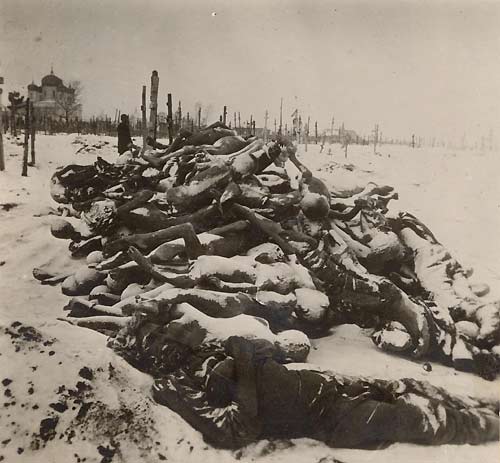
The photos were indescribably awful--they included people who simply died on the street from starvation, too weak to make it home, and the frozen corpses of people left in the cemetery, waiting for spring to be buried. As one of the museum visitors pointed out, it is almost impossible to convey the depth of the suffering during such famines. One piece of wisdom from an earlier famine was passed along through the generations: after boiling leather for about eight hours, it becomes edible.

I left with a flood of impressions from that museum, which covered the history of Buzuluk from prehistory to the present day. Aside from the exhibits of the famine and refugee crises that brought Friends to Buzuluk, one of the exhibits stood out as especially moving: the story of the September 1954 military exercise at Totskoe Military Site, not far from Buzuluk. Over 45,000 people took part in this exercise, including condemned criminals; the centerpiece of the exercise was the dropping of a 45-kiloton nuclear bomb. For many years, the catastrophic aftereffects of this exercise were deliberately concealed. (Russian language readers, start here: Тотский полигон.)

We cannot begin to say anything particularly perceptive about today's Buzuluk after only 40 hours, but we can promise to look, listen, and appreciate!

See also:
To see light more clearly
Return to Buzuluk
Memories of Buzuluk