Showing posts with label feminism. Show all posts

28 May 2026

"Where there was a wish, there was a way"

Source.  

Early in her new book, Live Laugh Love: The Secret History of White Christian Women and the World They Made, historian Kristin Kobes Du Mez (author of Jesus and John Wayne: How White Evangelicals Corrupted a Faith and Fractured a Nation) gives us some context for her major history of the Christian trends that are now seeking to dominate the USA:

It was my effort to make sense of the experiences of Christian women that led me to this new account of American Christianity writ large, and ultimately, to a clearer understanding of the spiritual underpinnings of our current cultural and political landscape.

While Live Laugh Love complements Jesus and John Wayne, it presents a more complicated narrative. To trace the roots of modern Christian women’s culture, I needed to reach back to an earlier era, to the dynamic religious landscape of nineteenth-century America. I also needed to extend beyond evangelicalism to include mainline and charismatic Christianity, Mormonism, and “secular” philosophies of positive thinking. Women’s relationship to power is more complicated than men’s. Women exercise agency, but it is often circumscribed by the authority of the men in their lives. Like Jesus and John Wayne, however, this is a book about whiteness. Although women of color have participated in aspects of this consumer culture and at times have voiced astute critiques of it, the book describes a consumer marketplace that caters primarily to white women’s needs and desires.

Also like Jesus and John Wayne, this story ends in a dark place, as perhaps any history of the United States that runs up to the present must.

The research that gave rise to this book was full of twists and turns. Early on, I was surprised by the frequency with which twentieth-century Christian women quoted the wisdom of Hannah Whitall Smith. A nineteenth-century “holiness” preacher, Smith had popularized a more optimistic version of Christianity than the one I had heard preached from the pulpit of my church. In contrast to Calvinism’s depiction of the persistence of sin even in the lives of believers, Smith taught that a simple act of faith granted believers victory over sin and a profound sense of peace, well-being, and happiness. Despite the fact that Smith had written one of the best-selling religious books of her time, most histories of American Christianity mentioned her only in passing. Why was Smith everywhere in the sources, I wondered, and why had so many other Christian women repackaged her ideas more than half a century after her death?

Following footnotes and traveling to archives, I began to piece together a narrative almost entirely unfamiliar to me. My sources brought me to the court of Louis XVI and to the woods of upstate New York, to the Chinese mission field and along the Mormon Trail. When I ended up back on the terrain of twentieth-century evangelicalism, the familiar had become strange. By then, three interlocking strands had come into focus: Smith’s holiness evangelicalism, Mormonism, and the philosophy of New Thought.

Du Mez totally keeps her implied promise of tracing those "interlocking strands" right through to this very year, including the ways Pentecostal and charismatic Christianity, along with the religious publishing, marketing, and broadcasting enterprises and the phenomenon of multi-level marketing, became part of the mix.

Early in the book, Du Mez addresses her audience:

This book is for the men in the room. It is for readers who have never heard of Beverly Lewis or Rebecca St. James, for those who wouldn’t dream of buying a Thomas Kinkade print or waiting in line for a Magnolia cupcake. You have no idea what you’ve been missing. But this book is especially for the women. It is for girls who braided their hair like Laura Ingalls and tried to obey like Elisabeth Elliot. It is for women who made all the crafts and know all the songs. It is for those of us who were not pretty enough or sweet enough or white enough. It is for women who loved Beth Moore and for women who still love Beth Moore. It is for all of us.

As a white male who came to Christian faith as an adult, I'm among those who never heard of Beverly Lewis or Rebecca St. James. I was aware of the "prairie fiction" and "Amish romance" genres, and of authors Janette Oke, Elisabeth Elliot, and Catherine Marshall, simply because I've worked in three different Christian bookstores, but I was completely unaware of the underlying influences and messages directed at women. 

I was aware of Hannah Whitall Smith's book The Christian's Secret of a Happy Life, because it was on my Canadian charismatic relatives' bookshelf as well as on the shelves of those bookstores. It had been in print ever since it was published in 1875.

In this book, The Christian's Secret of a Happy Life, Smith identifies with "we Quakers," the faith of her family and young adulthood, although later she and her husband were baptized by the Baptists and became Holiness celebrities in the context of Atlantic-culture evangelicalism. (She eventually rejoined Quakers through Baltimore Yearly Meeting.) What I didn't realize until reading Live Laugh Love was how her book was appropriated for the purpose of creating a specific message to women: you must decide to be happy, whatever your outward circumstances; that's (more or less) the only control you have. Other parts of her spiritual heritage, particularly the freedom she insisted upon to preach as a woman, and her belief in universal salvation, were de-emphasized and forgotten.

Du Mez mentions the neglect of Smith in histories of American Christianity. (I just checked Peter W. Williams's 604-page America's Religions and found one tiny mention of her, misspelled, paired with David Updegraff as "Quakers with evangelical leanings..." in a list of those participating in an early stream of the Holiness movement. No mention of her book.) This lack of recognition reminded me of Agnes Sanford, whose central role in the healing-prayer movement of the twentieth century while almost invisible to the academic world, was documented in William de Arteaga's book Agnes Sanford and her Companions: The Assault on Cessationism and the Coming of the Charismatic Renewal. (See this post.)

But the main reason I'm referring to Du Mez's careful study of Hannah Whitall Smith's work is that it is just one example of how she presents her many sources and the ways they influenced each other to this day, including the role of women in the Christian networks that now seek to remake the USA into a theocracy.

I found insights, references, and connections to highlight on practically every page of this book. It took over my life these last few days. Du Mez's writing is intense ... sometimes I was struck deeply by the bondages imposed on women under Christian pretenses, sometimes I cheered the Christian resistance to those bondages, but I was never bored. If you have any interest in these themes and variations of faith, politics, and culture, I can't recommend this book highly enough.


Hoping I'm not stretching fair use to the breaking point, here's another excerpt, this time related to the book's name.

Two years after William James published The Varieties of Religious Experience, an Iowa woman named Bessie Anderson Stanley submitted a poem to a magazine contest asking readers to define “success.” The person who achieved success, Stanley wrote, was one who “has lived well, laughed often, and loved much.” The poem won the $250 cash prize, enough to pay off the mortgage on Stanley’s home. Reprinted in various anthologies, the poem entered the popular lexicon in condensed form. Over the years, one variant was mistakenly attributed to Ralph Waldo Emerson, an error popularized by advice columnists Ann Landers and her sister, Abby. By the dawn of the twenty-first century, few bothered to ask where the phrase gracing glittery tumblers, decorative throw pillows, and Hobby Lobby wall art had originated. In 2021, online retailer Wayfair stocked more than fifty-six thousand Live Laugh Love products, and DIY marketplace Etsy reported over one hundred thousand searches and listed more than eight thousand products carrying the words. ... But the phrase’s popularity was more than a décor trend associated with “basic” white women. Its ubiquitous appearance on wall stencils and household items was a result, in part, of the enduring popularity of mind-power—if the mind could shape reality, then visual reminders to think positive thoughts could produce positive transformations. Where there was a wish, there was a way....

Live Laugh Love is a book about love and fear, longing and greed, about Mary Kay makeup, Christian romance novels, Joyce Meyer Ministries, and Ballerina Farm. Its cast of characters includes true believers and charlatans, well-intentioned people and predators, and it is not always clear who is who. This is also a book about politics. White Christian women often claim to be apolitical; if you ask them, they will tell you that their lives revolve around faith and family, yet what they think about faith and family informs their views on education, taxation, welfare, economic inequality, immigration, law enforcement, and what it means to be American. Far from trivial, the products women consume influence how they see the world they live in and the world they hope to create. Ultimately, this is a book about power—about women’s power to define their own lives, men’s power over women, and the power women wield over one another. It is about discipleship and devotion, authority and submission, manipulation, cruelty, and control.


These excerpts and my comments are based on a digital galley proof obtained through Netgalley. I was made aware of the galley when I joined the Live Laugh Love Launch Team. When the book is printed and made available in September, I may need to check and revise these quotations. However, what you've read so far accurately represents the author's promises to us readers, and the amazing work she has put into fulfilling them.


Lamorna Ash, author of Don't Forget We're Here Forever: A New Generation's Search for Religion, which I reviewed in this post, will speak at Westminster Quaker Meeting's meetinghouse on Saturday, June 20, 7 p.m. London time, in person and online. Theme: "Quakers and a new generation’s search for religion." Details here. (Thanks to Bunhill Fields Quaker Meeting's newsletter for the link.)

Elderchaplain Greg Morgan on Rosalie, her gratitude, and her quilt.

Pope Leo XIV and artificial intelligence: the encyclical. "...A religious imperative...." "...Counterbalancing alarm with hope...."


When I first heard this song as a teenager, I honestly didn't understand it but I couldn't stop listening.


#livelaughlovebook

08 April 2021

Faith and trust in Capernaum

In the Gospel of Mark, at the beginning of the second chapter, there's the familiar New Testament story of the paralyzed man (Mark 2:1-12, The Message; NIV). Four men were carrying his stretcher, hoping to ask Jesus to heal him, but the house was so crowded that they couldn't get past the door. Instead, they made an opening in the roof and lowered the patient into the room. Verse 5: "When Jesus saw their faith, he said to the paralyzed man, 'Son, your sins are forgiven.'"

Leonid Kishkovsky, protopresbyter within the Orthodox Church in America, rector at Our Lady of Kazan Church in Sea Cliff, NY, USA, and a respected ecumenist in the larger Christian world, gave this very brief sermon back on March 28, opening up an aspect of the story that I'd never really considered. If you have considered it, feel free to smile at my late awakening. [UPDATE: He also gave this sermon in English -- here it is. (Thank you, Sophia Kishkovsky.)]

In less than five minutes, he makes these important points:

  • Jesus responds to the faith of those men by healing the patient and sending him home on his feet, carrying the stretcher on which he had been lowered through the roof.
  • We don't know anything about the stretcher bearers except that they were men, and there were four of them. From the text, we can't say anything about their relationship to the patient. But it was their faith that decisively impressed Jesus.
  • People have various understandings of the word "faith." Some emphasize faith in the doctrines and teachings of the church. Still others understand that faith is best expressed in fulfilling the commandments and statutes of the church.
  • Not so many of us (he goes on) would connect "faith" with "trust" -- although in Russian, the word "faith" and the word "trust" have common linguistic roots. In other words, if we believe in God (have faith in God), we are demonstrating trust in God. [The phrasal verb "to believe in" comes from that same linguistic root.] This might be the simplest and most direct way of understanding faith.
  • In this account, we also see another dimension of trust: the trust that the paralyzed patient shows, most obviously, to those carrying him. And, together, they trust that Jesus can save him.
  • Let's orient our lives as Christians around trust -- that is, trust in God and trust in each other. Let's be friends to each other, so that we are each ready to entrust ourselves to each other. Amen.

To understand the importance of the patient's faith in his stretcher-bearers, all I have to do is to imagine myself in this scene, experiencing their scary improvisation, lowering me through the roof without tipping me off the stretcher.

For decades, one of my most urgent concerns as a Quaker has been the role of trust as the most basic Quaker testimony. Trust in God lies at the very foundation of our teachings on peace and nonviolence, equality, simplicity, and our method of church government -- centered (in all our flavors and branches) in the expectation that the whole community prays together to discern the will of God for each other.

In our own times, the centrality of trust in our lives as a community has never been a more important legacy for the Body of Christ as a whole. If we can, for the sake of discussion, set aside our mystical and metaphysical theologies about church and simply focus on its functional definition, is there any other social structure where we can meet together (despite all our secular differences) in utter vulnerability? Not only are we publicly saying that our faith/belief/trust is in God (which is no longer a reliable source of social approval!), but we are also meeting to carry each other, to risk for each other, to confess our weaknesses, tragedies, and addictions to each other, and relate our natural and supernatural experiences of God to each other.


I have never been part of a Quaker meeting or church where trust was always experienced at an ideal level. But there's something significant I've noticed in our Camas Friends Church's meetings for worship by videoconference over this past year. We have, in fact, become bolder in sharing our vulnerabilities with each other. It's this experience, week after week, that tells me Kishkovsky's sermon is solid.


Related posts:

What is our vocation?

The most important question.

Trustworthy, part one, part two, part three, part four.


On the basis of Paul's list of women co-workers (Romans 16:1-16) and other factors, Beth Allison Barr doesn't believe in male headship. (Dear Quakers: if you're tempted to pass this by because "we don't have this problem," please think again! First of all, historically we have had this problem. Secondly, Baptists are our brothers and sisters in faith; on the wider stage, our exceptionalism ill becomes us.) Thanks to Jim Fussell for the link.

What is the muon G-2 experiment and why is it so important? (And why should we remain cautious and wait a while before abandoning the Standard Model?)

Chuck Fager shares fascinating biographical writings by David Zarembka, who died in Eldoret, Kenya, of COVID-19 on April 1. Gladys Kamonya, David's wife, had just died of this same disease on March 23.

April 8, 1865: General Ulysses S. Grant was having a hard night.

Becky Ankeny on living with actual hope.

Nancy Thomas is Just Asking: poems based on Ephesians.


Kenny Neal, "The Things I Used to Do" and "Since I Met You Baby." Watch him hand the guitar off to Guitar Shorty at 9:30, then play the rest of the song on the harp.

16 January 2020

Are all hearts clear? (partly a repost)

Source: Wellcome Collection.  
"Are all hearts clear?" This question is often heard near the end of Camas Friends Church's meetings for worship. They are usually almost the last words we hear in worship, just before the closing words, "Go in peace."

At Camas Friends, we members and attenders take turns hosting the meeting for worship -- that is, calling us together to begin the worship, giving announcements, and then, at the end, signaling the close of worship with those two sentences.

On one recent Sunday, the person serving as host said that she wasn't going to ask, "Are all hearts clear?" because she wasn't exactly sure what it meant. She continued: speaking for herself, her heart was hardly ever "clear." Instead, she was going to ask whether anyone still had something on the tips of their tongues to contribute to the meeting.

Many of the Friends meetings and churches I've attended or visited end the meeting for worship, or the unprogrammed portion of the worship, with those words. The query feels warm and familiar to me. It says to me that the meeting for worship doesn't simply come to a mechanical halt; there's always space for the vocal ministry that might still be making its metaphorical journey from heart to lips.

The phrase also reminds me of a remarkable comment George Fox made just two days before he died: "...I am glad I was here. Now I am clear. I am fully clear."

I thanked that morning's host for making me think about this familiar phrase. Familiar to me, that is, but perhaps not to everyone who happens to be at a Friends meeting for worship on a given occasion. My point isn't to advocate giving up the phrase altogether, but to pause long enough to consider what we're doing as a community to learn and teach clarity of heart.

Any time I encounter an artifact of Quaker peculiarity -- from pacifism to plain language -- I am tempted to question its utility in building up our discipleship as Christians. Have we remembered to connect our peculiarities to the concern for integrity that gave them birth? Or have they become vanities, reinforcing Quaker exceptionalism?


I originally used the Wellcome Collection photo above in my post of September 6, 2007, "Open Hearts." Here's the title portion of that post:


Yesterday's The World program on Public Radio International had a remarkable interview. In June of this year, Jennifer Sutton, 22, underwent a heart transplant operation at Papworth Hospital, Cambridge, England. In the radio interview, she describes what it was like for her to examine her heart -- literally. Her old heart. The one on display at the Wellcome Collection, just west of Friends House on Euston Road in London.

As the Wellcome Collection's Web site explains, Sutton "had been suffering from Restrictive Cardiomyopathy, a condition in which the heart muscles stiffen, meaning the heart chambers are unable to fill with blood properly." Before the transplant, she was unable to walk more than a few meters without resting. Clearly, her heart was functionally inadequate for the life she wished to lead, and she was told she had maybe six months to live.

I wouldn't be surprised if all over the world preachers were finding ways to insert this news story into their sermons. If you look into your heart, what do you see? Rigidity? Without a healthy heart, how can you stay in circulation?

Actually, it's not a laughing matter, even as a metaphor. It just happened that, when I heard the story, I was in the weight room at Mount Scott Community Center. In fact, I was on the treadmill, doing the cardio part of my workout. Whenever I start revving it up on that machine, I touch my heart and tell it, "I love you." Thanks to The World and Jennifer Sutton, my words had extra weight this time.

One more thing. I thought about Jennifer's heart on public display, for all the world to see. Normally our hearts are tucked inside us, never exposed to the light of day. The world of realists doesn't honor hearts much, except in sentimental contexts -- our leaders are supposed to be hard-nosed, ready to make the tough decisions. We know that their lives don't always match up to this cerebral ideal; sometimes their other private parts don't stay private enough, but their hearts, conversely, too often stay too private. Sometimes I wish I could speak to some of our leaders and ask, "In your deepest heart, can you really not believe that the president of Iran was seriously reaching out when he asked about Christian consistency in our president's policies? Is there not ever any doubt in your heart about the efficacy of coercion over respectful persuasion in dealing with the world? Do you really believe that access to regular health care should be subject to the law of the capitalist jungle?"

I'm an organ donor, so I suppose it is possible that my heart will someday be inside someone else. I hope that the surgeons will judge that it will still give life and hope, as Sutton's new heart is doing now, and that the new owner will be able to touch it and say "I love you."


UPDATE: The Wellcome Collection's Web site has been thoroughly overhauled and now relies on archive.org's Wayback Machine for access to older pages, including those relating to the exhibit where Jennifer Sutton's heart was on display. Here's a BBC article with more information about that exhibit.


In 1980, Judy and I, newlyweds, moved to Charlottesville, Virginia, so that Judy could begin her MBA program at the University of Virginia. I worked at the Logos of Charlottesville bookstore, a Christian bookstore whose owner, Florence Skove, was a vocal supporter of the Equal Rights Amendment. During the ratification campaign in Virginia, she and I (and the bookstore's one other employee) wore ERA pins.

Yesterday, the amendment was finally ratified by Virginia's General Assembly.

Is Russia heading toward autarky? And what might be the possible upsides of Vladimir Putin's newly-announced reform proposals? (By the way, Aleksei Navalny and his team wonder how [Rus.] the new prime minister's wife earned 800 million rubles.)

Jennifer Wilson on an experimental approach to Elena Ferrante and the sources of literary influence.

Internet Monk: There's a big difference between a biblical approach and a biblicist approach.


Here's a delightful video about Samantha Fish: Fil Henley, a British rock guitarist, analyzes a video of Fish performing "I Put a Spell on You."

To his observations I'd add another quality that isn't as obvious on this track as it is on some of her others, namely her melodic discipline. This is a great quality in a genre that often allows cliche chords and hooks.

30 May 2019

Out of order

Nothing alarms the patriarchs like a woman preaching.

Just a quick review of recent versions of this debate: After seeing several recent social-media exclamations along these lines -- "Churches where women preach are false churches" -- I sat up and took notice when one of my theology feeds brought me Owen Strachan's article, "Divine Order in a Chaotic Age: On Women Preaching."

A few days later came this thread from preacher and teacher Beth Moore:
In the comparatively sheltered world of Quakers, maybe it's easy for some of us to minimize these debates as unrelated to us. It's particularly easy for me, being male and an adult convert. Beth Moore conveys some of the agony and grief and betrayal that would be frighteningly easy for me to miss completely. This would not be right, because we are in the same larger family of faith, both spiritually and historically -- and because we bear a testimony to challenge that larger Christian family, just as they challenge us in other areas of theology and discipleship.

Without brushing aside the specific debate within the Southern Baptist Convention and similar communities, I'm fascinated by a prior concern that I see in the Strachan article: the yearning for order.
Order is not incidental to Christian doctrine; order is central. God is the maker and ruler of all things; the creation is distinct from him, yet exists by the super-sustenance of his Son (Colossians 1:17); the world in which we dwell is not characterized in fundamental terms by randomness and disorder, but by divine design.
A few sentences and selected scriptures later, we have the implication of "order" for the dispute at hand: men must always shepherd women, not the other way around. Men lead, and women appreciatively follow and support, and instruct the younger women; thus has it ever been among those who Stand On the Word:
It is not man who has “fixed” the word of God, and written it in the sky. By God’s own hand and mind, there is order in the home; there is order in the churches; there is order in the world God has made.
Whenever I encounter this kind of reasoning, it often seems to pose a stark choice: either it's this kind of order, or none at all. One recent anti-egalitarian blog post quoted Abraham Kuyper:
Finally Modernism, which denies and abolishes every difference, cannot rest until it has made woman man and man woman, and, putting every distinction on a common level, kills life by placing it under the ban of uniformity.
(In Kuyper's defense, the same lecture included his Calvinist denunciation of "...not merely all open slavery and systems of caste, but also all covert slavery of woman and of the poor.")

This chain of biblical logic cuts short any discussion of the actual fact that the Scriptures were not "fixed" and "written in the sky" by God alone; they were assembled, edited, and ratified by a very human process. It's a process that we trust because we know the same Holy Spirit that guided those editors and assemblers. When we study the Bible reverently and prayerfully, we in effect receive the sacred texts NOT as some kind of occult oracles but as a legacy of the Body of Christ.

We receive that legacy with our brains fully functional even as our spirits eagerly await what the Holy Spirit has to tell us through those words. All new believers, every new generation, must ratify the Bible for themselves. Nobody can claim that the Bible magically translates or interprets itself, or imposes some eternal order of church politics with iron logic that trumps all human participation. Mind and Spirit must always collaborate. The outcome, the division of labor among us, is not controlled by any church bureaucrat, no matter how coercive their allegedly biblical rhetoric.

We don't have to choose between the vision of order represented by Southern Baptist complementarians and the caricature of disorder and uniformity that they sometimes present as the dangerous alternative. Early Friends raised a vision of "Gospel order" that agrees completely with Southern Baptists on the main point: God is a God of order, not of disorder. It's in the next steps -- leadership and discipleship -- that things tend to diverge.

In Lloyd Lee Wilson's summary,
The Quaker understanding of gospel order stems from an understanding of Christ's role as the restorer of the original relationship between the Creator and creation. By this view, Christ reconciled creation with the Creator, and by so doing enabled everyone who believes in Christ to enter into a new relationship with God. It was (and is) the responsibility of Christians to live in this gospel order, both out of the desire to do God's will, from the joy that being in that right relationship brings, and as a testimony to the rest of the world about the gospel. (Essays on the Quaker Vision of Gospel Order.)
However we might understand our eviction from the original Garden of Creation in Genesis, Christ reconciles us with the Creator, and enlists us in the Lamb's War to bring this good news of reconciliation and restoration to everyone, confronting all bondages in the process -- including those bondages imposed under color of presumptuous church authority. There is a definite order here:
  • God as creator
  • Christ as our reconciler and redeemer
  • You and I, equally, as the church gathered around him, learning from him what reconciliation means, and working out together our division of labor in living a reconciled life and extending the invitation far and wide.
There is no rigid formula, biblical or otherwise, that tells us in detail how to do this division of labor. The Bible records God's promises and our ancestors' checkered record in receiving and believing those promises. It is full of cautionary tales illustrating that record, including our nasty habits of lording it over each other! It is an incomparable storehouse of ethical and prophetic principles -- and the costs of ignoring those principles. It records how the first generation of Christians came to understand that their good news was for everyone everywhere. It assures us that the Holy Spirit remains with us to comfort and lead, and that the community has all the spiritual gifts necessary to accomplish a Spirit-led division of labor.

Our resources also include our church's memories of learning over centuries what it means to participate in God's order. We Friends have been experimenting and recording our results for many generations, so we have stories about what Quaker discipleship actually looks like in different circumstances and cultures. We also know we must be honest about our failures and our too-frequent lack of sufficient boldness. We are learning the signs and wonders (nonviolence, simplicity, equality, truth-telling, decision-making based on group prayer and discernment, and so on) that bear our testimony of reconciliation to the world.

Recording ministers. Photo: Judy Maurer.
Finally, we have each other. This past weekend, our Sierra-Cascades Yearly Meeting of Friends gathered in Canby, Oregon, for our annual sessions. Around 200 of us made significant decisions for the future of our new church association with tenderness and care for all. We recorded five ministers (four women and one man), certifying in our minutes that we have witnessed their public ministry and testifying that they represent us well. We have no paid staff at the yearly meeting level, our presiding clerks constantly emphasize that they serve us, not the other way around ... and I can honestly say that everything I saw was done in good order.

Reality check: Compare these admittedly oversimplified correlations of attributes:
  • Anti-egalitarian order: men in authority over everyone else; coercive, non-negotiable leadership styles
  • Gospel order: equality in leadership; decisions made through whole-group discernment
Which of these paths seems strangely similar to the ancient and corrupt patterns of worldly power, and which seems more consistent with Christian conversion and redemption?


A related post: Gospel order revisited.


A letter from Dan Evans about Saturday's funeral for Rachel Held Evans, and about the reality he finds himself in. Saturday update: The streaming video of the service remains available at that page. Nadia Bolz-Weber gave the sermon. centered on John 20:1-18.

Speaking of the Bible, another volunteer in Arizona goes on trial for helping immigrants survive desert conditions.

An interview with Christy Wimber on the church and its attitudes to healing.

Progressive AND orthodox... post-boomer religion and the resurrection. (Thanks to Fleming Rutledge for the link.)

Newly opened Nobel and CIA files reveal more about the 1958 Literature award to Boris Pasternak.

Orwellian? Roskomnadzor holds a seminar for regional journalists on how not to run afoul of recent Russian legislation.


Christone "Kingfish" Ingram is coming back to the Waterfront Blues Festival this July. You can hear why that makes me happy:

08 March 2018

Women's Day reflections

"All types of moms are needed; all moms are important."
Soviet-era poster.  Source.
Another International Women's Day Soviet-era poster.
Source.
"Happy March 8!" (Boys making cake for mom.)  Source.
A Moscow restaurant advertising a Women's Day program,
"Blondes vs Brunettes."  Source.
We are happy to have such a wonderful occasion to express again our deep respect for you, our enchantment with your beauty and tenderness. - V.V. Putin, president of Russia, in his address today to Russian women on the occasion of International Women's Day.

If working at the Duma seems dangerous to you, find another job. - Vyacheslav Volodin, speaker of the State Duma, in remarks yesterday aimed at women journalists reporting sexual harassment by the chairman of the committee on foreign relations.

There was a time when International Women's Day was linked with women's rights and women's equality. (In the Soviet Union, this March holiday had the additional advantage of drawing attention away from Lent and Easter.) In today's Russia, the political overtones have all but vanished.

During our years in Russia, we celebrated Women's Day nine times. As a male observer, it's not for me to tell anyone else how to regard this holiday, but I hope it's not out of place to share some of my mixed feelings.

As a holiday, it's a big deal. This year, tomorrow (March 9) is also a holiday, making a four-day weekend. In Russia, Women's Day feels to me like a combination of Valentine's Day and Mother's Day. Boyfriends, husbands, and employers present women with flowers and chocolates and other gifts. Male family members may offer to do cooking, shopping, and housework often reserved for women in this culture. Advertising plays up the "aren't women special?" theme. Florists are busy at all hours. As Judy pointed out, it's funny to go to the grocery store on March 8 and watch those men who never go shopping at other times, and who today will wander the unfamiliar aisles in search of items their wives can find blindfolded.

Little of this holiday's rhetorical "deep respect" and "enchantment" seems to have influenced attitudes toward (for example) women's place in political life or their ability to get jobs normally associated with men. Legal safeguards against domestic violence were actually weakened just last year. Against this background, even the most sincere Women's Day greetings -- and I don't deny the sincerity at all -- could be interpreted as reinforcing assumptions that women are valued for their ability to charm and delight and serve men.

In contrast, movements in the West to correct these same ancient patterns are viewed by many Russian men and women as proof that the West is degenerating. These views came up frequently in our classes, and sometimes even among our colleagues. We were asked, for example, if it was true that a man could be arrested for opening a door for a woman.

To make the picture even more complicated, not all of the Soviet Union's egalitarian myth has vanished. As a result of that era, many more scientists, engineers, physicians, lawyers, university deans, factory managers, and judges have been women than might otherwise have been the case. The glass ceilings in Russia are configured differently than in the USA or Western Europe. But the outright challenges to those ceilings in Russia, while growing, are still in their early stages. And the word "feminist" is too often connected in the Russian mind with the word "aggressive."

In sum, that's why the over-the-top saccharine sentimentality of Women's Day in Russia sometimes sets my teeth on edge. But there was another dimension of the holiday that seemed incredibly important and moving: Women's Day as a celebration of female friendship. As far as I know, there's no holiday like it in the West, when women give gifts and tokens of friendship to each other. I was lucky enough to witness countless such scenes. Judy is a generous soul, so she quickly took to this dimension of Women's Day and entered into its spirit wholeheartedly. Now that we've left, this occasion of affectionate gift-giving among women is one of the things we miss most about Russia.

To illustrate these strangely mixed qualities of exaltation and bondage, here is the poem by Andrei Dementyev that Vladimir Putin quoted in his televised Women's Day address earlier today: (please don't blame Dementyev for my clunky versification)

I know that all women are beautiful,
Loveliness and intelligence combined.
Playfulness, too, when there's a celebration,
And faithfulness, when there's division in the home.
We're not bowled over by outfits or classic profiles
It's the womanly soul that conquers us.
And her youthfulness ...
And motherliness ...
And, when the time comes, her grey hairs.
While I'm alive, I'll pray to women.
Above all other delights, I'll prefer love.
The Lord showed us woman as miracle,
Entrusting the world with this beauty.

Finally: there is nothing about Russian doublemindedness about women that doesn't have equivalents here in the USA, just in different proportions and emphases. National stereotypes should not block mutual listening and learning until we ALL reach the "whole measure of the fullness of Christ." (Ephesians 4:13, context.)


Related:

Patriarch Kirill on the special nature of women (and more on that special nature)

The Return (film) and the cult of the patient woman.


Vladimir Putin's Women's Day address in Russian, including poem.

On Women's Day, Russian lawmaker Slutsky apologizes (sort of).

Meduza's editorial: Leonid Slutsky must resign.

Kevin Rothrock's Russia Guy podcast reviews the Slutsky story and its context. (Just eleven minutes, very worthwhile.)

Evgenia Albats: Oprah and #MeToo, Russian style.

A challenge to sexism at St. Petersburg State University.


For Women's Day, Joy Lujan lists her articles about Quaker women on one convenient page of links.

Ethan McCarthy -- Louis C.K.'s sins and mine.

Lon Fendall: Standing alongside those who serve in public office.
Few if any of us will ever have the kind of relationship [Jim] Wallis had with [Senator Mark] Hatfield, whose staff knew that when Wallis called, time would be found for the two of them to talk. I certainly do not have such an open door with local or national officials. But I often wonder if there is something more I could be doing to stand alongside public officials who are grappling with hard issues. We would hope they would be willing to “stand alone,” but why should they have to?
Leon Neyfakh wonders whether going to sleep at the same time as his sweetie is normal.


Vanessa Collier, "Love Me Like a Man."

19 October 2017

My heart is breaking. So what?

We left Russia on Tuesday evening. Now we're traveling on Amtrak from New York City to Portland, Oregon. Our train stopped for nine minutes in Charlottesville, where we spent the first two years of our marriage. A lot has happened since then, with us and with Charlottesville.


My heart is breaking with the flood of #MeToo stories from people who've experienced sexual violence and objectification of all degrees. CNN reports a Facebook statistic: "...More than 45% of people in the United States are friends with someone who's posted a message with the words 'Me too'." Seems entirely possible. Just based on people I know, that proportion might actually be low.

But my breaking heart is completely beside the point. The problem is people whose hearts aren't breaking and will not soon be breaking. Many of them don't consider themselves predators, and their behavior is often supported and protected by their surrounding culture, as noted in Teri Carter's article, "Saying 'me too' isn't enough. Women have to stop excusing men." Some no doubt plunge into cycles of offense and remorse, hoping that their remorse counts for something....

Last year, a similar online phenomenon took off in Russian and Ukrainian social networks. Natalia Antonova described the origins of this movement and some of the assumptions it unearthed. She did not express wild optimism about outcomes, but there is a path toward progress:
We are seeing an example of real collective action — not sponsored by any government, not popularised by marketing or television. The very fact that there is such a big controversy, an outcry, criticism, and counter-criticism tells us that quite a lot of people are emotionally invested both in the problem of violence and trauma — and are also invested in public life and public discourse.
Before we protest that the USA (for example) is more progressive on this score than the post-Soviet world, can we honestly say that we never see examples of  the "hypocritical blending of patriarchal and liberal norms" mentioned by Antonova?

One thing that seemed possible in July 2016, the time of Antonova's article, was a woman serving as president in the USA, something that no Russian I spoke with thought would happen in Russia in their lifetime. Most Russians told me that it shouldn't happen, in Russia or in the USA. Of course, for the USA, that moment didn't come to pass.

(But yesterday came the announcement that Ksenia Sobchak plans to run in the Russian presidential election next year! The conventional wisdom so far seems to agree that this is just a way that the Kremlin wants to make the highly stage-managed Putin re-election process more interesting and entertaining. My question: Can Sobchak's candidacy nevertheless have subversive benefits in widening the forums for discussing sexual violence and related topics?)

Back to #MeToo and the chorus of male grief. The sad truth is that the existence of men (and women) who have no desire at all to offend, or are supposedly too nice to offend, or who repent, or who simply have learned how to manage their "needs," hasn't been enough to prevent that "more than 45%" statistic. Our goals should go way beyond expressing sympathy; they should include ending cultures of impunity. This isn't an easy thing to advocate -- my conscience is stabbed by the question, How often have I been given the benefit of the doubt?

Ending cultures of impunity ... what might this imply? How do we get there? For one thing, it would help to have offenders' peers confronting offenders, and for these stories to circulate. I'm reminded of a case I know personally: an alcoholic wife-abuser being confronted by his older brother, himself a recovering alcoholic: "Hey, take it from me, you straighten up or you're going to lose the best thing you have, and I'll want to know the reason why."

Victims' and survivors' dearest ones also have a role to play, especially in cultures where the "boys will be boys" attitude prevails. In theory, we know that love trumps shame, but we need to make that true in every concrete situation where shame smothers the truth. This is especially important where victims end up entering into alliances with their attackers and therefore feel complicit. Again, for cultures that don't value lofty theories, we need stories of families and sweethearts taking shame out of the equation. Let's tell our stories of shame being healed, whether we were the channels of healing or the ones experiencing healing.

What about men? (After all, the majority of offenders, and also the apparent beneficiaries of the prevailing power systems, are men.) Sometimes my inner cynic worries that this arena is just another channel for men to entertain fantasies of heroism, or (given the persistence of sin and addiction) to use a veneer of sensitivity for seductive purposes. But there are concrete steps we can take:
  • Listen, don't rush to fix. Be rooted in grace. Listen, listen some more. Be human! 
  • When women exert leadership, respond positively. That may simply mean getting out of the way without waiting for recognition or credit.
  • Replace the old "men have needs" excuse with active encouragement for any decent efforts to teach young people about sexuality and boundaries. Maybe it's an opportunity for liberals and conservatives to work together -- for liberals to assert the importance of equality, for conservatives to remind us of sin's devious persistence.
  • Other ideas?
One of my biggest frustrations is the lack of attention to sexual discipleship in the church. The resulting harm includes not just violence and harassment, but endless shame, anxiety, hypocrisy, homophobia, and ultimately cynicism, alienation, atheism, ... in total, a lot less joy, intimacy, and long-term pleasure than God intended for us.

I think I understand the reluctance to tackle sexual issues; I don't know about you, but I really don't go to church to talk about sex! That means finding creative ways to confront the old boundaries and allergies that ultimately served oppression, and create new boundaries that put sexual discipleship in proper perspective with other topics of life as believers -- such as financial discipleship, to name another awkward theme.

Think of the rewards of expanding our discipleship education: building a far more rewarding model of whole-life Christianity that doesn't keep two sets of emotional books (one for display at meeting, and the other reflecting our private anxieties and agonies). Think of the evangelistic advantages as well -- inviting skeptical people into a community that behaves as if it actually believes in the abundant life Jesus promises.


A related post from last year: Trust and its erotic dimension. ("Now it gets personal.")


How badly have traditional Christian sexual ethics failed?
In the absence of any concept of consent, patriarchy might have been the best humanity could do to provide a stable social order that somewhat protects vulnerable people from the kind of mayhem we see in Sodom in Genesis 19 and Gibeah in Judges 19. Unfortunately it fails to provide full protection; it just keeps the violence behind closed doors.
Postliberalism for Quakers. (Thanks to @MeetinghouseBP for the link.)

Another view of Ksenia Sobchak's candidacy, from a pro-Kremlin outlet.


"Johnny B. Goode" Russian style.

28 April 2016

An end to coercive Christianity

Or, more realistically, let's provide a robust, passionate, God-honoring alternative to coercive Christianity, because, let's be honest, some people seem to prefer being coerced.

Source.  
What sparked these reflections? It's all Melanie Springer Mock's fault (oh, and her co-author Kendra Weddle Irons). Reading their book If Eve Only Knew, I realized again that, in my beloved little corner of the Quaker world, I've lived a sheltered life, where men who want to marry seek brides who are intellectual companions, where women know their true strength, where churches choose leadership based on spiritual gifts rather than social status, and so on. I know this lovely picture isnt literally true -- all around me (and even in my personal experience) I see contradictions to these ideals, but somehow those contradictions don't hit me the way they should.

What broke through? This book! -- and its evidence that, whatever I might have optimistically assumed, cultural Christianity still plays a major role in oppression in the lives of millions. It was the data about Christian bookstore sales that reached me: the "biblical womanhood" industry is profitable. There's a lot of money invested in telling women lies about their roles and limitations in God. As Melanie says in the introduction,
Despite the voices of Christian feminists offering an alternative understanding of Scripture, gender, and God's call on our lives, messages about biblical womanhood continue to dominate Christian culture. Such messages provide easy answers to the messy, complicated question of who God wishes us to be, but they are also quite lucrative. According to the CBA (formerly Christian Booksellers Association) state of the industry report, in 2009 Christian products sales were reportedly $4.6 billion. Women assume a significant portion of this market share. Speakers such as Joyce Meyer draw large audiences -- and large sums -- by ironically preaching in mega-churches and to mega-audiences around the country about the primacy of women's domestic domain.
Source.  
Years ago, I worked for a CBA bookstore in Charlottesville, Virginia (helping put Judy through graduate school!). Though I suppose we stocked our share of nonsense, the owner of the store, Florence Skove, had her boundaries: she would not put stuff on the shelves that trivialized women. (If you insisted on buying them, you could order them.) Florence Skove was an active member of a conservative Presbyterian church; she laughingly told me that some of her friends called her "our fundie friend Flo." But my so-called fundie boss also asked me to wear an "ERA YES" button while on the job, supporting the campaign for Virginia to ratify the Equal Rights Amendment. It wasn't hard to convince me, although I'm sure we raised a few customers' eyebrows.

Flo wouldn't stock this book because she
said that the luxurious fur coat would be
a "bad witness" to nonbelievers. Source.
Among my excuses for being so oblivious are also the following: (1) My mother was a university professor. I never saw any sign in my parents' marriage that she subordinated herself to my father. Our family had more than its share of dysfunctions, but that wasn't one of them. As I looked to my own future, I never expected that my eventual marriage partner would be some version of that Biblical Womanhood ideal described in If Eve Only Knew's first chapter. Interestingly, most of the guys I knew in high school (admittedly in an experimental program that, already in 1970, had a course devoted to feminism) also seemed to assume that the ideal woman had brains and confidence equal to their own.

(2) When I became a Christian, my very first spiritual home was Ottawa Friends Meeting in Canada. There I came under the influence of Deborah Haight, about whom I've written several times. As she told me stories about her childhood in Norwich, Ontario, in what was then Canada Yearly Meeting (Conservative), she described an upbringing and a subculture which took it for granted that girls would learn carpentry and other farm jobs, and later would be exposed to science and theology, and (in the unprogrammed Quaker context) would be recorded as ministers, on the same basis as boys. It's surely no coincidence that Emily Stowe, Canada's first female doctor, came from Norwich.

Since making my home in the pastoral and evangelical Quaker world, I've found some contradictions a little harder to ignore. It was a memorable session of Indiana Yearly Meeting when (then) superintendent David Brock asked us, with obvious impatience, when we were finally going to implement our testimony to men's and women's equality. Part of his job was helping meetings find new pastors -- but why was it (he asked) that, of all the female candidates he offered, one third of the meetings seeking pastors would ignore them completely, one third of the meetings would put their resumes on the bottom of the pile, and only one third would take them seriously?

It's this aspect of Christian practice that I'm labeling "coercive." It's fine for you to have an interpretation of Scripture that's different from mine (though if you label it more "conservative," expect an argument). My problem starts when you use that interpretation to limit someone else's freedom in Christ, with no right of argument or appeal. When you tell girls that they can't be leaders (or, as If Eve Only Knew documents, attribute all our social woes to Eve's sin or Adam's passivity), and prescribe for them a life whose boundaries must be defined by men, that's coercion. It's bondage reinforced by social sanctions that seemingly can only be broken by disloyalty to God. What's more sorrowful and frustrating as we face an unbelieving world, this approach is profoundly anti-evangelistic. "Welcome to the household of faith," we say. "You are born again, your new life is just beginning! Rejoice!" And then the bait-and-switch: it turns out that you are asked to take on new bondages that seem remarkably similar to the tired old bondages of the world.

I'm not saying that the choice to live a modest life devoted to caring for children and home is wrong! The evil is in coercive boundaries, not freely-made choices. It may be that, if we somehow removed all the ideologies and polarizations that limit our children, a majority of boys and girls would still choose traditional roles and divisions of labor. But, at least within Christian communities, they would be making these choices in prayerful communion with Christ and each other, much as Deborah Haight described her childhood in Norwich.

Realistically, we're not going to put an end to coercive Christianity soon. People will still organize around those bondages and propagandize for them in CBA bookstores, in Christian celebrity mega-events, on Christian TV, and so on. What cheers me up is books like If Eve Only Knew and all the other ways we can and will proclaim a wonderful alternative vision of freedom in Christ for women and men alike.

This alternative does not depend on faking perfection or hiding contradictions. I dearly love Northwest Yearly Meeting of Friends, where I've met so many wonderful role models of functional egalitarianism and humane evangelicalism. We are wrestling with our own dilemmas around issues of sexuality, and the outcomes are uncertain. But we're doing this all out in the open. Our difficult discussions undermine any pretense that we can impose a single model of Quaker holiness on our children and newcomers. Our various models of discipleship are formed in conversation, debate, even conflict, but at the same time they are also formed in something approaching transparency, and in love.


This is Holy Week here in Russia, and Easter is in three days. As I do every year, I'm re-reading Emmanuel Charles McCarthy's The Stations of the Cross of Nonviolent Love (PDF file). In light of my ideal of alternative Christian community, here's a page I thought I'd highlight for today:


Not many links today! The Web site I use for preserving links, delicious.com, is in the process of shifting back to its old site and a previous generation of software, and seems unavailable today. (They promise to return shortly at del.icio.us.) But these links seemed especially urgent to pass along....

Tim Stafford on Cities of Refuge.
Bernd Wustl pastors a church of 500 in the German border town of Freilassing. He is a Teddy bear with a full white beard, who worked as an engineer for a local manufacturer before he joined fulltime pastoring at the age of 47. He says that ten years ago his church sensed God directing them to pray on the bridge that links Germany to Austria—the same crossing that Napoleon took to conquer Austria, and that Hitler followed in the Austrian Anschluss. The church held several open-air Sunday services at the bridge over the course of two years, but they never understood why they were praying.

Then in April of 2015 the refugees began to cross that bridge by the tens of thousands. Wustl's church decided to call a conference for all the local churches. "There was an unreal fear. What's happened with Germany? [At the conference] we taught people how to handle fear, so they could be freed for ministry."

The German church has two choices, Wustl tells me. "Either we wake up, open our doors and speak the gospel. Or we close doors, and forget about the German church."
Stop calling it "short term missions." Here's what you should call it instead. (Note the invitation for comments and ideas.)


Easter blessings, with help from the Oslo Gospel Choir: "Holy Is the Lamb."

15 January 2015

"Is this a women's conference?"

Confession time: When I get a Christian anthology or conference announcement, I cannot help but scan quickly through the participants to see whether there's any kind of balance between men and women among the contributors. Maybe you do this, too! I don't claim that this is a reasonable or sophisticated measure of anything, but this has been my secret practice for probably most of my adult life.

If gender balance is no perfect predictor of quality, why do I worry about it? I don't seek to be a hero on behalf of women. This concern is selfish: I love God and the church, but I don't love the religion industry. I don't love the many ways that the love of power and money has distorted Christian witness and suppressed spiritual gifts. As an adult convert who grew up in an atheist family, I keep hoping for evidence that this or that manifestation of church life is more than just the very tradecraft that Friends rose up to confront, and that helped keep me away from the church's door for too many years.

Honestly, it's not that there aren't women who have become spokespeople for old-time oppressive religiosity--there certainly are. But conferences and books with a variety of voices are just more likely to have something fresh and expansive to say.

Source
All this came to mind a couple of days ago when I read about a conference this coming September being led by Rachel Held Evans and Nadia Bolz-Weber with a 100% female group of headliners. This news story about the conference quoted Evans on the observation that the speakers' lineup "generates the question, 'Is this a women's conference?' Would an all-male lineup?" Can we already foresee the day when that question wouldn't be asked? Or, if we can't ... why not?


Judy and I lived in Richmond, Indiana, twice--1982-90, and 1993-2000. During the first period, when I worked at Quaker Hill Bookstore, attended Earlham School of Religion and then began working for Friends World Committee, we were often invited to the weekly Yokefellow lunches at First Friends Meeting. Yokefellow founder Elton Trueblood had a vision of men (yes, in those years just men) coming together weekly in a fellowship based on the common ministry of daily work. Women cooked, served, and were welcome to listen to the speaker from the kitchen door. One of Earlham School of Religion's administrators won my admiration by turning every invitation down flatly: he wasn't going where his wife wasn't welcome on an equal basis.

When I told Judy that I was planning to write about this experience, she added two things to the story: First, the women who served the lunch made a lot of money, which they themselves spent as they saw fit. Second, she reminded me of an incident I'd completely forgotten. One day there was a shortage of workers for the Yokefellow luncheon, and pastoral counselor Mike Brown asked her to pitch in for the day. She agreed, realizing that she was about 1/3 the age of the other servers (except Mike himself, who also often served) and intending to keep the whole thing a secret from me. Meanwhile, that very day, I was talked into attending by someone I couldn't refuse--namely that day's speaker, Elton Trueblood himself, if my memory serves me. I also intended to keep my attendance a secret from Judy. When we saw each other, we had a fabulous moment of sheepish delight.

So much for my heroic consistency.


~ Can Ukraine's divided church help heal the divided country? ~ Top Moscow newspaper asks whether the USA was behind the Charlie Hebdo massacre. ~ David Oyelowo on the film Selma as a spiritual endeavor. ~ My top two favorite favorites lists: Nancy Thomas. John Wilson. ~ From cosmology to race relations: Marilynne Robinson on Edgar Allen Poe.


Family memories from Richmond, Indiana, in the 1980's included a videotape of Horowitz in Moscow, which Luke demanded we play nightly. This clip is as moving for its audience portraits as it is for the music. Now we know this concert hall more personally....

More traditional forms of blues return next week!

11 April 2013

Straw feminists

Any question about who's boss here? Source.

As an evangelical Christian, I feel I have no choice but to be a feminist. Otherwise, everything I believe about the Gospel being GOOD NEWS for all men and women, boys and girls, and all that I believe about the SOVEREIGNTY of God, would go out the window. It would turn out that all my trust that  God was doing something new in Jesus, would be just pious decorations for the way power has always been arranged in this world. Christian faith and practice would be hostage to whatever the local culture felt about who should be on top, and who should meekly obey.

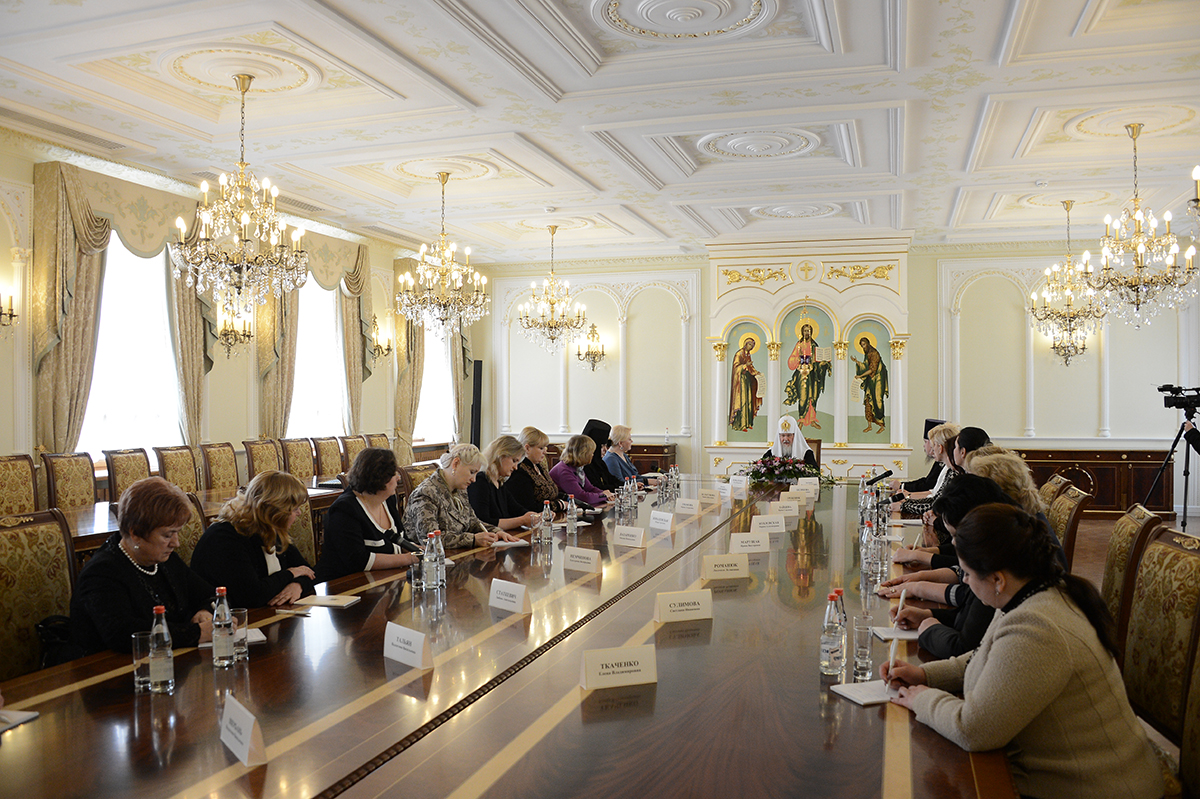
So here is what the current patriarch of the Russian Orthodox Church says about feminism (from a speech to the Ukrainian Union of Orthodox Women just this past Tuesday; original here):
... It is completely obvious that the woman is the keeper of the domestic hearth, the well-defined center of family life. Nobody would dispute this. The man directs his attention out beyond the home, working and making money; but the woman's attention is turned inward, toward home life and the children. And if this extremely important function of the woman is destroyed, then so is everything else: from the family of our birth to the land of our birth. No wonder we say Motherland--it's no coincidence, because the woman is the keeper of the home.

We know how it functions, this false propaganda of false values. It imposes a belief that to name a woman's role as mother is humiliating--that there are higher and more noble tasks for women, that women who carry out their inherent service (yes, I would call it service) are put into some kind of subordinate relationship to men.

...

I consider that the phenomenon we know as feminism to be very dangerous. This is because feminist organizations proclaim a pseudo-freedom that ideally should be realized outside the bounds of marriage and family. In the center of feminist ideology we don't find family or bringing up children, but a completely different role that frequently contradicts family values. It's probably no coincidence that most feminist leaders are unmarried women. I noticed this as far back as when I was working in Geneva at the World Council of Churches. At the time the theme of feminism was only starting to arise. While still a relatively young person, I was surprised that the leaders of the so-called feminist movement had no connections with family obligations, with very few exceptions. All the subtleties of mutual relationships--love, faithfulness, concern, responsibility--were reduced by feminist ideologues to social, political, financial levels, to the distribution of power and influence. This is, I believe, exactly where feminism goes astray.

...

Given all of this, I'd also like to say that I don't see anything bad about women making careers in politics, business, and many other areas presently dominated by men. But I must say that in many of these professional fields women achieve great success. This is evidence that, with the right allocation of responsibilities, with the right ordering of priorities, a woman can do both: carry out her service as wife and mother and make a contribution to society.
For many people I know, these sentiments would serve as an easy target for savage criticism and mocking. The news stories I've seen about this speech have emphasized the stereotypical gender roles and the description of feminism as "dangerous." And at about the time the patriarch gave this speech, two FEMEN activists had just greeted Russian president Vladimir Putin in Germany with their bare breasts and backs painted with rudely-worded political slogans, as if to confirm the "danger."

What can I say about Kirill's words that doesn't play into facile categorizations? Here are a few things for starters; maybe you have more.

What did he get right? The roles of wife and mother are precious and important beyond any possibility of dispute. A community, town, country, where these roles are cherished will be a better place to live. Anyone who does not value these roles should not be put into a position of power over those who do, because such a turnaround would surely lead to the ruin of the community.

But here's my point: I do not personally know a single feminist who proclaims the superiority of a "pseudo-freedom" that depends on being "outside the bounds of marriage and family." Not a one! I don't know who was working at the World Council of Churches in Kirill's youth, but is he in conversation with today's Christian feminists, those who are not ignorant of the "subtleties of human relationships"? Or does it serve his argument to ignore their existence in favor of just one narrow stream of feminism, namely those easiest to caricaturize?

Kirill accuses those ideologues of reducing human relationships to political and financial categories. But the male leaders of the church industry (and not just in Russia!) are not above swinging their political and financial clout--their "power and influence"--against people they disagree with. Listen to Kirill lay down the law in an earlier speech: "God willed that the apostles were men, that men fulfilled the apostolic ministry of the church; fortunately, in Orthodoxy, women are not attempting to promote a reconsideration of this provision of apostolic tradition. Men perform the hierarchical functions within the Church."

What is most disheartening about these speeches is their anti-evangelistic quality. This kind of talk must be very comforting to those who are already totally dedicated to the viewpoint that there is only one way to organize society, and that only men are qualified to define the boundaries around men's and women's roles. But for those who have an unquenchable, even God-given hunger for something more miraculous, something more trust-based rather than boundary-based, how can this rhetoric bring them to Jesus?

When will the time come for Quakers to raise a loving but unequivocal dissent?


By the way, by acknowledging the justice of Kirill's defense of marriage and motherhood, I don't grant women any monopoly on keeping "the domestic hearth." When Judy and I were young parents, each working part-time and staying home part-time, I cherished my daytime hours with my children. I resented being praised, by those who didn't know me, for "babysitting" my own children! (This was a quarter century ago.)


Two other articles I read this week have contributed to these reflections. Please read this one ("Linguistic Look at Russia's Human Rights Record") as soon as possible; I don't know when it will disappear behind a pay wall. I've often seen this phenomenon of Russians and Westerners talking right past each other because they have fundamentally different ways of analyzing and defining normal behavior. Russians themselves are divided along the linguistic lines described by Olesya Zakharova. For evidence, read descriptions of the debate going on right now in Russian legislative circles over the draft laws to protect believers' feelings.

Look at this item on homosexuals' rights in Russia, and again you can apply Zakharova's analysis.

The other article is by our friend and colleague Becky Ankeny, superintendent of Northwest Yearly Meeting, "God's Will for Women...." The powerful heart of her argument is this: "...the witness to equality makes space for women to be equally obedient to God as men can be." The issue now facing men: Are we going to be obedient to God in this matter, or are we going to prioritize our own "power and influence," dishonestly flattering the sacredness of motherhood while marginalizing the real mothers and wives who are among our most powerful feminists?


E.J. Dionne, Jr., "What we can learn from Margaret Thatcher and David Kuo."

"What's the point of teaching foreign languages?"

"Irrepressible Moscow." (Thanks to aldaily.com.)

In honor of tomorrow's Cosmonauts Day. (1981 television program, in Russian.)


A fascinating documentary about the blues in Russia. As Olga Ponomaryova says, "I did not choose the blues, the blues chose me. That's the way it is.... I compare it to when I go to church for confession. The situation is exactly the same: you can't lie."

Saint Petersburg Blues from Jazzgazz on Vimeo.