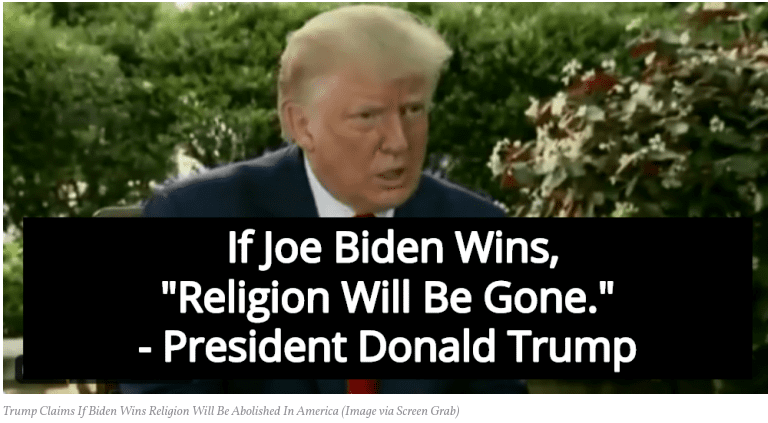
I have no idea whether my target audience for this post will ever actually see it. That audience: people who look at the "Christianity" typically portrayed by white USA evangelicalism, and reject it. Sometimes, this skeptical audience seems to account for half of the Twitter comments on almost any religion-and-politics thread.
If by any chance you are among those who look at the graphic above and say, "Religion will be gone? Great -- who needs it?", I'm trying to connect with you. I'd like to make just a few points.
You already know that Jesus is central to Christianity, and you might have some positive thoughts about him and his ethical imperatives, whatever your sense of his existence beyond his historical time and place. Hold on to that!
Christianity, stripped to its bare essentials, identifies a way of gathering and organizing the people who follow Jesus.
Whenever people try gathering and organizing themselves -- and each other -- they seem inevitably to screw it up much of the time. This is as true for any affinity group anywhere, except perhaps temporarily for some tiny group somewhere that I've never encountered. We are not immune -- sometimes this social dimension of Christianity fails miserably, but failure of this kind is not unique to us.
Over and over in the history of Christianity, corruption prompts reforms and rebellions -- people who insist on returning to first principles, to a purer intention of following Jesus. They reject coercive gathering, coercive organizing, coercive enmeshment with secular empires. They throw out compulsory ceremonies and formulas that don't contribute to a life of following Jesus. (This was the rebellion chosen by the founders of the Quaker movement I belong to -- but we're not the only example, by far!)
My challenge to you: look again at a Christianity stripped of authoritarianism, a Christianity that actually lets Jesus get a word in edgewise, and then consider whether the "Christianity" you've been presented is a credible representation of the followers of the Prince of Peace.
You may not find this argument convincing at all! For example, you might say, "What good is a God-figure who seems unable to convince his own movement to avoid power-and-control tangents that he himself warned about?" Fair enough, but consider that the social movement itself, and its flags and symbols, are not Jesus' main priorities. His main priorities might be loving you, and giving you an intuition of him that is not controlled by the religion industry, an intuition that might draw you into a trust relationship that no external authority could ever adequately promise or describe.
You have every right to be skeptical, even disgusted, by the pretensions of public religion that trades on the Christian brand to maintain its hold on power, leading you to decide, "Who needs it?" You might also not be persuaded that its Founder is exactly who he says he is, and who those of us who owe our lives to him say he is. But these are two separate decisions, and I ask, respectfully, that the first decision should not automatically lead to the second.
If you'd like to talk with people who already have some experience with these dilemmas and decisions, we'd love to meet you!
A well-known scientist (some say it was Bertrand Russell) once gave a public lecture on astronomy. He described how the earth orbits around the sun and how the sun, in turn, orbits around the center of a vast collection of stars called our galaxy. At the end of the lecture, a little old lady at the back of the room got up and said: “What you have told us is rubbish. The world is really a flat plate supported on the back of a giant tortoise.” The scientist gave a superior smile before replying, “What is the tortoise standing on.” “You’re very clever, young man, very clever,” said the old lady. “But it’s turtles all the way down!”
After beginning his Brief History of Time with this story, Stephen Hawking goes on to ask the reader, "...Why do we think we know better?" Or, let me ask, do we at least have some idea of what is at the foundation?
The Wikipedia article on the turtles story cites a number of versions of this fable and proposes that essentially it is "a jocular expression of the infinite regress problem in cosmology posed by the 'unmoved mover' paradox." I see the turtles used two different ways. First, the fable pokes gentle fun at naive attempts to oversimplify phenomena that are either complex or not understood at all. The second use is more or less the opposite: the "turtles" are some under-recognized thread or factor that unifies or helps explain complex realities.
For example, I think the first time I heard about the turtles was at Carleton University during my very first semester as a student. In one of my sociology classes, we talked about the size and scale of organized groups, and how they became exponentially more complex as they grew arithmetically -- and therefore social control also threatened to become exponentially more urgent, complex, and domineering. At one point the professor said that, instead of turtles, our reality is "politics all the way down."
The next time I ran into the turtles was in 1977, during a presentation on spirituality and sexuality by John Yungblut at the Friends Center in Philadelphia. Philadelphia Yearly Meeting Friends had been working on gay and lesbian concerns for several years at that point. Yungblut was not exactly opposing the increased acceptance of homosexual people, but he was pleading for an understanding of the male-female duality as something not to be minimized in both its biological and spiritual, even cosmic, manifestations. Arguing that this binary dynamic pervaded the structure of the universe, he said, "It's sex all the way down!"
What really does unify all creation? I think both politics and sex relate to the answer, at least metaphorically. Both are aspects of relationship; both are arenas in which power flows, is hoarded or shared. As we participate in all sorts of relationships, we are constantly challenged to consider, implement, and struggle for the points of our moral compass that can guide us at every level.
If John the Evangelist is right, those moral priorities are shaped by love.
Dear friends, let us love one another, for love comes from God. Everyone who loves has been born of God and knows God. Whoever does not love does not know God, because God is love. This is how God showed his love among us: He sent his one and only Son into the world that we might live through him. ... Whoever claims to love God yet hates a brother or sister is a liar. For whoever does not love their brother and sister, whom they have seen, cannot love God, whom they have not seen. And he has given us this command: Anyone who loves God must also love their brother and sister. (1 John 4:7-9, 20-21, New International Version.)
Politics involves how we allocate scarce resources; love ideally shapes why. (Quaker economist Kenneth Boulding comes to mind, in that he may be one of the few economists whose thought had an explicit place for love!) If God loved creation into existence in the first place (which I do believe), then that gentle, persistent, and ultimately victorious universal force of love, despite all our bumbling and fear and selfish resistance, must go all the way down, to the last turtle and beyond.
One of my exercises in moral prioritizing is to read even the flattest or most skeptical analyses of politics and other relationships through the eyes of love. The Lord knows, we have plenty of opportunities to practice this discipline, choosing (in Kenneth Boulding's terms) whether we will act in specific situations through threat, exchange, or love.
"Obama’s embrace of white innocence was demonstrably necessary as a matter of political survival." Ta-Nehisi Coates, My president was black. Update: the Political Gabfest panel just interviewed Coates about this article on their most recent podcast, which should shortly be available here.
OK, I'm determined to keep these "shorts" on the topic of truth to no more than three or four paragraphs. That way I can go back to bed as soon as possible and continue feeling sorry for myself. (Bad cold.)
The government uses euphemisms? How can that be?!
Yes, I know it feels like a never-ending slog, but we owe it to our children, our Christian testimony, and our civilization, to keep challenging these violations. Instead of succumbing to cynicism, let's fill whatever space is available to us, to challenge doublespeak and the sins that it covers.
Lots of news Web sites have been covering the story of the Russian warplanes that "simulated attack passes" near (very near) the American destroyer USS Donald Cook earlier this week. The videos properly impressed me with the apparent aggressiveness of the air maneuvers.
After I watched a few of the videos, I wondered whether there were similar incidents in or near U.S. waters. (The Cook was not far from the Russian port of Kaliningrad.) Given that the Russian military presence outside Russia is microscopic compared to the worldwide scope of U.S. installations, I was wondering if a double standard was operating: it's only wrong when "they" do it. After Googling the topic of Russian vessels near U.S. naval installations and similar phrases, I was amazed at, no matter how I worded the question, Google wanted to tell me about Russians being aggressive to Americans (and allies) rather than the reverse. I was a bit mollified to see moderate language coming out of Pentagon mouths: "'So long as they are operating in international waters -- as, frankly, we do around the world -- and are behaving in a responsible way, they are certainly free to do so and it doesn't cause any alarm within this building,' press secretary Geoff Morrell said at a Pentagon news conference." (Source. My italics.)
Here's a little side-item concerning truth. Compare these two treatments of the same story -- a Russian "research" vessel gathering information near a U.S. submarine base and transit routes. Version one with an actual picture of the vessel. Version two sounds a lot scarier: "Navy Spotted Russian WAR SHIP Near Georgia NUCLEAR SUBMARINE BASE!" In prominent place under the headline you will see, not a photo of the ship in question, but a Russian destroyer bristling with guns. In case you're wondering what the true meaning of Russia's maneuvers are, the article comes complete with a helpful hint: "Could this be a sign that Russia sense Obama's weakness, especially after the pathetic approval of the dangerous Iran nuclear arms deal?"
In the meantime, in Russia itself, things seem to be going from bad to worse for the beleaguered Jehovah's Witnesses. (I've covered this story before; in this post, I quote Vitalii Adamenko's opinion that conscientious objection is a major reason the authorities don't like this church.)
Anton Chivchalov, in his article in Religion and Law, "Russian law enforcement plants evidence on Jehovah's Witnesses," speaks eloquently about the social degradation that results when police are forced to plant evidence:
The more widely it is practiced, the less room remains for honest people. When you are required to plant evidence on innocent people or to convict them, you are forced either to lay your badge on the table or fulfill a dirty and immoral order, inevitably compromising your own conscience.
Every once in a while, the subject of official corruption comes up in our classes -- never at our initiative! (As I've said before, I'm from Chicago; I have no illusions that Russia invented political corruption!!) A few weeks ago, we took an informal poll of our students: "Raise your hand if you think that bureaucrats are something like 75% honest, 25% on the take. Or 50% - 50%. Or 25% honest and 75% dishonest." Not one student agreed with me that most bureaucrats in Russia are honest, though this has been my own observation. (The pat explanation: "You're a foreigner, they treat you differently.") Here's my question: If you are a government worker and you're trying to do a good job, how does it feel to have most people assume you're compromised? Even when cynicism sometimes seems justified by reality, it is still spiritual poison!!
Another truth issue: being honest about the cost of leadership. I was very impressed by something in Alan Amavisca's most recent newsletter from his North County Project. Here's his article, not subject to my four-paragraph limit because I didn't write it!
The Cost of Leadership
"As for you, always be sober-minded, endure suffering, do the work of an evangelist, fulfill your ministry." - 2 Timothy 4:5
A friend of mine has ministered in a semi-closed country, even planted a church there. He recently told me the church he helped plant has been closed down by the authorities.
The church became a victim of its own success-too many people responded to the gospel. The congregation jettisoned their invisibility and consequently became a target of the police.
"What will they do now," I asked. He responded by showing me a photo he had received. The church's small group leaders were being prayed over and commissioned as 'pastors' of their new little churches.' This was their response. The decision to shut down one church resulted in the birth of twenty new ones!
Opposition and persecution are trademarks of church life in my friend's country. When their churches have camps or retreats they often include a special service with an invitation to ministry.
As a part of the invitation campers are reminded that pastoral ministry means being "the last to leave when a church is raided"-in order to insure the brethren escape. It also means assuming you will be jailed - or worse.
He told me brothers and sisters always come forward at these services despite the warnings regarding the high price of the pastoral calling. Pastoring, as Christians in this country understand it, means doing time in prison.
What price am I willing to pay for the privilege of serving God?
In building a trustworthy Quaker church, there is no more precious role or service than sensitive eldership. In our era of hyper-individualism, is this still possible? And what do we do to help elders when their role drifts into a sort of executive committee of the church? These are some of the thoughts that came to me in reading Craig Barnett's blog post "Spiritual Eldership." (Thanks to quakerquaker.org.) Be sure to read and consider answering the questions at the end of his post.
Sarah Ruden on Mary Wollstonecraft and Mary Shelley: Women and the Ironies of Providence. The full article may be behind a paywall, but this site is one of only TWO that I pay to access. Worth it!
Posted on a lamppost near our local McDonalds restaurant:
ad for "a team of experienced teachers" who are ready to write
theses, term papers and homework assignments to order.
"Rush orders! All subjects!"
"Cheating" is not always a bad thing. When students resort to "cheating," they are looking for ways to solve a given problem, which in turn gives them an invaluable problem-solving experience that can be useful in the future in any sphere of life. It depends on the degree of "cheating." If a student copies brazenly without thinking, this should be stopped. "Light" deception may benefit the student. Moreover, it is impossible to keep all the details in one's head. To some extent, teachers also have their own shortcuts: they have immediate access to the textbooks, a dictionary, other books, and other teachers. If they're blanking out on something, they can always use one or another kind of prompt.
These words were written by one of the Russian respondents to my survey on homework, tests, and cheating. The survey question invited respondents to comment on this statement: "Some skills that are considered 'cheating' in an academic environment, such as sharing answers, are useful skills in research and business."
As I've researched the subject of academic cheating and looked at the responses to my survey, I've noticed several themes emerging: in order to reduce cheating, we should
avoid evaluations based on just a few high-stakes devices such as final exams;
distinguish between "raising achievement" and "promoting learning"--and favor the latter (thanks, Alfie Kohn);
teach with enthusiasm.
(from Soviet humor magazine Krokodil) "Judging by your son's
copybooks, you need to catch up on your math and physics,
but most importantly, you need to straighten up your conduct:
don't do your son's homework!"
Some comments in the literature I've read, and in the comments from teachers, are more systemic. These comments come in two broad and related groups.
First, does the educational system itself cheat? This includes and goes beyond the comment I quoted, about teachers having an advantage over students since they already have the expected answers and don't have to cope with the stress of remembering information and composing responses. What about the school that depends on good ratings for its funding? What are the forces that promote bare-minimum instruction, large classes, and mechanized procedures? In general, what interests are served by overemphasizing testing and homework transactions?
The second area relates to the Russian teacher's comment in the quote at the top: "When students resort to 'cheating,' they are looking for ways to solve a given problem, which in turn gives them an invaluable problem-solving experience that can be useful in the future in any sphere of life." I very much appreciated the honesty behind this expression of raw pragmatism, and it points to the social dimension of all our cheating. In his Chronicle of Higher Education series on cheating (starting here), James M. Lang refers to Dan Ariely's book The (Honest) Truth About Dishonesty: How We Lie to Everyone--Especially Ourselves. Our search for acceptable balance between self-respect (or in group terms, sufficient adherence to stated ideals) and pragmatic self-advancement runs through all our lives, not just our educational choices. What roles do schools have in helping us set our own boundaries and balance, even before we are presented with our first temptations to cheat?
Just today I was reading about the gas trade between Russia and Poland. Some are arguing that Poland is inflating its orders for natural gas from Russia, in order to cause shortfalls in Russia's fulfillment of those orders. If Russia can't keep up with those orders, presumably Poland gains an advantage in future contract negotiations. "You're not a reliable supplier; give us a lower rate."
"... Friends have denied that Jesus’ baptism by John set a precedent that all Christians should submit to water baptism." Here is a link to Howard Macy's very helpful article on Friends and baptism.
Given my elemental fascination with Nazism, it's not surprising that I'm reading In the Garden of Beasts: Love, Terror, and an American Family in Hitler's Berlin--I'm always trying to understand how a "modern" and "civilized" society, including some of my own relatives, surrendered so completely to a regime of utter cruelty and criminality. Maybe an account of this family of American observers, I figured, will give me some new insights.
And maybe it still will--I've barely started reading the book. At the point I stopped reading this evening, the Dodds, the ambassadorial "American family" who represented the USA in the early years of Hitler's regime and who are the subject of this book, have not yet even left the USA to take up the post. Right now I'm pondering, not Hitler, but Franklin E. Roosevelt. The new American president faces what is represented as a political dilemma: what to do about the documented, systematic cruelty faced by Jewish people under Hitler's new government. To protest or not to protest? Business as usual, or boycott? Open the gates to refugees, or continue underfilling even the existing quotas?
...Roosevelt understood that the political costs of any public condemnation of Nazi prosecution or any obvious effort to ease the entry of Jews into America were likely to be immense, because American political discourse had framed the Jewish problem as an immigration problem. Germany's persecution of Jews raised the specter of a vast influx of Jewish refugees at a time when America was reeling from the Depression. The isolationists added another dimension to the debate by insisting, as did Hitler's government, that Nazi oppression of Germany's Jews was a domestic German affair and thus none of America's business.
With hindsight comes our realization that the conventional "framing" of that era effectively abandoned millions of people to industrial-scale genocide just a few years later. But even discounting hindsight, simply judging by the standards of that time, a reign of brutality had descended upon Germany, and the evidence was abundantly clear that Jewish people were a specific, special target of that brutality.
Yes, the Depression was a true crisis. In that crisis, Roosevelt threw convention and caution to the wind and became a master of economic and legal improvisation, throwing one idea after another into the supreme effort to head off a financial meltdown. He "reframed" the crisis in practically spiritual terms: "We have nothing to fear but fear itself...." Why then did fear stop him from helping Jews? It's a haunting question.
Some who advocated or denounced various possible American responses to German anti-Semitic brutality were concerned about how those responses would be interpreted by various audiences. I wish it were possible to say to every politician, "Earn a reputation for honesty, and you won't have to worry about 'message'." My fantasy president of 1933 would say to Germans and Americans alike, "O ye that love mankind! Ye that dare oppose, not only the tyranny, but the tyrant, stand forth! ... O! receive the fugitive, and prepare in time an asylum for mankind." (Thomas Paine, Common Sense, 1776.)
I've always been pretty skeptical that it is possible to project a desired "message," or avoid an undesired one, through symbolic behavior. For example, among those debating American responses to German brutality, there was a worry that a concern for the oppressed would send such an irritating message to the oppressors that things would get even worse for the oppressed--but history has few if any examples of tyrants' hearts melting because nobody protested. When the USA invaded Iraq, we critics of this thoroughly despicable adventure were told that our protests "sent the wrong message" to the world, namely that we were not united. Damn right we weren't! What would have been a "right" message, if the "wrong" one was the truth? When the president of Iran sent George Bush a letter, our message experts seemed to analyze every aspect of the incident other than the plain text of the letter.
Coincidentally, while I was thinking about the debates over helping Jewish Germans, I came across this discussion in Christianity Today, about whether or not the U.S. ambassador to China should visit an unregistered church there. Would it send a powerful "message" about U.S. support for religious freedom or would such a visit be unhelpfully interpreted as demonstrating unregistered churches' ties to foreigners? Nobody said anything about the relevance of the ambassador's own spiritual needs. If there is integrity to the ambassador's visit--a genuine communion with other believers and with God--that is the only framing that counts. Any other messaging is bogus, and its interpretation by Chinese Christians or the Chinese government is beyond anyone's ability to control.
Speaking of Iran: Beyond Denial"-- The 1997 Iranian TV series Zero Degree Turn, featuring an Iranian/Jewish romance against the backdrop of the (not denied) Holocaust "... offers a unique invitation to call attention to the relationship between popular media and affective engagement, and to cultivate new knowledge where political grandstanding too often trumps substantive engagement."
These words came to me several times in the past few days: Remember what you know.
They came to me first as I was listening to a story about a church which was experiencing conflict between some church members and the pastor. Members were being drawn into pro-pastor and anti-pastor factions; I imagined some were feeling the temptation to resort to worldly tactics for the upcoming monthly meeting.
Although there were allegations about the pastor that needed to be taken seriously, I wasn't happy with the possibility of a struggle for or against an individual, a struggle that ignored the systemic "Lamb's war" dimension of the problem. I wanted to say to everyone, Don't get knocked off center; remember what you already know:
Among Friends, leadership involves mutual accountability; we don't accept theologies of authoritarian leadership, even when it is dressed up in contemporary shepherding language. Jesus is the center of a Friends meeting, not an ideology or philosophy (however good or bad). With Jesus at the center, there cannot be a human dictator or "decider" claiming presumptuous power. Friends leadership can be based only on spiritual gifts, never social status or politics or personality.
We avoid pointing at villains. Humans are made in the image of God, even when they have been taken prisoner by the principalities and powers.
Friends sometimes forget that every leader sometimes need to give strong advice, occasionally approaching commands, but only to people who are empowered. To give commands from on high to oppressed or subservient or frightened people can lead to awful mischief. The first task of a pastor dealing with frightened people or people in crisis is to build them up, rebuild their identity as people infinitely loved by God, not to tinker with their relationships.
Then those words came back to me as I was thinking about the marketing challenge faced by a particular college. Some people at this college are wondering how to angle their recruitment messages tactically to be more intriguing to larger numbers of people. They want catchier techniques.
Again, first they have to remember what they know about themselves--the goal shouldn't be to suck in inquiries from undifferentiated masses; their messages must reach more of those specific people who would actually blossom at their school.
Barack Obama speaks at
Ebenezer Baptist Church, Atlanta
Finally, I listened to yet more political coverage on the radio as I was coming home this evening from downtown Portland. I fantasized about what a candidate needs to do not to disillusion me after I'm just starting to dare to believe in a reawakening of idealism.
They need to remember what they know.
If the manipulations of opponents and the blandishments of contributors and pollsters make a candidate doubt that yesterday's message will be effective today, the reality check should not be "what do my tacticians say will give me an incremental advantage?" It should be, "Was yesterday's message faithful to my core convictions, to my heart? Or by spinning in a different direction today, will I take the wind out of my strongest supporters' sails for the sake of a clever soundbite?"
I was impressed by an observation David Brooks made in the New York Times in his December 18 column: "Obama is an inner-directed man in a profession filled with insecure outer-directed ones. He was forged by the process of discovering his own identity from the scattered facts of his childhood, a process that is described in finely observed detail in Dreams From My Father. Once he completed that process, he has been astonishingly constant."
Now Obama will be tested as never before. He has not put specific policy slogans or grievances at the center of his campaign, but the vision of a more united country -- united not by calls to fear, but by a renewed commitment to close the "empathy deficit" and regain the ability "to recognize ourselves in one another."
Listen to his speeches and sermons: The themes of hope and unity are hardly empty piety; they're part of a far richer rhetoric than the few seconds of sampling they're given in the media. Obama has taken the risk of setting his value standards very high. Judy and I once heard a prominent Christian child psychologist say that only sociopaths can get to the top of our political ladder in these hardball times. He had hoped that Bush II would prove him wrong, but I think we need a more convincing demonstration, and I hope that Barack Obama can provide it.
On the one hand ... On the other hand ...
from Russia Today, a story
on the Institute for Democracy
and Cooperation
There are multiple layers of reality in this Russia Today story on the new Institute for Democracy and Cooperation in New York City.
The institute is Russia's attempt to set up a human rights non-governmental organization, based in the very country from which stories critical of the human rights situation in Russia often originate.
And why shouldn't they, at last, set up such an idea shop here? When our own current White House occupants consider themselves qualified to lecture Russians on the proper conduct of elections, and for years we've financed civil-society NGOs in Russia, isn't it time for a little payback?
What got me going was a comment by Natalia Narochnitskaya at the press conference announcing the institute's foundation. "On the one hand, it will help us get a lot of useful information from the West so we can analyze the problems Russia faces," says Narochnitskaya. "The Western experience in the field of human rights deserves respect. On the other hand, we can also point out, it's not perfect."
This is truly Russia today: on the one hand, on the other hand. On the one hand, many Russians admire the West; on the other hand, they enjoy growing national self-confidence, along with some irritation and resentment at the double standards, harsh assessments, and outright condescension of Western observers.
On the one hand, some of my Russian friends are sick and tired of comparing their own shabby infrastructure with the glass-and-steel perfection they see in Western media. On the other hand, many suspect the West of spiritual shabbiness compared with the depths of the Russian soul.
On the one hand, they're suspicious of the new chill, the new peremptory tendencies emanating from Russia's local government offices. On the other hand, I've personally heard, more than once, Russians bring out the old adage, "We Russians need someone strong at the top."
On the one hand, when they have such a leader, they're ready to support him. On the other, they repeat that other old adage, "We Russians always figure out how to get what we want."
This is not a situation of static balance, either. On the one hand, I'm ready to believe that Vladimir Putin is fully familiar with the basic principles of democracy -- and to some important extent actually agrees with those principles. On the other hand, he believes it would be utterly foolish for him to relax his grip on any of the relatively few levers of power he controls, given the constant threat of total chaos on any number of fronts in his country, and perhaps even within his government. It's my intuition that this unresolved and dynamic tension is a reality in many Russian souls, perhaps even in Putin's. The political, social, and spiritual reality of Russia today: everything is in play.
Righteous Links:
Useful observations and distinctions from Sarah Imhoff on the continuing phenomenon of American antisemitism. ~/~ In the midst of the recent Quaker discussions on social class, perhaps we more than some other Christians need to grapple with the special role of the military in our society. Here's William Astore to help: "In the Military We Trust."
The hypnotic music of the late John Lee Hooker... "You know, I'm doomed with the blues." Second (on the other hand ...), the longer version, from which the first clip was taken:
Will T. returned from Friends United Meeting's recent General Board meeting in Kenya with a troubling load of impressions that he faithfully posted on his weblog under the title, "Back from Africa with a broken heart."
I was not at the General Board meeting, but so much of what he wrote felt so similar to the struggles a generation ago between some Friends in the "FUM-only" yearly meetings and some Friends in the "united" or "confederated" yearly meetings that also belonged to the more liberal Friends General Conference. My first thought was, "Oh, no, not again," and I had to remind myself that these systemic issues are hardly ever cleared up once and for all.
Among its many other wonderful qualities and shadowy sins, FUM is still paying for the decades it spent trying to pretend that it was truly "united," served by a staff and a leadership caste that, by and large, was highly invested in presenting the best face to each end of the spectrum, trying to be good friends (and actually succeeding miraculously often) with people who were often not friends with each other. Among the survival tactics: publishing a magazine that was as inoffensive as possible, therefore hardly ever carrying any substantial news, and publishing two lines of Quaker curriculum, Living Light and Living Word, for a market that was so small that it could barely sustain one.
The theological civil war known as "realignment" (which I briefly summarized in my comments here) was precipitated by a number of crises, including the embarrassing spectacle of a Triennial (1987) that almost could not unite in adopting a Christian self-description, and the controversial adoption of a sexual ethics policy. I became general secretary just as some of the passions of realignment were cooling off. The first board meeting of my seven years at FUM adopted a purpose statement that, for once, defined FUM not as an organization in charge of keeping everyone "United" at any cost, but as an association of Friends whose functional unity was grounded in a programmatic purpose. Friends could opt in or opt out of involvement with FUM, not on the basis of whether there were other Friends somewhere in the FUM community whose beliefs or folkways would trigger their allergies, but on the basis of a shared commitment to evangelism -- energizing and equipping Friends "through the power of the Holy Spirit to gather people into fellowships where Jesus Christ is known, loved, and obeyed as Teacher and Lord." In any case, FUM's success would be based on what it did, and whom it attracted in that service, not on being inoffensively winsome to everyone in order to preserve its core organizational conceit. Furthermore, those who did not share its purpose would presumably not have the leverage to sabotage that purpose.
It's not that balancing acts of linguistic symbolism were entirely given up: "Teacher" is a valid and powerful metaphor for the work of Christ, but it's a metaphor that is more associated with the liberal side of the community, whereas "Lord" is decidedly not. Nevertheless, the adoption of this simple purpose statement was a liberation for the staff and board of FUM. In a time of shrinking tolerance with traditional denominational bureaucracies, FUM no longer had to have a department to carry out every conceivable denominational function, anxious to balance each "orthodox" function (for example, missions) with a "liberal" function (peace and social concerns). Instead, we simply needed to ask ourselves how any given assignment related to the energizing and equipping of Friends for evangelism.
The other huge advantage of this purpose statement was its outward orientation. I love William Temple's assertion that the church is the only association that exists primarily for the sake of its non-members, but FUM's balancing acts and intermural struggles were taking energy away from that priority. It was wonderful to have permission again to remember that, while we jockey among ourselves, "the world as I see it is dying, literally dying, for lack of Quakerism in action." (Hugh Doncaster.)
So that's a bit of what was behind my "not again!" sinking feeling as I read the report from the FUM Board. I wrote several lengthy contributions to the comment section of Will's post, and seriously considered crossposting those comments here. I think the things I said there were important to get on the table, and I very much appreciated the loving give and take provided by Will, Marshall, and others.
But as I got ready to do that crossposting, a heaviness came over me. Being a Friend is not a matter of finding just the right combination of subtle ideas, Bible verses, and snippets of Robert Barclay, tastefully presented with the right blend of content and process. Being a Friend doesn't depend on mastery of a rhetoric, or on finding the verbal Holy Grail (borrowing here from Larry Ingle, I think) of Quakerism's unique intellectual and spiritual genius. Somehow, being a Friend is still a light and agile thing, a joyful and first-generation thing, a sprite in a community of sprites among the lumbering elephants of religiosity. (Okay, so I get a little carried away!) It's wanting and hungering to be as close to Jesus as possible; it's trying to be around others with that same yearning; it's trying to help each other live that way; it's trying to work out, in community, what the ethical consequences are; and it's working on keeping the doors of access open, so that there will always be people who are in the first generation. Not that those who have gone before are unimportant; but they're companions, not ancient Chatty Cathys with soundbites playing on endless loops.
Righteous links: Speaking of evangelism, try to top this: Shock and Agape. And from the realm of cinematic evangelism, here's "A Tale of Two Movies" [dead link]. I don't know whether I'll see either film (Facing the Giants and Stranger than Fiction), but I enjoyed reading Tim Jackson's review. [Here's another review of the two movies.]
In 2002, I met and listened to an incredible Australian guitar player named Fiona Boyes, whom Pinetop Perkins (present at the same Waterfront Blues Festival) acclaimed as a worthy successor to Memphis Minnie. To my delight, a Fiona Boyes clip landed in YouTube land, and without further ado -- see for yourself if Pinetop is right:
I originally wrote on this topic back in March, after I received a copy of the proposed guidelines for donors and implementers that Eden Grace forwarded from a consultation in Uganda. That document, which I reproduced in its entirety in that March post, openly acknowledged the history of corruption that made the document useful and important. In its own way, the document acknowledged the culpability shared by donors and implementers alike.
In recent months, Friends in Northwest Yearly Meeting have been hearing a lot about the Kaimosi Friends University. On the request of one or more members of Tigard Friends Church, that church became willing to serve as a collection point for contributions for this university project. Later, a proposal came to the Board of Peace and Social Concerns of the Yearly Meeting to make this project one of the two concerns that would benefit from our yearly meeting's annual Thanksgiving offering. At the same time, wide publicity was given to a campaign to collect books for the university's library. For some time, I was receiving weekly pleas for contributions on Sundays at meeting, and was receiving parallel requests in my e-mail.
I'm using the passive voice more than normal in telling this story, both because I don't always know what person actually made a proposal (for example, the proposal to adopt this project as one of the Thanksgiving offering recipients), and because I'm more interested in discussing the principles involved than pointing fingers. I could point a finger at myself because at the crucial meeting of the Peace Board where the decision was made concerning the Thanksgiving offering, I was not present. I had made my concerns known to others in the Yearly Meeting; interestingly, the Missions Board of the YM had decided not to participate in supporting this project.
My concerns about the project are many:
When I was active in Friends United Meeting administration, the University was presented as a vision of uniting the existing educational institutions in Kaimosi. At the time, not one of those individual instititutions was interested in participating in the formation of a university. I'm told that this is still true. The first classrooms will be located in a building owned by Friends Kaimosi Hospital, but that hospital itself is under Friends United Meeting management, and Friends United Meeting is explicitly not participating in the university project.
I've heard no vision for how the university would help build up either the nation or the church. All I hear is how there are not enough university entrance slots for those who are qualified to enter university. What are the specialties that would be best to offer for the job market? If the job market is not to determine the offerings of the university, what criteria would be used? In fact, what definition of the word "university" is being used? What percentage of those underserved students would be willing to travel to Kaimosi?
The kaimosifriends.org Web site says that there is a severe shortage of university entrance places, but in another place, the same site says that "New students must be Christians by faith, since the university is a Christian School. Other public and private universities are available to secular students." Are Christian students at a disadvantage in the larger educational market? Should secular students or those from other religions be excluded from the Christian influence of a Friends university? I can argue these things either way, but when was this conversation held? How is the word "Christian" being used here--referencing a spiritual community or a sociopolitical "tribe" that wants benefits for those who belong?
I've been told that Kenyan Friends are united in support of this project. What exactly are they united about? If they are asked whether Friends should have a major institution of higher learning above the level of the current institutions in Kenya, just like the other self-respecting denominations in Kenya, they might well say yes. But have they been told the cost? Is it a high priority? Is Kaimosi the right location?
Given the history of financial corruption associated with some Friends institutions in Kaimosi in the past, what are the mechanisms in place to safeguard and monitor donations? What has happened to money already collected? Is it true that some of the money donated to the university by Kenyan donors has gone into the general accounts of the Friends Church in Kenya and is no longer distinguishable or even traceable?
According to the Web site, "The University will begin as a third campus of Daystar University of Nairobi. The Kenyan government requires an established university to shepherd the initial years of a new school to guarantee a strong beginning. All academic programs will exist under the already established structure of Daystar University. The first classes to be offered will be in education, religion and business." What is the financial arrangement with Daystar University? Do some or all of our contributions go to Daystar?
The American Friends involved with supporting this project have decided to go ahead in spite of urgent and repeated private questions. Maybe a more public conversation would bring greater clarity. This project may end up being a wonderful breakthrough effort for Friends in Kenya, but for that to be true, we must have a far greater degree of transparency and accountability than I've seen to date.
Righteous (?) links:
Corruption among Friends, of course, has not just been a problem in Kenya. One case that made my life as FUM gensec miserable for most of a year involved the National Friends Insurance Trust, and was the subject of this article and this editorial in Quaker Life. Another case of corruption affected many of the same Friends organizations that were negligent and hurt by the Insurance Trust scandal. I am not saying that the Kaimosi University project is in this league, but I am adamant that we need to bend over backwards to provide world-class accountability for the ways we label and fund our efforts. When fundraisers don't bend over backwards to anticipate and answer donor questions, they're asking donors to bend over forwards. In Kaimosi, that's happened too often already.
"The righteousness which exalts a nation": Last week, an anniversary went quietly by: the 33rd anniversary of the Chicago Declaration of Evangelical Social Concern, Nov 25, 1973. Concern for creation did not have the same attention then that it does now, but for the most part, that document was an important milestone in raising a powerful vision of integrity before the American evangelical movement.
A simple and clear document like this has been needed for a long time. I hope it gets wide circulation.
On Giving and Receiving
Approved, Quaker Peace Network—East Africa March 19, 2006, Tororo, Uganda
I know that I am corrupt, but who is corrupting me? Sese Seko Mobutu, former President of Zaire (Democratic Republic of the Congo)
The issue of wealthier Quakers from the northern countries giving funds to Quakers in the Kenya, Uganda, Tanzania, Rwanda, Burundi, and the Democratic Republic of the Congo (DRC) is fraught with difficulties. Too often these funds have been unaccounted for, misused, and/or stolen. Traditionally the blame has been put on the African implementers, but the northern donors who have so quickly written off these losses as “that’s the way Africa is” are also part of the problem. There are more than enough Quaker organizations led by honest African Quakers that receive, spend, and account for their funds with scrupulous honesty that there is no need to “excuse” those who are unaccountable and dishonest. Each time funds are misused in Africa, it is the honest Quaker implementers who are hurt the most since the errors of the few tarnish the image of all. Money can lead to conflict so the proper use and accountability of funds is a peace-making activity.
There are various levels of corruption:
Outright theft of funds for personal use.
Misuse of funds for purposes other than those indicated in the proposal, including unauthorized “borrowing” of funds from another program.
Waste of funds without using them as prudentially as possible because they are given by wealthy people from overseas.
Lack of accountability for funds received which usually is used to hide one of the above misuses.
To rectify this situation guidelines for responsibilities of both donors and implementers are needed.
For Donors:
Funds are given only to a recognized organization with a valid bank account. Funds are never sent to an individual’s bank account or given to implementers to carry back from overseas because this forecloses transparency. Even in the case of a scholarship, funds should be sent directly to the institution or routed through a dependable organization.
In order to qualify for funding, the donor must receive a proposal from a recognized organization which has passed the proposal at a Board meeting of the responsible people. This proposal should include a detailed budget. Donors should have a clear format for the proposal. A neutral person, knowledgeable about the country and type of proposal, should review it with an onsite visit. Over-budgeting, currency transactions, over-pricing, hiking of salary beyond those normally accepted, and vague or unclear line items should be thoroughly questioned. The proposal including purpose, timeline, budget, and delivery of funds is public information.
After funds are sent, monthly or quarterly program and financial reports should be regularly received. In these days this can easily be done by email anywhere in the region. No further funding should be sent until such reports have been received and accepted as proper.
At the end of the proposal period, a final report and financial accounting must be submitted. There should then be another on-site visit by a neutral observer who should verify the accounting by looking at the bookkeeping and receipts to back it up. This protects not only the donor but also protects the implementer from any charges of mis-management of the funds.
This implies that small donations are difficult to monitor and verify. Consequently it is advisable that those who are unable to make the appropriate site visits by neutral observers channel their funds through organizations that have this capability, allocating a proper amount for this administrative task.
When theft, misuse, wastage, or unacceptable accounting is encountered, the donor must pursue these problems with the same diligence they would use for a similar case in their home country. Corruption cannot be excused under any rationale. If a donor is not willing and prepared to follow-up such mis-conduct, it should not accept proposals and disperse funds.
When theft, misuse, wastage, or unacceptable accounting is uncovered, the donor organization will discretely tell the other donor organizations of such problems so that implementing organizations are not able to move from one donor to another with impunity.
For implementers:
Funds are requested only by an established organization for one of its priorities and have been approved by the appropriate Board of Directors. The organization must have mechanisms for handling and reporting funds including checks and balances with a trained treasurer.
The proposal will be transparent and shown to all who are concerned with it for their input and approval. No paid professional fundraisers should be used.
Those who are dispensing the funds must be as careful with these funds as they would be with their own. They must receive receipts for all transaction (and have their own signed receipts when this is not possible) and keep an accurate accounting of all these funds.
If it is necessary to substantially change the budget of a proposal (meaning more than 5% or as specified in the proposal), prior approval of any such changes must be received from the donating organization.
Written reports and financial reports will be sent on a regular basis as indicated in the proposal.
The implementers of these funds will be welcoming and open for all on-site visits by anyone sent by the donating organization. All written and financial accounting will be open for inspection.
If anyone in the implementing organization is financially irresponsible, the implementing organization will notify the donor and take whatever appropriate action is necessary with the offending individual.
If these guidelines of responsibility for both donors and implementers are faithfully adhered to, many of the problems which have been encountered in the past will be rectified. In the long term, this will build a much healthy relationship between donors in the North and implementers in Africa. The result should be not only a much more prudent use of the funds available, but a larger flow of funding.
Many thanks to Eden Grace for passing along these guidelines, which emerged from a meeting she participated in last week. She says that the first draft of these guidelines came from David Zarembka.
My own commentary (do not blame the writers of the document above) ...
I remember a meeting of Quaker partner organizations that one of my Friends United Meeting colleagues held at a retreat center in Africa, where a similar set of guidelines for FUM work was being discussed. As my colleague reported, the main resistance to the guidelines came from Western representatives, who felt that such rules were colonialist. One of the African participants pointed out that avoidance of such rules was a plague in Africa, from the central governments on down. Honesty and transparency in financial relationships were not colonialist impositions, but actually the only hope for progress. (I might add that they were also the only hope for recovering the middle-class intelligentsia among African Quakers, many of whom seem to have distanced themselves from Friends in disgust at the corruption and government enmeshment that had become far too common.)
My own additions to the guidelines, from a North American's point of view:
Don't play the tired old game of simplistically choosing "good Africans" who can do no wrong, and "bad Africans" who can do nothing right, among ministry partners and constituency members. How do you know? Do you treat your personal circle of friends and colleagues this way at home? Africans have just as many complicated mixtures of ideals and compromises as anyone else! And that "good African" for whom you will collect money without proper safeguards, will become just as corrupt as you would become under the same circumstances. Genuine friendship can never be purchased, nor can you atone for colonialist atrocities of the past by lazy sentimentality today.
Part of a more mature and egalitarian vision of donor/implementer relationship includes being willing to examine very carefully when money or materials are the right form of resource transfer. Money and equipment can change power relationships and create new inequalities, not to mention increasing the "metabolism rate" of a local economy to an unsustainable level. On the other hand, don't go too quickly to the sometimes insulting notion that your technical expertise is what's needed, since many local cultures already have far more indigenous wisdom and expertise than political space or financial resources to use it. There's no simple formula for any of these dilemmas; what I'm calling for is taking the time to build relationships and trust and spiritual integrity before letting those relationships become monetarized and bureaucratized with the language of "projects" and "proposals."
Rule 5 for donors in the document above includes a huge principle that many individual donors apparently do not understand. We donors need to get it through our thick skulls that strong, ethical administration costs money and is worth it. To treat an organization as your private, cost-free bank, to transmit your precious, special money 100% to its destination as if by magic, is either ignorant or insulting. What makes your money so much more special than that of the others who must cover the costs of doing ethical business? Do you think that, without dedicated administrators, accountants, bankers, translators, etc., there would be a hope in hell of your money being useful? (I feel as if I've waited far too long to get that off my chest!)
The organizational corollary: Don't appear to donors and potential donors to be a black box! Issue annual reports, make your financial reports easily available to the partner organizations as well as donors, report governance issues honestly and provide easy access to minutes of meetings. Model the practices you expect to see from your implementing partners. When I was at FUM, I felt that historically, we had not done much better than the groups who received our funds. My colleagues and I did our best to change that.