I was so tired when I got home this evening that I decided to lie down and get a couple of hours of sleep before sitting down to this homemade computer and pounding out something profound for you. Before pounding, however, I happened to notice a new item in my e-mail. I didn't even have to open the e-mail: the subject line and one-line preview were enough. It was from our yearly meeting superintendent Becky Ankeny. Subject: Stan Thornburg. Preview: "Friends, Stan passed away at 3:30 today. I know his family appreciates your p..."
If you knew Stan, the memories are surely flooding back at this very moment. Tears, too, mixed with laughter as we remember one of the funniest and most profound public Friends of our time.
My first memories of Stan are from a Quaker retreat in the mid-1980's, a retreat on the "future of the prophetic ministry." We met at a strange motel in St. Charles, Missouri, the Noah's Ark. Part of the place really looked like a cartoon ark, with huge fiberglas animals. The oddest thing to me was the fact that, when we were in the conference room for our retreat, the windows were decorated with animals looking at us from outside! It was at that retreat that I heard Stan talking about the "Whamo Theory of Grace," which I summed up this way in a post on evangelical machismo: "...We ratchet ourselves up according to external measures of religious adequacy while God, at the top of our stepladder, waits with a big hammer to clobber us whenever we inevitably stumble."
He also told us about the time, early in his pastoral service, when his Friends meeting back in Kansas received a donation request from a big celebrity-led church, promising that the contribution would result in tenfold blessings for the donor. Stan's little Quaker church wrote back to Big Dollar Church with their own request for a contribution, pointing out that by the original logic, that was the best way for the big church to get blessed. A mere $100,000 to the Quakers would net a million for the big one.
A few years later, Stan came to Earlham College and gave a talk "on being a safe male." Our Indiana Yearly Meeting superintendent, David Brock, was on hand for that talk, I remember; probably not a coincidence, because Stan was a speaker for our next annual sessions. The talks he gave at those sessions were extraordinary, perhaps the best conference sermons I've ever heard, and I've heard a lot! I hope they're preserved somewhere.
Somewhere along the way, Stan began writing for Quaker Life--before the advent of online archives, sad to say. I remember him writing about a visit to a hospital: seeing the "admissions" desk, he walked to the desk clerk and started confessing his sins.
For about a dozen years, Stan was pastor at Reedwood Friends Church, who are the lucky custodians of dozens of tapes of his sermons over those years. I used to listen to those cassettes while driving--practically the only reason I would look forward to long car trips. How I've wished that I'd kept my copies of those tapes.
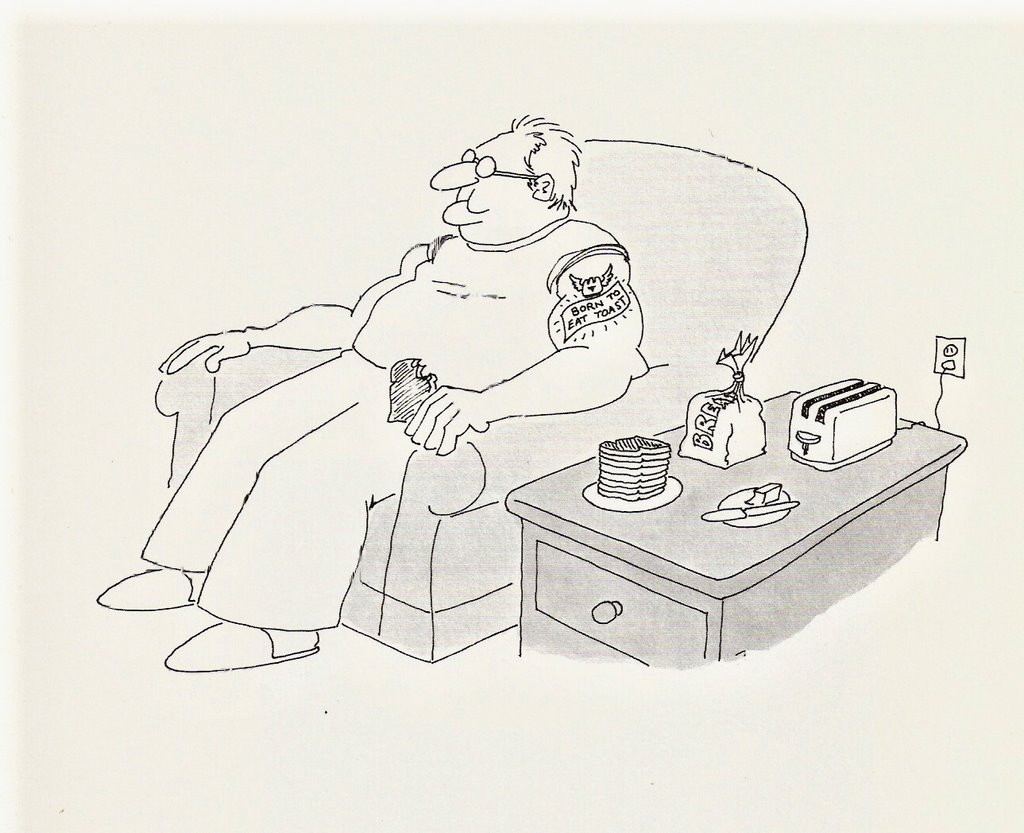
In more recent years, Stan kept a sporadic blog, Born to East Toast, which is a good sampling of his approach to the Bible, to humor, and to surviving long hospitalizations. He also wrote a year-long blog series about "the slow but steady progress of my understanding of GLBTQ folks," which probably complicated his relationships with some in our yearly meeting.
I'm sitting here finding it hard to stop writing about Stan. If I stop writing, I'll have to sit back and actually absorb the news. Here's what I'll do: First, provide a link to the PDF article on open worship that might be the most widely-circulated piece he wrote. Second, quote Stan himself, on the Lenten journey to Jerusalem:
Everyone is invited on this journey! It belongs to no one faith or sect. We will weather the betrayal, suffering, and sacrifice together. Come, join the throngs across our globe on this wonderful, terrible, trek. We will stand stunned into silence before the tomb. We will go crazy with celebration when death’s door makes way for resurrection power.
Watching Sakharov Prospect in comfort, thanks to tvrain.ru
Is it ever possible to make useful generalizations about a place?
Two essayists got me thinking about this question today. The first essayist (brought to my attention by Eden Grace at the Friends United Meeting office in Kisumu, Kenya) is Binyavanga Wainaina. The essay: "How to Write about Africa." The essay's genesis and aftermath are described here: "How to Write about Africa II: The Revenge." As I read the cliches and images, and cringed at times, I remembered David Niyonzima telling Northwest Yearly Meeting that the continent of Africa is "the opposite of dark." (This post.)
Binyavanga Wainaina's jeremiad reminded me that it's hard--maybe impossible--to keep personal biases and motivations out of our writings about people and places. Among our primary motivations may be to enhance our own profiles as wise and sympathetic observers, free of prejudice, neither too naive nor too cynical, far superior to ordinary tourists or jaded reporters. Our extraordinary insights will bring grateful tears to the eyes of locals who had otherwise given up all hope that someone from outside could understand their trials.
The second essayist is David Remnick, whose book Lenin's Tomb: The Last Days of the Soviet Empire was the first book I read on the dissolution of the Soviet Union--an event whose twentieth anniversary has just passed here without celebration. The essay: "The Civil Archipelago: How Far Can Resistance to Vladimir Putin Go?"
I honestly believe that Remnick probably doesn't worry overmuch, and does not need to worry, about his personal profile as an observer. But I do think that all of Binyavanga Wainaina's resistance to cliche and stereotype in African reporting applies equally to Russia--and should be taken to heart by those of us who produce and consume this verbiage. I'll never forget my furious reaction to a sectional tag inside an otherwise important Atlantic Monthlyarticle: "Zaire with permafrost."
Neither Russia's nor Zaire's importance is based primarily on how they fit into some ideological or imperial scheme of global relevance. They are simply places on this planet where people whom God loves try to find food, safety, love, and meaning. We can either forget this crucial truth in our pursuit of cleverness, or we can instead try to use our creativity to build relationships that express our common creatureliness.
Remnick's article is a thoughtful and non-sensational look at possible shifts in the nation's center of psychic gravity, as evidence mounts that old habits of resignation and deference to the "power vertical" may be changing. As every competent reporter does, he talks with specific people, both inside and outside the corridors of power, and presents them as, in some ways, representative of the trends he's covering. The constant dilemma for both writer and reader is, of course, how representative are those people, really? Do their moods and motivations actually reflect the country as a whole, or some segment to whom the reporters' (and readers') biases have drawn them?
The story of Russia's fragmented civic culture is rapidly changing--the crystallization image at the end of the article is apt. (When Remnick wrote his article, Vladislav Surkov still occupied his long-time post as deputy head of the presidential staff; now he's been allegedly demoted to a deputy prime-minister's post. But the insights that focused on him are still valid.) I appreciated Remnick's deftly drawn sketches of several actors in this changing scene--Evgeniya Chirikova, Liudmila Alekseyeva, "Sasha and Masha," and Olga Romanova. But here's my worry: do we like those people because they're truly representative of Russia, or because they represent our search for heroes who are like us? Are these courageous people Russia's future, or are we living our fantasy Russian future through these vicarious heroes--without our having to pay the heavy price that the next wrenching political transformation of Russia might cost? OK, here's a thought experiment: are insiders like Surkov and Aleksei Kudrin perhaps the real heroes? They have put themselves right in the center of the enormous grinding wheels that represent the nearly irreconcilable forces attempting to dominate Russia--nationalism, corruption, lust for power, demographic challenges, and the innate, patient decency of Russians (stereotype but true as well!), whose legendary tolerance of abuse does, however, have a potentially explosive limit. I'm not asserting this thesis myself!--my sympathies are with any "hero" who actually gives my own students real hope--but I want to keep us honest as we examine the choices our commentators make.
About four years ago, we took the electric train from Elektrostal's downtown station to Noginsk's downtown station, a journey of about 20 minutes. Elektrostal's station has no turnstiles, so it is possible to get on the train without a ticket. But Noginsk's station does have turnstiles, so you need a ticket to exit. OR you get off the train, jump down onto the tracks, and walk down the tracks about twenty meters, to where the station's perimeter ends, and clamber back into town. The vast majority of the passengers chose that path to free transportation. As one of our friends says, "The government's job is to build fences. Our job is to find the holes."
We see the same phenomenon every Sunday on our way from Moscow to Fryazevo--from one turnstile-equipped station to another. This is a much longer journey, so chances are good that, however they've boarded, passengers will encounter controllers. These are conductors whose job it is to check people's tickets. People who have boarded the train by finding the holes rather than using turnstiles still need to cope with these controllers. Here's how many do it: Everyone knows that the controllers are coming--people begin coming in from the next car in back, heading forward to evade the check. As our fellow passengers see this parade, they leave cigarette packages, newspapers, decks of cards, whatever, to reserve their seats, and join the procession. Sometimes they do this when the controllers have already entered the car. Last Sunday I saw a passenger get up when the controller had actually reached our seats. The passenger deliberately left a tissue on his seat, sidled past the controller, and walked forward out of the car. Badge-wearing guards took up posts at both ends of the car, but not before everyone who wanted to leave was able to do so. Apparently the tacit rule is: the very moment your rear end has gained any altitude above seat level, your ticket is not checked.
As soon as the train reaches the next station, these "jackrabbits," the passengers who have moved ahead of the controllers, exit as fast as they can and run back along the platform to reboard the train at a point behind the car reached by the controllers. This happens in full view of everyone still on the train, including the controllers. The train only stops for thirty seconds, so speed is of the essence. As the controllers move forward, people reclaim the seats they'd abandoned to evade the controllers. At the end of the journey, they must still find a way to get off railroad property without going through turnstiles. At Fryazevo, the microbus drivers will obligingly leave off and pick up passengers at a convenient point just past the station fence, even though it's not a formal bus stop.
I smile as I describe this familiar scene, but it does point to a contradiction that faces all who dream of a more engaged relationship between the average citizen and his or her government. In some ways, the present arrangement ("the government's job is to build fences--our job is to find the holes") reflects an ancient equilibrium. It's an equilibrium that might drive a Western idealist nuts (although I'd argue we have our equivalents!), and we might even argue that it reinforces a fatal self-enslavement that could keep civic reform movements in a permanently marginal status. But up to this point it seems to be working for the powerful and powerless alike.
It's not wrong for idealists, including outsiders, to imagine something different. But let's understand whose future is at stake and whether our fantasies are ultimately rooted in our own intellectual fascinations, in the calculations of empire, or in love.
Frederick Buechner is probably the first novelist I really paid attention to after I became a Christian. So it was interesting to see this recent item on the Internet Monk site. (Also see the comments.)
Has your church or meeting adopted a minute relating to the Occupy movement?
I always get sick when the
weather gets better...
but I don't lack for company!
an outstretched paw
ad on light pole outside Mcdonald's
--"a team of experienced teachers"
is ready to write your theses, term
papers and homework assignments;
rates from 500 to 8000 rubles,
roughly $15 to $240
Many of Barack Obama's election-year supporters are suffering from buyer's remorse--how in the world could he support indefinite detention at Guantanamo Bay!!--while, paradoxically, many of his political enemies continue to paint him as a rogue socialist. Are these two groups talking about the same person? I wryly remember my own somewhat cautious defense of his candidacy--even if he were only 5% better than his opponent in the election, I remember thinking, that could still mean the difference between life and death for hundreds of thousands of people.
Dear outraged readers, left and right, Obama is simply the chief executive of a huge bureaucracy. He's not an emperor; he answers to thousands of constituencies, all of whom know that presidents come and go. Just consider the mislabeled monstrosity "Obamacare," of which he is not actually the author. It's the product of hundreds of compromises and transactions among thousands of players; sadly, many of these transactions did not reflect the ideals of fair access to health care for all.
Still, the people demand a hero--or a villain. Too bad Obama is just a human being, a servant leader in a strategic and very exposed position. He deserves to be treated (especially by believers!) as a responsible adult--with prayer. love, and constant intelligent criticism. But that criticism must not stop with him! If you wanted him and his colleagues to take a more nuanced view on some subject of peace, justice, or the economy, what did you do--what did I do--to open up the space for such a discussion? Did we demand that legislators at all levels operate with similar sensitivity? Did we talk with neighbors about our concerns? Did we reach out to family members who disagree with us?
There's nothing wrong with heroes; for certain audiences, heroes and their stories are far more persuasive than theoretical arguments. By all means, let's find worthy heroes, but the best ones might be outside political structures whose leaders have a mere 5% mobility range from dead center. Once in a great while, such heroes appear even within the structures (possible nominees: Franklin Roosevelt; Nelson Mandela), but I for one will not demonize Barack Obama for being "merely" competent.
So if a hero won't do our heavy lifting for us, what hope do we have? Again, to take the economics of health care as an example, maybe we need to operate on at least two tracks.
Track one, bottom-up, is the way we behave as consumers and citizens--being intelligent patients and patient advocates, participating on local and regional health policy and management boards, balking at unreasonable fees, pursuing claims, filing complaints, expressing outrage (after checking the facts!) when others are treated unjustly, being squeaky wheels whenever necessary, always refusing to accept a passive role in a hero/villain drama.
Track two, wholesale reform, is looking at the whole system and working with others who are doing the same thing. In health care politics, as in so many other spheres, we Americans have operated on a hero-vs-villain based system, the hero being the so-called free market, and the villain being socialism. (True, some people suffer from the reverse oversimplification!) Trapped in these artificial frames, we've allowed rampant bureaucratism, lack of true choice, and non-medical interference in the doctor-patient relationship whenever the "market" imposed them, all in the service of avoiding "socialism" out of fear of rampant bureaucratism, lack of true choice, and non-medical interference! Let the hero be good health care and those who support it (just as we want good police care, good firefighting care, good post-office care) and the villain be any unnecessary complications, public or private, to that care.
One example of these distorted frames and the compromises they've forced "Obamacare" to make: many say that the recent health reform is unconstitutional because it requires purchasing health insurance. In fact, that requirement is functionally more like a tax--but because we're allergic to sane conversations about taxes and centralized funding, we can't call it that. In order to avoid the "socialist" simplicity of basing our health care on public funding, some part of the cost and the risk-pooling in this intricate compromise must be covered through the device of a "purchase"--but even this device isn't satisfactory to those who do not see equitable health care coverage as an overriding national priority.
As voters, we can get part of the way there through elections, but politician-heroes can only do so much. We must do our part to change the way the wind blows, starting with our own rhetoric. It's not what our heroes do, it's what we do in every relevant conversation, every transaction, every day, to advance health care as a public good rather than a marketable private luxury...and to re-recognize government as our own mechanism for working for the common good, rather than an external evil for which we have no responsibility.
In Libya, too, I wish I could imagine some heroic breakthrough. I wish I could picture how the whole world could rise up and say "enough." How could one colonel (who reminds me of a hugely inflated version of Jim Jones) be allowed to equate a whole country's fate with his own? Sadly, as much as I grieve for Libya, I can't imagine how violent heroics by outside forces could do anything but complicate the situation even more. I don't know whether the current lack of assertive outside intervention is based on cowardice, or a secret desire to defend present lucrative arrangements, or genuine wisdom, but one thing is clear--the nation-state system still trumps human solidarity as a basis for responding to injustice. No doubt the Western addiction to oil plays a role as well.
For those of us who are committed to nonviolent responses, maybe these weeks of unprecedented change, revealing a whole new generation of local heroes, will spur us to more creativity in enlarging and replicating such fledgling institutions as Christian Peacemaker Teams. Never has their need been so clear.
Christianity Today: "Behind Egypt's Revolution." "During the last month, we Christians in Egypt have witnessed an unprecedented coming together of local Muslims and Christians, especially among young people."
"Why the Mideast Revolts will Help al-Qaeda." Michael Scheuer: "Bin Laden and his peers are counting on the fact that the uprisings' secular, pro-democracy Facebookers and tweeters--so beloved of reality-averse Western journalists and politicians--are a thin veneer across a deeply pious Arab world. They are confident that these revolts are not about democratic change but about who, in societies where peaceful transfers of power are rare, will fill the vacuum left by the dictators and consolidate power." Is this a useful corrective to the optimism of many (such as al Jazeera's Wadah Khanfar, quoted here last week)? Or do Scheuer's glibness and false dichotomies signal another purpose? Is the region truly condemned to an endless succession of filled vacuums?
The theme of "suffering" has been in my mind lately. It began last Sunday at North Valley Friends Church, where it was the theme of meeting for worship--in fact, of a series of meetings. (I admire a church located in affluent Western Oregon that is willing to devote a big chunk of attention to a theme that is unlikely to fit into any church-growth strategy.) A church member described her journey into the valley of addiction, arrests, and a slide to rock bottom that ended with God interrupting her suicide attempt. Concluding the meeting, Stan Thornburg suggested the church's goal: to become a community where it was safe to ask for help and healing in the midst of torment.
The next evening, several of us gathered in a home to see a DVD that North Valley Friends recently bought, Pray the Devil Back to Hell, about the ending of the civil war in Liberia, the political campaign that ended with Ellen Johnson-Sirleaf's election as president, and the nonviolent women's movements behind both events.
Using contemporary news footage and low-fi on-the-run video clips from the civil war, the film gives us a glimpse of ordinary people's lives when bullets are flying--and all your child wants is just a little piece of doughnut, but you have nothing. We viewers are not sheltered from those scenes, but the film was produced with respect and dignity; there's no gratuitous disaster voyeurism.) There's a notorious link between suffering and passivity, and a lot of our post-film discussion revolved around the roles of faith and courageous leadership in mobilizing people to say enough is enough.
That same day the Christian Peacemaker Teams sent out a link to a video showing children in the Zharawa camp for internally displaced people, in Kurdish northern Iraq.
"These beautiful, wonderful, creative, joyful, talented and bright Iraqi-Kurdish children have been forced from their homes due to repeated bombing by Turkey and Iran," explains the caption. "They now live in a tent camp that offers no protection from the summer heat, the winter cold (yes, it does get cold), dust storms, or illness.
"We asked them to tell us their stories and they did so by drawing pictures of their happy lives in their villages, attacks on their homes, and fleeing to the tent camp they live in now."
The accompanying CPT news bulletin tells the story of how CPT members have been trying to get permission for some of them to live within the camp itself. There's never a shortage of stories of suffering. Liberia's strong man, Charles Taylor, is right now on trial in Sierra Leone for contributing to that country's civil war, and on Tuesday, we heard his lawyer telling a BBC reporter about his humanitarian heart.
On Wednesday, Caspian Airlines flight 7908 crashes with the loss of all on board. On the same day, the Russian human rights organization Memorial loses its respected Grozny-based activist Natalia Estemirova, kidnapped outside her home and shot in the head, her body dumped out in nearby Ingushetia.
Today, the New York Times Web site included a moving video on the Cambodian atrocity tribunals. (Related article here.)
I don't have any special wisdom, just two thoughts.
First, I don't want to be sheltered from this raw data about the world's agonies and God's frequent (apparent) non-intervention, because denial would make a fraud of my faith. As I've probably said before, my mother saw the flash of Hiroshima, and therefore lived much of her life under the shadow (she was told) of leukemia statistics. In the city itself, thousands of innocents were vaporized, roasted, or lethally irradiated.
When the war finally ended, both her own country (Japan) and her parents' homeland (Germany), and huge swaths of the world, were pockmarked with smoking ruins and mass graves, as great-power politicians strategized to reassemble their empires, and the sober idealists among them cobbled together the new United Nations to slow down our perennial cycles of butchery. This is reality, every bit as real as the Bible. Zooming down to family scale, my mother also endured the kidnapping and murder of her own fourteen-year-old daughter in 1970--but Ellen was only one of 86 school-age young people murdered in Chicago that year. I study and pray and trust without pretending to understand. Through prayer, I can remain aware of suffering as a prod toward mindfulness, as a standing query about remaining oriented toward justice, without becoming morbid or paralyzed, without turning my back on God's equally pervasive provision of joy. (See the Zharawa camp kids!)
Second, your sufferings and mine may seem mild compared to the Liberian civil war, Nazi atrocities, and Cambodia under the Khmer Rouge. We should not inflate our own woes, but neither should we deny or suppress them--they may be the key to our ability to empathize with those whose trials are more dramatic.
Back when I was working with Right Sharing of World Resources, we had a partnership with a grassroots group in India that was developing a dairy cooperative. We provided seed money that was supposed to go into the bank to secure loans for 30 women. But as we found out, another dairy in town was selling watered-down milk. At first, this seemed great for marketing--"our" milk would be more attractive. But the owners of the rival dairy wanted to head off competition, so they told the women that if they went ahead with their plans, they would tell all their business friends to make sure that the co-op members' husbands would lose their jobs. They also pressured the bank to deny loans. Showing the photos from India, it was hard to convince some American audiences to see these co-op members and their husbands as neighbors, Biblically speaking--the outward differences were so stark. None of my audience members were depending on milk from one or two water buffalo to put food on the table. But who among us hasn't suffered some kind of analogous injustice? Who doesn't have a story of political corruption and discrimination somewhere in their past, or the past of their community? (Being from Chicago, I don't have to work my memory very hard!)
The hardships we acknowledge can build a human link to others far away, and we can become mutually supportive companions in building justice. (And we in Right Sharing had to learn to be far more systemic in understanding what grassroots-level development aid could and couldn't accomplish.)
I took some time yesterday and today to listen to the Senate Judiciary hearings on Judge Sotomayor's nomination to the U.S. Supreme Court. Just a few impressions: First, her opponents who criticize her for identity rhetoric, fearing subjectivity and bias (although I doubt they truly fear it; the worry is so blatantly ideological and contrived to score political points) can't have it both ways. They admit that diversity on the Court is a virtue, but seem to imply that the diversity must only skin-deep.
White males are still the gold standard for objectivity. One or two of her critics have said that if a white male had made a statement analogous to the "wise Latina" wording that they're hounding her with, he'd be out on his can. But that would not be a true analogy--unless white males represented a traditionally marginalized viewpoint. We white males seem to have fairly weak irony detectors, especially when we're in positions of power. Friday PS: I have empathy, if that's allowed, for the New Haven firefighters whose case eventually prevailed (barely) in the current Supreme Court. Today, plaintiff Frank Ricci appeared as a witness at the Sotomayor hearing. According to the New York Times, he "call[ed] the Federal District Court ruling that rejected his and others’ claims of discrimination flawed. 'Americans have the right to go into our federal courts to have their cases judged based on the Constitution and our laws, not on politics or personal feelings,' he says. The lower-court ruling, he says, reduced them to racial statistics and served to divide people." Earlier, he talked about how hard he'd worked to prepare for the promotion exam.: "I was a virtual absentee father and husband," the Times quoted him as saying. (See, he wants empathy, too, and I'm not going to fault him for it.)
The confirmation issue, of course, is not whether we sympathize with his entirely understandable anger, it is whether Judge Sotomayor correctly navigated issues of law and precedent when the case reached her panel. The true villain in Ricci's case is the cumulative load of sin represented by Jim Crow. For that deep social poison there has never been a perfect antidote; and, sadly, the chosen correctives caused private pains for the public good. I'd argue that without those imperfect solutions and private pains, our national search for justice would be decades behind where we are now. There may be nothing but cynical politics in an attempt to pit Frank Ricci against Sonia Sotomayor, but when her approval process is over, I hope we can continue to talk as a country about the poison, the antidotes, and the human beings who are affected.
A feast of theological links: From zoecarnate: "Theodicy (’the problem of evil’) is with us almost no matter what we believe, and panentheism does not come out unscathed – indeed, it’s even more vulnerable, I think, because (unlike Deism or a highly ‘Sovereign’ removed God concept), panentheism seems to implicate God rather intimately in life’s hurts as well as joys." ~~ Two items from the Pew Forum's Faith Angle conference: a "short course" on Reinhold Niebuhr, Obama's favorite philosopher, and a conversation on faith and science with Obama's NIH director nominee Francis Collins. ~~ From Sightings: "The radicalism of Caritas in veritate?" ~~ Are men from Mars and women from Venus?--the Christians for Biblical Equality are about to meet. Also: The courage of Natalia Estemirova. ~~ Tomgram: Are Afghan lives worth anything? ~~ Caritas in blues ... Taj Mahal and Bonnie Raitt alone and together.
Mentioning Chicago gave me a serious case of nostalgia. The cure, at least for now: Chicago blues. This video from 1981 is fuzzy, but just listen: from the very first guitar notes you'll know that this is the one and only, the GREAT J.B. Hutto performing "Too Much Alcohol."
[The video I had here has been removed, but here's some documentary footage featuring this wonderful musician.]
Yesterday, we got a hint of snow, but the first significant snowfall came today. Students approved--nearly to a person they agreed that the fall had dragged on too long.
I think it was two winters ago that the first snow did not come until mid-January. Everyone I know here prefers genuine winter with fresh snow rather than the muddy, slushy alternative that gives local credibility to theories of global warming.
My students on Obama: Questions about Barack Obama and the elections have come up frequently at the Institute. Most students who've spoken to me express some optimism about Obama and the improvement of Russian-USA relationships. (It is telling that this is the main concern about American leadership these days.) In two different classes, students expressed caution, in one case reflecting a Russian television program that student had seen, that perhaps Obama was too young, too much of a lightweight. I don't think they realized his actual age; he has an ability to project youthful energy, but he's really middle-aged.
I showed some videos of election night--both mainstream TV coverage of the vote-counting and the Stewart/Colbert alternative. Aside from everything else, we got in a lot of conversational English content. "We project that...", "16% of the precincts reporting...", "John McCain's gameplan...", "bellweather states," "voter suppression" and so on.
One question I always hedge on is "What do you think of our president, Dmitri Medvedev?" I can't think of any analysis that I could make at this point that would add to students' knowledge either of conversational English or of politics, so I usually decline to go beyond a few courteous generalities. However, recently I've pointed out that both Obama and Medvedev are deeply rooted in the study of law and both claim to have deep respect for the rule of law. Based on this shared attitude, we can be optimistic that, when they meet and work together, they'll share an intuitive bond.
"Trying to know Christ in the poverty I see...." Recently, one of Northwest Yearly Meeting's list services has carried a fascinating conversation on simplicity. I appreciated this contribution from Debbie Thomas in Rwanda, and got her permission to include it here:
This discussion leaves me with so many thoughts that I want to share and talk about...These issues are where I live, I'm trying to know Christ in the poverty I see around me and at the same time believing that bringing Christ into that poverty will make a difference on the physical level in many different ways. (while of course having a spiritual impact as well.)
I hardly know where to start...
Even though being a Christian doesn't mean we will prosper financially, God does want his people to have the ability to feed their families. The people I know can't feed their kids more than once a day right now. They are Christians, fully trusting and loving God, working hard too. Christianity here in Africa has largely been spiritual only and hasn't traditionally touched the areas of economics, social relationships, politics, education, etc. Why is that? That's what I'm trying to figure out, and I'm trying to live out a Christianity that does address all those social realities.
[Another participant's] comments tend to lean (I think) towards saying 'use capital to make money then give it to the poor'. That's probably not exactly what he is saying...but I really don't think that's what God is asking of us. It's a horrible thing to have to depend on others to give to you, without ever gaining the ability to get what you need for yourself. It's the difference between giving someone a fish and teaching them to fish. The problem is that it's so painfully difficult to teach someone to fish. And, when you get to the lake, you find that it's been polluted, over-fished, and the poor aren't granted access....
...
What do I see as a viable answer to the question of poverty that all Christians feel somewhat responsible to respond to? We have to be willing to go the long haul with people. To know them, love them, hurt with them and not have answers. To help them think, help them become the kinds of people who can tackle the problems that face them. It's not easy. It's not quick. It's actually rather messy and painful.
For example, right now we have trained 4 teams of Rwandan Christians who volunteer their time to engage over a 3-5 year period with one poor community (so we are doing this in four communities). We don't have any money or projects to give them; we don't even have any answers to their problems. But we can help them to really examine their problems, and their resources, and help them as a community to start tackling some of their problems. We can share with them our hope in Jesus and why we would even take the time to reach out in this way. We can discuss the cultural norms and expectations and lead them through discussion of how they might want to act in different ways.
I've visited communities that have done this in Uganda, they are called transforming communities, it was an absolutely amazing experience. In these transforming villages there was spiritual vitality--meeting in homes, in church, loving God, studying and applying his word...and this spiritual vitality was transforming all aspects of their communities. They had complete food security (while other villages nearby were starving), they sent all their kids to school, they had trained members of their community as health workers and no longer suffered from intestinal parasites and malaria, they had beautiful crops using improved seeds, they raised cattle and drank the milk, they used the fertilizer on their crops.....they were happy, healthy and they loved God fully. They realized that they weren't 'fi nished', there is still a lot of work to do, but they realized that they were able to live in the goodness of God's provisions.
Now isn't that what we are aiming for? Could I ever get enough money from the US or from capital investment to buy that kind of contentment for a community? Never. Are they rich? No. Are they prosperous? In many ways, yes. Are they content? Yes. Much more than many Americans I know. And they, as a community are reaching out to other desperately poor communities helping them to go through this same process.
Ok, so I'm totally off the subject of simplicity. I am passionate about these things, and it thrills my heart to hear other Christian leaders grappling with the same issues. Thank you for wrestling out loud with the issues, so I can benefit too.
A righteous link from Sean Guillory on the media's self-criticism over its coverage of the recent Ossetian war. Interesting comments, too.
Otis Spann and Sunny Boy Williamson on the winter theme: "Nine Below Zero."
What does "liberal" mean? For this much-maligned and confusing word, David Jenkins wrote a nice clarification at the beginning of his book, God's Continent:
Another word requiring explanation is "liberal," which refers to quite different political values on either side of the Atlantic. Generally, an American liberal favors expanding personal rights and civil liberties while using state intervention to achieve socially progressive causes, to advance traditionally underprivileged groups. Hence, liberals are on the political left. In Europe, in contrast, liberalism usually means a belief in laissez-faire economics and small government, combating the growth of the over-mighty state; liberals are thus opposed to socialist or communist advances. In American terms, then, European liberals are thus on the political "right."
Most of us are not satisfied with linear definitions. If we put liberals and progressives on the left side of a line and conservatives on the right, what analytical or dialogic advantage do we have? Do we need something in common for us to have a conversation? I would like to assume that the common value is the good of the community--but is that a valid assumption? If it is, we'll be motivated to put our "left" and "right" differences in perspective, and even consider that a fertile recombination of ideas traditionally associated with one or the other side might be possible. Examples: Jim Wallis preaches both family values and economic justice. Seamless-garment Christians advocate "pro-life" attitudes toward abortion, while also opposing militarism, racism, and capital punishment.
What if we don't take it for granted that everyone shares a commitment to the good of the community? (I'm not going to complicate this discussion by worrying about the argument that unfettered personal greed is the greatest good for all.) Maybe we need another line that intersects the left/right line, and this new line is labeled "common good" above the intersection and "individual gain" below, signifying actual personal priorities rather than the line we might take in public. That might help compensate for those of us who espouse generous and progressive social theories while holding tight to what's ours, and rarely lifting a finger to challenge systems either through concerted prayer or through prophetic action.
Following Urban Holmes's diagram of a "phenomenology of prayer" (A History of Christian Spirituality: An Analytical Introduction), we can imagine a "circle of sensibility" within which all of these compass points maintain a healthy tension and dialogue, but outside of which we can see worrisome exaggerations.
I could imagine yet a third axis, perhaps a spectator/activist line, for a true festival of variations and nuances! But as Robert Benchley said, "There are two kinds of people in the world: those who divide the world into two kinds of people, and those who don't." Maybe for someone who cautions against objectifying, I've done enough dividing for one post!
PS: These thoughts were inspired in part by this article on the Christianity Today Web site: "The Government We Deserve."
This weekend and next week, the full Northwest Yearly Meeting Russia team is meeting with several members of the Yearly Meeting's Global Outreach Board to pray, discern, and plan. Please pray with us!
Russia is very much in the news these days, with the presidential election just three days away. I can't believe how frustrating it is not to be there! The wife of one of my friends is a staffer at a polling place--I'd love to sit over tea and talk with her about that job, but you can bet I'm not going to be doing that over the phone!
The New York Times recently published an article which can mildly be described as rather negative: "Kremlin Rules: Putin’s Iron Grip on Russia Suffocates Opponents." To me, more instructive than the article itself were the many comments from Russians. Some of them are here; the newspaper's own summary of the discussion is here.
If I had to choose one comment that is most like what my some of own Russian friends would say (remembering that they're a diverse bunch of people!), it is this one.
National "security," again: Today President Bush, apparently reflecting the imperial arrogance that must be the air they breathe in Washington, explained at a press conference why it is unsuitable for the U.S. President to talk with our adversaries. Even after being reminded by a reporter that talking doesn't mean "embracing," Bush said, "Sitting down at the table, having your picture taken with a tyrant such as Raul Castro, for example, lends the status of the office and the status of our country to him. He gains a lot from it by saying, look at me, I'm now recognized by the President of the United States." (Read the transcript here.)
So those leaders who do get the Presidential photo-op bestowed upon them must walk away just glowing: they've been recognized by the President of the United States!! How did they ever raise their heads in public before they were lent the status of His office and His country? I don't suppose He would ever benefit from the status of another leader?
Mr. President: How about meeting with our adversaries because it is your JOB?
"Voices without Votes opens a window on what non-Americans are saying in blogs and citizen media about US foreign policy and the 2008 presidential elections."
"Faith without a home"--Michael Gerson in the Washington Post. "For my Nazarene preacher grandfather in Kentucky, the Democratic Party of Franklin Roosevelt stood for God and the common man." (Thanks, Karen Street.)
Another flush of the tax toilet: the high-tech fence designed to score political points--but, as it turned out, mercifully ineffective at curbing illegal immigration. ("Remember, you were once aliens in Egypt.")
Cinematic "meditations on celebrity"--Jean Bethke Elshtain's review of the films I'm Not There and The Assassination of Jesse James by the Coward Robert Ford.
Bill Clendineng recently posted an interesting item, "Meeting is a verb," mentioning the Plainfield Friends Meeting's sign which is in plain view on U.S. 40.
It was my fantasy then that we Friends would somehow dare just say on our signs, "We gather here every Sunday at 10:30 to meet with God. Please join us."
Our signs often serve as filters rather than invitations. Of course, my fantasy sign would serve as a filter, too, but the worst kind of filters are those with unintended messages, or perhaps those signs whose messages are formed by our anxieties rather than our best hearts and hopes. What is the unintended message of a sign that has a silhouette of a Quaker bonnet? (Here I'm nudging a meeting I love very much!--and who knows, these many years after I was last there, the sign might have changed.) Or a sign that simply announces "Wilbur Friends"?
The Quaker Outreach Forum on yahoogroups had an interesting discussion on signs from a mainly unprogrammed viewpoint back in summer 2006. [UPDATE: Link is dead. If this forum is active on another platform, please let me know.]
Kenya's agonies are on many Friends' minds. In keeping with the signs theme, I want to present (with permission) an epiphany meditation by Ray Downing, who served, along with his wife Jan Armstrong, as doctors at Lugulu Hospital during much of my time at Friends United Meeting and who were my hosts for my visits to the hospital.
Yesterday was Epiphany. Epiphany means appearance or manifestation; in the Church, the appearance of Jesus, his manifestation as Messiah, and the revealing that He is not for Israel only, but for all nations. The last week in Kenya seems to demonstrate the reverse, a sort of Devil's Epiphany, the appearance of killing and burning and chaos, the manifestation of evil. It's been bad.
I think there has been an epiphany here, but of a different sort. The question near the surface of so many commentators is, "We expect this sort of thing in Somalia or Liberia or Congo – but how could this happen in Kenya, a country with a stable democracy and such a strong economy?" In fact, the election itself was remarkably close, and orderly – until the tallying. What happened?
One Kenyan commentator said these events exposed Kenya's "thin veneer of civilization", and I think the comment points us in an interesting direction, depending on what we mean by "civilization". If by civilization we mean a strong (Western-style) democracy, then Kenya had that: political parties, free press, campaigns, pre-election polls, elections, the works. All the things we in the rich West have said make up a strong democracy. Were all these just a "thin veneer" in Kenya? What happened?
There is a clue in Kenya's other piece of civilization, the "strong economy". I have been struck by news reports that speak of Kenya as "an east African economic powerhouse with an average growth rate of 5 percent" – and in the same sentence tell us the country still struggles with poverty, without noting the contradiction. Another news report explains: " Although the Kenyan economy grew at a rapid pace, so did economic inequality, resulting in a concentration of wealth in a small oligarchical elite, while most Kenyans earn less than $1 a day. " A strong economy that has not confronted and addressed poverty is in fact not a strong economy; it is a "thin veneer" of economic strength. The epiphany is that this has now been revealed.
So what about democracy? The real question is "what about Western-style democracy", the sort we keep insisting on. And again, we sense a "thin veneer" – but we must be careful about concluding that democracy is only a thin veneer here, and that underneath people are fundamentally undemocratic. Quite the contrary. "Kenya," a friend wrote, "has borrowed bits and pieces over the past century or so from the West, and has pasted these fragments together with a glue that does not withstand high political temperatures. It conforms, generally, to all modern sector fragility…" What is being revealed in this epiphany is the fragility of Western political and economic "solutions" for Africa.
So where does that leave us? Not with a grand "solution", but only the logical working out of the above epiphany that Western-style political and economic civilization is a veneer here. The obvious question is: a veneer over what? I don't think it's a veneer over the violence we are seeing this week; that violence is simply a sign of the veneer cracking and breaking. Our question remains: what is under the veneer, under the violence? Has it ever occurred to us to look?
By "us" here I mean those Westerners who have worked here, and others who will undoubtedly flock into Kenya now to help: peace teams, negotiators, humanitarian feeding efforts, disease fighting specialists, and the like. There is a clear script for how to help: make sure the displaced people have food and shelter, help them return home when it's safe, document the atrocities, bring those responsible to justice… Yes, that is all important. But I think we have a unique opportunity now to look under the veneer, now that is has cracked. And there are these startling starting-places:
In a community near here torn by ethnic violence, why would a Luhya woman shelter in her home a Kikuyu woman who had just delivered a baby – knowing that if some in the community found out, her house would likely be burnt?
When we sang Kenya's National Anthem in church on New Year's Day, my first response was that national politics don't belong in church – until I realized that the Kenya's National Anthem is a prayer set to a traditional African melody.
And this: why has there been no killing yet in Webuye, where we live? Why, in this Luhya town deep in the heart of western Kenya, are Kikuyu shops remaining open? Why, when some youths from another ethnic group came trying to incite violence, did the youth here refuse?
The answers to Kenya's problems are in Kenya. In fact, God is in Kenya, though sometimes in disguise. One of the best things we can offer Kenya is to look for God here, to document not the atrocities but the epiphanies of God here. The heart of Africa is too rich and too beautiful to be covered by veneers. It's time for us to admit that we have too often only tried to develop and repair these veneers of civilization. It's time to look at what is working well underneath the veneer, and to ask why.
I was fascinated by an observation made at the Friends conference on peace this past Sunday in Nairobi, by Hizkias Assefa--an observation which applies not just to Kenya but also to countries such as Russia, whose fitfully evolving democracies may not be following an American script:
Multiparty politics, which has been promoted by the West since the end of the cold-war, tends to polarize society. In countries with a longer history of democracy, such as USA, there is greater agreement on major social issues and elections are often fought on peripheral issues.
In countries with a shorter history of democracy, there may be no general consensus on fundamental issues and elections are likely to have more important consequences. A different system of choosing leaders is needed [in Kenya] so that those who are elected will play a cohesive role in bringing society together.
In both Kenya and Russia, parties (and, for that matter, ethnic identities) may play different roles in aggregating the people's political will than they do in the USA.
A large jet airplane crash-landed at Heathrow Airport today--and as someone who travels far too much by airplane, I couldn't help following the news with horrified fascination. Although I absolutely believe in prayer, I have given up looking for God-signs in disasters and near-escapes, not wanting to believe that the difference between life and death for innocent people was that someone had been negligent in praying, or that someone's prayer had been found wanting by God and ignored. Prayer reflects a relationship of love and trust; it's not a pious crowbar.
Even so, I'm praying my gratitude for the disaster that did not happen. And I'm continuing to pray for Kenya and Iraq and of course for the villages in my head.
Righteous links: Eastern Orthodox writer and speaker Frederica Mathewes-Green is visiting George Fox University January 28-30. Contact Paul Anderson for more information. ~/~ Todd Farley on embodied preaching. (Seed for yet another post on "worship seeking understanding"?) ~/~ John Wilson writes, "Among evangelicals, suspicion of eloquence is in part an inheritance from the Reformation, still potent after five centuries." And from the same site, loving remembrances of Madeleine L'Engle by Luci Shaw. ~/~ Christian Peacemaker Teams publish "an open letter to the U.S. government regarding Turkish bombing of Kurdish civilians" in Iraq. And CPT "elder" Gene Stoltzfus talks personally about peacemakers and anger.
Judy gave this incredible DVD for Christmas: Muddy Waters' Classic Concerts. Thanks to Youtube and bornblues, here's a sample from Molde, Norway, thirty years ago--the very month Judy and I met.
I've been absurdly happy for as long as I can remember. I do mean "absurdly," because the evidence for an opposite attitude has been overwhelming at times. Alcoholism and violence in my own family of origin, even the killing of my sister by a drug dealer in Chicago, was just a microsample of the world's realities. But to my relief and occasional embarrassment, I seem to bounce back.
The world doesn't approve of "absurd happiness," as Sebastian Moore made clear in his fascinating book, The Inner Loneliness. This was the first book that helped me understand that we're supposed to pretend to want to be happy--being happy is good in principle--but in fact if we don't express all the ways we're too busy or overwhelmed to be happy, people will let us know that we're not carrying our full load. Or we worry that they will.
All this came back to me in reading Colin Saxton's keynote address to Northwest Yearly Meeting. He quoted Douglas Steere, who in turn had quoted with approval William Russell Maltby, as in this excerpt from Steere's Pendle Hill Pamphlet, Prayer in the Contemporary World.
There was a Roman Catholic priest in Detroit who used his church in the derelict section of the city as a place of service for the outcasts whom no one else wanted. The city welfare office called him one day about one of their “cases” and told him that the city of Detroit was through for good with this man, that he was undeserving, and they would do nothing more for him. The priest said, “Send him along to us. We’re all undeserving down here.” In my community, as the Gospel ethic begins to dawn on me, all kinds of new and alarming and highly unpopular insights begin to lift above the parapet. Are there to be no limits at all to my vulnerability? William Russell Maltby would answer this question by noting that Jesus promised the disciples who would follow him only three things: “that they should be absurdly happy, entirely fearless, and always in trouble.”
The theme of fear and happiness, light and shadow, was powerfully reinforced by David Niyonzima on Tuesday night, in the first of his two plenary-session talks at our yearly meeting. David's organization, Trauma Healing and Reconciliation Services, works among those who are perhaps the least likely in the world to talk glibly about happiness--survivors of the indescribable horrors of civil war and genocide in Central Africa.
David set up his comments by mentioning the phrase used by some early European missionaries--Africa as the "dark continent"--and responding that the continent is the opposite of dark. To those who are born and raised in Africa, there's plenty of sun for all--more than, say, in Newberg, Oregon! He went on to talk about the dark of the night: when he was a child, his parents warned him about all the dangers lurking in the dark, to encourage him--as he says now--not to come home too late. That fear of the dark worked for the child David Niyonzima, just as it did for the young Colin Saxton, hustling home quickly lest the crickets stop their comforting sound.
David then talked about the "dark" in terms of the Central African horrors of recent years, and how the "children of the Light" should respond to such horrors. He illustrated the power of the Light (John 1:5, "And the light shines in the darkness, and the darkness cannot comprehend [or overcome] it") by asking that the house lights of Bauman Auditorium be dimmed completely. He took out a tiny flashlight and shone it at us, the audience. We could all see it. He went on to say (by my memory), "You Americans have invented many clever things. But I believe nobody has invented something that can project darkness. Yet even a small light can penetrate what might otherwise be overwhelming darkness."
Just as the brightest, most unfiltered light we can see comprehends all colors, the children of the Light must comprehend all conditions. Together, we must be ready to shine the light into places where unspeakable horror is hiding. We may be personally sheltered from those realities in ways that David Niyonzima has not been; as a teacher, he witnessed the massacre of all of his students. And, individually, we vary in our capacity to see those things, both by location and by temperament. But together we can see, and we can shine. For me, happiness and joy are names for that experience of shining together, and are subversive of the shadows in which the principalities and powers conceal themselves to do hideous things to God's beloved creation.
And we need that light, not just for others, but for ourselves, because too often we find that we are unwilling or unconscious accomplices of those same principalities and powers. Our own sins may not be dramatic, but my correctable ignorance about how my tax money is spent, how my spending habits reinforce injustice, and how my looking away increases a victim's isolation, will probably only be reduced in dialogue with others.
I'm so grateful that Yearly Meeting is turning out to be a place where such "mutual irradiation" (to borrow again from Douglas Steere) is happening. It makes me very happy!
* That is, by a human being created by God, Tyrone King, who somehow became a drug dealer and murderer by processes that I wish we were far more curious about as a society.
A topic for another time, one that arose from the FUM board retreat I wrote about last week: What is the healthy function of boundaries and borders, and when do they become destructive? The topic just came to my mind again, because of the page of Douglas Steere's pamphlet just after the one I quoted above. See how potent his words are today, especially the last line:
It is not easy to see how to reconcile the claims which the state may make upon my loyalty and the unlimited liability which I as a Christian bear for all people. There are surely duties I owe to the state which orders the relatively secure roof over my head. Yet ready as we must be to help the state sustain this order, the Christian’s duty does not stop at the frontier of the nation-state. For the state is only an arbitrary limitation, and what happens to the sister or brother who is outside its boundaries is of primary concern for the Christian. God is always revising our boundaries outwards.
Righteous links:
In a week or two, I hope to write a review here of Philip Jenkins' important book, God's Continent: Christianity, Islam, and Europe's Religious Crisis But in the meantime, the Pew Global Attitudes Project Web site has a couple of relevant pages. Their report, "A rising tide lifts mood in the developing world" bears the intriguing subtitle, "Sharp decline in support for suicide bombings in Muslim countries." An earlier report on the site concerns Muslims in Europe, and includes this comment that seems to me to be in accord with Jenkins' book: "No clear European point of view emerges with regard to the Muslim experience, either among Muslims or in the majority populations on many issues."
I've linked several times to items about the rise of neo-Nazis in Russia. Here's an item from the 24/7 Prayer Web site about, among other things, confronting this phenomenon spiritually right in Germany.
Forgiveness envy: I was both blessed and angered by the item in Peggy Parsons' blog about Hamid Karzai, "hero of the faith," for having pardoned Rafiqullah, a 14-year-old would-be suicide bomber. Try as we might to muzzle the awkward message of grace, it will come out. The words of Martin Luther King came back to me with striking force (and I'm not making a point about comparative religions here!): "...Don't let anyone make you think God chose America as his divine messianic force to be a sort of policeman of the whole world. God has a way of standing before the nations with judgment and it seems that I can hear God saying to America, 'You're too arrogant. If you don't change your ways, I will rise up and break the backbone of your power, and I will place it in the hands of a nation that doesn't even know my name.'"
The reality-based community and the Onion: which is which? Have they merged? Visit the Belly of the Whale and judge for yourself.
Quaker convergence in Barnesville: Thanks to Peter Blood for drawing my attention to some Web documents that emerged from the recent "Quakercamp at Stillwater," which he described as "an effort to bring together Friends who wanted to seek & share together in a rather unprogrammed way for where God is leading us as Friends today both individually and as a movement." The pages: The epistle; queries on confidentiality and openness; queries on faithfulness in sexual relations. It seems to me that there's a little current of excitement and open dialogue and hope that is coming from a common Holy Spirit source, and the evidence for which includes this Barnesville event, the diligent spirit at the FUM Board retreat, the energy and direction evident in Cherice Bock's recent Beacon Hill lecture, and many other reports on meetings and visitations of recent months. But maybe I'm just absurdly happy!
I think I promised this one a couple of weeks ago: David Johansen as the voice for Hubert Sumlin. Charlie Musselwhite's on harp. Blues is full-spectrum happiness, too.
After working two 19-hour days and a 13-hour day, followed by a cross-country flight, it was wonderful to get to my desk and find Dima, my teddy bear, holding things down for me. In my absence, someone had made sure that he found his way to my keyboard.
Dima and I get along together because we complement each other. He's dignified, always wearing a tie. He is quiet. I may be free with my opinions, but he keeps his own counsel. I am constantly on the move, but he stays put. I sometimes worry about what I might have done better, but he's always looking forward.
I almost didn't get Dima. It's been about eight years since Paul Riley, a Friend and doctor in Indianapolis, helped us gather stuffed animals for children at the orphanage in Buzuluk, Russia, the city where Quaker relief efforts during the Russian civil war and the associated famine were headquartered.We filled two suitcases with the wonderful collection Paul provided, but one big bear just didn't fit. When I got home from Russia, Dima was patiently waiting for me. He has been with me ever since.
A few of you might already know that my ever-helpful Dima played a role in the stories I used to tell our boys when they were young, and later told to the children at Reedwood Friends Church. When Garfield and Lamb Chop (who are friends and partners in my universe) decided to open a restaurant, the Sassy Animal Cafe, Dima was the banker who helped them arrange the financing, asked thoughtful questions about their business plan (which was to charge people what they could afford, while making the place the place to be seen in Kokomo, Indiana, so that people who could pay more would pay more, making it possible to provide for people who had no money to enjoy Garfield's signature lasagna).
Dima also taught Garfield and Lamb Chop about grace and about honesty. These qualities weren't just important for the Sassy Animal Cafe's finances, but also for the rivalry they had with Barney the Dinosaur, whose Eggplants R Us restaurant was their main competition. It was okay for Garfield and Lamb Chop to give out placemats with discount coupons in their own restaurant, but to smuggle them into Barney's restaurant was crossing a line.
While I was in Oakland, at least eleven U.S. soldiers died in Iraq, along with a harder-to-determine number of Iraqis. Politicians continue to jockey over the terms of relief for Darfur, Sudan, while Kofi Annan's rhetoric understandably grows more frustrated. Litvinenko's radioactive corpse takes center stage in a macabre search for political meaning, and political advantage, in his mysterious death. I think back to my innocent fantasy land of Garfield and Lamb Chop, where Dima tried to open up the world of truth and promises for his young listeners. I'm glad that they didn't ask him whether adults actually behave the way he described.
The habits of imperial arrogance are hard to break. It used to be that negotiations were conducted with people and countries with whom we had a serious problem. The more serious the problem, the more urgent the need for discussion. Now it appears that such forms of communication are reserved only for nations on our "approved" list. Iran and Syria are not on that list, although James Baker and others are lobbying our petulant president to bend. I am certain that discussions are in fact going on behind the scenes, perhaps through intermediaries, but we moralizers must maintain appearances at all cost. Well, maybe not at all cost: of course, We are pragmatically allowed to make exceptions. When someone refuses to speak with us (as in the case of Iran, whose president demands a change of attitude), I wonder whether anyone on our side recognizes the taste of our own medicine.
A few days ago, Wolf Blitzer of CNN hosted Jimmy Carter for a conversation on Carter's new book, Palestine: Peace Not Apartheid. Carter's reasonable and low-key description of the actual facts of Israeli policies and actions on the West Bank were inexplicably labeled by Blitzer as "very blunt talk." There was nothing blunt about it; it was simply at variance with the U.S. government's abject public subservience to those forces within Israel that functionally promote apartheid.
A few righteous links:
Simon Barrow refers us to an article on giving up Christmas for Advent. For more heat and light on the fraught relationship between Christmas and culture, Christianity Today's Ted Olsen tells us about "the year conservatives saved Christmas."
Nancy's Apology takes us to an emergent church called Next. Also see her follow-up, "Next on Next." And take a look at Ryan Bolger's brief essay on Lesslie Newbigin and the church in the 21st century.
Gene Stoltzfus answers a student's question on the role of interfaith dialogue in building peace.
For Russian readers: the BBC posted an article on the World Wide Russian Web--interesting Web sites serving Russians in various far-flung places. One example: africana.ru, a serious site with the tagline, "All good people love Africa."
Finally, a Hound Dog Taylor blues clip with a rare glimpse of one of my favorite blues harpists, Little Walter:


 Maybe we need another line that intersects the left/right line, and this new line is labeled "common good" above the intersection and "individual gain" below, signifying actual personal priorities rather than the line we might take in public. That might help compensate for those of us who espouse generous and progressive social theories while holding tight to what's ours, and rarely lifting a finger to challenge systems either through concerted prayer or through prophetic action.
 ), we can imagine a "circle of sensibility" within which all of these compass points maintain a healthy tension and dialogue, but outside of which we can see worrisome exaggerations.


 . Thanks to Youtube and
  . This was the first book that helped me understand that we're supposed to
  But in the meantime, the
 (which was to charge people what they could afford, while making the place