The third "No Kings Day" program of protest actions in the USA are being organized for this Saturday. We will be out of the country that day, but hope and pray for a peaceful day, and a good turnout. I'd love to see lots of creative messaging that will reach new audiences, and a minimum of stupid caricatures.
Some USA citizens here in the United Kingdom will be marching under a slightly different banner, "No Tyrants," since here there is an actual king. The king is styled "sovereign" but, ironically, in normal times the British sovereign has practically no political power in comparison to King Donald.
The kings and queens in constitutional monarchies do have enormous symbolic power in their roles as stewards of national identity and guarantors of continuity. They would quickly lose that legitimacy and its grounding in the affections of their people if they became kings in the ancient tyrannical model described by God to Samuel, who—in vain—passed that warning on to the people demanding a king.
Many actual monarchs, having more majesty than power, still have the use of grand palaces, elaborately decorated, and they participate in impressive rituals and spectacles. They may have buildings, organizations, and various projects named after them, and their pictures may appear on currency or on the walls of government offices, but, again, if they themselves were to decree these arrangements, their legitimacy would suffer.
King Donald wants both power and spectacle. May he get an unmistakable NO on Saturday.
My June 14 sign.
On his blog, Interrupting the Silence, Michael K. Marsh points out that this upcoming No Kings Day is on the weekend of Palm Sunday.
This Saturday, March 28th, is the third No Kings Day protest and Sunday, March 29th, is Palm Sunday, but here’s what I wonder:
What if Palm Sunday was the original No Kings protest?
What if Jesus, the disciples, and the crowd that follows Jesus are protesting violence, injustice, and imperial power?
Instead of protest songs there were shouts of “Hosanna!”, a cry for deliverance and liberation, a plea for change. Instead of protest signs there were cloaks and palm branches, symbols of joy, peace, submission, and the celebration of a new way.
Here's how Nancy Thomas has been using slugs in her writing. It reminded me of the tradition among some pastors and seminarians to challenge each other to embed some incongruous word in sermons they'll be preaching.
Philosophers, political scientists, and advocates of civil discourse are grieving the death of Jürgen Habermas.
Jeremy Morris tells us why he thinks "Paul D’Anieri’s updated Ukraine and Russia: From Civilized Divorce to Uncivil War is the single best book you can read to understand the domestic and geopolitical causes of the current war." He managed to persuade me to buy the book. I haven't started reading it yet, but I think Morris's post is interesting on its own ... as usual.
Source: David Sipress, New Yorker via Seraphim Sigrist's Facebook page, commenting on his own back pain.
... [T]he gifts of the Holy Spirit are revealed in community. As such, they are for all the community, and so one gift does not quench the others, even when, as happens often, they are opposite. So the analytical does not quench the emotional, the gift of tears does not quench that of laughter, the gift of the spiritual elder does not contradict that of the psychologist, the gift of ecstasy does not stand in disharmony with that of calm.
Bishop Seraphim Sigrist (Orthodox Church in America) died last Saturday morning. There must be many people all over the world who are going through what I'm feeling now. Yes, it's true that we believe that "he fell asleep in the Lord," but he gave us so much wisdom and care and sheer fun that I, for one, can't help feeling sad and very sorry for us.
I never met him in person. The closest we came to meeting each other was when I visited the Pleasantville campus of Pace University to conduct marketing interviews at a time when he was working in the library. We actually met through a Facebook chat when he contacted me to consider joining an ecumenical fellowship that, during the peak COVID years, was meeting online. That invitation led to, among other things, five years of correspondence that I'm very grateful to be able to revisit anytime. We chatted about Japan (where he served as Bishop of East Japan, and where my mother was born and raised), our experiences of Russia, several mutual friends there, the intersections of Eastern Orthodox and Quaker Christianity, authors and artists we both admired, and the joys and puzzles of ecumenical life. We sent each other many links over the years; it was he who told me that Friends Journal had published an interview with the Norwegian author Jon Fosse, whom he was reading at the time.
Looking over that correspondence, I am amazed at my own openness with him in writing about my family and early life. I've no doubt that many others found him to be a person of surpassing empathy as I did. And some of you lucky people knew him for far longer than my five years.
His scope of knowledge, interests, sympathies, and ability to detect unexpected affinities and hidden kinships across all those fields was amazing. And he frequently made those connections with gentle playfulness.
In his positive review of Bishop Seraphim's book Theology of Wonder, the Christian Reformed scholar James Peyton wrote words that ring very true, more generally, of what I came to know and love about our friend. In the Calvin Theological Journal (pages 479-481), Peyton wrote,
There is no question that the author is a gifted theologian: It is clear that Bishop Seraphim is well-acquainted with a wide spectrum of views and controversies, both among Christians of various stripes and with the views of practitioners of other faith traditions throughout the world. However, he never makes such familiarity the point of his presentation or of any of the sections; indeed, he wears his extensive learning lightly. He is not concerned to show us how much he knows, although he knows a great deal: He refers deftly to the understandings current among Hasidic Jews, Buddhists, Hindus, and various kinds of Muslims. He cites with considerable dexterity literary figures from various cultures, across many centuries, and in a host of genres. Unostentatiously, the author weaves these all into a seamless tapestry that invites readers to appreciate that "all things (considered in their depth) led into eluctable mystery" (93): Bishop Seraphim is concerned to show us how much he does not understand—or, better put, what no one can comprehend. In the best traditions of the rich Eastern Orthodox tradition in which he stands, this little book offers a contemporary—and very accessible—mystical theology.
Maybe he truly was a seraph cast among humans, sent on some mysterious mission. A seraph on earth would move awkwardly in crowds, his wings more hindrance than help, yet he would ache constantly for the divine presence he had known before. That longing defined Seraphim. I have never met anyone so profoundly nostalgic for heaven.
The fourth Global Ecumenical Theological Institute (GETI) in Wadi El Natrun, Egypt—an Eastern Orthodox perspective. (How I wish I could talk about this report with Eden Grace!)
You've heard of virtue-signalling. Now we have vice-signalling and vitriol-signalling.... (Skip these links if you want to stay on the sunny side of the street.)
Kristin Du Mez, Bruce Berglund, and the Moscow Playbook.
Writer and poet Nancy Thomas on the writing vocation, technological interruptions, and ... what rhymes with Forsythe?
This time, our "Baby Scratch My Back" version comes from Otis Redding (audio only with slideshow). It's probably my favorite version strictly for vocal performance. Musicians: Booker T. & the M.G.'s (Steve Cropper, Donald Dunn, Al Jackson Jr., Booker T. Jones) along with pianist Isaac Hayes and a horn section including Wayne Jackson, Charles "Packy" Axton, Andrew Love, Floyd Newman, and Sammy Coleman.
"A flag of peace and freedom"—a design for a post-colonial Russian flag. Source.
Since the death of Alexei Navalny, I've not written much here about the theme of the "beautiful Russia of the future." I continue to think about Russia often, and am in touch with some of our friends and colleagues of our years in Elektrostal, but the ongoing war, and the repressive political context, has complicated these relationships, to my sorrow and frustration.
However, I was reminded that this state of affairs won't last forever, Here's the communication I received today, written by two old friends, that reminded me:
Planting Seeds for Healing
A brutal war is raging in Ukraine and near the border with Russia. Will there be a winner in this conflict? I think not. In war, everyone loses. Both sides have lost many lives. The destruction in Ukraine is immense.
All wars eventually come to an end, and this one will not be an exception. When this war is over, the reconstruction begins.
However, it is not just the infrastructure and buildings that must be rebuilt. It is the lives of the people that will need restoring and healing—a return to mental and physical health. For every soldier who is killed, many lives are affected—parents, children, siblings, spouse, friends—and their lives will never be the same. Some sources estimate over one million killed plus many other wounded. There will be a great many people on both sides with unimaginable losses who suffer from trauma, stress, depression, hatred, grief, shame, regret, and many will carry unthinkable physical injuries for the rest of their lives.
Healing is a long-term process which will require dedicated professionals and volunteers who believe that, with compassion and understanding, it is possible to do healing work with individuals and groups. This process begins now in anticipation of the eventual end to this terrible war and the normalization of travel: willing professionals must be located; a sustainable program developed; volunteers
trained; money raised for transportation, office space, supplies, outreach.
There is a registered non-profit in the US that has been supporting projects in Russia and Ukraine for 29 years. Its supporters believe that an intense effort will be needed to answer the call for help from both sides in this war. They want to be involved and are looking for others who want to engage with the creative and inclusive process of assessing needs, connecting with the people in both countries, developing programs, raising funds, and implementing such healing.
Knowledge of the Russian or Ukrainian language is not necessary.
I can vouch for the authors of this invitation and hope that, if something stirs in your heart, you'll get in touch with the authors through that e-mail address.
Quakers have been involved in Russia and Ukraine for many years, dating back to Peter the Great. I know personally some of those who now carry these concerns for healing, but the majority of them are now 70 or more years old. If there are younger Friends with a concern for this part of the world, I'd love to hear from you. (johan@canyoubelieve.me.) And so would those who wrote the invitation above.
When I started studying the Russian language in high school in Evanston, Illinois, I didn't feel alone. It was great fun to go to the University of Illinois campus in Chicago on May 15, 1971, for the Illinois State Russian Contest, and see a whole lecture hall full of high school students with similar enthusiasm. (I won a "Superior" certificate!)
Stats for high school students of Russian then and now are hard to find, but college level enrollments have taken a dive since those years. At their peak (1990), there were about 44,500 students of Russian in the USA. (I wasn't one of them; I majored in Russian at Carleton University in Ottawa, Ontario.) By 2021 the number had gone down to 17,598. And that's before the full-scale invasion of Ukraine in 2022, which I'm sure made the language even less popular among those from non-Russian backgrounds. In my high school years, the Cold War (and the alarm over Sputnik I) gave some of us a sense of urgency, but the current grievous situation hasn't had the same effect.
As writer and critic Dmitri Bykov noted back in 2022, commenting on the full-scale invasion,
It is clear that Russia crossed many red lines. It cannot live any longer as it did in the past. The world will no longer see [in Russia] a place of spirituality, a place of great culture, a place representing victory over fascism.
That may all be true, now and for some time to come, but all the severe judgments, indictments, cultural boycotts, social and economic isolation, and other consequences that this nation has brought down upon itself through coercion, passivity, and toxic cynicism, I can't help continuing to cherish the vision of a "beautiful Russia of the future." And a key component for recovering that beauty is the gift of healing.
It may well be the case that young adults in the United States view Christianity as an impediment to women’s equality, a view amplified by the “Orthodoxy as Masculinity” narrative. But that is not what Orthodox Christianity proclaims.
Last Sunday, Daniel Smith-Christopher gave a sermon, "Disciples of the Sacred Story Tellers," at Reedwood Friends Church, that touched on, among other things, one of the recurring contrasts in the Old Testament/Hebrew Bible:
We're all familiar with many of the difficult and troubling and sometimes violent attitudes in some of the passages of the Old Testament. It's why so many people have asked me over the years, "Old Testament! What's a Quaker doing studying and teaching the Old Testament? Aren't you a bit out of place?"
I enjoy sharing my thoughts as to why I don't think I am out of place at all. So, here's the strangely compelling part: sacred storytellers whose names we will never know in each case, sacred storytellers in the Old Testament seemed to keep offering gentle, loving, sometimes compassionate stories in the face of terribly violent texts.
Daniel gave several examples of the way the Bible's storytellers provided this kind of contrasting content alongside some of the warnings of divine violence coming from various biblical prophets. See the video; he gives three interesting examples of prophets and storytellers.
It seems to me that this fits in with the divine dialogue that the Bible invites us into. That dialogue is what I try to enter into when I am particularly challenged by something in the Bible, something that seems contradictory or strange, something that I just don’t understand. Sometimes the participants in the dialogue are the biblical record and me, and sometimes I’m imagining a dialogue between different voices in the Bible itself.
In this post, my example of contrasting messages compares the psalms of praise and the warnings of the prophet Amos. Fifteen psalms include the imperative verb Hallelu (that is, "praise") followed by a short version of God’s name, Yah: so, Hallelujah. The last five psalms in the Bible are all part of this group of Psalms, but they vary in their descriptions of whom they’re asking to praise God, including the monsters of the deep sea. Psalm 150 keeps it simple … where, why, and how to praise:
Psalm 150
1 Praise the Lord. Praise God in God’s sanctuary; praise God in God’s mighty heavens. 2 Praise God for God’s acts of power; praise God for God’s surpassing greatness. 3 Praise God with the sounding of the trumpet, praise God with the harp and lyre, 4 praise God with timbrel and dancing, praise God with the strings and pipe, 5 praise God with the clash of cymbals, praise God with resounding cymbals. 6 Let everything that has breath praise the Lord. Praise the Lord.
On a Sunday last spring, one of our Camas Friends Church attenders gave a brief opening message, what we call the "First Word," and his text for that message was one of these last five praise psalms. As he read that psalm with dignity and reverence, I felt like a thirsty cactus getting a needed rainshower. If there’s one temptation some of us Quakers sometimes give in to, it’s the temptation to overthink things. Sometimes maybe we just need to let go and praise.
(By the way, that First Word speaker also talked about the reason we praise. It's not because God has an inferiority complex and needs our reassurance that the Creator of the Universe really is the Supreme Being. Now God might demand that we must not look for other gods, idols, and cultish substitutes, but goodness knows we can praise with our lips while drifting away with our souls. At our best, we praise because that is the soul’s natural response to the gift of life. If we’re responding to our being loved into existence by God, and, as Spokane Friends' John Kinney says, we realize that the stones will be rolled away from our own tombs as well as Jesus’s, our gratitude as expressed in praise seems like a natural and unforced expression.)
Contrast this imperative of praise in the psalms with what Amos is saying in the mid 700’s BC. Maybe you remember the context here: Amos has been reading the riot act to the people of Israel, particularly to the Northern Kingdom, accusing them of the same crimes of idolatry and oppression that he has seen in the surrounding Gentile nations, and saying that God demands the same purity and the same ethical standards of all of them, Israelites and Gentiles alike. He warns Israel that the woes that will fall on those Gentiles will also fall on his own audience. You can’t mock God. Judge for yourself:
Amos 5:12-24
12 For I know how many are your offenses and how great your sins. There are those who oppress the innocent and take bribes and deprive the poor of justice in the courts. 13 Therefore the prudent keep quiet in such times, for the times are evil. 14 Seek good, not evil, that you may live. Then the Lord God Almighty will be with you, just as you say God is. 15 Hate evil, love good; maintain justice in the courts. Perhaps the Lord God Almighty will have mercy on the remnant of Joseph.
16 Therefore this is what the Lord, the Lord God Almighty, says: “There will be wailing in all the streets and cries of anguish in every public square. The farmers will be summoned to weep and the mourners to wail. 17 There will be wailing in all the vineyards, for I will pass through your midst,” says the Lord.
18 Woe to you who long for the day of the Lord! Why do you long for the day of the Lord? That day will be darkness, not light. 19 It will be as though a man fled from a lion only to meet a bear, as though he entered his house and rested his hand on the wall only to have a snake bite him. 20 Will not the day of the Lord be darkness, not light— pitch-dark, without a ray of brightness?
21 “I hate, I despise your religious festivals; your assemblies are a stench to me. 22 Even though you bring me burnt offerings and grain offerings, I will not accept them. Though you bring choice fellowship offerings, I will have no regard for them. 23 Away with the noise of your songs! I will not listen to the music of your harps. 24 But let justice roll on like a river, righteousness like a never-failing stream!”
I wonder if you were as struck as I was by the apparent condemnation of the praises commanded in David’s time and now banished from Amos’s gloomy vision. The God of Amos doesn’t appreciate their festivals and assemblies. “Away with the noise of your songs! I will not listen to the music of your harps.” This seems to me to be clearly a different voice.
By the way, it does not scandalize me that the Bible has voices that don't always agree with each other. The Bible is much more credible to me with these awkward juxtapositions than it would be if some ancient public relations copy-editors had made sure that nothing odd stuck out at us from these sixty-six-plus books. The Bible was compiled by a mixed process of prayer and church politics, and the end product did not conceal the different sources and different points of view of the authors. I believe that the Scriptures are God-inspired, as Paul said to Timothy, but God’s inspiration acts in the assembly process as well as in the writing process, and takes full advantage of the varieties of human temperament.
Along with Amos’s impatience with pious sacrifices and praises, he has some interesting things to say about “the Day of the Lord.” Quakers have traditionally had two related interpretations of this phrase. One concerns the end of history, when the Lamb of God has the victory, when redemption rules, and the New Jerusalem is revealed. The other is our individual Day of the Lord, our Day of Visitation, our invitation to accept or reject God’s free offer of grace and redemption. Most early Quaker theologians assumed that this offer would be made to everyone, whether or not they had had outward access to the Christian gospel. In other words, culture and geography were not barriers to salvation. (See the quotation from Robert Barclay here.)
Amos paints the Day of the Lord with his usual gloomy colors. “Woe to you who long for the day of the Lord. Will not the day of the Lord be darkness, not light—pitch-dark, without a ray of brightness?” This is Israel’s destiny if they do not give up the sin and injustice he spends nine chapters condemning. There is an alternative in these same verses: “Seek good, not evil, that you may live. Then the Lord God Almighty will be with you, just as you say God is. Hate evil, love good; maintain justice in the courts. Perhaps the Lord God Almighty will have mercy on the remnant of Joseph.” This is the boundary line between Amos’s stern gloom and the promise of the New Jerusalem and its life of praise: We won’t just say God is with us, and assume that nothing needs to change, but we will wake up to the reality that following God has content and consequences, so that, if we have anything to do with it, justice will roll on like a river and righteousness like an everlasting stream.
What does that justice and righteousness look like? Here's a glimpse from George Fox’s experience of what he called the "restoration." (Page 27 of his Journal, Nickalls edition.)
Now was I come up in spirit through the flaming sword into the paradise of God. All things were new, the creation gave another smell unto me than before, beyond what words can utter. I knew nothing but pureness, and innocency, and righteousness, being renewed up into the image of God by Christ Jesus, so that I say I was come up to the state of Adam which he was in before he fell.
In case you think that Fox was referring to himself as a special case, he has some specific instances of what this will look like for everyone in the restoration—for example, specifically for men and women:
[Speaking to the men, now… same Journal, p. 667]
And thy ruling over thy wife and eldership [over her] is in the Fall [that is, the capital-F Fall of Adam and Eve], for thou art in the transgression and not an elder in the image of God and righteousness and holiness, before transgression and the Fall was, nor in the restoration where they are helps-meet in the righteousness and image of God, and in the dominion over all that God made. …
And on p. 668,
I was moved of the Lord to recommend to Friends, for the benefit and advantage of the Church of Christ, that the faithful women who were called to the belief of the Truth, being made partakers of the same precious faith, and heirs of the same everlasting Gospel of life and salvation as the men are, might in like manner come into the possession and practice of the Gospel order, and therein be meet-helps unto the men in the restoration, in the service of Truth, in the affairs of the Church, as they are outwardly. That so all the family of God, in civil, or temporal things, women as well as men, might know, possess, perform, and discharge their offices and services in the house of God, whereby … all the members of the spiritual body, the Church, might watch over and be helpful to each other in love.
Fox has a fascinating understanding of what the Day of the Lord means here. At some time, the whole of creation will be like this, but we are not to wait! We ourselves are to go back through the flaming sword. When we ourselves experience all things being made new, and the creation giving forth a new smell, beyond what our words can utter, we will have a sense of what right praise is, and I predict that we will give way to it with great freedom and joy. The world is a long way from this New Jerusalem, and it may certainly be that our beloved, suffering planet will undergo a time of darkness as Amos predicted for Israel. (See "The long defeat, part one.") Darkness seems to be descending in various places even now. But at this very time, maybe it is given to us, and to faithful communities everywhere, to live out a discipleship of justice and righteousness, just as Amos said we might and must.
What does that discipleship look like in the community? What steps do we take so that, in George Fox’s words, “all the members of the spiritual body, the Church, might watch over and be helpful to each other in love”?
Eighteen years ago I taught a course in American studies at the New Humanities Institute in Elektrostal. The photo shows me in front of the class, with a diagram of the life cycle of a movement.
On the first day of the class, I gave my very oversimplified theory of history to the students: History is something like a constant debate between idealists and skeptics, or to put it another way, between optimists and cynics.
Whether it’s in the councils of state or in your typical church fights, they’re usually guaranteed to get on each other’s nerves. I think in the short run, skeptics usually win, but in the longer run, idealists have a fighting chance to prevail, if you’ll excuse the expression. In any case, when the idealists and the skeptics actually meet and converse, they have a real opportunity to bless each other. Each one, no matter how crazy or sensible, centrist or extreme, an ecstatic praise-giver or a gloomy prophet, is a child of God, and if they can, even for a moment, glimpse that of God in each other, they can move closer, together, to that river of justice and righteousness that, deep inside, both of them want.
This blog post is partly based on a message I gave at Spokane Friends Meeting last spring.
Two items from Facebook... Colin South, former director of the Ramallah Friends School, writes to the Israeli embassy in London and to the Israeli prime minister. And David Goode passed along this interesting item from Brian Drinkwine: little Charlies or little Christs?
Timothy Snyder on the virtues of a certain movie superhero. (I may have to see the film after all.)
"Walk in Beauty": Remarks by Ecumenical Patriarch Bartholomew at Fordham University last Tuesday.
In the courtyard of the high priest's house, Peter denies knowing Jesus but is unmasked by his own Galilean accent. In a classic post by our late friend Stan Thornburg, he wonders whether we Christians have lost our accent.
Ever get this feeling? "No Rest." Chris O'Leary Band.
For several days, I've been thinking about Benjamin Netanyahu's speech at the United Nations General Assembly. The specific words that pulled at me were these: "I have a message for the tyrants of Tehran: If you strike us, we will strike you. There is no place—there is no place in Iran—that the long arm of Israel cannot reach. And that’s true of the entire Middle East."
(My italics.)
I'm not going to evaluate the whole speech, which is based on the unquestioned assumption of Israel's total innocence and victimhood in the region and at the UN. For just one example of the one-sidedness of the speech, its "blessing" does not take into account the treatment of Palestinians. Their existence in limbo has been prolonged indefinitely because Israel's leadership for generations has seen no advantage in resolving this cruel anomaly. The resulting inevitable bloody clashes, as each side "teaches lessons" to the other, are exploited as just another proof of Israel's victimhood.
Right now I'm more interested in the words, "If you strike us, we will strike you." On one level, that's the history of the human race. In any long-standing conflict, each side says these words to the other, taking turns with every action and reaction. It's true that one side's case may have more justice than the other's, but rarely do we see 100% good fighting 100% evil. Each side, however, usually portrays the conflict in those terms.
The politicians who raise the banner of "If you strike us..." are speaking to at least two audiences—the enemy and their own voters. The enemy doesn't need this information; they already assume the customary game is going to continue. The voters are supposed to understand that these politicians are their heroes, doing their heroic job to defend them, and deserve to remain in office.
What the "if you strike us" politicians are not making clear is the moral implication of their threat. "If you strike us, there must be death and destruction on your side. Our only choice is to kill people. We hope guilty people will die, but innocent people will also die. Instead of finding a more creative and lasting response to your attack, one that saves people on both sides of our conflict, we prefer to waste those lives."
In my fantasy world, Netanyahu's speech would have included ways that Iran could be part of "the blessing" and that the grievances of Palestine's allies could be addressed. (After all, the treatment of the Gaza Strip and the West Bank are the ostensible reasons for the current hostilities against Israel.) To go even deeper into fantasy, he could also have admitted that Israel is not always innocent.
Those would be politically hazardous steps to take. When Barack Obama told international audiences that the USA was not always innocent, he was endlessly attacked by his political adversaries for "apologizing for America." Netanyahu's own political situation is far more precarious, and he would probably not survive the revolt within his coalition that would result. But the space might well open up for a wiser approach to the present conflicts.
In 2007, an ecumenical delegation with Quaker participation went to Iran and met with counterparts there, including an Iranian ambassador who quoted a proverb: "Build a bridge to me, and I'll build 99 bridges back to you." How many innocent people must die for lack of serious bridgebuilding?
The rhetorical strength of the "If you strike us" language, presented without any references to moral implications, depends on people accepting it as true and obvious. Christians particularly ought to be saying, in season and out of season, that it is not true and obvious at all. We are not to return evil for evil. (1 Peter 3:9; context. Romans 12:17; context.)
We might think that all we need to do is put more energy and creativity into evangelism, making the world more aware that paths to genuine peace do exist, that we are not trapped in endless rounds of counterstrikes, and there is a global community that has arisen around a Prince of Peace who has overcome death. I agree. But of course there's a problem with that. The awkward question arises: do we Christians ourselves believe that we are not to return evil for evil? After all, "if you strike me I will strike you" is Donald Trump's own attitude to conflict, and God knows how many Christian followers have become admirers of his belligerence. Apparently it turns out that it's hard to believe in Jesus.
Juan Cole, writing before the current stage of the Israeli-Lebanese war, described how U.S. president Joe Biden's Mideast strategy was disastrously falling apart.
Bloomberg's Matt Levine: Is there a way to automate (via AI) the things we like about Warren Buffett?
During a prayer meeting for peace this week, a Friend read this passage, ascribed to 'Anna', from the second chapter of Britain Yearly Meeting's Quaker Faith and Practice:
Prayer is an act of sharing with God, the Spirit, and not an attempt to prompt God to action. It is a promise that I will do my best, even if what I am able to do seems too insignificant to be worthwhile. When I pray for peace, and that the hearts of those in authority may be changed, it is a promise that I shall do such things as write to those in power, share in vigils, and above all lead my own life, as far as possible, in such a manner as to take away the occasion for strife between individuals and between peoples. When I pray for others who are in need, it is a promise to make my own contribution, perhaps by writing, by visiting, by a gift, by telling someone whom I know could help. When I pray for forgiveness, for strength and courage, I try to open my heart, making it possible for me humbly to receive.
I wish I were this mature! For me, prayer absolutely is full of my attempts, pathetic as they may be, to prompt God to action.
A few months ago I wrote about my prayers that God would send angel armies to the skies over Ukraine, fully conscious of my prayer's lack of logic or chances of being fulfilled. It's not that I believed that my tiny voice would push God over the edge, despite history's long evidence that, whatever God is doing, it doesn't apparently include restraining the hands of warmakers. It's more that, in the face of the constant stream of tragedies and agonies (for example, in Gaza) witnessed by the whole world, my relationship with God will suffer if I don't make this plea.
Consider the unnamed representative of God's people laying out their frustration in Psalm 44 (inEugene Peterson's paraphrase, slightly adapted), starting with verse 8:
All day we parade God’s praise— we thank you by name over and over.
But now you’ve walked off and left us, you’ve disgraced us and won’t fight for us.
You made us turn tail and run; those who hate us have cleaned us out.
You delivered us as sheep to the butcher, you scattered us to the four winds.
You sold your people at a discount— you made nothing on the sale.
You made people on the street, people we know, poke fun and call us names.
You made us a joke among the godless, a cheap joke among the rabble.
Every day I’m up against it, my nose rubbed in my shame—
Gossip and ridicule fill the air, people out to get me crowd the street.
All this came down on us, and we’ve done nothing to deserve it.
We never betrayed your Covenant: our hearts were never false, our feet never left your path.
Do we deserve torture in a den of jackals? or lockup in a black hole?
If we had forgotten to pray to our God or made fools of ourselves with store-bought gods,
Wouldn’t you have figured this out?
We can’t hide things from you.
No, you decided to make us martyrs, lambs assigned for sacrifice each day.
Get up, God! Are you going to sleep all day?
Wake up! Don’t you care what happens to us?
Why do you bury your face in the pillow? Why pretend things are just fine with us?
And here we are—flat on our faces in the dirt, held down with a boot on our necks.
Get up and come to our rescue. If you love us so much, Help us!
Look at this comment in the New Interpreter's Study Bible:
Pledging innocence and faithfulness to the covenant, the people accuse, because of you we are being killed all day long (v. 22, cf. Rom. 8:36). There is no justice in God's crushing them. The text insists that there is no congruity whatever between the people's sin and the judgment that has befallen them. It is easy to understand why this text was so frequently on the lips of those facing death in the Shoah (Holocaust) of 1939-45.
And from today's Palestine, Munther Isaac of Bethlehem Bible College does not hold back, either:
We prayed. We prayed for their protection … and God did not answer us, not even in the “house of God” were church buildings able to protect them. Our children die before the silence of the world, and before the silence of God. How difficult is God’s silence!
'Anna' (of Quaker Faith and Practice) is right about the promises that we make, or could make, as we pray: promises to do what we can in the face of violence. But those promises are in the context of our plea to our God for justice. After we pray and lament and grieve before God in utter honesty, and confess our inability to match reality with God's own explicit promises, we face what it actually means for us, our limited and often discouraged selves, to be the Body of Christ (1 Corinthians 12:27, context). So, even as I stubbornly ask for angels over Ukraine (counting on God and you to overlook my naïve ways), what I also want and need is for guidance on how we can rise up, in all our diversity of gifts and temperaments and levels of maturity, and be that Body of Christ.
It's in that context that I understand Anna's encouragement (again, drawing on the Britain Yearly Meeting text), to "write to those in power, share in vigils, and above all lead my own life, as far as possible, in such a manner as to take away the occasion for strife between individuals and between peoples." As communities, we can join and support the letter-writers and those who participate in vigils. We might find other strategic ways of influencing events: becoming diplomats, or serving in the government, even seeking elective office! Others may be led to take riskier paths: withholding war taxes, serving in medical teams, becoming war correspondents, or providing pastoral care and accompaniment in the very places of violence, knowing that in the Body, others are praying and paying in support. As Paul says (my emphasis): "[God] has committed to us the message of reconciliation."
Alice Walker wrote, "We are the ones we have been waiting for." Maybe God, the sovereign Creator, has been waiting for us, too....
Coming later this month to Youtube, the film For Our Daughters("stories of abuse, betrayal, and resistance in the evangelical church") is based on the final chapter of Kristin Kobes Du Mez's book Jesus and John Wayne. Kristin gives some context for the film on her substack blog.
Jeremy Morris on the Ukrainian invasion of Kursk, why the invasion registers so minimally among Russians, and (once again) the challenges of measuring popular opinion.
What are the specific challenges Friends face as we seek to embrace gifts of public ministry? Windy Cooler considers the results of Friends General Conference's survey on public ministry.
I'm delighted to see that Simon Barrow, long associated with Ekklesia, has just launched his substack column, Illuminations.
"Mellow Down Easy"—a version of Willie Dixon's classic, made famous by Little Walter. Here are Steve Guyger and his band at the Mojo Music Club in Kleinstaasdorf, Austria. Enjoy!
By offering those links above, I intended to provide access to news coverage and commentary about the memorial events for Aleksei Navalny. I can't, and don't need to, compete with these sources.
Instead, I'd like to turn to one specific aspect of these events: their Christian context.
When I wrote about Al Sharpton, I framed my comments in our common identity as Christian ministers, which allowed me, as a commentator, to dare to cross lines and rush in where angels might sensibly fear to tread. My goodbye to Navalny is in a similar context. With all the differences in our social locations, political circumstances, and all that, we are brothers in Christ.
Maggie Phillips urged us, in her article in America, not to ignore Navalny's Christian faith, as the news media usually do. (Thanks to Faith on View for the link.) A fascinating sample of that faith came in the form of a statement by Navalny in a court hearing on February 20, 2021. Inga Leonova, in Public Orthodoxy, provides the full text of that statement. You can hear the original recording here, and read Leonova's article in Russian here.
These words leaped out at me:
This teaching—“Blessed are those who hunger and thirst for righteousness, for they will be satisfied”—appears somehow esoteric and odd, but in fact it is the central political doctrine in modern Russia. Your Honor, what is it, this phrase or slogan, the most important political slogan in Russia? Where does power lie? Power lies in truth.
The more that the principalities and powers try to distract us with lies and confusion and doubt and cynicism, the more persistent we need to be in our hunger and thirst for righteousness; the more determined we need to be to seek out truth; the more ready we need to be to admit (without wasting time shaming ourselves and each other!) when we fall short, and continue the pursuit.
This "central political doctrine" applies in this very moment in Russia, and in the USA, too. Where does it not apply?
If we Christians apply this doctrine consistently in our political involvement, we will bless our neighbors far and wide. But, for some of us at least, our first challenge may be to continue confronting the scandalous stink that too often surrounds the word "Christian" in the public arena. Where did that stink come from? Evidence suggests that some of us hunger and thirst for something else—dominance, privilege, the approval of the alpha figures of the moment. Maybe it takes the words of a contemporary martyr to recalibrate our values.
Thank you, Aleksei. Eternal memory!
Related:
Saying goodbye (memoirs by Sarah Rainsford and Aleksei Navalny).
I've never forgotten a post I read back in 2007 on Contemplative Scholar's blog:
On Being an Animal
July 12, 2007
As a human being, I am an animal too. And so are you.
This summer I am feeling moved not to travel much. While my main plan had been to get back into my academic writing, I'm having a really hard time with that. I think I am just profoundly tired. Plus, my support system has been seriously diminished over the past year: from the ending of my music group, to the departure of two people in my life who have been really important mentors and guides.
After my busy year and these important losses, I'm now mostly focused on trying to reestablish a basic discipline of taking good care of myself. No one else can do that for me anyway. More and more I realize that this is a deep and fundamental animal responsibility we each have. It is exactly for ourselves, but not selfish. We are not just our own private property. We matter to others in the world. And so if we don't take good care of ourselves, we can bring considerable grief into others' lives, because they can do little to restore health and well-being if we are not ourselves cooperating.
I have come to realize this in myself, but I also see it from another perspective in my relationships with others. Those who are good at taking care of themselves are happy and healthy and their lives are in balance, which means that they have lots of energy to attend to others as well.
As philosopher Immanuel Kant points out, we have a basic duty to be happy, so that we are not so distracted by our unhappiness that we fail to attend to our other moral duties!
The key marker for my own self care is exercise. Happily, I am running again. This is a very good sign. This year, I will place this as one of my highest priorities. No matter how busy my life gets, I will try to regard this as essential as eating and sleeping and going to Meeting! (Hold me too this, my faithful readers!)
So I've made the radical decision not to worry about how "productive" my summer is. I'm going to live my days as aimlessly as I need to. I'll attend to anything urgent that crosses my desk. But other than that, I'll just do what I feel moved to do from moment to moment. I haven't had a real vacation as such in a long time. I hereby declare the rest of this summer to be the first really extended vacation I have ever in my whole life let myself have.
I feel open and in a data-gathering mode. What gives me life? I want to experience the world in a new way. I want to let the world fill me with healing and renewing energy. I want to pay full attention to everyone I see, but refrain from agreeing to anything that establishes a controlling dynamic in our relationships. I refuse to expect anyone to do anything for me in particular; and I refuse to agree to anything that means that others expect something of me.
(I must emphasize that this is purely temporary. When the academic year begins again, I will have no choice but to enter back into that complex network of relationships dominated by controlling dynamics going in both directions.)
But for now, I just want to be a wild animal, quiet and shy, alert and tuned mostly into the pure present moment. I want to eat and sleep and run in the woods. I want to watch beautiful sunsets and let them work their magic on my soul.
The summer, after all, is beautiful. The sun. The breezes. The freedom to walk straight outside without the fanfare of coats and hats and scarves and gloves and complicated shoes slipping on icy walks. This is the time store up health and hope.
The other things I care about will come to fruition in their own good time. Let me finally honor the wisdom of the structure of the academic year. Let me finally trust in the natural rhythms of life and nature.
At some point I posted a link to this essay on my own blog, but soon after that, Contemplative Scholar had decided to close public access. The Contemplative Scholar blog remains closed to this day, although the Scholar gave me permission to republish this post here.
(The author said that it's also possible that the blog will be reopened in the future. I'll be sure to let you know if that happens.)
Maine Botanical Gardens.
Water vole, Klamath Falls, Oregon.
Panther Pond, Maine.
Maybe you've already guessed, at least in general, why I've found solace in this post at this particular moment, even though my own life cycle isn't academic anymore. For me, the winter serves as something of an equivalent to Contemplative's summer. And yet the coming winter season in the Northern Hemisphere promises even more cruelties among vulnerable people than we witness today. How can we justify ever averting our eyes?
On one of our online Quaker meetings for worship, with our attention focused on Ukraine and the Holy Land, one of our attenders drew our attention to this "Invitation to Sit Together for Peace," with its guided meditation in the Buddhist tradition taught by the late Thich Nhat Hanh. I found points of contact on a communal level with "On Being an Animal."
(Dear anxious members of my Christian family, I'm very willing to discuss what might make you anxious about this meditation, but not here.)
Another impulse to reprint "On Being an Animal" came from a letter I just got from a friend of mine in the UK. She wrote, "... I am due one of my biannual deplugs ... so from Nov 25th to Dec 25th that's it—no news or views on the present day (...history will be permissible)."
There is something in me that resists the idea of unplugging, as if I am somehow letting humanity down if I give up, for a time, my obsessive attention to the deeds and misdeeds of the Powers That Be. How much worse off everyone would be if I withheld my awesome influence for good!
If you sometimes feel the same way, but know down in your bones you really do need a time of retirement, consider some of these thoughts:
Consider that you, too, are an animal. Contemplative Scholar does not advocate inattentiveness, but a different, more creaturely kind of attentiveness. There is no break from reality, only a break from a set of stylized behaviors that we humans esteem much too highly, given that they are all elaborate variations on the same behaviors that all mammals display—data-gathering, marking territory, distinguishing friend from threat. We are wise to be aware of the ways human myths and conceits impact us and our global neighbors, but let's dedicate some time to resting quietly with our Creator, aware of the present moment, before returning to those demanding arenas.
Back in 1990, I made a tour of about thirty communities in southern India that, at the time, were active or potential partners with Right Sharing of World Resources. My first visit was to a non-governmental organization in Chennai. One of the most helpful and liberating pieces of advice that the director gave me was this: "Never believe (or allow people to convince you) that you are indispensable. The communities were there before you ever showed up and will be there after you leave."
The kind of retirement I see in "On Being an Animal" is very different from simply quitting in disgust or becoming cynical. However, if you feel those temptations to quit altogether, a period of retirement from the deluge of difficult news may be just what's needed. Everything we have to offer is rooted, not in our own undoubted competence and cleverness, nor in our righteous anger (though it's sometimes exactly right!), but in the everlasting and universal love of God.
But the Lord did stay my desires upon himself from whom my help came, and my care was cast upon him alone. Therefore, all wait patiently upon the Lord, whatsoever condition you be in wait in the grace and truth that comes by Jesus; for if ye so do, there is a promise to you, and the Lord God will fulfil it in you. And blessed are all they indeed that do hunger and thirst after righteousness; they shall be satisfied with it. I have found it so, praised be the Lord who filleth with it, and satisfies the desires of the hungry soul. O let the house of the spiritual Israel to say, 'His mercy endureth for ever.' It is the great love of God to make a wilderness of that which is pleasant to the outward eye and fleshly mind; and to make a fruitful field of a barren wilderness.
— George Fox (Journal, Nickalls ed., pages 12-13), 1647.
A letter from Ramallah Friends School students to the U.S. Congress, posted by the Friends Committee on National Legislation. Related note: the three young Palestinian men shot in Vermont last Saturday, Hisham Awartani, Kinnan Abdalhamid, and Tahseen Ahmed, were all graduates of the Ramallah Friends School.
An Orthodox priest writes to Christians in Russia who are not in unity with Orthodox officialdom on the war in Ukraine. (English. Russian.)
'Your post titled "Vanity of vanities" has been unpublished.'
About a week ago, I was startled to get this notice from blogger.com. It went on to explain that "Your post titled 'Vanity of vanities' was flagged to us for review. We have determined that it violates our guidelines and have unpublished the URL http://blog.canyoubelieve.me/2008/01/vanity-of-vanities.html, making it unavailable to blog readers."
The letter went on to explain how I could edit the post and submit it for reconsideration. Naturally, being a spiritually mature, even-tempered Quaker, I was ... INCENSED! I looked back at this fifteen-year-old post (archive.org version) which I'd revisited a couple of years ago to edit dead links, photos, and video, and tried to figure out what could have caused the blogger platform to blow the whistle.
After a day or two of calming down, I made a couple more changes—one or two more dead links eliminated, and a newer version of a video subbed in—and republished. Only then did I notice that I had received another notice from blogger.com, from the same date as the previous notice. Subject line: "Your post titled 'Vanity of vanities" has been reinstated." Well!
It just happens that this "Vanity" post's theme, class issues among Friends, has been popping up again.
For one thing, I've had a long-standing concern that I've sometimes shared in this blog, that the ways we Quakers talk about our faith is often too wordy. According to Elizabeth Gray Vining's biography of Rufus Jones, he once gave an address after which he was gently criticized with these words: "Our dear Lord said,'Feed my lambs.' He did not say, 'Feed my giraffes.'"
I've had a couple of chances to help edit text on Quaker Web sites, and I've looked for chances to use language that doesn't imply "if you don't have an advanced education, you're not welcome among Friends." I also remember a Methodist writer who pointed out, rightly or wrongly, that most devotional literature is written by intuitive introverts for intuitive introverts.
And for another thing, Quaker writer and activist George Lakey is coming to our town and to our church this month (information below), and that reminded me of something I've always appreciated about him: his advice that successful movements united people across class lines, rather than dividing them. See the links section below for a couple of samples of Lakey's thinking on class.
Here's an edited and shortened version of my "Vanity of vanities" post. (You can read the comments on the original post through this link.)
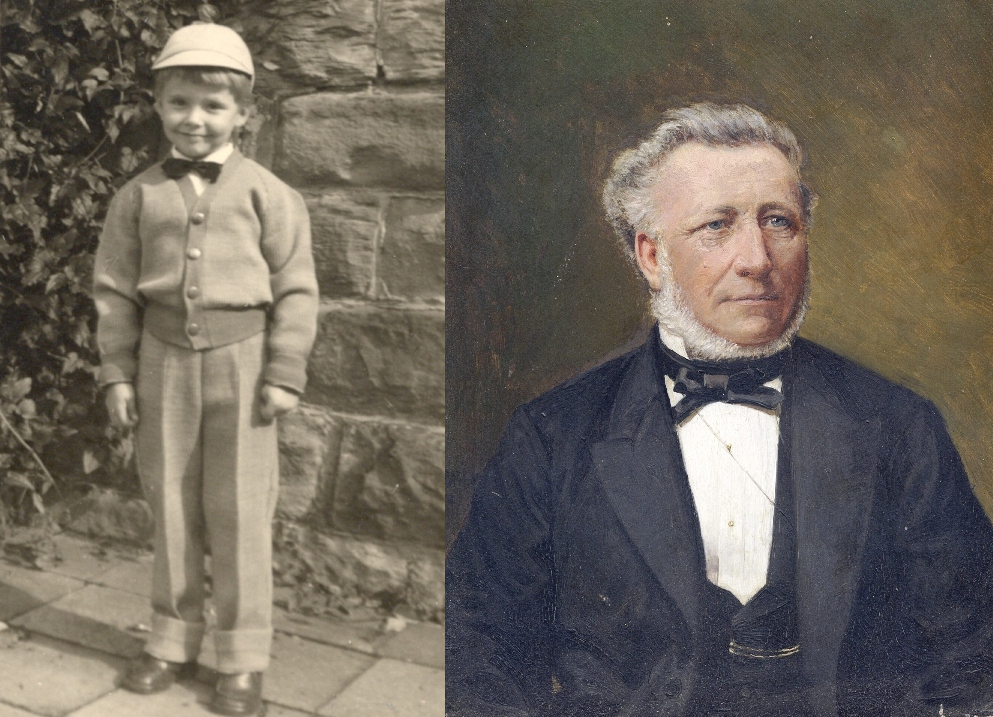
Two Johan Fredrik Maurers, both nattily dressed. (At right, my great-great grandfather, 1817-1887.)
Vanity of Vanities [January 2008]
Questions about Friends and social class have been prominent again in recent weeks in the Friends blogging community.
I'm happy about this development, in part because of my visceral dislike of elitism and of the spiritual violence that we do when we objectify others. (We "objectify" when we look at people coldly, forgetting their equal status with us as made in the image of God; when we reduce people to categories; when we see them as objects of our agendas, or as irrelevant to those agendas.)
Some of my intense feelings no doubt come from growing up with my mother who believed in the superiority of her German "master race"—to the point that she displayed a swastika on her Skokie, Illinois, front lawn during the controversy over Nazis' wanting to march in Skokie. (Did she ever see the irony later on when she moved north to, of all places, Zion?)
For reasons that relate to our family's own violent history, we straddle classes, which gives me insights that I sometimes would rather not have. No doubt this also adds to my blind spots.
But, turning to Friends, I also share a concern that elitism in any form is a dangerous heresy. It is a betrayal of Friends theology, which is radically hospitable because it respects no categories that are not directly tied to God. You (every possible "you") and I are, first of all, created and loved by God—we have no license to create a category outside that compass. The only relevant remaining categories are (1) presently in community with God (converted and convinced, in Christian Quakerese) or (2) potentially in community with God!
The big issue in my mind is: what is the nature of the border between those two categories? From God's all-encompassing perspective, I'm sure the answer is far more interesting and gracious than anything we can conceive. But descending to our Quaker perspectives for a moment, I can imagine how personal biases affect our answers. I want to defend the importance of conscious personal decision, of saying "yes" to God, so I see a definite boundary there, although one for which that "yes" is the only, and I mean only, requirement to pass. Universalists inside and outside Christianity would see that boundary differently, or not at all. A strict Calvinist would have a different understanding, too.
Whether or not you agree with me about the importance of that conscious and personal "yes," we probably all agree theoretically that nothing else should obstruct the threshold into the community. If there is anyone not living in the glorious freedom of the children of God, we should invite them in. We should certainly think carefully and creatively about what it would take to connect both honestly and persuasively with that person, and what aspects of our corner of the community would undercut our message of hospitality.
Back when Brooklyn Quaker first posted his "class narrowness" thoughts, I responded on his blog as follows:
... I won't take the space here to enumerate the number of class-related snubs I've seen or heard about among Friends.
One such snub deprived us of a working-class smoker (*gasp!* - yes, he smoked, but many of the nonsmokers drank like fish). [Fifteen years later, I am inclined to soften this last judgment.]
A working-class woman struggling with Catholicism was another brief visitor, snubbed in part because of her enthusiasm. [Let me add, however, that one of the weightiest members of that meeting said that this visitor was more like George Fox than anyone he knew.]
A husband and wife who wanted to do door-to-door evangelism were told, "Perhaps you'd be happier elsewhere." This, in a meeting that had shrunk to one-third of its size in fifteen years!!
A meeting made its bathroom off-limits to those coming to get boxes of food.
More pet peeves. (Sure feels good to get these off my chest.) ... Meetings whose rhetoric, however well-intentioned, makes it clear that poor people, low-income people, people of "other" races, addicts and members of addiction recovery groups, are not part of THIS fellowship, even when they actually are. [I'm referring to Friends who regard such people as not necessarily worse than us, but as OBJECTS of our goodness.]
I do have a hypothesis: a group that has integrity and spiritual power can attract people from any race and social class. (Unfortunately, so can groups that fake it well: there's never a time when discernment isn't required.) I remember one very dear Friends fellowship that was pretty homogenous but yearned for diversity; half a block away was a Pentecostal church where there was ACTUAL diversity—racial, social, class, temperament, language. Spiritual power does NOT necessarily mean emotional contortions, but it does mean crossing a threshold of conversion and self-abandonment not typically found among the self-satisfied or terminally autonomous.
For the nnnnth time, this sort of meditation has led me to the question: If I see so much incompleteness, why do I stay among Friends? Because I'm deeply convinced that Quaker discipleship is the most authentic way of being Christian that I've been led to. And the inhibitions and compromises that keep this authenticity under wraps are wearisomely familiar to me because ... I share them! Finally, every meeting for worship is a new opportunity to confront those inhibitions and take another step toward greater faithfulness for myself and my community.
Several of the above-referenced blogs refer in one way or another to cultural screens that may or may not play a role in our being inclusive or exclusive. For example, are we too intellectual? Does our comfort with ambiguity repel those who prefer certainty? Are our activist folkways too full of "inessential weirdnesses"? (Thanks to Jeanne/Social Class & Quakers for this link.)
I resist making these class issues—there are intellectuals in every discernible social class, and certainly self-regarding elites can be addicted to certainty. (How else did we get into Iraq despite the misgivings of ordinary people of every class?)
And I'm not at all worried about our having weirdnesses, since every social group has them, and nobody of any class is so stupid as to think that a new place they're visiting will have no peculiar features at all. My question is, are we willing to do the hard, worthwhile work of figuring out which of our behaviors is just our particular wallpaper, and which actually undercut our theology of radical hospitality?
Some additional thoughts, in no particular order:
I continue to believe that the most important pathology underneath Quaker elitism is a defective understanding of God's role in our community. I wrote about this at excessive length here: "Nancy's question" (What are we so afraid of?)
I've visited more than two hundred Friends meetings over the years, and we're in the middle of a ceaseless round of visitations within Northwest Yearly Meeting right now. Some Friends meetings have a very truncated social spectrum; others have an amazing range of people. The wider-range meetings seem to have at least a couple of characteristics in common: First, they are places where talking about one's faith is very easy and natural, where people speak openly about what God is doing in their lives. Second, they're places where it is possible to confess doubt, problems, failures, addictions, fear.
Just one verbal picture: At Melba Friends Church in Idaho, a few weeks ago, a meeting for healing prayer was announced to take place at the rise of meeting for worship. Those who wanted healing prayer were to gather at the front of the meetingroom, while the rest of us got ready for the potluck dinner. There was no mistaking the intense spiritual work that was going on among those gathered at that meeting—but everything about the atmosphere of that community told us that this was completely normal.
When I was a Friends denominational bureaucrat, I noticed (and wrote about) the divide between those who were temperamental skeptics and those who were temperamental proclaimers. The seminary, specifically Earlham School of Religion, was a perennial arena for collisions among those two groups. One group was there to explore their spiritual issues; the other was there to refine their existing commitments and prepare to deploy them in pastoral or other forms of service. What I longed for was a depth of love and accountability in the community that would allow both groups to be themselves and still contribute to building up a faithful, hospitable body.
No group will grow in numbers or faithfulness through guilt or shame. When Judy and I were young adults, we were at a meeting for business at which someone said, "What our church needs is more young couples." No, not so fast! ... what they needed was more confidence in their own identity as people of God. Anxiety about their defects was useful only if it led to positive, creative work on tearing down barriers, not to a negative tearing down of themselves. This was a meeting full of people who'd done amazing things in their (mostly) long lifetimes; they needed to reveal more of themselves, not obsess on their shortcomings.
But on the other hand, maybe that meeting I just mentioned did need to enter a season of self-doubt. They'd been a prestigious Main Street church for so long that perhaps it was important to face at least a few unpleasant realities. My point is to use those doubts creatively, let them break the power of respectability and denial, but then move on to build a more solid foundation of group identity. Recover your dear early love! (Revelation 2:4-5)
This same meeting had young people who once challenged the meeting, through a Sunday School teacher, "Some of you have been Quakers for 60 years—why can't you tell us more about why you became Friends and what you've learned about God in those years?" Well, part of the answer was: "Our generational culture is very private." That privacy is not something to be ashamed of, but it needs to be worked on.
Details on George Lakey's upcoming visit, and a few links: