Showing posts with label silence. Show all posts

12 March 2026

Boredom for Dummies (and everyone)—partly a repost

Detail from Japanese Pearl Harbor attack plan. Source.

First, a few words about our latest war.

When I heard the first news bulletins about the 2026 Iran War, I couldn't help thinking about Pearl Harbor, December 7, 1941, that "dastardly" attack that happened while negotiations between Japan and the USA were still underway. U.S. Secretary of State Cordell Hull expressed his sense of betrayal very plainly to the Japanese negotiators.

The U.S./Israeli opening attack on Iran also happened during a period of active negotiations, facilitated in good faith by Oman.

I'm sure you have as much access to good analysis and commentary on this war as I do, so today I don't plan to say more here. I'm just aware that there are people alive at this moment, in Iran, Lebanon, Israel, perhaps the Gulf states, and beyond, who will not see tomorrow. May God have mercy on them, and on us.


Wess Daniels (from Reedwood
Friends Weekly
)

Last Sunday afternoon, Reedwood Friends Church here in Portland, Oregon, hosted C. Wess Daniels (biography) for a fascinating afternoon advertised as a session on "The Practice of Silence as Resistance in an Attention Economy."

It turns out that one of the themes that Wess has bravely connected to the topic of silence is boredom.

Boredom.

He's been thinking about how to attract more Guilford students to silence as a topic and as a practice ... and not just the Quaker students. Furthermore, he's certainly not hiding from the topic of boredom. He's not defining "boredom" as a danger for budding practitioners of silence, but boredom as a part of something good! Boredom as a superpower

Maybe it's best if I let  Wess explain it himself. Here are two of his blog posts that contain some savory hints of the content he shared so engagingly with us last Sunday:

Let’s Get Bored Together: The Practice of Silence and Resisting the Attention Economy. (February 26, 2023)

A Shot of Light - Getting My Head Above Water. (September 5, 2025)

By the time we met on Sunday, Wess had some other interesting stories to tell from his experiences with students—for example, when he asked them to interview trees.

All of this reminded me that I wrote about "boredom for dummies" back in October 2017, just after our final trip to the USA from Russia. Here it is:


The Amtrak Empire Builder.

... I don't have time for those who don't know what time is.

These words from Boris Pasternak came back to me during the long, slow hours we spent on Amtrak's trains from New York City to Chicago, and then from Chicago to Portland, Oregon.

To tell you the truth, I really needed those long, slow hours of sitting by the train window and letting time carry me into my future. In my last weeks and days in Elektrostal, time went by with dizzying speed, and my mind struggled to keep up, storing up impressions and sensations against the uncertainties of that future. It's likely that we'll never live in Russia again. (Yes, we hope to visit, but even that is uncertain. In any case, I don't think we'll ever again be residents.)

We are learning about gravitational waves rippling through space and time, thanks to Albert Einstein and the recent LIGO observations. For most of us, it's not news that time also seems to be experienced in waves, now compressed and now just dragging along. I love living in the moment, but slow moments, and stretched-out periods where time nearly seems to stop, are equally precious to me.

In a moment of unguarded boastfulness, I once said that I was never bored. That claim didn't stop me from preparing for the transatlantic flight and the train trip by loading my Amazon Fire with episodes of Doctor Who and the Vietnam War series, along with two novels, two books of theology, a history of Protestant missions, and two autobiographies—by Norwegian politician Gro Harlem Brundtland and American astronaut Scott Kelly. But much of the time, day and night, I just watched the country scroll past the window. I felt no pressure to savor or memorize or store up—I just let the planet be the planet and me be me.


Boredom is not a problem to be solved. It is the last privilege of a free mind.

These words open Gayatri Devi's essay on boredom, published on the Guardian Web site about two years ago. Her essay seems to assume a definition of boredom as a state of discontent resulting from lack of external stimulation. (Dictionaries, on the other hand, often seem to focus on boredom as a state resulting from the wrong kind of stimulation—tedious, repetitive, uninteresting.) She rightly recommends not curing boredom by reaching for new sources of stimulus, such as the ever-handy smartphone. Instead, she recommends "metathinking"—in a sense, observing yourself as you slide into boredom, considering what makes you bored, "how your mind responds to boredom, what you feel and think when you get bored."

I would just add a couple of things that are, maybe, already implied in Gayatri Devi's advice:

  • Learn to enjoy your own company. This doesn't mean to give yourself a free pass on everything that might appear on a Fourth Step AA inventory -- but look beyond your imperfections to the whole of yourself, the person whose God-given mind is capable of thought, reflection, observation, intention, reconciliation, synthesis of old and new ideas, and so much more. That apparently empty period of time, whether it's at on a slow train or in line at a bank, is just a golden opportunity to get to spend some time with your complicated self. (Learning to enjoy your own company is a good step toward confronting temptation and addiction. God loved you into being, as Anthony Bloom said, so it's time to look at yourself with God's loving intention in mind.)
  • Reframe slow time as prayer time. You can ask God or your own memory banks for prayer concerns that you may have forgotten or just heard about or that simply beg for your attention. Devi mentions Wordsworth's daffodils; you might instead choose or form a short prayer along the lines of the prayers I mention here....
Make me an instrument of your peace.

Yes.

Lord Jesus, have mercy.

I want to dwell in you.

Back in 2011, I wrote about reading Pasternak's words about time as I sat waiting my turn at the bank branch in Elektrostal.

(End of repost. Original is here.)


John Kinney speaks to Spokane Friends on abundance and scarcity.

Elizabeth Glass Turner calmly considers American evangelicals and the Epstein files.

Luis Parrales: The raw experience of love restored writer Christopher Beha's faith, or at least the possibility of faith. "Beha’s response is to describe himself as 'a skeptical believer'; for him, moments of certainty commingle with moments of doubt." Such restorations have happened to other writers, too.


Also at Reedwood Friends Church: Last Wednesday we welcomed musician Dann Pell and his resonator guitars for a wonderful evening of music.

Some of his songs reminded me of the bard tradition in Russia, though in Dann Pell's case, there is an amazing balance between the poetry and spirituality of the lyrics and his intense and often intricate fingering.

Dann is from Exeter Friends Meeting of Caln Quarter in Philadelphia Yearly Meeting. He's originally from Chester County, which, a lifetime ago, I knew well....

Don't miss a chance to hear him yourself, or invite him to your meeting or church. Here's a video that gives you a better sense than my words could.

17 August 2023

Silence, freedom, and trust, part two

Looking at Rublyov's Trinity. Tretyakov Gallery, Moscow, 2016.

Psalm 122:1. I was glad when they said unto me, Let us go into the house of the Lord.

Habakkuk 2:20. But the Lord is in his [sic; KJV] holy temple: let all the earth keep silence before him.

Katharine Evans and Sarah CheversWe said, we had thousands at our meetings, but none (of us) dare speak a word, but as they are eternally moved of the Lord; and we had Miracles, the Blind receive their sight, the Deaf do hear, and the Dumb do speak, the Poor do receive the Gospel, the Lame do walk, and the Dead are raised.

Last week I tried to make a case for the classic Quaker discipline of silence as a setting to experience the freedom and trust offered by (and required by) worship centered on God.

This week I just want to add a related aspect. I mentioned the noisy world we all live in now, whatever our theological and devotional preferences might be. The scandal I'm pointing to now is how much of that noise is God-talk.

True, some of that God-talk is simply earnest attempts to persuade the audience of one or another form of Good News, with wildly varying degrees of effectiveness.

But so much of it is just plain argumentative. And many of those arguments verge on, or cross the line of, false witness.

(You can see that I've generated my own share of this noise!)

Maybe we're under the illusion that if we don't keep up this barrage of argumentation, the forces of heresy will win. The bigger danger is this: those who claim to speak for God (including those I approve of!) will continue to lose credibility.

Amos 8:11. Behold, the days come, saith the Lord God, that I will send a famine in the land, not a famine of bread, nor a thirst for water, but of hearing the words of the Lord....

Are some of us experiencing this paradoxical famine? If so, let's do something about it.

Let's risk going into God's presence, and gently invite (without clever arguments) anyone who'd like our company there, and gather there, praying quietly for the famine to end. Let's experience freedom and joy in the quiet. Let's trust that the Holy Spirit knows what to do. In the meantime, let's at least consider keeping our mouths shut.


See also: Reverence.

And Yakov Krotov's lessons on courteous communication for Christians: See this post, and scroll down to "Kind questions."


"Can you show me how to pray?" Greg Morgan's reply.

The Guardian reviews Russell Moore's Losing Our Religion.

“We see now young evangelicals walking away from evangelism not because they do not believe what the church teaches, but because they believe the 'church itself' does not believe what the church teaches,” Moore laments.

Tom McCall and the doctrine of good works, interviewed by Beth Felker Jones.

Yuri Sipko (left); Russian Evangelical
Alliance annual meeting, 2016.
The recent criminal case against Baptist minister Yuri Sipko, formerly head of the Union of Evangelical Christians/Baptists in Russia, came as a shock. Maybe it should not have; Sipko has always publicly expressed himself against authoritarianism, including the current war. He has been so eloquent and consistent in his Facebook posts that I'd begun to wonder whether he was under some special political protection. Apparently not. There's been a lot of coverage of his case in the Russian-language Internet, but here's a sample in English. And a Friday update from the same source.

Video: Barbie goes to Russia. (Tuesday afternoon, with street temperature of 107 degrees F. here in Portland, Oregon, Judy and I enjoyed watching it in a local air-conditioned theater.)

... *sigh* I see in these links, I've not entirely avoided God-talk!


Ireland's Imelda May, "When It's My Time."

10 August 2023

Silence, freedom, and trust

The Atlantic Ocean.

During the years we visited and lived in Russia, we were active in the Friends Meeting in Moscow. That small Quaker congregation was unprogrammed—we participants worshipped in silence, waiting on inner prompting before speaking.

Russian historian Tatiana Pavlova was the person around whom the Friends community in Russia gradually developed, starting in the late 1980's. She herself was strongly Christian (I interviewed her about her faith in Quaker Life magazine back in 1999) but the meeting did not require an explicit Christian commitment for participants, and its diversity reflected some of the spiritual ferment and experimentation that abounded in those early post-Soviet years.

Tatiana Pavlova herself was uneasy with some of that variety. Once she said, "When I sit in worship, I want to know that the person next to me is worshipping the same God."

I understand and sympathize, but I'm not quite ready to make the same sort of firm statement. On the one hand, I love the mutual inspiration and encouragement we can get from worshipping with a group of people who fully expect that (in George Fox's words) "Christ has come to teach his people himself." It's this experience that, to me, makes us Quaker, makes us ready to reject the world's reliance on power, violence, objectification of others, and social bondages of all kinds, in favor of trusting in God's leadership.

On the other hand, how will we provide access to this mutual inspiration and spiritual freedom if we don't dare let anyone in who doesn't already speak in Quaker terms? This is what I love about the silence. There's a time for talking and writing, for putting our minds and our creativity into expressing our faith and answering our critics. There's also a time to refer to others' words, whether they're from the Bible or from our more recent prophets and mystics. All that plays a huge role in opening access to our communities, and can serve as an invitation to those who would like to test the values we claim. 

What the silent part of our gatherings give us is this: a chance to put aside our own words, and the writings we love. In other words, it's a time for actual trust—that as we come together in wordless communion, we can trust God's witness to become real in ways that our arguments simply cannot do. In that silence, we are ready to risk precisely what Tatiana Pavlova was concerned about, that the person sitting next to us may not have the same spiritual understanding that we do. Can we trust the Holy Spirit to minister to whatever gap there really is? If we can trust God in unity, can we also trust God in diversity?


Let's say there were two possible ways to describe the ideal Quaker meeting.

One would be a community of worshippers of unlimited social diversity who cherish the values often associated with us—peace, simplicity, equality, decisionmaking by communal discernment, and so on.

The other description would add just one more feature: ... and who are united by that promise from George Fox, "Christ has come to teach his people himself," fully expecting that the community will experience this promise fulfilled.

Most Friends of that first variant use silent "waiting worship" as the main mode of worship in the community. Among Friends who practice this form of worship, some have become very clear that Christian language is optional and sometimes even unwelcome. How does this affect the freedom of silent worship?

The majority of the world's Quakers worship in programmed meetings, with singing and sermons and other planned elements, sometimes with a limited period of time for spontaneous testimonies and silent waiting on the Holy Spirit. Again, is there trust and freedom in the silence? Or is there an expectation of conformity? Or, honestly, has the silence practically vanished, its crucial demonstration of trust and freedom forgotten?

There are lots of historical reasons for the variety of approaches among us Friends, including internal disputes and personality conflicts, and external trends as well. As many others have noted, it's no big surprise that liberal/skeptical Friends meetings are often found where the wider culture is thoroughly secular and faith is belittled. And, conversely, the evangelical variants can flourish in the world's Bible-belt zones. But almost all of us now live in a very noisy world, and keeping a space open solely for quieting ourselves and listening for the Spirit, might not be easy to realize, whatever our local customs and conceits might be.


I know that my particular temperament loves silence, and I don't want to imply that I just happen to have the official Quaker temperament. (I remember a woman who was visiting Fresno Friends Church when we were there. About silent worship, she said, "I wouldn't last five minutes.") However, if something is important to the integrity of our claims and values, it doesn't have to have equal weight for everyone, just as singing and sermons and children's sermons and collecting money don't have equal value for everyone. All spiritual disciplines demand commitment and exercise, whether it's during our public worship or our lives at home and work.

In fact, all of our spiritual gifts and temperaments are exercised on behalf of everyone. Those who pray and listen intensely in silence are not just practicing an enhancement to their individual spiritual lives; their attentiveness and devotion is on behalf of all of us, including those with attention deficits. Thank God, there are those who excel verbally, those who are good with numbers, those who have a special care for children, those with the gifts of mercy and healing and discernment of spirits, those who are musicians and poets—we need everyone!


Silence is like spiritual oxygen to me, and I've written about it many times over the years. But in this post today, I'm particularly concerned about keeping that unprogrammed space open in our meetings for worship, because in the silence of waiting for God, we have an immediate experience of both freedom and trust. Those testimonies are at the heart of Quaker spirituality, and transcend arguments about theology and doctrine. If we don't believe God can be trusted to minister directly to each person who is truly listening, then we should not expect that our outward programming, however valuable on its own merits, will compensate.

Some related posts: Silences. Gathering to meet with God. Quaker communion. Return to silence.

Silence, freedom, and trust, part two.

Молчание, свобода и доверие (this post in Russian).


Windy Cooler: why support public ministry when we're all supposed to be ministers? (Be sure to scroll down to read updates.)

Juan Cole: how the Palestinian crisis became the crisis in Israel itself.

Anna Funder has written a new biography of Eileen O’Shaughnessy, "... a compelling figure strangely absent from her husband’s writing." The husband: George Orwell. The book (which I've pre-ordered): Wifedom: Mrs. Orwell's Invisible Life.

Nancy Thomas's four-year-old theology professor.


Blues dessert: Steve Guyger in France.

22 October 2020

Quaker communion (partly a repost)

If there's such a thing as Quaker communion, is it more like what some of us call open worship, or more like a potluck?

(For the moment, I'm not addressing those places in the world of Friends where a formal communion is celebrated that resembles other Protestants' practices -- although I'd welcome their comments.)

These two comparisons came up in a recent discussion of communion in the Facebook group "Christian Quakers." Participants made a variety of good points about Friends' spiritual understanding of communion. The comparison with open worship was there, but most Friends in this thread focused on the connection with a common meal. 

How does the meal fit in? If in worship we seek the companionship of the living Christ, we are already memorializing his life and death and resurrection; what more do we need? However, if we rush to answer, "Nothing at all -- we're Quakers!" ...  we may be giving in to an abiding temptation in at least northern-hemisphere Quaker culture: to over-spiritualize our religious experience, and then, worse, to look down upon other Christians when those others value outward markers for their experiences of initiation (baptism) and spiritual intimacy with God (communion).

My original post (see below) was dated July 2010, and it was occasioned in part by an experience we had in Moscow Friends Meeting that summer. Our friend Sasha marked the fortieth day after his mother's death by leading a period of communion with bread and wine during our normally unprogrammed meeting for worship. It may have been only the second or third time in my whole life that I experienced such an observance in a Quaker setting, but, given the occasion, I had no hesitation about participating.

Applying the word "communion" to unprogrammed worship, or to the period of open worship in programmed meetings, seems to happen much more often than using it for potlucks or common meals, although I honestly see the validity of both if the heart-level intention is there. I've visited a fair number of pastoral and programmed meetings where the open worship period is described in terms similar to this: "Communion after the manner of Friends." The Richmond Declaration of Faith (1887) says, "The presence of Christ with His church is not designed to be by symbol or representation, but in the real communication of His own Spirit." ("The Supper of the Lord.") Deep Creek Friends Meeting in Yadkinville, North Carolina, referred to Quaker worship as "a time of intimate communion with God and one another..." in this newsletter article from 2013 that described a Sunday morning when their pastor suddenly needed to be elsewhere.


Here's the original text of my post from 2010.

Not long ago, I read some reference to "the Quaker mass," and that got me to thinking. When I'm in a Christian community that practices communion or the Eucharist, I love its deep connection both to history and to the earthiness of life. Usually I'm a sympathetic observer, but occasionally I've participated myself.

Moscow Friends enjoying tea after worship (2010)
Moscow Meeting is unprogrammed, and usually nothing takes place during the hour of worship that would look like a traditional communion to most Christians.

This is as close as we normally get: somehow over the years, a practice arose among us of singing a simple prayer before beginning our tea, asking God to bless us and pour grace on each of us.

Honestly, some Quaker arguments against ceremonial communion seem a bit thin to me. Back when I was serving with Friends World Committee for Consultation, my colleague Val Ferguson used to caution her Quaker audiences about the "three misleading negatives" that we sometimes use to define ourselves. If I remember correctly, she listed those misleading negatives as "we don't have doctrines, priests, or sacraments." 

Val urged us to define ourselves positively, not negatively. She reminded us that we have our own forms of doctrine and leadership, and pointed out that the absence of something is not always an advantage. The sacrament of communion, for example, can be a vivid reminder of the physicality of God's creation in the form of food and drink -- essential products of the earth, and in fact products which too many people don't have enough of.

Among our beloved 17th-century Quaker soundbites are these two from George Fox: "Christ has come to teach his people himself," and "You will say Christ saith this, and the apostles say this: but what canst thou say? Art thou a child of Light and hast walked in the Light, and what thou speakest: is it inwardly from God?" Both imply the importance of communion as relationship, of being in the Presence, of "meeting" in the deepest sense.

So when we Friends argue for an inward and spiritual understanding of communion, as Robert Barclay did in his Apology for the True Christian Divinity (see Proposition XIII), I tend to agree, as long as we modestly remember we still need to make the effort to connect our faith to our practice (for example, keeping a time of quiet waiting in our meetings for worship so that we can actually, simply be in God's presence). If we don't make this effort to link intention and opportunity, it's probably not communion, no matter how lofty our theory.

In fact, isn't this the same effort required by ceremonial communion? What is superior about Friends' practice? Is it the fact that we devote a time of unprogrammed silence to this intention, shielding it from getting crowded out by the other elements of worship? My experience is that communion can be happening whenever God's people assemble -- as I've found among Pentecostals and Russian Orthodox people, among others -- and most Friends wouldn't deny that this can be the case.

No, what I cherish about our minimalist approach is actually more political than spiritual, if it's okay to make that distinction. As soon as you establish an outward practice, you need to guard it. How frequently is it celebrated? Is it optional or mandatory -- and what are the stakes? Who is allowed to lead and to participate, and who isn't? How do we interpret the relevant biblical passages? Is there a script, and how far can we deviate? Must there be literal bread (what about gluten intolerance) and wine (will grape juice do)? Barclay, in his Proposition XIII, touches on the difficulties Christians have had in reconciling their different understandings -- "For there have been more animosities and heats about this one particular, and more bloodshed and contention, than about any other."

But here again, Quakers are not off the hook.

It's true that most yearly meetings don't use ceremonial communion at all, and those yearly meetings that do provide for communion simply allow it, they don't require it. So maybe we're not tempted into the politics of licensing and quality control for this specific practice. However, I know what happens when someone speaks a second time in certain unprogrammed meetings, or speaks too long, or too emotionally, or too early in the hour, or uses the wrong theology. Without "forms," is there also a danger of treating the reality of communion so casually that we, too, might lose the connection between faith and practice? So maybe we still have issues of quality control after all.

Many meetings and churches have elders, or meetings of ministry and counsel, and this is the provision for "quality control" I like the best among Friends. Elders approach the discipline of matching faith and practice, not by appeal to a rule-book or external authorities, but again by going into communion and asking God for guidance. Being humans, they can't guarantee that they will always discern correctly, but neither does an external structure carry any guarantees.

Communion at ecumenical peace demonstration
Jesus said, "Do this in remembrance of me" -- and Barclay rightly points out that it's the remembrance that counts, not the exact method of remembering. Jesus uses other occasions to make similar connections, such as his discussion of Living Water with the woman at the well, and washing the feet of his disciples. But do we in fact remember Jesus? The Russian Quaker Tatiana Pavlova said, "When I sit in worship, I want to know that the person next to me is worshipping the same God." Our practices may seem very different from those of Christians with more liturgy and ceremony, but if we stay faithful to Jesus' words, and if we use our Quaker understandings of communion to grow in Christ rather than to marginalize him in favor of private meditation, or (just as bad) to one-up other Christians, we're still at the same Table. 

(Here's a link to the post as it appeared originally, along with Bill Samuels' thoughtful comment.)


Confession: I prepared this post instead of watching this evening's U.S. presidential election debate.


This Saturday: Friends Peace Teams present a workshop, "Toward Right Relationship with Native Peoples." Information. Registration.

Seventeen countries send their diplomats to the South Hebron Hills. Guess what? The USA was not represented.

A Lesley Stahl interview. No, not that one -- here she interviews Aleksei Navalny. I didn't know his English is this good.

Two very different examinations of a dysfunctional U.S. presidency: Amy Siskind. John Piper.

Louis René Beres examines the continuing risk factors for a miscalculated war between the USA and North Korea. (Thanks to jurist.org for the link.)

Fifty years ago, the concert that launched Greenpeace. (Thanks to Bill Smith for the link.)

Nancy Thomas presents a poetic breath of fresh air from C.S. Lewis.

Mike Farley on the life of prayer that (in the context of today's post, I believe) supports any real communion -- or any movement for social transformation.


A different sort of blues clip: Christone "Kingfish" Ingram describes his guitars, pickups, and pedalboard, demonstrating how each contributes to the sound he wants. Enjoy!

02 April 2020

Return to silence (partly a repost)

Yesterday I was startled by the sound of an airplane overhead.

Until just a couple of weeks ago, I wouldn't have been able to write that line. Planes were overhead constantly. The lack of planes and cars in our daily soundscape here, in this era of self-isolation, has allowed me to hear distant human conversations, nearby birds and insects -- and I can, for once, almost literally hear myself think.

For a retiree, this silence may be golden. But there's a vacuum in the silence, too. The cessation of many familiar sounds is linked with another reality that rings very hollow -- the interruption of work and commerce. The silence on the streets is linked with a record flood of unemployment claims, over 6.6 million in the last full week of March.

Sometimes this deeper silence buoys me up, and sometimes it weighs on me. I'm a terminal introvert, but I've found that even I have limits to my desire for isolation. Unexpected reunions by e-mail and social networks have given me great delight. The nice speakers that Judy gave me for Christmas are booming with classical music when others are nearby, and blues when I'm alone.

Silence during my morning centering hour, on the other hand, seems more precious than ever. As I pass out of the zone of words into the spacious territory of quiet, I've become aware of a hum, a vibration at the very edge of my perception. Maybe it's like the low hum of an amplifier. Maybe it's simply the carrier waves of my nervous system. I'm sure there's a natural explanation. But I'm interpreting it differently, using the analogy of cosmic microwave background -- the residual waves still lingering throughout space from the big bang that gave birth to the universe. When God desired Creation into existence, that original motion of love has never died away, and if I listen carefully enough, I catch a hint of its persistent presence.


The current public health emergency interrupted the plans that Michael Eccles and I had made to be in Moscow for part of last month. Our very first appointment had been the twice-monthly Wednesday worship group of Moscow Friends. The following thoughts on silence originated in a presentation I made six years ago to that same group. I reposted it again three years later, but it has fresh meaning for me now.

Earlier versions of this post had my translation from Natasha Zhuravenkova's Russian version of Pierre Lacout's essay "God Is Silence" for the italicized quotations below. This time I've substituted John Kay's English translation from Lacout's original French.


Fritz Eichenberg, Christ of the Breadlines
Pierre Lacout and silence

The "Thursday group," a circle of Friends who meet on two Thursdays a month [now they meet on Wednesdays], invited me to speak on Friends' understanding of silence, which I did this evening. I was so delighted by the invitation, since for me silence is like spiritual oxygen.

I started by telling about an incident that happened to me at the age of 19, when I was living in rural Pennsylvania and had to walk an hour every workday in the early morning, sometimes starting in darkness, to meet my ride the rest of the way to the Western Electric factory at King of Prussia. I spent the day on the assembly line. At the end of the day, I had the same four-mile walk in reverse, back home. One day, walking in silence as always, I was suddenly overwhelmed by the certainty that I was not an observer, separate from the landscape around me, but that I was the observed one, with the whole visible reality around me was doing the observing.

I fast-forwarded a few years to Ottawa Friends Meeting, within whose community I lived for three years, 1974-77, from the time I became a Christian until the moment I left Canada. I talked about my spiritual mentor, Deborah Haight, and the sense of centeredness I felt in her presence. Deborah was born into a Conservative Friends family in Norwich, Ontario. There were some in our Friends meeting who seemed to aim for an ideal of perfect silence in the meetingroom--street noises and even the sound of children could be a problem. But I had this feeling that Deborah held silence within her.

Discussion handout; read online
The rest of my comments this evening were based on Swiss Friend Pierre Lacout's booklet God Is Silence, which is available online in Russian, translated by Natasha Zhuravenkova. I organized my thoughts around some quotations from that booklet, which I had put in a handout along with discussion questions. I also drew from J. Brent Bill's Holy Silence and Anthony Bloom's conversations on prayer entitled "Let's Try Praying in Truth." (PDF, Russian.)

Lacout, after extolling the advantage of silence:
If nevertheless I speak, it is to communicate with souls whose silence is in unison with mine and who hear the Silence of God in the words I use. If I speak again it is to awaken to this silence souls ready to receive it.

And a bit further on, Regular practice is important. The Spirit blows where [the Spirit] will but ... only fills sails already spread.
Here I emphasized the inner discipline implicit in Lacout's words, and asked if this was any different from what Katherine Evans was talking about among early Friends when she said, "...we had thousands at our meetings, but none (of us) dare speak a word, but as they are eternally moved of the Lord...."

And when our Friend Jan Wood encourages us to "tell the stories of God's power among us," as we might experience it in worship, is this the same kind of talking that Pierre Lacout advocates among those who would otherwise prefer silence? As we discussed how to bring the gift of silence to those for whom deliberate silence is a wholly new idea, Friends mentioned how important it is to demystify it for newcomers to our worship, and not to let Quaker "culture" repel the tender visitor.

More from Lacout on the discipline of silence:
The life of silence is always a willed attention [as contrasted with spontaneous attentiveness to an external distraction]. ... The fully developed religious life becomes a mystic life. For some 'mystic' is synonymous with 'exceptional', involving visions, transports, levitations. ... This is putting the important thing into second place, pushing the central to the periphery. For Paul, a mystic is a person who knows the fullness of Christ, who lives by the inflowing of the Holy Spirit: 'It is not I who live, but Christ who lives in me.' [Galatians 2:20; context.] And 'They are the [children] of God who are guided by [God's] Spirit.' [Romans 8:14; context.]
We spent some time on the question of whether devotional literature, as some have suggested, tends to be written by introverts for introverts, and to what extent Lacout's insights apply equally to those of other temperaments. (Several Friends laughingly took issue with my self-description as an introvert, but I assured them it was a valid label!)

Lacout asserts that
Contemplative silence is a way of seeing which needs no object. It can only be defined as direction. It is a looking towards, not a looking at. Ideas about God are good only if I move quickly on from them. 
But those conceptions, or representations, have a use:
As a starting point [for the practice of silence], we choose beforehand a theme whch can gather together, not disperse, our spiritual forces. This preparation can be infinitely varied according to individual personality, character, vocation and religious experience. 
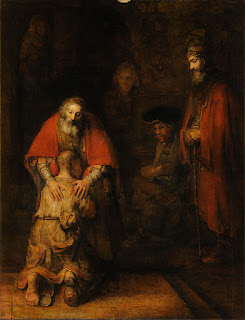
Here I mentioned the role of pictures (Eichenberg, for example, or Rembrandt's Return of the Prodigal Son) in my own life, as well as music, books, and so on. I wish we had spent longer on gathering ideas from the other participants this evening.

I mentioned that a lot of spiritual literature, including that written by and about Friends, reminds me of socialist realism -- it's so upbeat and aspirational that we can wonder whether we'll ever have such wonderfully angelic and serene inner lives. Lacout writes honestly about two main obstacles to growth in silence--firstly, distractions and dissipation, and, secondly, the inner demons of the subconscious.
But the one who does not stop on the way, but goes beyond meditation, ideas and the enjoyment they give, to silence itself; the one who seeks the deepest Center, the very heart of being; such a one cannot avoid meeting in [their] path the subconscious and its phantoms. 
Unfortunately, we barely had time to touch on this important aspect, and the related topic of inner healing, during this evening's session.

One of the topics of our lively discussion afterwards was this question: was there a difference between what we know as Christian prayer and the sort of objectless, contemplative silence that Lacout seems to describe? In the material I distributed, I mentioned Brent Bill's comparison of the Eucharist and Quaker worship, particularly his insight that "We become the liturgist, priest, penitent, and communicant." None of these roles are the end point of silence, but to me they are crucial movements on the path. I talked about the villages in my head (now there are four!) in trying to describe why, for me, intercession is one of the central "objects" of silent prayer. I may cherish the experience of absolute self-abandonment to the Holy Spirit, but first I have to stay rooted enough to keep my promises!

It's also vitally important to remember that Pierre Lacout's definition of a mystic implies that the practitioner of contemplative silence may be "objectless" but is far from empty. I remembered the biblically resonant comments of my Dagestani conversation partner last week -- "If God isn't there, something else will fill that space."

I'm so grateful to the Thursday group for giving me the chance to put these thoughts together and to hear their experiences. Including our own time of silent worship, three hours flew by too quickly.

Originally published on March 6, 2014.


Related:

Silences.

Silent worship: "I wouldn't last five minutes."


Weldon Nisly of Christian Peacemaker Teams writes on enemy love, and on not becoming what you hate. (PDF, go to page five.)

Roger E. Olson's blog specializes in theological posts that simply and calmly invite discussion on topics that are anything but simple. This is why I've linked to him several times in the past. This time he asks if a true Christian can be demon-possessed.

Micael Grenholm lists the five worst Christian responses to the coronavirus pandemic.
We also believe in healing and the value of fellowship. But if the Jesus movement could go on fine during its first 300 years without cathedrals or megachurches, we can handle a few weeks or months.
It's been a long time since I posted anything about Linux-based operating systems. Jack Wallen presents two helpful articles ... the five best Linux desktop distributions, and the rise of the Linux distribution-specific laptop. (Here's mine, still going strong.)

While we're in the world of computers, I'm going to try Wess Daniels' recommended research-oriented notetaking application, Roam Research.


Megan and Rebecca Lovell, known together as Larkin Poe:

06 March 2014

Pierre Lacout and silence

Fritz Eichenberg, Christ of the Breadlines


The "Thursday group," a circle of Friends who meet on two Thursdays a month, invited me to speak on Friends' understanding of silence, which I did this evening. I was so delighted by the invitation, since for me silence is like spiritual oxygen.

I started by telling about an incident that happened to me at the age of 19, when I was living in rural Pennsylvania and had to walk an hour every workday in the early morning, sometimes starting in darkness, to meet my ride the rest of the way to the Western Electric factory at King of Prussia. I spent the day on the assembly line. At the end of the day, I had the same four-mile walk in reverse, back home. One day, walking in silence as always, I was suddenly overwhelmed by the certainty that I was not an observer, separate from the landscape around me, but that I was the observed one, with the whole visible reality around me was doing the observing.

I fast-forwarded a few years to Ottawa Friends Meeting, within whose community I lived for three years, 1974-77, from the time I became a Christian until the moment I left Canada. I talked about my spiritual mentor, Deborah Haight, and the sense of centeredness I felt in her presence. Deborah was born into a Conservative Friends family in Norwich, Ontario. There were some in our Friends meeting who seemed to aim for an ideal of perfect silence in the meetingroom--street noises and even the sound of children could be a problem. But I had this feeling that Deborah held silence within her.

Discussion handout; read online
The rest of my comments this evening were based on Swiss Friend Pierre Lacout's booklet God Is Silence, which is available online in Russian, translated by Natasha Zhuravenkova. I organized my thoughts around some quotations from that booklet, which I had put in a handout along with discussion questions. Since I don't have an English-language copy, the italicized excerpts that follow are from the Russian text. I also drew from J. Brent Bill's Holy Silence and Anthony Bloom's conversations on prayer entitled "Let's Try Praying in Truth." (PDF, Russian.)

Lacout, after extolling the advantage of silence:
And if, even so, I speak, it's just to communicate with those whose silence resonates with mine and who hear the Silence of God in my words. And if I speak again after that, it's to encourage silence among those ready to receive it. And a bit further on, It's important to practice silence regularly. The Spirit blows where the Spirit wishes, but fills only those sails which are already raised.
Here I emphasized the inner discipline implicit in Lacout's words, and asked if this was any different from what Katherine Evans was talking about among early Friends when she said, "...we had thousands at our meetings, but none (of us) dare speak a word, but as they are eternally moved of the Lord...."

And when our Friend Jan Wood encourages us to "tell the stories of God's power among us," as we might experience it in worship, is this the same kind of talking that Pierre Lacout advocates among those who would otherwise prefer silence? As we discussed how to bring the gift of silence to those for whom deliberate silence is a wholly new idea, Friends mentioned how important it is to demystify it for newcomers to our worship, and not to let Quaker "culture" repel the tender visitor.

More from Lacout on the discipline of silence:
The life of silence is always a deliberate attentiveness [as contrasted with spontaneous attentiveness to an external distraction]. ... The fully-developed religious life becomes the life of a mystic. For some, "mystical" is synonymous with "not normal," bringing to mind visions, trances, levitation... This kind of approach focuses on secondary aspects instead of the main point. For Paul, the mystic is an individual who has come into the fullness of Christ, whose life is filled by the Holy Spirit: "I no longer live, but Christ lives in me." [Galatians 2:20; context.] And "For those who are led by the Spirit of God are the children of God." [Romans 8:14; context.]
We spent some time on the question of whether devotional literature, as some have suggested, tends to be written by introverts for introverts, and to what extent Lacout's insights apply equally to those of other temperaments. (Several Friends laughingly took issue with my self-description as an introvert, but I assured them it was a valid label!)

Return of the Prodigal Son
Lacout asserts that
contemplative silence is visioning that doesn't require an objective, a target. It can only be designated as a direction. It involves looking in the direction of something, rather than looking right at something. Conceptions of God are fine as long as I quickly move beyond them. 
But those conceptions, or representations, have a use:
As a starting point [for the practice of silence] we choose an object that can gather together our spiritual strengths, rather than letting them dissipate. This kind of preparation can be endlessly varied according to individual inclinations, character, vocation, and religious experience. 
Here I mentioned the role of pictures (Eichenberg, for example, or Rembrandt's Return of the Prodigal Son) in my own life, as well as music, books, and so on. I wish we had spent longer on gathering ideas from the other participants this evening.

I mentioned that  lot of spiritual literature, including that written by and about Friends, reminds me of socialist realism--it's so upbeat and aspirational that we can wonder whether we'll ever have such wonderfully angelic and serene inner lives. Lacout writes honestly about two main obstacles to growth in silence--firstly, distractions and dissipation, and, secondly, the inner demons of the subconscious.
The one who doesn't stop along the way, but goes on past the joys of reflection, and arrives at genuine silence--in other words, the one who seeks the deepest Center, the very heart of existence--cannot avoid encounters with the subconscious and its phantoms. 
Unfortunately, we barely had time to touch on this important aspect, and the related topic of inner healing, during this evening's session.

One of the topics of our lively discussion afterwards was this question: was there a difference between what we know as Christian prayer and the sort of objectless, contemplative silence that Lacout seems to describe? In the material I distributed, I mentioned Brent Bill's comparison of the Eucharist and Quaker worship, particularly his insight that "We become the liturgist, priest, penitent, and communicant." None of these roles are the end point of silence, but to me they are crucial movements on the path. I talked about the villages in my head (now there are four!) in trying to describe why, for me, intercession is one of the central "objects" of silent prayer. I may cherish the experience of absolute self-abandonment to the Holy Spirit, but first I have to stay rooted enough to keep my promises!

It's also vitally important to remember that Pierre Lacout's definition of a mystic implies that the practitioner of contemplative silence may be "objectless" but is far from empty. I remembered the biblically resonant comments of my Dagestani conversation partner last week--"If God isn't there, something else will fill that space."

I'm so grateful to the Thursday group for giving me the chance to put these thoughts together and to hear their experiences. Including our own time of silent worship, three hours flew by too quickly.


"The Most Underrated Sound in Our Society."

The most helpful article of its size that I've seen so far on the situation in Ukraine in political context. Thanks to Sean Guillory (via Facebook) for the reference.

"This Lent, give up products that are inferior to our product."

"Taking the Start-Up Scene from PDX to Gaza." Thanks to Stu Willcuts @ Mercy Corps for the reference.

Anthony Bloom speaks on Forgiveness Sunday. (In English.)


Rory Block, "If I had possession over judgment day." (Part of my series in memory of Jeremy Mott.)

06 April 2006

Silences

I have several gigabytes of music on this computer, and I'm not listening to any of it. This is one of those times when silence is the best music. This is the first of the silences I'm thinking about today: the silence I voluntarily enter when I want to remember the texture of existence.

This is the most challenging silence. I have to enjoy my own company, go on internal resources, be responsible for my own spiritual awareness, and resist the temptation to addiction and self-numbing. In this silence I can awaken the channels I usually ignore—sounds from upstairs or outside or even from inside me.

The second silence I'm thinking about is that vulnerable silence of Quaker worship. The worship leaders can say "God is with us" all they want; in the silence, we can listen and taste for ourselves. We can approach the altar within, and receive communion there. Or we can stop short of that, remembering someone we're not reconciled with, and note an intention to attend to that. We can merge silences—personal and shared. We can be baptized in the silent Spirit bath, and receive a leading to tell others about the cleansing experience ("All the creation gave another smell unto me than before, beyond what words can utter," said George Fox). Or we can hide in the silence and embroider its lacy esthetic to the point that the crying child is an irritation, not the miracle that is feeding others.

When I first encountered intentional silence, in my meditating days before becoming a Christian, I felt as if I were on the slide of a cosmic microscope. Then, when I began worshipping with Friends, the silence took on a very rounded shape, like a hill. At the beginning, I felt—still feel—the excitement of a journey ahead of me. I'd ascend with the help of the inward liturgy that Deborah Haight of Ottawa Meeting first told me about. Adoration, contrition, thanksgiving, supplication. Then the top section of the curve—the bliss of just worshipping, without agenda, at times almost weightless. As close to Jesus as I dare get. (Sometimes, the baggage I bring makes me not very daring.) On the descent, merging worship and daily life, letting my mind synthesize my images and intuitions, and test out leadings to speak or stay silent.

Another silence: God's silence. I know all the theological excuses, but when millions prayed for Tom Fox, and specifically when I thought I'd given God the most exquisitely persuasive reasons to keep him among us, the discovery of his corpse was so hard that piety gave way to anger. I had to remember that God's universe has a lot of built-in silence and apparent discontinuity in it, from our ground-level viewpoint. If God could tolerate the communal idiocy and cruelty of Judges 19, there is evidently space in God's creation for endless tragic mystery. Nothing that happens is so terrible that it hasn't happened before, I uselessly remind myself as I think about my murdered sister. The Bible seems to tell us that these things are what happens when people operate outside God's covenant. (Judges 21:25, "At that time there was no king in Israel. People did whatever they felt like doing.") Timing is everything, I guess. I'm just glad I don't run the universe, I just live in it, and try to live consciously. And the best way for me to do that is to live with people who stick close to Jesus, without hiding either in convenient cynicism or false piety.


Speaking of sticking closely to Jesus, read these eulogies for Tom Fox. And Alivia Biko's Web site is hosting Derek Lamson's downloadable song for Tom Fox, the song I mentioned back here. (Thanks to Peggy Parsons for alerting me that the song had been posted.)


Immigration and immigrants are again the focus of a national conversation, and I detect a bit more compassion this time around. (Disclosure of self-serving sentiments: I'm an immigrant.) I loved reading in an AP/Yahoo headline that the authorities were surprised by the size of the immigrants' rally in Los Angeles. On a sadder note, this BBC item reminds us that anti-immigrant attitudes and xenophobia are by no means confined to the USA. In Russia, I have personally witnessed antisemitism and racism being flaunted openly in a way that is truly shocking, considering how many millions of Russians were lost in a world war, still in living memory, that was ignited precisely by Hitler's antisemitism and racism.


How indirection and evasion work: I appreciated George Bush's willingness to accommodate challenging questions at today's appearance at the World Affairs Council of Charlotte. Here's a bit of the AP story:
Defending his decision to go to war in Iraq three years later, Bush said it was important that he follow up his words with action when Saddam Hussein refused to cooperate with the United Nations.

"When America speaks, we ought to mean what we said," Bush told the World Affairs Council of Charlotte. "I meant what we said when we embraced that resolution that said `Disclose. Disarm. Or face serious consequences.' Words mean something in this world if you're trying to protect the American people."
Shouldn't this audience be able to trust that Bush's assertive recounting of history is accurate? We know that, by the terms of international demands, Saddam Hussein had indeed disarmed. Bush's coalition did not reluctantly attack Iraq to comply with a UN resolution but eagerly, with unseemly haste and sloppiness, lined up its compliant ducks to do so, after yanking out the inspectors who were in the process of assessing Iraq's weaponry. What serious consequences does Bush face if words, and facts, truly mean something in this world?

It's also frightening when our Supreme Court justices set an issue in a false frame. In this Reuters/Yahoo story, Antonin Scalia dismisses the constitutional rights of Guantanamo detainees. Scalia was quoted as saying, "If he was captured by my army on a battlefield, that is where he belongs." That IF is one of the points at issue, and it's not a minor point. We're not talking about a traditional infantry battle by uniformed soldiers, nor about a traditional war with traditional closure. Prisoners got enmeshed in the conflict by a variety of ways, including innocent blundering, denunciations, bounty-hunting, and, by most prevailing standards, honest combat against an invader. None of these ways provides a humane nation with an excuse to practice the cruelty of indefinite detention without recourse.

Scalia also said, "War is war, and it has never been the case that when you captured a combatant you have to give them a jury trial in your civil courts." He's right. Actual combatants are released to go home. I cannot remember a case in modern times outside the Soviet bloc when someone else's soldiers were held in indefinite captivity. Inside the Soviet bloc is another matter: captured Germans and others sometimes disappeared for years inside the GULag, and so did Russian veterans who had simply had the misfortune of being captured by the enemy. Is this the comparison we've stooped to?