Showing posts with label humor. Show all posts

05 March 2026

Convergence in the Trump era

Back when I was first interested in Russia and the Soviet Union, in my mid-teens, physicist Andrei Sakharov proposed a new twist on Marxist determinism: that, among other factors, the demands of industrial management, the rise of consumer demand, and the danger of nuclear annihilation would cause the great rival superpowers to take on each other's better traits and eventually converge. The resulting societies would feature both rational economic planning and freedom of thought.

Sakharov did not live to see much of the "end of history" phase and the idealists' disappointments in both superpower camps—both with their individual fragilities and their discontented peripheries. The year 2000 featured secret bargains, manipulations, dangerous theatrics, and general confusion in both Russia and the USA, with Vladimir Putin and George Bush ending up on top. Not exactly the convergence that Sakharov had in mind.

In both systems, the neocons (creatively defined for my purposes!) relatively quickly demanded the right to define reality for the rest of us. Putin arguably was ahead in this development, as he and his allies slowly but surely extinguished independent media and built the cult of the indispensable leader. "Putin is Russia, and Russia is Putin," proclaimed Vyacheslav Volodin, currently speaker of the State Duma, in 2014. And since that year, just in terms of government process (setting aside the ultra-nationalist intellectuals and church leaders who are his favorite influencers), Putin alone is the stubborn owner/driver of the war in Ukraine.

The USA's equivalent developments, although far less linear and absolute (we did elect two Democrats in those years), have reached the point where Donald Trump can assert to a journalist that "MAGA is Trump" and that, in starting yet another war, he faces no opposition in true MAGA.

In this Russian bookstore, someone put the Constitution
in the fantasy section. (Originally used here.)

Both of these countries' constitutions nominally have power distributed among several branches. In Russia, the legislators and judiciaries go through the motions of their jobs but, when the stakes involve the interests of those at the top, they see no point in resisting.

Our situation may be less bleak: the judiciary still displays some independence, but the president's party's majorities in both houses of the U.S. Congress mostly continue to fall in line. In the present case of Iran (and Israel and most of the Persian Gulf states), what the president wants is what he gets. Iran is, of course, just the most recent target of U.S. bombs and artillery in the past 13-1/2 months, after Somalia, Iraq, Yemen, Iran (June 2025), the Caribbean Sea and Pacific Ocean, Syria, Nigeria, and Venezuela. In almost every case, Trump gave the orders personally and did not deign to invite Congressional consent. And now he supposedly gets to decide personally who will be the next leader of Iran.

One of the lonely critical Republican voices in Congress, representative Warren Davidson of Ohio, points straight to the constitutional illegality of Trump's process, as reported in The Guardian:

Make no mistake, Iran is an enemy of the United States. As our military engages them, they do so justly. [sic] Unfortunately, they are not yet doing so constitutionally.

For some, this debate will be about whether we should even be fighting in Iran. For me, the debate is more fundamental: is the president of the United States, regardless of the person holding the office, empowered to do whatever he wants? That’s not what our constitution says.

In fact, the U.S. Constitution, and most Republicans' unwillingness to defend it, is at the heart of several of today's crises as we transition from a republican democracy to a personalist authoritarianism. Due process and equal protection of the law came into the Constitution after a terrible Civil War, but today's legislative timidity in the service of throwing out immigrants is shameful. So is the attempt to organize a permanent governing majority through federal legislation, when the Constitution makes it clear that the states are to make election rules.

In 1967, a group of anthropologists contributed papers on war at a conference of the American Anthropological Association. The resulting book, War: the Anthropology of Armed Conflict and Aggression, opened my eyes to the possibility of studying war as a human behavior just like many others, subject to the same disciplines of observation and analysis totally apart from the myths, justifications, and deference it usually gets in real life. One of the contributors proposed that societies are usually either in a "relaxed" state or a "mobilized" state, and anthropologists should study the process by which a society goes from one state to the other. A respondent pointed out that, in modern conditions, most of society can remain in a "relaxed" state while specialists conduct wars on our (supposed) behalf, often without ever seeing their opponents, not to mention the collateral damage. To me this raises a question that I hope you can help me answer: how do we mobilize, not in favor of war, but in favor of our Constitution, before our "relaxation" becomes utter and permanent passivity?

Or, as one of our Moscow friends used to say to us, ironically, "Welcome to Russia!"


Related: "The Cult of Personality and its Consequences."

Living without lying.

A special brand of patriot.

The Bible, MAGA, and a new mission field.


OK, so Kristin Du Mez has some evidence we've not all fallen into a complete stupor.

Conor Friedersdorf wants to know who the USA is at war with right now.

Sojourners Faith and Practice Forum ... a forum for "civic discipleship."

George Lakey on the relationship between prayer, aging, and getting arrested. (Part of a wonderful series on "Aging and Quaker Spirituality.")

Nigel Biggar proposes nine intellectual virtues, and the costs of neglecting them. Thanks to Faith on View for the link.

Please read this lovely tribute to Bishop Seraphim Sigrist, whose passing I noted with great regret on February 12.

Ukraine's Pacifists in a Country at War. (One of them is a faithful participant in this weekly meeting to pray for peace, whether or not his electricity is working.) I encourage you to include them in your prayers.

Speaking of Friends World Committee (previous link), the Section of the Americas has opened up registration for its annual sessions on Saturday, March 21. This year the sessions will be 100% online.


Once again, another version of "Scratch My Back." I've presented this one at least twice before, but it takes me back to Chicago like no other.... Illinois Slim does the chicken scratch.

18 September 2025

Television, censorship, and first principles

Screenshot from source.  

When Judy and I were a young married couple, we had a black and white television that had been a gift from Judy's father. My most vivid memory from that TV was the final episode of M*A*S*H.

In the post-M*A*S*H era, we became very fond of the weekly courtroom comedy Night Court. In fact, on one memorable day, the black and white TV died. It was Night Court's day of the week. What to do?! Somehow in an hour or two we managed to choose and buy a new TV, drive home, hustle it into the house, and plug it in before the show began.

Our regular television diet in those years also included Star Trek: The Next Generation, Northern Exposure, and Inspector Gadget. Some part of our daily schedule was shaped around that sort of television entertainment, always tied to their fixed broadcast times. At some point, we signed up for cable TV as well. However, eventually the Internet disrupted all that. When broadband Internet became available, we explained to our kids that our family budget could allow Internet (at first, DSL on our home telephone line) or cable television, but not both. Which did they want? The Internet won.

So: it's been years since I was a regular TV viewer. The few TV shows that we still watch, separately or together, we access on streaming platforms at times we choose, and most of them have only a handful of episodes per season. Basically, regular television evenings are a thing of the past.

These last few days I've been following the controversies over the ending of the Late Show with Stephen Colbert and the indefinite suspension of Jimmy Kimmel Live! I don't remember ever seeing full episodes of these shows or any of the other late-evening comedy/talk shows on television; I'm basically a random consumer of the clips that show up on YouTube and elsewhere, particularly Seth Meyers' "A Closer Look." When the networks and their owners claim that their traditional broadcast business model is no longer sustainable (one of the explanations for cutting Stephen Colbert), I can't contradict them. We're mostly not in their shrinking audience base.

The abrupt cutoff of Jimmy Kimmel's show, linked with his deliberately misinterpreted comments on the murder of Charlie Kirk, is being treated by many commentators as an alarm bell, even as a Reichstag fire moment. That was my first reaction as well: we've crossed a line into full-blown authoritarianism. But I have two comments that might be clarifications or diversions—you decide.

First: I agree with those connecting the dots between corporate mergers, the president's dislike of criticism, and astoundingly biased Federal Communications Commission leadership. However, I would not look to the television networks' owners (and the television stations' owners) as guarantors of the First Amendment. Certainly they should prioritize loyalty to their long-time talent above placating MAGA, but the brutal truth is that they've always been in it for the money and they will be even more so in this uncertain era. The first-amendment violation is not on those companies' side; they're entitled to broadcast, or not, whomever they want, and the once-applicable FCC fairness doctrine died nearly 40 years ago. The violation is the organized, malicious leverage wielded by the president and his gang against the "agents of Lucifer," namely those of us who now find ourselves under their occupation.

The cancellations (recent and future) of television comedians aren't the Reichstag fire, but they're arguably part of the smoke. The emergency has already happened: the wholesale appointment of unqualified executive-branch and "independent"-agency top managers who are bought and paid for by MAGA; the slashing of safety-net programs and the abandonment of balanced budgeting (including the idea of rational revenue increases) in favor of tax benefits for the wealthiest; encroachments on the constitutional roles of courts and Congress; willful and dangerous denial of climate change; the reversal of years of hard-won progress in racial justice; and a police-state approach to urban crime and immigration enforcement—all happening at a pace that threatens to overwhelm all our civic and constitutional guardrails.

Second (at the risk of introducing a tangent): The political content delivered by the late-evening comedians on Trump's hate list doesn't exactly conform to the first principles I mentioned a couple of weeks ago, and that I committed myself to after Trump's victories (first, second). Often those comedians rudely ridicule and mock and taunt their MAGA targets, making full use of tightly edited video clips and graphics. No pratfall captured by a camera goes to waste. Nobody is fooled; these performers are quite up front in what they're doing. It can be a very seductive comfort to see our political opponents, some of whom are themselves past masters at political insult and able to hide behind the impunity of high office, get a taste of their own medicine.

Don't get me wrong; their biting humor, whatever my doubts about fairness and good taste, is protected speech under any interpretation of the First Amendment, and this brand of political rhetoric has ancient traditions. But what does a steady diet of these commentaries do to our (my) ability to regard these opponents as made in the image and likeness of God?

That blog post of mine from two weeks ago drew these comments from Ken Rubesh on Facebook, who gave me permission to repost them here:

We must ourselves not fall into the same mind as the ones we despise. We must ourselves avoid the three sins of politics.

  1. Impugn the motives of your adversary: To dispute policy or disagree on substantive issues is what politics should be about. To react to a disagreement by always calling your opponent a liar is to assume motive that you, most often, have no right to do. It is to disregard good faith on any discussion and arrogantly assumes your own purity at the expense of others. If we are to get anywhere in our political discourse, we must first assume that all arguments are from good faith and not intentionally intended to deceive, however misguided they may be.
  2. Speak in vitriolic/glistening generalities: Powerful generalities incite the emotions with no substance. They are the lazy way to engage politically. They are intentionally hard to contradict because they have no grounding with which reason against. They make huge assumptions that are not evidenced by facts.
  3. God is on my side: To claim the moral and religious high ground in a secular society is not only unfair but presumptuous. ‘Render unto Caesar what is Caesar’s’ not only supports taxes for the common good but presumes the right to a secular, unbiased government while respecting all religious views. To take on Politics as a moral and religious cause is to invite Cultism and allegiance to a person rather than principle.

Just one additional comment from me: to resist is not to despise. Resistance that has integrity always grants the humanity of the opponent. Even with heightened vigilance for danger, resistance seeks openings for communication, hoping to address together these overriding questions: What are the specific blessings you and we would like to see for our country and our world as a whole? Whom do we not wish to bless, and why?


David Van Reybrouck in the Guardian: "We must not let the shooting of Charlie Kirk become Trump's Reichstag fire."

Lili Loofbourow in the Washington Post: "Kimmel’s suspension confirms what many suspected after Colbert’s cancellation: Media companies must punish Trump critics if they want their mega-mergers approved."

William Barber and Jonathan Wilson-Hartgrove provide some moral context for responding to Charlie Kirk's death and its aftermath.

Meanwhile, in our own city, "A more complicated protest outside Portland’s ICE facility." Thanks to Norma Silliman for the link.

Sunday, September 21: British Quakers join UK churches in an urgent call to pray for peace in the Middle East.

Greg Morgan pays tribute to Fred White, his high school chemistry teacher and lifelong friend. Who is your Mr. White?

Is old age God's way of preparing us for heaven? Nancy Thomas offers metaphors, poetry, and hope.


Aki Kumar, "Scratch My Back." (Kid Andersen is playing Slim Harpo's guitar.)

31 July 2025

The whole Jericho Road

Source.  

A couple of evenings ago I was at a Friends World Committee event with staff and donors. Someone asked about fundraising in a time of crisis. As a donor, how do I choose between FWCC and the children in the Gaza Strip?

In the ensuing discussion, another participant brought up the River Story. (If we see babies drowning in a river, we rush to rescue them, but at some point we must also go upriver to find out how the babies got tossed into the waves, and address that cause.) We support FWCC and our Quaker congregations, along with the rescue work we all want to accomplish, because with these contributions we're helping both goals: we're nurturing our communities' capacity to make our care more systemic and confront the sources of the problem. At the same time we're continuing to support relief and rescue, but not putting all our energy there. In any case, the more we share with each other about our choices and reasons, the more complete our answer will be to the central query before every Quaker congregation: In this time and place, what does God want to say and do through us?

Martin Luther King, Jr., had his own version of the River Story. He used Luke's story of the Good Samaritan (whose setting is not far from Gaza) and applied it to us:

On the one hand we are called to play the Good Samaritan on life’s roadside, but that will be only an initial act. One day we must come to see that the whole Jericho Road must be transformed so that men and women will not be constantly beaten and robbed as they make their journey on life’s highway. True compassion is more than flinging a coin to a beggar. It comes to see than an edifice which produces beggars needs restructuring. 

Following the Web's rabbit trails in pursuing the history of this River Story, I found many references, almost all of which agreed that upstream investigations and interventions should claim a greater share of our resources. But I also appreciated Libby Willcomm's honesty about her own inclination:

Just as it's important to address immediate needs (babies in the river), it's equally important to seek policy reform for long-term, sustainable change. This is where I see the role of MLK's "inescapable network of mutuality". In order for everyone to thrive, everyone must work towards a just and equitable future, yet everyone can have a unique role in this "network of mutuality." And that's where High Road principles come in. By valuing and centering grassroots efforts and community voices while calling for collective, transformational change we're rescuing babies and keeping them out of the water.

Personally, I am much more of a "rescue babies" kind of person. I prefer to work on the ground, in communities, but I applaud those working at a higher level to make changes on a much larger scale. My passion lies in youth development. ... I truly believe that the reallocation of funds (starting with police budgets) to youth-based initiatives could radically change our world. Youth are our future, and based on the young people I've met, especially my High Road peers, it's a hopeful and optimistic one. Whether you prefer to pull babies out of the river or address where they come from, remember that we all hold critical roles in this "inescapable network of mutuality."

"... We all hold critical roles...." Exactly. And here's what I would love to see: that "mutuality" would also become mutual accountability and mutual trust. The next time the question of how to prioritize our resources comes up, I hope I'll remember (or better yet, someone else will remember!) to invite us to go around the group and ask how we arrive at our priorities, and how we make our contributions accordingly.

Maybe you have ways I've never heard of, to address the systemic causes or the most effective methods of direct relief. Unless we talk, I might never know. Even if I don't sign on to your priority, I can pray for you, and support you in the direction you've chosen, knowing that our whole community will then be more effective in keeping God's promises ... rather than one-upping each other on which of us have chosen the better path. I think it's also good to let each other know how we arrive at the amounts or forms of giving that we choose.

At Camas Friends Church, the elders and stewards are collaborating on ways to help us overcome our traditional reluctance to talk about money. Maybe these questions could be part of the conversation:

  1. Which approaches to relief, rescue, and reparation align with our gifts and temperaments: direct aid to those who are suffering, or prophetic challenges to structures? (Not that these two are the only choices!)
  2. Having reflected on what we are best equipped for, how have we chosen to direct our resources of money and property and time, as well as our spiritual focus?
  3. Do our churches and meetings have space for us to exchange our ideas, proposals, and questions?


A blessing and curse of getting older is realizing that many conversations that seem vital for today have been going on for generations. Talking about money, faith, and priorities reminds me of such ancient books as Elizabeth O'Connor's Letters to Scattered Pilgrims (1979, with a foreword by Douglas Steere), and John Alexander's Your Money or Your Life: A New Look at Jesus' View of Wealth and Power (1986).

Among the most powerful books of that era on these general themes is, in my mind, Charles Elliott's Comfortable Compassion?: Poverty, Power and the Church (1987). Among Elliott's observations that made an impact on me were the consequences of the separation of mission and service paths in the church. When service (relief and development, for example) lost its immediate connection to theology and spirituality, it took on the trappings of Western secular agencies and their modernizing agendas and  conceits.

Friends World Committee for Consultation once held Mission and Service Conferences. Maybe we need to find sustainable ways to renew those consultations.


Related posts:


Speaking of things I'd not heard of, this Washington Post article, dated today, was the first I'd heard of Ms. Rachel and her videos, continuing the humane legacy of Fred Rogers. Idealists of the world, unite!

Kristin Du Mez on DEI or CEI? The dangers of Conformity, Exclusion, & Inequality.

The Israel-based human rights groups that are charging their country with genocide.

Friends Journal covers the story of Robert Jacob Hoopes, his arrest in Portland, Oregon, last Friday, and his preliminary hearing. He is charged with violent acts at a June 14 demonstration at an ICE facility here in Portland.

Wilmington College receives a carefully crafted $23 million gift from the late Jerry Scheve.

The Bremerton (Washington) Friends worship group will gather this coming Sunday. There's information on the Web site of North Seattle Friends Church.

Racism: an informal five-question survey.


Rest in peace, versatile mathematician Tom Lehrer. We used some of Tom's songs in our classes in Russia. Students particularly liked the Lobachevsky song (or at least they said they did!), for which I couldn't find a video.) The song in the video below, "Send the Marines," also led to some interesting conversations.

05 November 2020

Election week shorts

Source.  
It's a very different U.S. presidential election experience this time than we had four years ago. For one thing, in 2016 we were living eight hours ahead of the USA's Eastern time zone, which meant that we did not learn the outcome until we were in the second period of our Wednesday morning teaching schedule.

(On second thought, maybe that's not a good comparison. In this year's election week, it's already Thursday, and we still don't know the 2020 results.)

Another difference: in 2016, almost all of our face-to-face social community was pro-Trump (and assumed we were, too). With some of our friends and colleagues, we had a lot of explaining to do. Now, thanks to the pandemic, we temporarily don't even have a face-to-face social community, but most people we're in daily contact with are not Trump supporters.

Election day itself was also very different. Four years ago, I was teaching a class at the Moscow Theological Seminary on election day. Now we're retired -- and on Tuesday we dealt with the stress of election-day suspense by going to the Oregon Zoo, where the residents were definitely able to take our minds off our anxieties: 


In a few days, or maybe even a matter of hours, we will know the 2020 results. A few minutes ago, I saw a video of today's White House press conference, and my mind flashed back to yet another election day -- November 4, 2008 -- and to John McCain's remarkable and historic concession speech.


"It's so interesting who's been elected U.S. president, I'm monitoring every channel, it's so hard to wait, ohhh, if they'd just announce the results already!"
"Here's what interests me: how much more of this I can take.Source.

Elections in USA: Will Trump or Biden win?
Elections in Russia: "I guess I'll choose Putin."
As I shake my head over the clumsy ways of USA elections, I have to remind myself that there are others in this world whose perspective is very different. 

For example, a few days ago I was speaking online with a group of Russians. I was bemoaning the potential dangers of a second Trump four-year term: "We'll be just another banana republic." One of the Russians smiled and said, in effect, "Welcome to the club." He must not be the only Russian who shares this perspective -- there's a theme going around the Russian Internet, which can best be summed up as "be glad you have any elections at all."

Here's an article on this Internet theme, with some bittersweet examples.


Speaking of Russia, here's an interview with Taisia Bekbulatova, founder of a new magazine dedicated to quality journalism in the distant regions beyond Moscow.

Stephen Bates on theologian Reinhold Niebuhr's timely pessimism.

Is it fair to call "make liberals cry again" the Battle Hymn of today's Republicans? (I wonder what Niebuhr would say about this question!)

The remarkable International Space Station celebrates twenty years of continuous human habitation. Robin McKie: Has it been worth it? Alice Gorman and Justin St P Walsh: the unromantic realities -- and the future -- of living in space.


Taj Mahal!

26 March 2020

To Russia with love

According to a joke circulating in Russia during the 1998 financial crisis, two bankers are conversing:

“How did you sleep last night?”
“Like a baby…”
“How could that be??!!”
“Every hour I woke up and cried!”

(Source.)


Judy and I were talking today about what's helping us personally get through the current worldwide public health emergency. I realized that one of the gifts Russia gave us in our years there (2007-17) was an appreciation for the value of humor in maintaining sanity. Not all crisis-related humor is benign, but at best it never minimizes suffering or belittles anyone; instead (as Tom Nicholson points out) its appeal depends on the ways we're all experiencing these challenges together.

People outside Russia might not realize that Russians are simultaneously dealing with at least three big realities. In addition to COVID-19, they're suffering from declines in the financial markets in connection with the fall of oil prices (a crisis which itself is exacerbated by the pandemic), and the brazen constitutional coup engineered by Vladimir Putin, by which he is in the process of awarding himself a fifth and sixth term as president. He would be the first to argue that, if the popular referendum approves his constitutional amendments, he would have to earn those terms by winning elections, but few doubt that he will win any election he contests.

In any case, all of these situations are dead serious, and at the same time, all of them present endless possibilities for humorists. You may recognize some of these examples as originally coming from outside Russia, but, home-grown or imported, here's how Russians presented them:


(Left) "Do you have any summer travel plans?" "In June and July we'll be home, but in August we want to go out to the store."
(Right) Going to work. Specialists recommend observing your daily rituals, even if you don't step out of your home because of the coronavirus.

(Left) In the USA, sales of weapons have gone up sharply. In Russia, sales of condoms have gone up sharply. In a nutshell, that sums up the differences in mentality of the two nations.
(Right) If the traffic cops stop you... [Sign] I have the coronavirus.

(Left) Doctor's advice: To prevent coronavirus infection, eat five garlic bulbs a day. Of course this isn't the least bit effective, but those around you will keep their distance.
(Right) Newscaster: "The ruble's value has fallen so that Russians can't travel abroad and get sick from the coronavirus." My dad: "Great -- a versatile approach."

"Are we going to be at this forever?"
"I don't know. I'm not interested in politics."


Another important thing we learned from Russians, to risk a stereotype: to live in the moment. This is not an argument against planning ahead and anticipating opportunities for change, but it does mean living attentively in the present, appreciating and enjoying what is right before our very eyes, cherishing our relationships and blessings. If we can't be present where we are (to borrow from the title of Douglas Steere's lecture On Being Present Where You Are), what will we be able to bring to the hypothetical future?

From Sarah Masen's "Carry Us Through"
At the beginning of one academic year, the leaders of our institute in Elektrostal gathered the faculty together and told us very plainly that the very existence of the institute continued to be threatened by unreasonable regulations and capricious enforcement, and that, among other things, we had to observe all record-keeping requirements minutely. Carelessness on the part of any of us could endanger everyone. I think we left that meeting discouraged and fearful of the tense months facing us. But as soon as I stepped into the classroom, wrote my first gap-fill exercise on the chalkboard, and greeted the students as they entered the classroom for our first meeting of the year, I was overwhelmed by gratitude for their trust, humor, curiosity, and boundless good will. We set to work.

I've written before about the Russian word normal'no and its enormous range, from "OK" to "the usual misery" -- and of course, like many Russian words, it can be used entirely ironically. In this pandemic season, the comforting power of the word (don't worry overmuch: sooner or later, everything will be normal'no) comes back to me.

If it were not for the pandemic, I would be in Russia this very day. Michael Eccles of Friends World Committee for Consultation and I had spent months planning a trip to visit Moscow Friends, only to have our plans thwarted by the novel coronavirus. I'm sad but not distracted -- there's much to do here, plenty to appreciate, plenty to be vigilant about in this moment. It's a comfort to notice that there's a big piece of Russia in my heart, helping me to cope.


Friends World Committee for Consultation provides a very partial list of online Quaker meetings for worship. Should yours be on the list? (This is not a rhetorical question -- churches and formats vary in their ability to absorb visitors not known to the worshipping community.) Contact information is in the introductory paragraphs.

The coronavirus in Russia ... the view from The Moscow Times.

A rich case study in Russian education and cross-cultural challenges: The demise of Moscow's Protestant university.

Faded records tell the story of school segregation in Virginia.

In his post, Without Assurance, Mike Farley quotes Jennifer Kavanagh: "... Faith is not about certainty, it is about trust...."


Another version of last week's song, "Needed Time."

12 December 2019

Olive harvest

Dialogue Quilt at Ramallah Friends Meeting (see explanation panels at end of this post)
As my family knows, I have the opposite of a green thumb. (Red thumb? Blue?) I seem to have no affinity for plants. When I mow the lawn, Judy carefully places wooden stakes to mark anywhere I might otherwise (despite all efforts at vigilance) cut down a newly-planted treasure.

Olive harvesting in Palestine gave me a chance for a more positive relationship with plants -- specifically, with the majestic olive trees who occupy a central place in the economy as well as the culture of the region.

When our Christian Peacemaker Team in Hebron planned our participation in this fall's olive harvest, we coordinated with several other Palestinian, Israeli, and international teams and offices. We were also in direct touch with several olive-growing families whose groves were adjacent to Israeli settlements or roadways, making them vulnerable to settler harassment. Some of the families needed Israeli permits to access their trees -- permits that only gave a short time to complete their harvests, rain or shine.

We participated in seven families' harvests ourselves. My share of the work seemed safe enough for a city boy -- I would draft an article about the harvest. No way I could hurt a tree with words! At three of the actual sites, I would be part of the accompanying team monitoring potential harassment and making photos for CPT use.

That's all I did at my first site. We had two team members who loved climbing the trees, and who worked very competently alongside the growers and their families, pulling or shaking the olives off the branches. Several settlers walked across their property peaceably, along with nearly two dozen Israeli soldiers, over the course of the afternoon. The single ladder at that site was used by a grower, and I couldn't reach any olives from the ground at that site. The only actual labor I did there was carry a heavy sack full of olives about 300 meters to a roadside taxi stand.

When we arrived at our second assignment, a group of volunteers was already hard at work helping the local Palestinian family, which included a retired educator who had known CPT for most or all of our 24 years in Hebron. Among the helpers was a group of Israeli volunteers who worked at one side of the property, and several Palestinian college students and faculty members were picking olives at a second site. One of the Israelis met us at the entrance to the property. She asked with a smile, "Do you want to work where there are Jews or where there are no Jews?" A bit startled, I replied that this was the first time in my life I'd been asked such a question! As it turned out, by the time we'd finished our interview with the retired educator inside her home, most of the hard work had already been done.

My third experience was with the grower shown in this Facebook video. Finally I had a chance to do some harvesting myself! Once again the only ladder was in use by a more qualified person, and I didn't quite dare climb up into the trees myself, but in this case there were hundreds and hundreds of olives within reach from the ground. By the time my arms gave out, I think I had done a more or less decent job for a first-time picker. Best of all, I don't think I did the trees any harm.

We had heard some distressing reports about recent settler harassment of olive harvesters in various parts of the West Bank, including an incident in which an elderly member of Rabbis for Human Rights was injured. In the three locations where I participated, the harvests were completed without incident.

You can find the CPT report here.


This past Monday I returned from a three-month period of volunteer service with Christian Peacemaker Teams. I'll write about some of my experiences with the team in Hebron in the next few weeks. I'll also be looking for opportunities to speak with your church or meeting, or with other audiences as way opens.

In the meantime, here is a glimpse of my final moments with my kitty companions. Of course they didn't know that I would soon disappear from their lives, but I knew it.

I would also post any number of photos of the wonderful team with whom I served, but posting each other's personal photos on public Web sites is something that can cause complications, so we don't do it.


Nancy Thomas's book on Bolivian Quaker history has been published! I ordered my copy at Wipf and Stock's special Web price from this site. (UPDATE: My review is here.)

News from another writing friend: Bill Yoder has put his archive of religious journalism in one convenient location: wyoder.de.

Does the Christian right in the USA worship a false idol?

Leon Aron on Russian political humor. (My own tribute from last year. And an earlier post comparing Quaker and Russian humor, plus Mike Royko on corruption in Chicago.)

God and Stephen King.

Netanyahu wags the dog ... again.


Gino Matteo and Jason Ricci ... "I need Jesus to walk with me."


Information about the Middle East Dialogue Quilt and its imagery (photo at top of post):

26 April 2018

Russian humor as testimony

Facts about Pluto:
 1. Pluto's surface area is equal to Russia's.           
   2. Pluto has about the same level of infrastructure.


"The correct way to wait for the bus, to avoid violating
the law against unsanctioned demonstrations."
In my recent post grieving the end of our residency in Russia, I mentioned my love of Russian humor. Much of that humor consists of national self-deprecation, and that's why I'm a bit reluctant to share too much of it among my friends and contacts outside Russia. There's enough dumping on Russia in the West right now, and I don't want to add to it without good cause.

"Good cause" often does exist, mostly resulting from actions by Russian politicians following well-worn paths of authoritarianism, corruption, and toadyism. Russia is not alone; similar patterns afflict many other countries with local variations, myths, and blind spots. The USA is currently challenged by its own particular outbreak of this plague.

Russia's endemic political ailments are very competently diagnosed -- and ridiculed -- by Russians themselves. Foreign help is not needed, and furthermore can be resented. I've quoted Pushkin on this point before: "Of course I detest my homeland from head to toe -- but it really gets on my nerves when a foreigner shares this feeling with me."

So: my intentions are honorable. I neither want to add to the undifferentiated criticism of Russia as a country (as distinguished from the well-earned criticism of some of its leaders); nor do I want to irritate Pushkin and his descendants, the Russian people who may somehow find this post. Sharing Russian humor is my testimony to the intelligence, honesty, discernment, and resilience of the Russian people as I've come to know them over my whole adult life.

Three other points of "testimony":
  • To convey something of the flavor of Russian self-reflection is not a matter of comparing Russian highs and lows with America's or anyone else's. To me it's a reassuring evidence of human solidarity that Russians cope with absurdity and adversity with humor, just as we do. Self-deprecating humor, the specific type of humor that can be both howlingly funny and risky to share with unintended audiences, is also found all over the world. (Once, in rural Honduras, I remember a farmer pointing to a flock of large black birds flying overhead. "Look," he said. "It's the Honduran Air Force.")
  • Nancy Ries, in her book Russian Talk: Culture and Conversation during Perestroika, studies the Russian use of self-deprecating humor in detail, as part of the litanies and laments that often characterize Russian commentary on their lives and their nation (their "Anti-Disneyland" as one of her interviewees said). As an American who lived in Russia, and loved living there, it was not my job to fix the problems that that went into those laments, despite the American tendency to jump immediately to problem-solving mode, but it was my job to listen. As a human being, as a Christian evangelist, as a Quaker communicator, listening was the highest priority. When we listen, we hear the witness of God in each person, and temptations to intervene recede to their proper place.
  • However, there is a spark of truth in that desire to intervene. Nancy Ries encourages us to consider when the rhetoric of hopelessness, no matter how wittily deployed, actually perpetuates powerlessness. The ideal ministry team includes the pastoral listeners, but also the prophetic capacity to propose next steps.


In the parts of Russian national life most visible to me here in the USA, namely the Russian Internet, there is a new crescendo of biting humor arising from the misadventures of the Russian agency in charge of supervising media and telecommunications, Roskomnadzor. Its nameplate looks like this:
 
... which is important, because that little diamond logotype refers to Roskomnadzor in the flood of memes that commemorate its so-far-disastrous attempts to shut down Telegram, the online messaging service. Telegram is, in turn, represented in the graphics by own logotype, the little paper airplane on a blue disk, or by founder Pavel Durov's face.

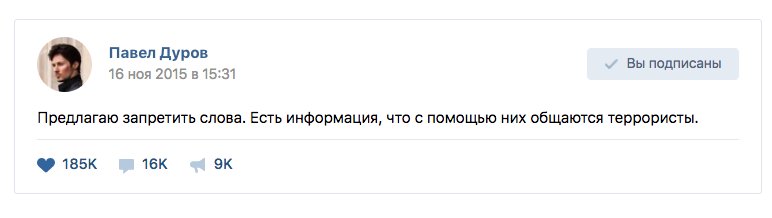
Pavel Durov, 2015: "I suggest banning words. It's reported
that terrorists communicate with the help of words."
Roskomnadzor charges that Telegram, with its capacity for anonymous encrypted communication, is used by terrorists, and demands that the company provide access keys for the government. Telegram's head, Pavel Durov, was the founder of Russia's answer to Facebook, Vkontakte, whose current ownership is in Kremlin-friendly hands. Durov is committed to security for Telegram's users, as he was to Vkontakte in the years before his ouster. (Whether Telegram actually provides 100% security is a disputed technical question; the political issue is Durov's commitment to refuse any demand for access.)

"I couldn't resist."
In the face of Durov's refusals, Roskomnadzor applied to a court for approval to block the service in Russia. When approval was granted after an eighteen-minute hearing, the agency began blocking more and more servers and IP addresses associated with Telegram's pathways through cyberspace, and in the process blocked or impeded hundreds of businesses and services, including Google, Amazon, and Yandex, none of which are linked in any way with Telegram other than the coincidence of using some of those same pathways. It's almost as if you decided to block my phone number by blocking everyone who used the same exchanges or area codes I might have used once, simply because I could change my number to outwit surveillance.

Roskomnadzor now has to deal with the floods of complaints of blockage and lost business, but also with being made a laughing-stock: Of all the victims of Roskomnadzor's tactics, Telegram is (so far) among the least affected.

"OK, so where's Telegram?" (Source: found on memepedia.ru.)
(Source: found on memepedia.ru.)


Dialogue in graphic at right:

"We built a gigantic wall. There's no way you can get around it."

"But that's a door right over there." (VPN)

"Nevertheless, you're not going to ..."

"Ooh, looks like I got through."

"Make that wall three times higher. HURRY!"

(The name of the graphic file is the very Russian saying, "There's always a doorway.")


(Source: found on pikabu.ru.)

On fence: "INTERNET" (Source: found on oborot.ru)

"Give me Telegram, and I'll let you live." (Source: found on oborot.ru)
Finally, "The Battle of the Century: Telegram vs Roskomnadzor"... this homemade modification of a fragment from a classic Soviet-era cartoon. The chair is labeled "Constitution of the Russian Federation"; probably nothing else needs translation.


More information on the Meduza Web site: The damage done. Telegram supporters will protest in Moscow on Monday. There's an update in Russian here.

ADDED: An interview with Tanya Lokot.


Were these evangelicals trying to save their movement from Trumpism? (And Mark Labberton's address to the Wheaton consultation.)

Exchanging the worship of God for cheap emotional thrills. (Is this article completely fair?)

Higher power: When Americans say they believe in God, what do they mean?

Julia Duin on the Religion News Service "meltdown," part one.

Melanie Spring Mock: Why it's ok to cry at writing retreats....


Deborah Coleman, 1956-2018

25 January 2018

To Russia with love

"The most realistic path to political change in this country." (Found on vk.com)
The Russian presidential election is less than two months away. There's already a lot of skeptical commentary about whether the word "election" (which implies actual choice and the possibility of change) can even be honestly used for the process. Yes, much of that commentary will come from outside Russia, but it's also a huge theme on vk.com (vkontakte, Facebook's big rival within the Russian-speaking world) and other social media in Russia. To risk a generalization, the older the commentator, the more audible the sigh of resignation.

The election season, then, threatens to add to the cloud of negativity around the great nation of Russia. Three months after our own departure from the country, it seemed right to counter some of that negativity, not by spraying nice deodorant on the politics -- that I won't do -- but by looking back on just a few everyday things about Russia out of the many details of daily life that I intensely miss.

No kidding! This package came to us from the
postal workers at P.O. 144010, Yalagin St.
Before my first detail, I want to stipulate one huge category that I can't possibly cover adequately: the people. From the Russian Orthodox peace activist with whom I shared a talk show appearance, to the young woman who cut our hair, the dear members of the Russian Quaker groups, the extraordinary students and colleagues at our Institute in Elektrostal, the Baptist seminarians, the neurologist who treated my plantar fasciitis, the grocery store cashiers, refrigerator techs, poets, librarians, Kurskii railroad cafe workers, bus conductors, taxi drivers, hockey players, and not least, the postal workers who sent us candy for Christmas!!! ... the wonderful memories of friendship, kindness, patience, sympathy, and hilarity come flooding back.

Just sampling a few lesser things I miss severely:

Buying prescription drugs

If you live in the USA, your medicines are dispensed manually: you get a bottle with your name on it, and the pills are counted into the bottle while you wait in line, if you're lucky. If you've run out of refills, you will have to wait until your doctor authorizes a new supply.

Lisinopril in familiar box
Russia spoiled me. As soon as the staff at our local drugstore got to know us, we didn't need fresh prescriptions for our routine (that is, non-narcotic) prescription drugs. Just say the name of the drug and the dosage, and you get the blister packs in seconds. If one store is out of a particular medicine, there are five more pharmacies within ten minutes' walk.

Blood and urine tests were practically as easy: the clinic/collection point was one minute away from our apartment, and results were available online later that day or the next.

Only in Russia? Poetry readings on your bus ride.
Minibus sign: "A few minutes of terror, and you're home!"
Public transportation

I can't find too many nice things to say about driving in the Moscow region -- there were simply too many cars for the road system. Aside from the unpredictable duration of the trip, driving required developing a fine intuition for knowing when to yield and when to be aggressive, when to obey the rules and when to drive on shoulders and sidewalks. After two years, we sold the car we had inherited, and relied exclusively on public transport.

And why not? Almost every inch of Elektrostal (pop. 150,000) was reachable by buses running on convenient schedules that were posted on the Internet. Trains left nearby Fryazevo village for Moscow every 20-30 minutes at all times except the noon hour, connecting us to Moscow's unrivalled subway system in a little over an hour. Buses to Moscow were slower, but the Moscow bus stop was one minute away from our apartment.

Transportation costs were, admittedly, subject to high inflation. From September 2007 to September 2017, bus fares in Elektrostal nearly tripled. However, actually paying fares was easy ... you don't need exact change or a ticket. Once a guy got on board a Fryazevo-Elektrostal bus with a thousand-ruble note to pay the 20-ruble fare. The driver didn't have that kind of change: "Do I look like a bank?" The passenger appealed to the rest of us, and pretty soon practically all of us were involved in getting him the change he needed, with a lot of good-natured ribbing. Instant community.

During our last year in Russia, we began using the Yandex Taxi system, an Internet-driven taxi ordering and monitoring service with an Uber-like mobile phone interface that really took all the uncertainty out of using taxis.

Cheap Internet

Ministry of Culture blocks theaters from showing the film
The Death of Stalin. Plane is labeled "By Internet." (Source.)
In our apartment, for 100 Mbps (maximum speed) we paid under $10 per month. Now that we have given up our apartment and are in the USA, we see that our Elektrostal provider is running a special: for about $1 more, we can get 132 channels of cable television! We probably would not have paid that extra dollar if we'd stayed, since we rarely watched television, but when I look at what our friends here in Oregon are paying for Internet service, there's no comparison.

True, our actual speed rarely reached that theoretical limit, but nothing we did on the Internet required anywhere near that speed, even with two laptops, two tablets, and two phones connected all at once.

We were sternly warned to use a VPN in Russia, which we did. Now VPNs have been declared illegal. I have no doubt that they are still in use, one way or another.

Internet service on our mobile phones was also very reasonable. We paid about $6/month per phone for unlimited domestic voice and SMS usage and 4G Internet. However, we had to pay full price for the phones themselves; they were unblocked and not bundled into subscription contracts. On balance, it was an economical arrangement. I've kept my number and can use it even from the USA when I need to receive SMS texts -- for example to connect with my Russian bank.

Humor

Russia's constitution -- in the bookstore's fantasy section.
I miss Russian humor -- and as a dedicated follower of politics, I especially miss being around Russian political humor. Of course, in this highly politicized presidential-election season, I'll have access to a lot of it through the Internet, but that's just not the same as the stage whispers among our students, or the side-comments in the teacher's lounge.

Political humor in Russia is nothing new. In Soviet times it was far riskier, but nevertheless persisted, and some might say it came into full flower during the late Soviet era. (Heard on Radio Yerevan: What's a Russian classical trio? Answer: A Russian classical quartet after an overseas tour.)

Humor can make life bearable, but it also has a shadow side. The sad tradeoff of the current consolidation of Russia's "power vertical": the less hope for positive change, the more cynical humor. This kind of humor is a two-edged sword; the emperor might not have clothes, but who cares? What do you want me to do about it?

Still, I bet Americans have no idea how much Russians are able to laugh, not least at themselves. It's just not part of the stereotype here. And I miss it.

Friday PS: Winter

This morning, the following "one year ago" picture showed up in my Facebook feed. I actually miss winter ... except the ice.

Our courtyard one year ago, at 7:14 p.m.


Last September we led a learning tour of Moscow, Elektrostal, and St. Petersburg. I'm already thinking of what to include in the next edition of our tour.


Becky Ankeny: Hope and living water.

Now that's what Jim Kovpak calls Russophobia.

Three items on Russia's upcoming presidential elections: by Elena Solovyova, Leonid Ragozin, and Andrei Kalikh. Please read these writers with care: you will learn something about the wisdom and danger of passivity, and maybe the uselessness of glib insights from the West.


Last week, Mark Hummel's Blues Harmonica Blowout came to Eugene. At first I was startled to hear such ecstatic music in such staid concert surroundings (the Shedd Institute's Jaqua Concert Hall), but then I realized why it was entirely suitable: utter virtuosity. Among many other great musicians, I was delighted to hear Billy Boy Arnold, now 82 years old.

On this video, the guitarist on our left is one of my favorites, Charlie Baty.