Showing posts with label travel. Show all posts

12 March 2026

Boredom for Dummies (and everyone)—partly a repost

Detail from Japanese Pearl Harbor attack plan. Source.

First, a few words about our latest war.

When I heard the first news bulletins about the 2026 Iran War, I couldn't help thinking about Pearl Harbor, December 7, 1941, that "dastardly" attack that happened while negotiations between Japan and the USA were still underway. U.S. Secretary of State Cordell Hull expressed his sense of betrayal very plainly to the Japanese negotiators.

The U.S./Israeli opening attack on Iran also happened during a period of active negotiations, facilitated in good faith by Oman.

I'm sure you have as much access to good analysis and commentary on this war as I do, so today I don't plan to say more here. I'm just aware that there are people alive at this moment, in Iran, Lebanon, Israel, perhaps the Gulf states, and beyond, who will not see tomorrow. May God have mercy on them, and on us.


Wess Daniels (from Reedwood
Friends Weekly
)

Last Sunday afternoon, Reedwood Friends Church here in Portland, Oregon, hosted C. Wess Daniels (biography) for a fascinating afternoon advertised as a session on "The Practice of Silence as Resistance in an Attention Economy."

It turns out that one of the themes that Wess has bravely connected to the topic of silence is boredom.

Boredom.

He's been thinking about how to attract more Guilford students to silence as a topic and as a practice ... and not just the Quaker students. Furthermore, he's certainly not hiding from the topic of boredom. He's not defining "boredom" as a danger for budding practitioners of silence, but boredom as a part of something good! Boredom as a superpower

Maybe it's best if I let  Wess explain it himself. Here are two of his blog posts that contain some savory hints of the content he shared so engagingly with us last Sunday:

Let’s Get Bored Together: The Practice of Silence and Resisting the Attention Economy. (February 26, 2023)

A Shot of Light - Getting My Head Above Water. (September 5, 2025)

By the time we met on Sunday, Wess had some other interesting stories to tell from his experiences with students—for example, when he asked them to interview trees.

All of this reminded me that I wrote about "boredom for dummies" back in October 2017, just after our final trip to the USA from Russia. Here it is:


The Amtrak Empire Builder.

... I don't have time for those who don't know what time is.

These words from Boris Pasternak came back to me during the long, slow hours we spent on Amtrak's trains from New York City to Chicago, and then from Chicago to Portland, Oregon.

To tell you the truth, I really needed those long, slow hours of sitting by the train window and letting time carry me into my future. In my last weeks and days in Elektrostal, time went by with dizzying speed, and my mind struggled to keep up, storing up impressions and sensations against the uncertainties of that future. It's likely that we'll never live in Russia again. (Yes, we hope to visit, but even that is uncertain. In any case, I don't think we'll ever again be residents.)

We are learning about gravitational waves rippling through space and time, thanks to Albert Einstein and the recent LIGO observations. For most of us, it's not news that time also seems to be experienced in waves, now compressed and now just dragging along. I love living in the moment, but slow moments, and stretched-out periods where time nearly seems to stop, are equally precious to me.

In a moment of unguarded boastfulness, I once said that I was never bored. That claim didn't stop me from preparing for the transatlantic flight and the train trip by loading my Amazon Fire with episodes of Doctor Who and the Vietnam War series, along with two novels, two books of theology, a history of Protestant missions, and two autobiographies—by Norwegian politician Gro Harlem Brundtland and American astronaut Scott Kelly. But much of the time, day and night, I just watched the country scroll past the window. I felt no pressure to savor or memorize or store up—I just let the planet be the planet and me be me.


Boredom is not a problem to be solved. It is the last privilege of a free mind.

These words open Gayatri Devi's essay on boredom, published on the Guardian Web site about two years ago. Her essay seems to assume a definition of boredom as a state of discontent resulting from lack of external stimulation. (Dictionaries, on the other hand, often seem to focus on boredom as a state resulting from the wrong kind of stimulation—tedious, repetitive, uninteresting.) She rightly recommends not curing boredom by reaching for new sources of stimulus, such as the ever-handy smartphone. Instead, she recommends "metathinking"—in a sense, observing yourself as you slide into boredom, considering what makes you bored, "how your mind responds to boredom, what you feel and think when you get bored."

I would just add a couple of things that are, maybe, already implied in Gayatri Devi's advice:

  • Learn to enjoy your own company. This doesn't mean to give yourself a free pass on everything that might appear on a Fourth Step AA inventory -- but look beyond your imperfections to the whole of yourself, the person whose God-given mind is capable of thought, reflection, observation, intention, reconciliation, synthesis of old and new ideas, and so much more. That apparently empty period of time, whether it's at on a slow train or in line at a bank, is just a golden opportunity to get to spend some time with your complicated self. (Learning to enjoy your own company is a good step toward confronting temptation and addiction. God loved you into being, as Anthony Bloom said, so it's time to look at yourself with God's loving intention in mind.)
  • Reframe slow time as prayer time. You can ask God or your own memory banks for prayer concerns that you may have forgotten or just heard about or that simply beg for your attention. Devi mentions Wordsworth's daffodils; you might instead choose or form a short prayer along the lines of the prayers I mention here....
Make me an instrument of your peace.

Yes.

Lord Jesus, have mercy.

I want to dwell in you.

Back in 2011, I wrote about reading Pasternak's words about time as I sat waiting my turn at the bank branch in Elektrostal.

(End of repost. Original is here.)


John Kinney speaks to Spokane Friends on abundance and scarcity.

Elizabeth Glass Turner calmly considers American evangelicals and the Epstein files.

Luis Parrales: The raw experience of love restored writer Christopher Beha's faith, or at least the possibility of faith. "Beha’s response is to describe himself as 'a skeptical believer'; for him, moments of certainty commingle with moments of doubt." Such restorations have happened to other writers, too.


Also at Reedwood Friends Church: Last Wednesday we welcomed musician Dann Pell and his resonator guitars for a wonderful evening of music.

Some of his songs reminded me of the bard tradition in Russia, though in Dann Pell's case, there is an amazing balance between the poetry and spirituality of the lyrics and his intense and often intricate fingering.

Dann is from Exeter Friends Meeting of Caln Quarter in Philadelphia Yearly Meeting. He's originally from Chester County, which, a lifetime ago, I knew well....

Don't miss a chance to hear him yourself, or invite him to your meeting or church. Here's a video that gives you a better sense than my words could.

11 December 2025

Traveling shorts

A couple of weeks ago I sketched our travels from London, England, to Hampstead, New Hampshire, via Barcelona. As I prepared to publish that post, we were hearing reports of winter conditions predicted for the path of our upcoming train trip home via Boston and Chicago.

As it turned out, we traveled in great comfort (despite being in coach seats the whole three days), but winter weather did cause several delays, particularly west of Chicago. By Malta, Montana, outside temperatures were down to -6 F.

At one time, technical problems and "congestion" got us five hours behind schedule, but we pulled into Portland, Oregon, only four hours late.


I brought an 800-page book with me, and nearly finished it on the train. It was Anne Rivers Siddons's Peachtree Road, a fictionalized social history of 20th-century Atlanta, Georgia, mostly from the point of view of its midcentury elite families. It's a sweeping cultural epic combined with close-up accounts of family dysfunctions and episodes of social failure worthy of Tolstoy. In any case,the book had plenty to keep me occupied.


One moment in Peachtree Road was particularly poignant for me. The author described the impact of President Kennedy's assassination on the idealists in Atlanta's emerging leadership of the early 1960's. I remember the assassination vividly, but at age ten, I had not had any sense of the "Camelot" aura around the Kennedys' White House. 

Now, reading the novel, I remembered an incident in my Russian history class at Carleton University. The professor was Carter Elwood, a central figure in Slavic studies in Canada and the world, and an inspiring instructor in the classroom. (And Carleton had no lack of inspiring instructors in Soviet studies—Vladimir Grebenshchikov, Paul Varnai, Halina Stepanovna van de Lagemaat—see last item here, Edward Lee, and others.)

On November 22, 1973, the tenth anniversary of John F. Kennedy's assassination, Elwood set aside his normal themes. He talked to us about that brief period of new ideals, energy, and elegance, that Kennedy's presidency seemed to bring, and that were ended so cruelly by Oswald's bullets. With tears in his eyes, he contrasted the Kennedys' Camelot with the state of affairs in 1973, Nixon having just gone on television the previous week to tell us he was not a crook.


We have made this particular three-day railroad trip several times before, but it's not the longest train trip we've taken. That happened in 2011, when we spent four days on the train from Moscow, Russia, to Sukhbaatar, Mongolia. Some pictures from that trip are here, and I described the book I read on that trip, Crazy for God, in the following week's post.


One final note on travel. This year I marked the fiftieth anniversaries of two trips that helped shape my life. The first one was to Mississippi, and the second, to Moscow and Leningrad. More on those trips at From Mississippi to Moscow.


The Friends Incubator for Public Ministry presents an online conversation with Windy Cooler and historian Tom Hamm on bold Quaker ministers. It's this Saturday at 11 a.m. Pacific time. Register through the link on this page.

Two Washington Post items on religion in the USA: "A hidden trend" (new fascination with faith among young people); and Senator Warnock's warning to all of us,  particularly Democrats, of the cost of ignoring faith. (Video of Warnock's presentation is available here.)

Is there a moment of truth coming for the USA's NASA and its moon-landing project? Ars Technica's Eric Berger describes a recent congressional hearing in which one credible scientist made his doubts very clear.

Tricia Gates Brown on "the hidden burden of chronic shame."

I cannot, cannot press "publish" on this post without noting the vulgar inhumanity of Trump on Somalia and Somalis. It is a festering scandal that such a man occupies the White House. Words fail me, so I'll link to The Guardian's Moira Donegan.


In keeping with the travel theme, I'm closing this week's post with a classical pianist from London, Nataly Ganina. She began her musical education at age 5 in Riga, Latvia. We first heard her at a lunchtime concert at St. Olave's Hart Street, London, three years ago, and then again at the same place last month. I couldn't find a video clip from that location, but here she is at Holy Trinity South Woodford last October, playing one of my favorite impromptus from Schubert, as she did again a couple of weeks later at St. Olave.

(I've selected the segment that starts with Schubert's fourth impromptu from Op. 90, but if you have the time, listen to the whole concert.)

27 November 2025

Thanksgiving shorts and links

... for those who celebrate on this day, and anyone who likes the idea.

Source.  

I'm grateful for a wonderful time in London with our son, and for safe travels back to the USA on two airlines I'd never heard of. Both airlines—Vueling and LEVEL—are owned by the same company that owns British Airways, Iberia, and Aer Lingus, and both serve Barcelona, Spain, through which we flew to get to our transatlantic destination, Boston. Although Vueling's A320 had the tiniest pitch of any airplane I've ever flown in, with my knees pressed into the seat in front of me, I was thankful for a reasonable fare for a one-way transatlantic trip.


I'm grateful for the wedding that was the occasion for coming back to the USA through Boston. Our nephew Ben Cabezas married Chris Rainville last Saturday, in Hampstead, New Hampshire. Among the many blessings resulting from the wedding was the biggest reunion of extended family that I've experienced for decades. Best wishes to Ben and Chris, and thanks for the wonderful occasion and reunion. On the most basic level, I'm incredibly grateful for family, wherever they may happen to be today.

Our next stage of travel is planned to start tomorrow: Amtrak trains from Boston to Chicago and then Chicago to Portland, Oregon. We made this trip several times during our Russia years, and are looking forward to those days of continental sightseeing through train windows and the Empire Builder's observation car, along with plenty of time to read and to do my daily Norwegian language homework.

One wintery wrinkle: significant snow predicted along our Amtrak route.


I'm grateful that this is a holiday post, and I can end this post a bit early, compared to my usual length! It's time to celebrate.


Elizabeth Meyer on baking pies in God's presence.

Diana Butler Bass: "This Thanksgiving, we do not give thanks. We choose it."

Becky Ankeny on having trust that is based on the character of God.

Micah Bales on adulting in the Kingdom. "This is really good news for us who are just trying to be adults in a world that feels like it’s flying apart."

A tribute to sweet potatoes (one of Judy's Thanksgiving specialties).

Even leopards give thanks, according to Nancy Thomas.


"Take My Hand Precious Lord" in musical and spiritual context, with Rev. Robert Jones.

10 October 2024

Prayer and place, twelve years later

Underground prayer cell, Transfiguration
Monastery, near Buzuluk, Russia.

I wrote my first post on prayer and place in the context of the Pussy Riot controversy twelve years ago in Russia, when the dissident rock band of that name managed to get into the Cathedral of Christ the Savior, near the Kremlin, and performed their musical prayer against Vladimir Putin.

In the post, I confessed my "mixed feelings about the very concept of sacred space." In my final post about the controversy, I wrote, "I have grown to have a lot of respect for them [the dissident musicians], but it's a complicated respect." I also wondered whether we Westerners with our diminished sense of reverence (is this fair?), were qualified to comment.

On reverence (freely expressed or compulsory), I also wrote a separate post.

All of these related themes came back to me when I read Mark Russ (Jolly Quaker) posting about Thicc places: a Quaker on pilgrimage. My best service to you now would be to reduce my own verbiage in favor of persuading you to read Mark's post. I'll just add a couple of thoughts:

First: I utterly agree with Mark that both the journey and the destination are important, for the reasons he expresses so well. I also want to take into account our varying temperaments. For some of us, the regular pilgrimage, perhaps every week, to our usual places of worship, and the anticipation and fulfillment of the worship itself, are all that we need. Those who go on pilgrimage to a more remote or special location might anticipate a more immersive experience than they experience in that regular cycle; are those of us who find no such need in ourselves qualified to deny them?

My red flags would go up only if those pilgrims inform us on their return that they're now superior to the rest of us. That's never happened in my experience; what actually happens is that they're eager to share the riches they've gained with the rest of us, and we listen eagerly, to everyone's benefit. It was wonderful to hear my cousin Johan Fredrik Heyerdahl talk about walking the Camino de Santiago when he was about the age I am now. I experienced a somewhat similar pilgrimage without leaving home when I read Timothy Egan's marvelous book A Pilgrimage to Eternity: From Canterbury to Rome in Search of a Faith.

In my experience, this last century of Russian history, with religious repression followed by Orthodox triumphalism and state-church enmeshment, has intensified and complicated all concepts of sacred space.

Second: Might it be true that those who argue for a flat and fastidious Quakerism, one that denies any forms of specialness, are often perfectly happy to go on holiday to interesting and, to them, exotic destinations? Maybe they would be willing to consider that traveling with a spiritual intention or hope would be equally legitimate? This line of questioning does have its own complication: the cost of such travel, whether or not it is for spiritual gain, surely puts some forms of pilgrimage beyond the reach of many people.

I'm reminded of my dislike of the way spiritual books are sometimes marketed. See my comments on Richard Foster's Sanctuary of the Soul—go to this post and scroll down past the movie stuff.

If I'm making unfair correlations, let me know!

We Quakers generally downplay sacred actions as well as sacred places, but maybe you'll see why I loved this Threads post from Karen Swallow Prior, which I present not to one-up anyone, but simply as a reminder to remain tender:

My parents love their church immensely. For health reasons, however, they’ve had to join the service online for some time now.

Yesterday, I was taking them lunch and unintentionally arrived before the service had ended. It was communion Sunday.

When I saw the two tiny cups of juice and two tiny crackers my father had set on the kitchen table, I felt like I had entered some of the holiest, most sacred ground I’d ever been honored to enter.

Now, please go to the post that provoked these thoughts, from Mark Russ.


While we're enjoying Mark's good company, here's more to think about: Dirty religion.

Other related items from my own blog: To see light more clearly. Memories of Buzuluk. Quaker communion.


Helen Benedict on Israelis, Palestinians, and ending the cycle of revenge.

Issa Amro: "It's a miracle that I even exist." His organization, Youth Against Settlements, has just won the Right Livelihood Award, one of the prizes sometimes known as the "Alternative Nobel Prize."

Forum 18 reports that a wide range of religiously-oriented Web sites have been blocked to Russian audiences. (Also: the Discord messaging platform is now being blocked in Russia.)

If you would like to join Friends United Meeting's "Living Letters" group, visiting Cuba in January 2025, the registration deadline is November 10.

Becky Ankeny finds comfort and consolation in the blunt words of Micah chapter 3.

The Washington Post's guide to helping people in distress owing to hurricanes Helene and Milton.


This afternoon at St Olave's Church and its free concert series every Wednesday and Thursday, we heard a wonderful piano concert by Kanae Furomoto, including the famous "Raindrop" prelude by Chopin. Here it is performed by Alice Sara Ott: 

08 August 2024

Fifty years!

April 29, 1974: At first, Nixon offers transcripts rather
than tapes. 
Source.
Source.

On Wednesday, August 7, 1974, impressionist Rich Little opened a four-day engagement in his home town, Ottawa, Ontario. I was there, among the audience members in the opera hall of the National Arts Centre.

In those moments of political high drama just across the border in the USA, I'm sure most of the audience was looking forward to Little's signature impression: U.S. President Richard Nixon. We were not disappointed.

The very next evening, August 8, fifty years ago today, Nixon announced his resignation. It took effect the following day at noon. I understand that Rich Little dropped that segment of his program for the rest of his engagement.

I was in Ottawa in those years as a student of the Russian language and Soviet area studies at Carleton University. But I was also very interested in the politics of my own country, the USA. Along with other USA citizens among my Carleton University friends, I followed the Watergate scandal closely.

In fact, the news of the Saturday Night Massacre (October 20, 1973) hit me so strongly that on the following day I got on the overnight train from Montreal to Washington, DC, where I found little knots of people in Union Station discussing the latest developments. Not having any definite idea of what to do, I felt led to walk to the White House, and there, along the White House fence, I met others who had felt a similar elemental pull to come to Washington and witness events for themselves.

I'm writing these notes in Raymond, Maine. I have my diaries from 1973 and 1974 back at home, and when I get back there, I may fill in some more details. But I don't need my diary to recall some of these Watergate anniversaries, including Rich Little's performance of August 7, and the resignation announcement the following day.


Rich Little with impressions of Nixon and several Watergate personalities, on the Tonight Show, 1973.

It is, of course, very sobering to realize that five whole decades have passed since Nixon's resignation, and even more sobering to think of how quickly those decades seem to have gone by. As we pass through another time of testing for our democracy, another campaign seeking to convince us that the USA would do better under authoritarian rule, I'm hoping that our younger friends and relatives, those who will still be around in 2074, will be celebrating the fiftieth anniversary of this year's upcoming victory of freedom and compassion.

August 1974 has a more private significance to me as well: On August 11, I made my very first visit to a Quaker meeting—Ottawa Friends Meeting of Canadian Yearly Meeting. Since that day, Friends have shaped my understanding and practice of Christian discipleship and provided me with many precious mentors and companions in our worldwide faith family.

A year later, in August 1975, I made my first visit to Russia. I had no idea that eventually I'd spend nearly ten years of my life there.

Two years later, in August 1977, I first met Judy Van Wyck. In August 1980, we became husband and wife. Tomorrow we celebrate our 44th anniversary. August has become a very important month!


We cannot let these days in August go by without another acknowledgment: August 6 and 9, 1945, the only times atomic bombs have been used as weapons. Here is a BBC History survey and debate on the justification for those bombings. My own skeptical (grumpy?) attitude toward Hiroshima-Nagasaki commemorations.


Eric Berger (ars technica) on the lively discussions concerning when and how to bring the Starliner astronauts Butch Wilmore and Suni Williams back to earth. (Reminder: I first wrote about this spaceflight back on June 6!)

Viking Venus (a relatively small cruise ship, 930 passengers) at Flåm, pop. 500.
Starting in 2026, Norway's UNESCO Heritage fjord ports will no longer host cruise ships that don't meet certain ecological standards. This is part of a larger trend of cities banning cruise ships over ecological and sustainability concerns.

Since I'm the grandson of a cruise ship captain, I have mixed feelings. However, it helps to remember scale. Knut Maurer's last ship was about one-fifth of the length and about 1% of the displacement of today's typical cruise ships.

Here is a glimpse of the future of fjord-eligible cruise vessels. These solutions may work for destinations with appropriate tourism infrastructure on land, but don't meet some of the other concerns of cities and regions trying to cope with unsustainable numbers of visitors. (Is the Camino de Santiago a worthy case study?)

Related: Tourism. ("To feel superior to the ordinary tourist might just be another form of that primordial social poison, elitism.")

The opening line of "Reflections on Britain Yearly Meeting 2024" by Mark Russ: "Should I keep my membership of the Religious Society of Friends?" Keep reading!

Becky Ankeny on sacrifice and salvation.

When Jesus chose to allow himself to be arrested and crucified, he sacrificed himself despite all his human fear of pain, his ordinary desire for life and happiness. In the garden he sweated drops of blood as he contemplated his near future of torture and death, and on the cross he cried out his sense of abandonment by God. He protested against pain and death and aloneness, but he held fast to his intention because it brought and brings good for us. His ultimate act of agency was choosing to forgive his torturers.

Lightnin' Hopkins in full storytelling mode. "Mr. Charlie's Rolling Mill." (Hopkins mentions John Lee Hooker's stuttering; more about that here.)

01 August 2024

Until next week ...

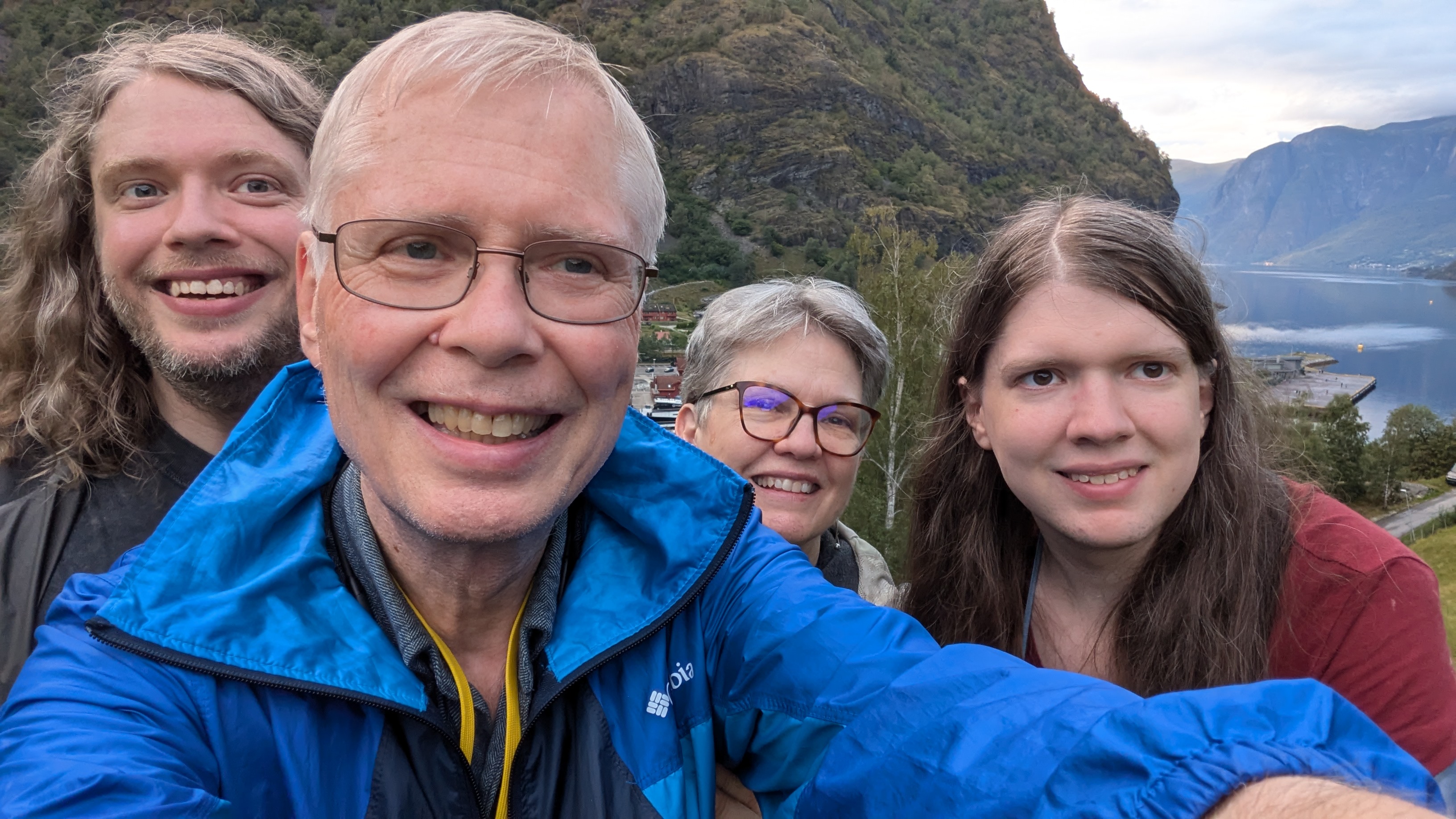
Our family lives on two continents, but for ten glorious days we are together in Norway, the country where I was born. I've been an unapologetic tourist these ten days, making up for all the times that my visits were shaped by family obligations. Sadly, that whole generation is now gone, which added a bittersweet tinge to my feelings about being back, but (thank goodness) we were able to spend some time this evening with someone from the next generation!

My point at the moment is that, after all these stimulating experiences, along with a certain amount of unrequited nostalgia (the ways Norway has changed since the "wooden Norway" of my childhood), I don't have two neurons to rub together. So I will write again next week with a little more energy.

In the meantime, some photo highlights:

Almost all my favorite Edvard Munch paintings in one room! (At the National Museum.)
Overlooking FlÃ¥m.
Thor Heyerdahl's raft that defied conventional wisdom.
Fjords up close...
... with good gear.

18 July 2024

Tale of two sloops: LiLo and Restauration

Captain Knut Maurer.
My only experiences learning to sail have been in the calm waters of Panther Pond in Maine, not exactly the open ocean. But my grandfather made a life on the sea, following a classical path—running away from home to join a ship's crew, then rising up the ranks, going to the Maritime School at Ekeberg, Oslo, eventually becoming skipper of a passenger ship.

My father also went to sea as a young man, making a round trip from Norway to the USA and back on the school ship Christian Radich. The first movie I ever saw as a child was Windjammer, filmed on and around that ship. 

All my own childhood transatlantic travels were by sea. When I'm not on the open ocean, I'm often dreaming about the next time it might happen. In the meantime, I love a well-told story about the adventures of others. And those stories don't get better than this ... Close to the Surface: A Family Journey at Sea, by Bethany Lee.


Source.  
For years, Bethany and Bryan Lee of Lafayette, Oregon, and their two daughters, Hannah and Meira, had been learning to sail, gaining serious experience handling their 32-foot Islander sloop LiLo, gathering information and equipment, constructing their own dinghy, and learning to work as a team in good weather and bad, in the various and sometimes unpredictable situations the ocean might offer. They were daring to dream that the time might be coming for them to put their land-lives on hold, leave their home port in the Columbia River, and make a serious Pacific coastal voyage that could easily take the best part of a year....

December 2012. Bethany Lee gets a phone call from her husband Bryan at work:

"They want to renew my contract for eighteen months. If I sign, we'll be stuck here until Hannah's in high school. I may have just told my boss we're leaving this summer. Are we really ready to do this?"

What, exactly, was "this"? As departure day drew near, one friend asked Bethany what seemed like a very reasonable question: "What's your itinerary?"

"South," I said.

"That's not an itinerary," she said. 'That's just a direction!"

I explained that we didn't know how fast we'd end up traveling or how long our savings would last. We had no idea which ports we'd stop at or where we'd want to spend extra time exploring.

"Schedules kill sailors," I said, echoing wise advice we'd been given from more experienced mariners. "If we set a firm itinerary, we'll risk making bad decisions to follow it. We can't just go out in any weather. We have to adjust to conditions as they arise."

She shook her head. "I couldn't handle leaving without a plan."

"We're not unprepared," I said. "We have charts stashed in the V-berth for the coastline from here to Panama, although we don't think we'll make it that far. And we're not sure what the return journey will look like.... Whatever we end up doing, we'll have to figure it out on the way."

These words are a wonderful preview of the riveting paradox that drives this book: careful planning, training, and stockpiling on the one hand, but also a readiness to shift to whatever the wind and waves and tides and underwater reefs require in the moment, sometimes with zero warning. Above all, what is required is constant alertness. Especially in the fog, especially in the busy shipping lanes, especially....

Bethany Lee's superb writing conveys this intensity. She knows just when to include log-worthy details and the specific features of their boat and the demands of weather and navigation, when to give us glimpses of family life in the confines of 150 square feet, and when to acknowledge inner moments of joy, crashing doubt, and sudden crisis. Among the most fascinating dimensions of their ten months at sea are the friendships the family developed with other sailors and with the people living in many of the communities they visited. Just as Judy and I found in Russia, there were angels among the people they encountered in those communities—in the USA and in Mexico. The map of their voyage turns out to be a trail of mutual goodwill.

I've known Bethany Lee for several years as a musician and a fellow Quaker minister. I've also been aware of her and her family as sailors, having followed her blog at the time of the voyage. What I'd like to say after reading her new book, Close to the Surface: A Family Journey at Sea, is that I now also know her as a master chronicler with a sure pen and an irresistible command of pacing. I hope you will get this book and enter the new spaces she opens for us, and be encouraged to dream courageously.

LiLo. (Source: Bethany Lee.)

 
The sailors. (Source: Bethany Lee.)

The voyage. (Source: Close to the Surface, pages 6-7. The book also includes helpful diagrams
of the boat and a glossary of nautical terms. A reader's guide for the book is available here.)

Visitor. (Source.)

Sloop number two: Restauration  (the Norwegian Mayflower) and the recreation of a historic voyage.


Map basis: Gunleif Seldal. Illustration: Jens Flesjå. (Source.)

A 54-foot sloop (a bit larger than the LiLo, and with 52 souls on board) left Stavanger, Norway, on July 4, 1825, bound for New York. Many of the passengers were Quakers or influenced by Quakers, and this little ship, the Restauration (Restoration) carried the beginning of the Quaker migration from Norway to the USA. In fact, it started an enormous stream of Norwegian immigration to the United States over the next decades, a stream that eventually included me.

My first passport.
A replica of that historic vessel will sail from Stavanger on July 4, 2025, precisely on the 200th anniversary of its predecessor's departure. It plans to time its arrival in New York for October 9, 2025, again observing the 200th anniversary. Plans are underway to coordinate its arrival with Friends in New York Yearly Meeting. We expect that the official welcome the first Restauration got on its arrival (arrest of the captain and confiscation of the boat and its cargo, and a stiff fine, for exceeding the passenger load limit for a ship of its size, thankfully commuted by President John Quincy Adams!) will not be repeated. 

There's a lot of good background material on this 200th-anniversary event at  restauration.no. Norwegian Quakers are very involved in this inspiring project. (Stavanger Friends met for worship aboard the ship on this past Pentecost.) I have no idea at the moment whether I will be able to witness either the departure or arrival of the new Restauration, but I can dream ... and mark my calendar!

Source.  

Henry J. Cadbury on the Norwegian Quakers of 1825.

Another recreated voyage I was following in the early years of this blog: In 2006, the Tangaroa followed the course of Thor Heyerdahl's Kon-Tiki.

As long as we're considering the oceans, is the Atlantic Overturning Circulation approaching a tipping point? (Recommended by Katharine Hayhoe.)

For the AMOC [Atlantic Meridional Overturning Circulation] and other climate tipping points, the only action we can take to minimize the risk is to phase out fossil fuel use and stop deforestation as fast as possible. If we can reach zero emissions, further global warming will stop within years, and the sooner this happens the smaller the risk of passing devastating tipping points. It would also minimize many other losses, damages, and human suffering from “regular” global warming impacts (e.g., heatwaves, floods, droughts, harvest failures, wildfires, sea level rise), which are already happening all around us even without the passing of major climate tipping points.

Water, John Milton, and the life cycles of gardens: "Olivia Laing on the Care and Keeping of Gardens In an Era of Climate Emergency."

Eszter Kováts considers the cost of turning a blind eye and letting polarized categories do our thinking for us.

A Conversation with Joel Jackson of Kake, Alaska, and through him, with his community. (An interview by Judy Maurer in the Sierra-Cascades Yearly Meeting of Friends newsletter.)

Santa Claus or Grace: John Kinney speaks to Spokane Friends Meeting.


Bonnie Raitt receives Kennedy Center honors this year. Congratulations to a wonderful singer and guitarist! I used some of her songs in our classes in Elektrostal; for example, this song, with its gap-fill version on our Institute chalkboard, and (below) possibly one of the cheesiest videos ever.

We used exercises like these as a part of our listening comprehension lessons.

25 April 2024

"Is there fire under the ashes?"

Coventry Cathedral (Cathedral Church of St Michael)—the ruins remaining from World War II and the new cathedral building, consecrated in 1962.
Provost Richard Howard had "Father Forgive" inscribed behind the altar of what remained of the cathedral after the Luftwaffe bombing of November 14-15, 1940. Later he participated in building a relationship between Coventry and Kiel, Germany, which had suffered similar bombing.

Last week, Judy and I visited Coventry Cathedral. The ruins left by the worst night of the Coventry Blitz of 1940 still remained for visitors like us to walk through, trying to imagine the horror of that night.

In the days and years since then, this extraordinary cathedral was reborn as an international center of reconciliation. Is it too soon to ask whether a witness to reconciliation will arise from the ashes of the Gaza Strip?

That may seem unlikely now, but imagine how unlikely it must have been in the heat of World War II's mutual destruction to envision the Coventry Cathedral of today. Just listen to these crushing words from that war:

Adolf Hitler, Germany: The other night the English had bombed Berlin. So be it. But this is a game at which two can play. When the British Air Force drops 2000 or 3000 or 4000 kg of bombs, then we will drop 150 000, 180 000, 230 000, 300 000, 400 000 kg on a single night. When they declare they will attack our cities in great measure, we will eradicate their cities. The hour will come when one of us will break – and it will not be National Socialist Germany!

Arthur Harris, Britain: The aim of the Combined Bomber Offensive ... should be unambiguously stated [as] the destruction of German cities, the killing of German workers, and the disruption of civilised life throughout Germany ... the destruction of houses, public utilities, transport and lives, the creation of a refugee problem on an unprecedented scale, and the breakdown of morale both at home and at the battle fronts by fear of extended and intensified bombing, are accepted and intended aims of our bombing policy. They are not by-products of attempts to hit factories.

But despite the terrible cruelties they inflicted, their voices did not prevail. The very day after the destruction of Coventry Cathedral, its provost made a commitment to forgiveness and reconciliation—a commitment that, by human persistence and God's mercy, survived the hatred and revenge of total war.


After Coventry, we had a wonderful visit with Diana and John Lampen, who promised to show us a cathedral of a very different sort. We were not disappointed. In the National Trust's Kinver Edge, just a few minutes' drive from their home in Stourbridge, we followed a trail that soon emerged into a space that took our breath away. Huge beech trees formed what really did seem like a natural cathedral—not only in appearance but in a sort of quiet grandeur that invited reverence.

Earlier that morning, the Lampens had given us a tour of the Stourbridge Friends meetinghouse, the main part of which dated back to 1689. The outward contrast between that beautiful little meetinghouse and Coventry Cathedral was impossible to deny, but the deeper kinship was also very evident. As soon as the four of us sat down in the quiet meetinghouse and entered into a meeting for worship, I knew that we were in a place where many generations of prayer had built an unquenchable flame.

(If you've kept up with this blog, you've seen the Lampens' names before, most recently in my review of their book Inner Healing, Inner Peace: A Quaker Perspective. We first got to know the Lampens when I was a new member of Reedwood Friends Church's pastoral team, back in the year 2000, and they came to Portland for several weeks as guests of Reedwood's Center for Christian Studies. For more about their interests, activities, and concerns, visit hopeproject.co.uk.)


The title of this post, "Is there fire under the ashes?", seemed to me to be very applicable to the spiritual fire that survived the ashes of Coventry, but the question is actually a quotation from John Lampen's novel, Hester and Sophie.

There are several reasons I'd very much like it if you would get a copy of this novel and read it yourself. (See the Hope Project's publications page.) In part this is because it would be hard to avoid revealing too much of what Hester will tell you in her own wonderful timing. But mainly I want you to experience the way Hester draws the reader into her life with her utterly believable thirteen-year-old voice—whether she is musing on the peculiarities of the Friends meeting her family attends, considering Ariane Grande's lyrics after the Manchester concert bombing, or trying to cope with the devastating loss of Hester's best friend Sophie.

At the beginning of her story, Hester wakes up from a vivid dream. Before she forgets the dream, she uses a blank book, a gift from Sophie, to write it down. She then locks up the book, but later that day, she goes back to read what she had written, and to her astonishment, the words "Is there fire under the ashes?" had been written below the dream...in Sophie's handwriting

Thus begins a crucial week in Hester's life. It's a week that she describes in her own engaging way, sometimes deadpan and sometimes wry, as she discovers capacities in herself and unanticipated depths in others, and a growing realization that Sophie is still in her life.

As I was reading Hester and Sophie, nothing made me stop and think, "Hey, this was written by an 80-year-old man!" But I wonder if you'll agree that, even so, John peeks out from the pages in the form of quiet little hints and maybe one very brief cameo appearance, gently linked to the concerns that he and Diana have devoted their lives to.

I began my own diary when I was just a year older than Hester. I didn't have mysterious writings appear in my diary's pages, but some of what I wrote in those first years of my diary had a similar combination of directness, receptivity, skepticism, and hope.

After I finished the last page of the novel, I found Hester's voice continuing to echo in my mind and spirit. It was a deeply refreshing experience.


George Lakey, at age 86, is still getting into "good trouble." Here's what that looks like to the Philadelphia Inquirer. (My thanks to Keith Barton for the link.)

Here's the latest epistle from Friends Peace Teams.

Rwanda's own experience of organized reconciliation, following the genocide of 30 years ago.

A fascinating, sometimes intense, video: Frank Schaeffer interviews Christian ethicist David Gushee. Normally I don't have the patience to watch long video interviews (I much prefer reading the transcript, if there is one), but this interview really drew me in.

More from David Gushee—on a gathering of the Post-Evangelical Collective.

Young Adult Quakers are invited to gather at Jordans Friends Meetinghouse and Centre, August 21-25, at Beaconsfield, not far from London, UK. Information and registration form are here.

Voyager I is back in business. It's transmitting coherent data again.


"I can't stay at your house no more because you quit drinking." Buddy Guy and Charlie Musselwhite jam.

21 April 2022

Anger, healing, and the Atlantic Ocean


Eighteen hours after departing Fort Lauderdale, our transatlantic voyage has just begun. We're out in the open ocean. We reach our first European port in nine days.

Though this voyage is marketed as a cruise, my personal conceit is that I've booked a normal transatlantic passage by ship, the way my family always traveled from Europe to the USA and back during all my childhood and teenage years. I remember the troopship that first brought me from Germany to the USA; the Statendam (twice); the United States; the France. More recently, Judy and I traveled by sea to Japan, arriving there the same way my mother's parents came to their new home in Japan in 1905.

In earlier times our ship's position was marked by pins on a map prominently posted near the purser's office. Now each stateroom is equipped with a huge monitor that can show our exact position from minute to minute.

This ship, Wonder of the Seas, is supposedly the world's largest cruise ship, but somehow its owners left out something that no ship I've ever been on lacked: a library. In fact there is no location anywhere on the ship specifically set aside for reading or writing, not even a computer room. Words fail me, literally.

Capt. Knut Maurer, M.S. Meteor.

What the ship does have, and my soul needs, is the constant sight and sound and motion of the ocean. I'm sure this necessity was programmed into me by my ancestry on both sides of my family. As we make our way through the waves and whitecaps, I'm remembering my father's father, Captain Knut Maurer (Bergen Line), his brother-in-law Captain Martin Jensen (Wilhelmsen Line) and my father, who spent a term on the school ship Christian Radich.


I'm thankful for the healing power of these elemental sensations as I realize how tiny I am -- how tiny even this ship is -- compared to the ocean surrounding us on all sides. As my body relaxes in response, I realize with something of a shock: for the last eight weeks I have been in a state of constant anger and grief.

Not that I have now made my peace with the Russian government's war on Ukraine. My retreat to the ocean does not reduce the agony of this war by the tiniest degree. Nor are we passengers isolated from the world; television and Internet are available aboard the ship just as if we were on land. This retreat does not reduce my need and desire to pray for peace, and to stay in contact with those among our old friends and contacts in Russia who are themselves trying to come to terms with what's happening.

One friend deviates, somewhat, from the pattern. Here's what she wrote:

Right now in the mass media there is a lot being said about how Russia is the aggressor, the invader. But what is happening now was bound to happen. In the western part of Ukraine they have never loved Russians. My husband and I were there for the first time twenty years ago. And when we were on the train, traveling on our way there, they warned us, don't go to places at night where there are not a lot of other people, and don't speak Russian. And when you go to the store, be prepared to find that, when you speak Russian, you are not served.... [Her ellipsis.] The soil was already prepared for the growth of conflict. And what is happening is a sign of the times.

The most recent survey showed that 83% of Russia's population supports Putin's actions. They don't speak about this in the West, where he is portrayed as a tyrant.

Contrast this with the friends who write to me along these lines (quoting one of them): "I am already tired of arguing with them [Putin supporters] because it's absolutely useless.... I have never felt before like I feel now, no hopes for a better future, no power to survive."

The samples are small, but my own observations are in accord with this video sampling of reactions to the Bucha revelations (from a U.S. government-funded outlet):

In this video, the generational differences are pretty much what we observe among the people we know personally.

And here's a more recent sampling concerning reactions to Russia's battlefield experiences:

Given all this reality (and also given the actual agony playing out in hundreds of locations in Ukraine this very day!), what use is my anger? I don't blame myself for it -- after all, wouldn't it be worse to feel no anger at all?? -- but at some point it numbs my ability to pray and discern; it just burns me out to no purpose.

And what is my purpose? The Quaker in me answers that it is the same purpose we always have as a community: to ask what God wants to say and do through us in this time and place.


Alfred McCoy on how Russia can be made to pay for rubbishing Ukraine.

Putin as hero for USA's evangelicals? Maybe not so much anymore.

Rethinking the Russian Orthodox reunification of 2007: was it accomplished under false pretenses?

Nancy Thomas on still being two years old.


From Russia's Bridges Blues Festival: The Jumping Cats.