Thirteen years ago I wrote a post on "Quaker culture." I had just read a novel whose Jewish and Catholic characters were described with lavish details from their Jewish and Catholic religious cultures—rituals, architecture, thought patterns, built up, elaborated, and passed on from generation to generation over many centuries. I wondered if our Quaker religious cultures aren't a bit thin by comparison.
I've recently read two more novels with dense religious settings and the same thought occurred to me. Given the temptation toward Quaker exceptionalism among some of us, maybe a bit of modesty would do us some good!
Of course it's not that simple. A beautiful and rich culture can honor God, and can do so through so many emotional and sensory channels that go far beyond the doctrines and propositions that were hallmarks of that highly contentious period of English history when we got our start. (Come to think of it, doctrines and propositions, and our conflicting feelings about them, continue to exercise us Friends to this day!) But those rich, dense, beautiful cultures can, at their worst, also exclude, entrap, and alienate.
Those two newer novels illustrate this beauty and this hazard in very different ways. I highly recommend both of them. The one I read first was Niall Williams's Time of the Child, set in a rain-soaked village in the west of Ireland in the year 1962, the year that, among other things, the first television arrives in the town. At the center of the story is an agnostic general practitioner who attends Mass faithfully, and whose relationship with the parish priests is fascinating. Also in the center of the story is his eldest daughter, who serves as his receptionist; his other two daughters have moved away. Almost every important action in the story is somehow linked, whether by intention or habit, to the region's Catholic culture and faith. I loved this story so much that I hope you'll read it without further commentary from me, so I can avoid revealing its compelling and gradually unfolding plot. Williams, in all the novels of his that I've read, somehow manages to convey love with extraordinary depth but without sentimentality.
If you still need a bit more detail to be persuaded, here's a review.
The other novel is Kate Riley's Ruth. I think it is a small miracle that this book even came to be published. It is by turns deadpan and laconic, reverent, snarky, sad, and wicked funny. Ruth's story is a near-lifetime compressed into a chain of telling incidents from a life lived in an Anabaptist commune, with similarities to Hutterite and Bruderhof communities. Ruth understands the rules, until she doesn't. Her son doesn't. She loves her husband, and despises his annoying habits. In the community she's loyal and skeptical, a total insider who is somehow not trapped.
For a time, the community seems oddly totalitarian, but the leaders confess their inadequacies. Misdeeds can lead to temporary shunning, usually on a voluntary basis! Travel to the outside world is permitted when necessary—for example, to meet and pray "with a Quaker colloquium at the Wyndham Sault Ste. Marie." "In the van Ruth had erred in wondering aloud whether Quakers might love peace more than they loved Christ, which she'd read somewhere and liked the sound of. No one responded."
(Talking about people behind their backs is not permitted in the community, but, just between you and me, it's worth listening to Ruth!)
Rachel Muers does an amazing job of describing Friends faith, practice, worship, and diversities in a compact, even-handed, and well-organized article for the St Andrews Encyclopaedia of Theology, with lots of useful links. Thanks to Jim Fussell for the reference.
Ashley Wilcox on "Alaska in my bones," and the example Anchorage provides us.
Adrienne LaFrance wishes happy 100th birthday to Mel Brooks, "the funniest man who ever lived."
Kelly Zirbes and her band Kelly's Lot perform "Ship." Kelly's tour dates include Klamath Falls (July 25), Burns OR (August 5), Spokane (August 10), and Portland OR (August 12, with Carolyn Wonderland).
'Your post titled "Vanity of vanities" has been unpublished.'
About a week ago, I was startled to get this notice from blogger.com. It went on to explain that "Your post titled 'Vanity of vanities' was flagged to us for review. We have determined that it violates our guidelines and have unpublished the URL http://blog.canyoubelieve.me/2008/01/vanity-of-vanities.html, making it unavailable to blog readers."
The letter went on to explain how I could edit the post and submit it for reconsideration. Naturally, being a spiritually mature, even-tempered Quaker, I was ... INCENSED! I looked back at this fifteen-year-old post (archive.org version) which I'd revisited a couple of years ago to edit dead links, photos, and video, and tried to figure out what could have caused the blogger platform to blow the whistle.
After a day or two of calming down, I made a couple more changes—one or two more dead links eliminated, and a newer version of a video subbed in—and republished. Only then did I notice that I had received another notice from blogger.com, from the same date as the previous notice. Subject line: "Your post titled 'Vanity of vanities" has been reinstated." Well!
It just happens that this "Vanity" post's theme, class issues among Friends, has been popping up again.
For one thing, I've had a long-standing concern that I've sometimes shared in this blog, that the ways we Quakers talk about our faith is often too wordy. According to Elizabeth Gray Vining's biography of Rufus Jones, he once gave an address after which he was gently criticized with these words: "Our dear Lord said,'Feed my lambs.' He did not say, 'Feed my giraffes.'"
I've had a couple of chances to help edit text on Quaker Web sites, and I've looked for chances to use language that doesn't imply "if you don't have an advanced education, you're not welcome among Friends." I also remember a Methodist writer who pointed out, rightly or wrongly, that most devotional literature is written by intuitive introverts for intuitive introverts.
And for another thing, Quaker writer and activist George Lakey is coming to our town and to our church this month (information below), and that reminded me of something I've always appreciated about him: his advice that successful movements united people across class lines, rather than dividing them. See the links section below for a couple of samples of Lakey's thinking on class.
Here's an edited and shortened version of my "Vanity of vanities" post. (You can read the comments on the original post through this link.)
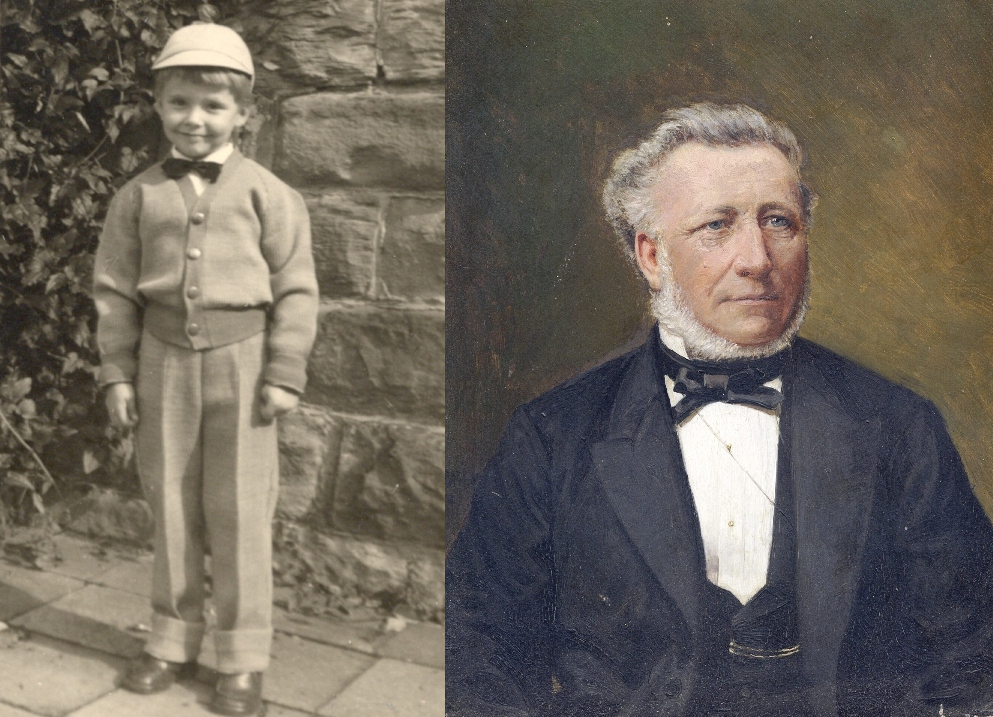
Two Johan Fredrik Maurers, both nattily dressed. (At right, my great-great grandfather, 1817-1887.)
Vanity of Vanities [January 2008]
Questions about Friends and social class have been prominent again in recent weeks in the Friends blogging community.
I'm happy about this development, in part because of my visceral dislike of elitism and of the spiritual violence that we do when we objectify others. (We "objectify" when we look at people coldly, forgetting their equal status with us as made in the image of God; when we reduce people to categories; when we see them as objects of our agendas, or as irrelevant to those agendas.)
Some of my intense feelings no doubt come from growing up with my mother who believed in the superiority of her German "master race"—to the point that she displayed a swastika on her Skokie, Illinois, front lawn during the controversy over Nazis' wanting to march in Skokie. (Did she ever see the irony later on when she moved north to, of all places, Zion?)
For reasons that relate to our family's own violent history, we straddle classes, which gives me insights that I sometimes would rather not have. No doubt this also adds to my blind spots.
But, turning to Friends, I also share a concern that elitism in any form is a dangerous heresy. It is a betrayal of Friends theology, which is radically hospitable because it respects no categories that are not directly tied to God. You (every possible "you") and I are, first of all, created and loved by God—we have no license to create a category outside that compass. The only relevant remaining categories are (1) presently in community with God (converted and convinced, in Christian Quakerese) or (2) potentially in community with God!
The big issue in my mind is: what is the nature of the border between those two categories? From God's all-encompassing perspective, I'm sure the answer is far more interesting and gracious than anything we can conceive. But descending to our Quaker perspectives for a moment, I can imagine how personal biases affect our answers. I want to defend the importance of conscious personal decision, of saying "yes" to God, so I see a definite boundary there, although one for which that "yes" is the only, and I mean only, requirement to pass. Universalists inside and outside Christianity would see that boundary differently, or not at all. A strict Calvinist would have a different understanding, too.
Whether or not you agree with me about the importance of that conscious and personal "yes," we probably all agree theoretically that nothing else should obstruct the threshold into the community. If there is anyone not living in the glorious freedom of the children of God, we should invite them in. We should certainly think carefully and creatively about what it would take to connect both honestly and persuasively with that person, and what aspects of our corner of the community would undercut our message of hospitality.
Back when Brooklyn Quaker first posted his "class narrowness" thoughts, I responded on his blog as follows:
... I won't take the space here to enumerate the number of class-related snubs I've seen or heard about among Friends.
One such snub deprived us of a working-class smoker (*gasp!* - yes, he smoked, but many of the nonsmokers drank like fish). [Fifteen years later, I am inclined to soften this last judgment.]
A working-class woman struggling with Catholicism was another brief visitor, snubbed in part because of her enthusiasm. [Let me add, however, that one of the weightiest members of that meeting said that this visitor was more like George Fox than anyone he knew.]
A husband and wife who wanted to do door-to-door evangelism were told, "Perhaps you'd be happier elsewhere." This, in a meeting that had shrunk to one-third of its size in fifteen years!!
A meeting made its bathroom off-limits to those coming to get boxes of food.
More pet peeves. (Sure feels good to get these off my chest.) ... Meetings whose rhetoric, however well-intentioned, makes it clear that poor people, low-income people, people of "other" races, addicts and members of addiction recovery groups, are not part of THIS fellowship, even when they actually are. [I'm referring to Friends who regard such people as not necessarily worse than us, but as OBJECTS of our goodness.]
I do have a hypothesis: a group that has integrity and spiritual power can attract people from any race and social class. (Unfortunately, so can groups that fake it well: there's never a time when discernment isn't required.) I remember one very dear Friends fellowship that was pretty homogenous but yearned for diversity; half a block away was a Pentecostal church where there was ACTUAL diversity—racial, social, class, temperament, language. Spiritual power does NOT necessarily mean emotional contortions, but it does mean crossing a threshold of conversion and self-abandonment not typically found among the self-satisfied or terminally autonomous.
For the nnnnth time, this sort of meditation has led me to the question: If I see so much incompleteness, why do I stay among Friends? Because I'm deeply convinced that Quaker discipleship is the most authentic way of being Christian that I've been led to. And the inhibitions and compromises that keep this authenticity under wraps are wearisomely familiar to me because ... I share them! Finally, every meeting for worship is a new opportunity to confront those inhibitions and take another step toward greater faithfulness for myself and my community.
Several of the above-referenced blogs refer in one way or another to cultural screens that may or may not play a role in our being inclusive or exclusive. For example, are we too intellectual? Does our comfort with ambiguity repel those who prefer certainty? Are our activist folkways too full of "inessential weirdnesses"? (Thanks to Jeanne/Social Class & Quakers for this link.)
I resist making these class issues—there are intellectuals in every discernible social class, and certainly self-regarding elites can be addicted to certainty. (How else did we get into Iraq despite the misgivings of ordinary people of every class?)
And I'm not at all worried about our having weirdnesses, since every social group has them, and nobody of any class is so stupid as to think that a new place they're visiting will have no peculiar features at all. My question is, are we willing to do the hard, worthwhile work of figuring out which of our behaviors is just our particular wallpaper, and which actually undercut our theology of radical hospitality?
Some additional thoughts, in no particular order:
I continue to believe that the most important pathology underneath Quaker elitism is a defective understanding of God's role in our community. I wrote about this at excessive length here: "Nancy's question" (What are we so afraid of?)
I've visited more than two hundred Friends meetings over the years, and we're in the middle of a ceaseless round of visitations within Northwest Yearly Meeting right now. Some Friends meetings have a very truncated social spectrum; others have an amazing range of people. The wider-range meetings seem to have at least a couple of characteristics in common: First, they are places where talking about one's faith is very easy and natural, where people speak openly about what God is doing in their lives. Second, they're places where it is possible to confess doubt, problems, failures, addictions, fear.
Just one verbal picture: At Melba Friends Church in Idaho, a few weeks ago, a meeting for healing prayer was announced to take place at the rise of meeting for worship. Those who wanted healing prayer were to gather at the front of the meetingroom, while the rest of us got ready for the potluck dinner. There was no mistaking the intense spiritual work that was going on among those gathered at that meeting—but everything about the atmosphere of that community told us that this was completely normal.
When I was a Friends denominational bureaucrat, I noticed (and wrote about) the divide between those who were temperamental skeptics and those who were temperamental proclaimers. The seminary, specifically Earlham School of Religion, was a perennial arena for collisions among those two groups. One group was there to explore their spiritual issues; the other was there to refine their existing commitments and prepare to deploy them in pastoral or other forms of service. What I longed for was a depth of love and accountability in the community that would allow both groups to be themselves and still contribute to building up a faithful, hospitable body.
No group will grow in numbers or faithfulness through guilt or shame. When Judy and I were young adults, we were at a meeting for business at which someone said, "What our church needs is more young couples." No, not so fast! ... what they needed was more confidence in their own identity as people of God. Anxiety about their defects was useful only if it led to positive, creative work on tearing down barriers, not to a negative tearing down of themselves. This was a meeting full of people who'd done amazing things in their (mostly) long lifetimes; they needed to reveal more of themselves, not obsess on their shortcomings.
But on the other hand, maybe that meeting I just mentioned did need to enter a season of self-doubt. They'd been a prestigious Main Street church for so long that perhaps it was important to face at least a few unpleasant realities. My point is to use those doubts creatively, let them break the power of respectability and denial, but then move on to build a more solid foundation of group identity. Recover your dear early love! (Revelation 2:4-5)
This same meeting had young people who once challenged the meeting, through a Sunday School teacher, "Some of you have been Quakers for 60 years—why can't you tell us more about why you became Friends and what you've learned about God in those years?" Well, part of the answer was: "Our generational culture is very private." That privacy is not something to be ashamed of, but it needs to be worked on.
Details on George Lakey's upcoming visit, and a few links:
Quick quiz: which four countries of the world have the highest numbers of Quakers?
Answer: Kenya is in number one position, followed by the USA and Burundi. In fourth place by total number, and in third place by proportion of total population, is Bolivia. How did Quakers attain such prominence in a relatively small South American country?
This is the story that Nancy Thomas tells in her new book, A Long Walk, a Gradual Ascent: The Story of the Bolivian Friends Church in Its Context of Conflict. The particular stream of the Bolivian Friends movement chronicled in her book is the National Evangelical Friends Church (INELA, Iglesia Nacional Evangélica de Los Amigos). INELA is one of several different Friends denominations in Bolivia, but at the beginning of Nancy's account, between 1915 and 1924, parts of their story merge.
Nancy's book is just one product of a joint INELA-Northwest Yearly Meeting commission on INELA and mission history. In addition to compiling and preserving written records, the commission conducted numerous interviews with descendants of the earliest generations of Quakers in the country. The commission's Facebook page includes videos with a sampling of their work.
A Long Walk, a Gradual Ascent includes an early chapter by Nancy's husband Hal Thomas on the history, worldview, social structures, political context, economic life, and language of the Aymara people who are the great majority of Bolivian Quakers. As he notes, "The Aymara-speaking people of the Bolivian and Peruvian Andes have inhabited the mountain pastures, high plains, and the breakaway valleys of what is today Bolivia and southern Peru as a significant social and cultural presence for more than nine hundred years." Their experience over the last four and a half centuries includes cycles of colonialist oppression and Aymara resistance, making 20th-century experiments in Bolivian democracy, and the honoring of indigenous identity that is part of former president Evo Morales's mixed legacy, an important part of the history.
Conflict is a recurring theme in Aymara culture and history, leading Nancy to write, "It may be an irony that this should be the setting for the development of a 'peace church' such as the Quakers; or it may be a sign of grace."
I call this a grand epic and a modest epic. Its grand scale is in part geographic -- starting from just one village church on the shore of legendary Lake Titicaca and one urban church in La Paz. A hundred years later it counts around two hundred congregations in the INELA denomination alone, with hundreds more in the other Quaker yearly meetings in Bolivia. Along the way, a sister denomination took hold and flourished in Peru, and outreach began in Chile, Brazil, and Argentina. INELA, as an independent denomination, has formed strong relationships with the rest of the world Quaker family while maintaining its close fellowship with Northwest Yearly Meeting.
William Abel, 1916 (from book)
At the beginning of this epic, it's a story on an intimate scale. One young man, a son of the Kumeyaay tribe in San Pasqual, California, William Abel, became one of the very first students of the Training School for Christian Workers in Whittier, a mostly-Quaker initiative which later became Azusa Pacific University. The narrative of Abel's life, including his education at this school, interrupted halfway by eleven years of missionary service in the Philippines, is truly gripping, thanks in part to new details about his youth that emerged from the Thomases' research.
When he finished the Training School, Abel decided to serve God in Bolivia. This was a fateful decision. In Bolivia, he met and began joint ministry with three Quaker women. One of them, Florence Smith, had taught at the Training School in California. The other two, Mattie Blount and Emma Morrow, were from Westfield, Indiana (the originating point of the other major stream of Bolivian Quaker history, now associated with Central Yearly Meeting).
During these months in La Paz, Abel met a young Christian, Juan Ayllón, who (as events unfolded) is now considered, along with Abel, the co-founder of the Quaker movement that became INELA. After this important convergence of personalities, and after only eight months in La Paz, William Abel contracted smallpox. Morrow and Ayllón cared for Abel in his final days; when Abel died, Ayllón arranged for his funeral and burial in La Paz. The commitments made by everyone involved during these eventful days and months, including the international and inter-Quaker relationships represented by these diverse personalities and the prayers of their communities, laid the foundation of the Quaker movement in Bolivia. Nancy's book leads us through these stories with sensitivity but also an earthy realism. This is history, not hagiography.
Meanwhile, a seemingly separate story was unfolding on the shore of Lake Titicaca. A Christian convert comes home from the big city and holds small meetings in his village of Amacari, forming a completely independent little Christian movement that reminds me of the Seekers of English Quaker history.
As you've no doubt anticipated, Juan Ayllón eventually makes contact with Amacari village. Those early developments, along with the shift of sponsorship for Ayllón and the young Quaker movement from Central American Friends Church (Guatemala) to Oregon Friends (now Northwest Yearly Meeting), the founding of Bolivian Friends schools, the formulation of the "indigenous principle" to guide relationships between the Oregon missionaries and Bolivian Friends, all the way to the independent yearly meetings in Bolivia and Peru that we have today -- are all part of Nancy's grand epic.
It's also a modest epic, in several senses. There is genuine heroism and amazing self-sacrifice in this movement, including, at times, serious persecution from the unsympathetic sectors of the Roman Catholic church, sometimes in combination with skeptical politicians. However, Nancy also reveals less heroic dimensions of the story: conflicts among church leaders and among missionaries, and several instances of leaders falling into various moral pitfalls, both sexual and financial. (There's also a story of a genuine, touching romance with a heartbreaking conclusion. Here is a missiological study that doesn't lack for human drama!) The theme of conflict arises repeatedly, sometimes among church leaders, often between INELA's Bolivian leadership and the Oregon missionaries, and sometimes between generations in the church. The Thomases' commitment to tell the story from both "inside" and "outside" (from the Bolivians' viewpoint as well as the missionaries') means a commitment to unvarnished truth.
Throughout the decades of INELA's history, Nancy weaves Bolivia's political developments into the narrative, as the country endures right-wing and left-wing authoritarianism, coups and revolutions, and eventually adopts electoral democracy. One very specific and illustrative case study involves the farm that the mission bought in 1947 as a source of income and a location for leadership training. As it turns out, the farm came with a whole community of farm families (colonos) that were bound to the land as part of Bolivia's hacienda system! Oregon Quakers were shocked to find themselves as, to put it bluntly, slaveholders. To make things more complicated, as the new owners sought to free the farmworking families and give them title to their plots, a few of them actually preferred the existing arrangements, but demanded improvements within that structure. As Nancy says, "... [O]ne has to ask if the mission or the OYM [Oregon Yearly Meeting], back in the 1940s and 1950s, had any sense of the gravity of owning an ex-hacienda in such revolutionary times." The story of Quakers divesting themselves of the farm and smuggling out its equipment in the dead of night is told from contemporary correspondence. Unfortunately we don't have access to much of the local non-Quaker point of view at the time.
Nancy also avoids exalting the Quaker element in this narrative. The earliest missionaries were, as she points out, more interested in planting churches in the Protestant holiness mold than conforming to specifically Quaker models. However, the Quaker element is always present as a sort of subterranean stream. The Chaco War with Paraguay (1932-35), for example, found some of the young Quaker men choosing to be conscientious objectors. The egalitarian and participatory nature of Friends governance coincided with similar features of Aymara culture. Women were central figures in the early history of the movement, and have regained influence in more recent years through their own women's organization within INELA. An increased emphasis on social justice outreach in recent decades fueled both innovation and tension within INELA's ministries.
In sum: this history balances well-sourced historical accounting (1,151 footnotes!), with a testimony to the power of the Holy Spirit in raising up a people for God's service in Bolivia and beyond.
I've spent most of the past week immersed in historical television dramas on Soviet themes. Despite their grim subjects, I can't deny the deep nostalgia for Russia that these shows evoked. They reminded me of our universal human capacities for kindness and cruelty, humor and cynicism, acceptance and resistance ... and the specific ways I experienced these capacities in Russia and other places in the former Soviet Union, ever since my first visit in the fall of 1975.
The first program I devoured over these last few days was HBO/Sky's miniseries Chernobyl. I thought that for an American to create a program on the USSR's most serious nuclear accident was nervy -- just imagine all the political and cultural distortions that could result. But I remembered the U.S. television coverage at the time (sample: CBS Evening News) ... surely a carefully constructed drama would be better than those speculative TV news summaries that filled the information vacuum of the time?
I was aware that the HBO/Sky series was getting good marks from a lot of critics, even Russian critics. In Novaya Gazeta, one columnist essentially said "This is the film we should have made." As I weighed the many specific criticisms made by both western and Russian commentators, I appreciated the accompanying five-part podcast in which host Peter Sagal talks with series creator Craig Mazin about his creative choices, and the deviations from the historical record that critics often refer to.
The "voice" of the Sagal/Mazin podcast is typically American -- mostly upbeat, offhand, slangy, sometimes verging on glib. But one thing comes through this conversation constantly: in the series itself, Mazin and his co-workers were determined to show respect to the men and women who risked (and sometimes gave) their lives to save their fellow citizens and potentially a whole continent. They demonstrated that respect by choosing to focus on individuals and stories that exemplified human decency and generosity and the finest aspects of patriotism -- all of which combined to contain the worst possible outcomes of the disaster. Even self-serving bureaucrats occasionally displayed flashes of humanity; the series avoided presenting us with total villains. However, the overwhelming desire of the ruling system to protect itself at all costs, deny problems, and avoid humiliation, was presented with brutal realism -- and (despite some oversimplifications and dramatic exaggerations) rightly so.
"Our goal is the happiness of all humanity."
There were imperfections in the series and podcast accompaniment that aren't explained by the choices imposed by compression and dramatic continuity. For example, in episode four, one of the squads sent out to catch and eliminate abandoned pets is eating and chatting outside a cultural center. A squad member points out a banner attached to the building: "Our goal is the happiness of all humanity." The irony isn't lost on the squad, but even so I wasn't happy that Sagal and Mazin mocked the sentiment. Maybe it's my own exaggerated idealism, but those slogans (however compromised by official corruption and everyday coping mechanisms) reflected real pride among Soviet people. Today those old banners and slogans evoke nostalgia among many Russians who look about in vain for similar ideals in our own time.
Other critics have pointed out historical inaccuracies -- the reactors' deficiencies were not that secret; the authorities were generally no longer threatening executions; the courtroom scenes were practically fictional; the apartment buildings had modern windows, and so on. You can find these complaints for yourself. They don't diminish the main point for me: the enormous wave of heroism among ordinary human beings in the face of a catastrophe that they cannot even understand.
Finally: apart from the riveting plot, a very rewarding aspect of the TV series for me was the attention to visual detail, to the texture of daily life in the mid-1980's USSR. The hospitals I've seen in Russia still look like those in Chernobyl. Same with the older apartment buildings, and with such details as clocks, telephones, stoves, radios, wallpaper, stairwells, and so on. Chernobyl isn't a one-stop substitute for deeper research and reading, but it is a very worthwhile attempt to dramatize history with care and respect for its human dimensions.
The second program was one I'm returning to after almost a dozen years since I first saw it. Here's how I described Shtrafbat after my first binge-watching exposure to the series: (Thanksgiving 2007) ...
I just gave eleven hours of my free time to a fascinating Russian television miniseries, Shtrafbat ("Penal Battalion") on DVD. In WWII Russia, penal battalions were the most expendable of soldiers, made up of criminals and "enemies of the people" who were offered this service as a way to get out of the GULags and redeem themselves by blood from the crimes they'd allegedly committed. The series has some battle scenes, but it's far more devoted to the human relationships among the characters--between regular Red Army and the shtrafniki, between the criminals and the politicals, between the Red Army's military officers and the political officers, between atheists and believers, between wounded soldiers and nurses, and occasionally between Russians and Germans.
Source: IMDB
In these eleven episodes, there were so many memorable characters and moments of drama. And complete frankness about the NKVD (predecessor to the KGB) and its horrible methods. The battalion commander Tverdokhlebov mentions to his assistant that, when they go into action, the NKVD will station troops behind them to shoot anyone who turns back, even if they're wounded. (It happened.) And the assistant, Glymov, smiles and says, "Ah, how our Soviet leaders so lovingly look after their citizens." Later, after their beloved commander has been arrested by the NKVD on trumped-up charges, the soldiers are standing in formation and the NKVD colonel introduces them to the new commander. One of the soldiers asks, "And what about Tverdokhlebov?" In the confrontation that ensues, the colonel says, "You are enemies of the people. Nothing! Useless!" Glymov waves at the ragged penal battalion troops behind him and says, "These boys still have a bit of usefulness left in them. As for you, your loss wouldn't make a bit of difference."
This could have been a concept ready-made for exploitative violence and sensational gore, or for mindless patriotism and militarism. Instead, the series believably brings to life an almost-forgotten dimension of Russia's wartime experience. At one point, Glymov says that the secret of his survival to that point was not courage, but rather sheer cunning. Nevertheless, we see genuine kindness in his character. I can't help wondering whether, in similar circumstances, I would have been able to preserve as much humanity.
At the time I first saw this series, I wasn't aware of some of the controversy it raised. Some of the controversy I'm inclined to minimize -- for example, I totally disagree with the charge that the series exaggerates the role of penal battalions in the USSR's victory over Germany, or demeans the victory itself. There are no such implications, although in the context of today's victory cult, Shtrafbat's distinctly anti-Stalinist tone might be out of fashion. In fact, (spoiler alert), the last penal-battalion attack on the Germans is merely intended as a diversionary nuisance, although these soldiers don't know it.
Yuri Stepanov in role of Glymov the thief, about to volunteer.
Headquarters.
Alexei Serebryakov (comm-batt Tverdokhlebov), Stepanov.
Screenshots made from episodes at Советское кино.
More serious criticisms involve the actual composition of the USSR's penal forces, most of which apparently consisted of active soldiers condemned to this form of service as punishment for military infractions, as with Tverdokhlebov in this series, who escaped from German capture. They rarely consisted of GULAG conscripts, either criminal or political, and their officers were likewise drawn from officer ranks rather than from the soldiers being so punished.
One critic pointed out the unlikelihood of a priest serving in a penal company (although another source vouched for one such actual case).
Whether or not these criticisms were 100% justified, we know from both combat literature and GULAG literature that the characters who come to life in Shtrafbat are realistic, both in their range of opinions and their mixed motives for service. Many of the supporting characters are of necessity two-dimensional; even the main characters sometimes slip into well-worn stereotypes, but the ensemble acting is truly inspired. Furthermore, the debates between the politicals and the criminals -- debates that reflect tensions going back to the Civil War and collectivization -- have an immediacy that reminds us of the constant interplay between authoritarian government and a long-suffering but wily population determined to survive.
Father Mikhail, the priest (played by Dmitri Nazarov) who first appears in episode seven presented a bit of a challenge. When Germans unexpectedly attack the battalions in a small village that our heroes have been ordered to clear, he is in the church's bell tower, ringing the bell to warn of the approaching Germans. As German snipers force him off the tower, he seizes a gun and joins the defense, and subsequently throws his lot in with the soldiers. Eleven years ago I thought this character threatened to bring an element of mixed absurdity and sentimentality into a drama built on painstaking realism. The priest seems to be custom-built to fulfill a stereotypical role as a bigger-than-life warrior-confessor, source of pithy observations and sonorous blessings. In the climactic battle, spraying the enemy with machine-gun bullets, he roars "Find your graves, you damn thieves! ... Forgive me, Lord."
This time through, I put more weight on the fascinating dialogues between the priest and various soldiers (many utterly skeptical). Right away they challenge him on the propriety of a priest killing. He agrees that it's problematic: "Even sins committed by necessity must be cleansed. I won't be able to take communion for three years.... I'd miss ten years if it's the Lord's will." The priest's presence in the ranks also becomes a political problem, and contributes to the arrest and torture of battalion commander Tverdokhlebov.
I'm not in a position to argue that such figures and incidents never arose in real life. And the drama, after all, still ground on to its bloody conclusion.
The reason I began watching this series all over again was that I stumbled across the fact that the whole series is available through Amazon, with decent subtitles (although the English-language descriptions of the series and its episodes on the Amazon site are hopelessly bad). I had no subtitles to help me back in 2007, so a lot of the rapid-fire slang in soldiers' dialogues went right past me. Now, once again I can enjoy the friendship between battalion commander Tverdokhlebov (played by Alexei Serebryakov) and his company commander Glymov (Yuri Stepanov) as they figure out how to fulfill the impossible demands on their pitiful band of shtrafniki by the general, Lykov (Alexei Zharkov). We see both the respect and the exasperation within the relationship between Lykov and Tverdokhlebov, complicated by the close watch on them both on the part of the NKVD officer, Kharchenko (played by Roman Madyanov), assigned to Lykov's headquarters to ensure strict political compliance. Excellent actors, every one of them.
If you have some Russian and would like to try watching the series without subtitles and without Amazon, all eleven episodes are here. Whichever source you choose, be prepared to meet some unforgettable characters.
First time for everything dept: Becky Ankeny begins a sermon on keeping faith with an Alfa Romeo story.
I've put together this survey to help me think through the theme that's been preoccupying me the last few years: building a trustworthy church. I hope you'll help me by filling out the survey ... as much or as little of it as you have time for.
It's not a scientific survey; I've hopelessly mashed together qualitative and quantitative elements, there's no randomizing of the order of questions; and I've probably done a poor job of concealing my own biases. In compensation, I've also put in lots of places where you can comment, introduce concerns that I've left out, and in general let me know your priorities. I may make changes in the survey form based on your feedback.
Among the sources and biases: I've adapted some of the "eight essential qualities of healthy churches" advocated by Natural Church Development, although I've not used their wording for any of them. I've tried not to make it too obviously a Quaker-derived survey, although that too probably leaks through.
Here it is! (Below.) And here's a link to the bare survey form without decoration or commentary: maurers.org/survey
UPDATE: I'm no longer collecting new survey responses. Here is the series of posts that followed this initial survey post:
A lot of Quaker energy has gone into reassuring skeptics and wounded refugees that we Friends are not like "those people," referring to the zealots, authoritarians, and religious entrepreneurs who have sometimes given faith a bad name. But what are we affirmatively promising? And how do we increase our capacity to keep our promises and become more trustworthy?
Let's say you are someone who's presently not in a church, but you're not totally allergic to the idea of being among people of faith, and are ready to learn what guides and motivates us believers, and to see whether it confirms a growing sense of faith already within you -- but you are not in the market for theatrics or manipulation or enmeshment with nationalist politics. What can our church promise you?
It's those concrete promises, and earning a reputation for keeping them, and using that reputation to increase our accessibility, that I'm interested in learning about. If you have already had experiences with churches that are trustworthy, or, sadly, with untrustworthy churches, or simply have an idea of what such a community might include, I'd like to learn from you.
(I may have finished with this survey, but I am always eager to hear from you on this theme.)
Nancy Thomas's next chapter in her selected stories from Bolivian Quaker history.
It seems, then, that Chau failed not just in secular terms, but in theological and evangelical terms as well, and so my anger is also directed—unless they did whatever was in their power to stop him—at whoever trained and formed him in ministry, for they are also otherwise culpable for his death.
Peter Marks describes a fascinating collaborative process within the creation of the musical Hamilton.
Our corner, Yalagin Street and Fryazevo Highway, two nights ago. Our time in Russia is nearing an end; I'm storing up all these impressions, sensations, and amazing memories.
It's a sign of today's toxic political environment that the revelations of Hollywood sexual harassment connected with the Harvey Weinstein scandal are exploited by some Trump supporters as evidence of a liberal double standard.
That might be, but you can't convince me that only liberals "pester" women in the entertainment industry! I draw the word "pester" from this BBC interview with Emma Thompson. Locating Weinstein in a larger context, she says,
What I find sort of extraordinary is that this man is at the top of a very particular iceberg, you know he’s — I don’t think you can describe him as a ‘sex addict,’ he’s a predator. But what he’s, as it were, at the top of the ladder of is a system of harassment, and belittling, and bullying, and interference, and what my mother would have referred to in the old days as ‘pestering.’ ‘Is he pestering you?’ That’s the word we used to use in the olden days, if you recall. This has been part of our world, women’s world, since time immemorial. So what we need to start talking about is the crisis in masculinity, the crisis of extreme masculinity, which is this sort of behaviour, and the fact that it is not only OK, but it also is represented by the most powerful man in the world at the moment....
Not all public conservatives are reacting to the scandal with glee. Samuel James takes a much more measured look at men and women relating in the workplace, referring back to the brief swirl of controversy around Mike Pence's use of the "Billy Graham rule." The dilemmas of managing human lust (a problem not confined to liberals, considering how often Republicans get caught in sex scandals!) while also confronting systemic imbalances of power, will not be solved by confusing the issue with left/right labels. "All have sinned and fall short of the glory of God" [context] and all of us need to confront that impulse to exploit -- when we see others being targeted, and when we ourselves are tempted to target others. The last thing we Christians need to do is feel superior!!
One more point. Many evangelicals who do not themselves pester anyone nevertheless do not allow women to exercise leadership in their churches and religious organizations. Their stained glass ceilings are reinforced with scriptural arguments and the weight of centuries of tradition. The evangelical publishing and conference industry (specifically, the "biblical womanhood" industry -- see this post) harvests billions of dollars peddling this message to this day. I dare not mock this community, because I know many dear people who are under its sway, but I'm totally opposed to its message and influence.
The Christians in this corner of Christendom claim to be conservative and Bible-believing. Here's my question: why do they not make a direct connection between sex-based oppression and the Fall? Why is sexual equality not linked with the redemption and reconciliation offered by Jesus?
When we try to understand pervasive sexual discrimination and patriarchy (not just in Hollywood, but as Thompson says, "this has been part of our world, women's world, since time immemorial"), we have two choices:
This is how things should be ... Christ did not come to lift this oppression, and we will accordingly continue to let men lord it over women -- in the church just as in the world. God chased us out of Eden, and we're content to stay out.
This sorry situation is part of the Fall; but the life, death, and resurrection of Christ, and the coming of the Holy Spirit, offers reconciliation to men and women -- all humans -- and makes them unashamedly equal, able to accept or challenge traditional roles according to their own prayerful seeking and the gifts they have been given, but in any case resuming the innocence and intimacy they had in the Garden of Eden.
Which of these alternatives fits our own understanding of the transforming power of the Good News?
Tebow and Kaepernick: two Christians on their knees. Is there a false dichotomy here? ("One is concerned with private sins like abortion. The other is concerned with public sins like racial discrimination.") Gene Veith has some additional thoughts.
When Judy was director of financial aid at Wilmington College in Ohio, she had a Garfield poster on the back of her office door. Garfield was in suit and tie and was carrying a briefcase. His bright green sneakers illustrated the poster's caption: "Maturity is overrated."
Judy's job involved, among other things, handling millions of student aid and student loan dollars -- and she also had a staff to supervise, so maybe it was good that the poster was only visible when her door was closed! Federal auditors probably wouldn't have been able to see it.
I thought of that poster when I was reading Owen Strachan's blog post, "If Everyone’s a Visionary, Why Do We All Sound So Alike?" and his linked article, "The Kidification of America: On the Goodness of Maturity." To take the second text first, Strachan provides a lot of good food for thought. He exaggerates to make his points (something I never, ever, ever do) and there are some unexamined socioeconomic assumptions, but I totally support his main points: "... contra our narcissistic culture, you find yourself when you find God" and the church has a role to play in forming and modeling that maturity.
The blog post, "If Everyone's a Visionary, ..." is a bit snarkier, despite (correctly) criticizing a culture that uses snark in the service of its exhibitionism.
You may have a rebellious posture. You might affect a cynical, skeptical air. There may be no piece of received wisdom that you don’t slice and dice like a Master Chef. You may be–in your own mind–the living embodiment of the one who speaks truth to power. You may sneer at dress codes, break rules just to break them, and bend the truth just to see it strain against your will. You might broadcast your resistance on a daily basis, showing everyone how you bravely stand against The Man.
...
In truth, the idea of an actual outcast curating their image is amusing to ponder. Traditionally, the outcast has moved far from the mainstream; today, the self-styled outcast craves at an insatiable level the attention of cultural gatekeepers.
The path to authenticity isn't cultivating a fake image of alienation. Instead: "You mark yourself out in our time when you push away from self-branding, when you obey God in the power of Christ, when you die to yourself, when you embrace maturity."
I don't really have a serious argument with any of this; I just want to add some comments of my own, based on my own struggles against becoming a curmudgeonly observer of contemporary hip sense and nonsense.
First of all, I've mostly made my peace with the way people dress and decorate themselves, whatever their peculiar choices might be. Why should I criticize the self-expression of others, just because their modes of expression are outside the range of choices I make (or don't bother making) for myself? I try to extend the same patience to the way people express their opinions, although for me that's a much harder task. I will continue to argue that neither secular pundits nor Christian bloggers ought to use obscenities in their writing, for example, but that's not my hill to die on.
Since my own obvious hipness may seem to you the very definition of kidification, or alternately of aggressive offensiveness, it's great to promote a public conversation as Strachan has done. But as part of my struggle to take the apostle Paul's advice seriously in regarding others, I've deliberately adopted the discipline of questioning my own temptation to judge. Life is short; let people play!
Secondly, I'm sure that there is truth in Strachan's observations about the way people sneer and break rules and broadcast their resistance, but these apparent transgressions may not be solely in the service of showing off. In this world of personal and structural sin, there are good reasons to resist. The task is to learn how to resist in truly radical ways -- rooted in the public good, and ultimately in God, rather than in self-promotion.
That task, of learning and growing roots for fertile resistance is not the work of a day, and not a solo task. When young people, for example, are only starting to realize that the world is full of organized cruelty, who will be around them to confirm their observations ("You're not crazy. Thank God you care!") and teach them how to anchor their response in God and in mutual accountability to their community? If we are doing nothing to provide winsome access to such support, I suggest we avoid severe criticism of those who fake and flounder in their rebellion.
In my earliest days as a war resister, I had almost no idea of how deep the Christian roots of such resistance were. Then, during the Vietnam-era Moratorium movement, I went to an event that was billed as an anti-war meeting at the Ebenezer A.M.E. Church in Evanston, Illinois. Having grown up in an atheist family, I found myself inside a church building for perhaps the first time in my life. Thank God some of the speakers made the links with Christian faith explicit; I'm sure it was part of the chain of events that led, four years later, to my conversion.
So far, I've agreed with many of Strachan's observations, and I have also defended right rebellion. My third point is that resistance that is rooted in a believing community ought to have evangelistic power. No matter how immature and exhibitionistic our hip rebels may seem to be, there is an element of truth in their expressions of alienation. They are right not to be at peace with the way things are; let's help them link that element of truth with the Truth we claim to be publishing.
I've written before about the anti-war protest in Portland, Oregon, in 2003, when a lone fundamentalist preacher was haranguing part of the crowd. As our Reedwood Friends Church banner came into view, I could hear people in the crowd saying "Thank goodness, the Quakers are here." I hope that, for some of the demonstrators, our presence was an affirmation of Christian witness, significantly different from the shaming message that they were getting from the fundamentalist prophet. In the best case, however, he would also have been included in the conversation.
Finally, a few words about submission, a feature of discipleship that is implied in Strachan's articles. Submission to God and to a trustworthy church community is of central importance in discipleship and is a great antidote to the snarky self-promotion he criticizes. But what makes a church trustworthy as a place to make submission real? I've seen my share of untrustworthy places, where authoritarianism rules, where (for example) nobody cares about how the word "submission" might sound to women and others at the traditional receiving end of demands to submit. Try as I might, I have no easy formulas and very few sweet experiences to report. What can you say?
More on connecting the dots (or not): questions for American churches who celebrate Memorial Day. Be sure to read the comments as well ... and, if led, respond to them.
Yeast and Christian resistance. "So, though top leadership wants to disregard the health of the world, people at risk, and future generations, we can resist and live Kingdom lives now."
One reason I have such a visceral dislike of racism and anti-Semitism is that I grew up with that poison. My German mother believed that she was born into the master race, and that others' inferiority was obvious.
(Her special brand of racism had an unusual asterisk: having been born and raised in Japan, she freely admitted that the Japanese were, if anything, perhaps slightly superior to Germans.)
When my mother left Germany to live and study in Chicago, she did not leave behind this master-race mentality. I can tell you first-hand what it was like to grow up in this family micro-culture, in which any neighbor who didn't match her Teutonic ideal was dismissed. In this way I experienced some attenuated version of the mentality that seduced a whole modern nation into total war and premeditated mass murder on an industrial scale.
Maybe this explains why I'm so moved by German chancellor Angela Merkel's persistent and intelligent defense of her refugee policy, even as some pundits point out the political risks involved. Today the BBC quoted her telling an interviewer, "I'm proud that we are receiving refugees in a friendly and open manner. I don't want to compete to be the country which does best at scaring off refugees." I can't help wondering what my mother would say to that.
A first taste of winter
Yesterday's snow. Bulat Okudzhava monument, Arbat, Moscow.
Photo by Vladimir Filonov, The Moscow Times. Source.
What's even more remarkable to me, especially in view of the too-frequent American correlation of conservative Christianity with anti-immigrant views, is (as the BBC article points out) her associating generous refugee policies with Christian faith. In defending her policies, for example, "she claims she's simply exemplifying the Christian values of the CDU" -- referring to the political party she leads, the Christian Democratic Union.
Although her party has no religious restrictions on membership, its intellectual DNA has strong connections with both Catholic and Protestant social ethics, some of whose proponents were in the anti-Nazi resistance or in prison during Hitler's reign. Merkel herself grew up in a Christian family in a politically hostile context, communist-run and USSR-dominated East Germany, where her father was a pastor.
Almost all prominent politicians in Europe are far more reticent to emphasize faith in their public behavior than their American counterparts, and Merkel is usually no different. But refugee and immigration controversies seem to have struck a nerve with her. I found her comments at her European Parliament caucus, as reported by Politico, fascinating and inspiring ... and even redemptive. Quoting the article,
In the party meeting, Merkel was especially tough on European countries that have portrayed the acceptance of refugees as a threat to religion. "When someone says: 'This is not my Europe, I won't accept Muslims...' Then I have to say, this is not negotiable."
European leaders, she said, would lose their credibility if they distinguished between Muslim and Christian refugees. "Who are we to defend Christians around the world if we say we won't accept a Muslim or a mosque in our country. That won't do."
Given my own childhood memories, maybe you can understand the healing effect of hearing such sentiments in a German accent.
Another instance of Merkel's linkage of immigration and faith happened about a month ago in Switzerland, where she received an honorary doctorate from the University of Bern. Her comments on the refugee crisis were widely reported in the English-language press (example). According to McClatchy's Matthew Schofield, "During a news conference Thursday in Bern, Switzerland, Merkel said it was both an honour and a moral obligation for Germany to take in 'die Fluechtlinge,' the refugees."
However, most English-language reporters seem to have ignored her comments on Muslim immigration and Europe's Christian heritage. I found several references in Russian-language news sites. Drawing in part on a Polish source, the newspaper of the Roman Catholic diocese of Novosibirsk headed an article on Merkel's news conference in Bern by quoting her: "You don't want the Islamization of Europe? Go to church!"
She went on to explain, "I would like to see more people who dare to say 'I am a Christian,' who are brave enough to enter into dialogue," noting that she also supports the guarantee of religious liberty in Germany.
I find it refreshing (in the American context as well) to hear Christians challenged to go deeper into their own faith, and prepare for honest dialogue, rather than be corrupted by fear, identity politics, and searches for enemies. I think that is a reasonable interpretation of Merkel's words; I hope, but can't be sure, that this was the motivation for publishing her words here in Russia, where Islamophobia is also a sad reality.
Merkel, "Faith in God makes many political decisions easier."
Grevel Lindop (author of Charles Williams: The Third Inkling) describes Williams as a teacher ... and his impact on the Oxford University students who were fortunate enough to hear him lecture.
Charles King on the dangerous decline of international studies.
Given that no one can know where the next crisis will erupt, having a broadly competent reserve of experts is the price of global engagement. Yesterday’s apparent irrelevancies—the demographics of eastern Ukraine, for example, or popular attitudes toward public health in West Africa—can suddenly become matters of consequence. Acquiring competence in these sorts of topics forms the mental disposition that J. William Fulbright called "seeing the world as others see it"—an understanding that people could reasonably view their identities, interests, politics, and leaders in ways that might at first seem bizarre or wrong-headed. It also provides the essential context for distinguishing smart policy-specific questions from misguided ones.