Showing posts with label race. Show all posts

18 December 2025

Continuing the work

Maison Quaker à Congénies / The Quaker Centre in Congénies, France. Source.

There's a Russian phrase, both precise and vague at the same time, that translates to English as "in times like these...."

In times like these, we write about Friends' service in Russia with love and enthusiasm tempered with discretion. We don't give names of people and partner organizations. We do emphasize our nonviolent and truthful principles, just as we "harmless and innocent people of God" did in earlier turbulent times—the years of our movement's origin.

As a former member of the board of Friends House Moscow, I appreciated receiving this report on the meeting held this autumn in southern France. I'm grateful for the permission to use it here, with one or two edits. Links were added by me.

— Johan


Maison Quaker Congénies warm embrace of FHM

Seventeen Friends travelled from far and wide to be in Congénies in Languedoc-Roussillon in southern France during the weekend of the 24­-27th October, 2025, coming from as far away as Berlin, California and Moscow. For some, the journey took several days to complete, which made it all the more gratifying when we were offered a warm welcome on arrival at Maison Quaker by the resident staff, Eli and Miranda. Their generous hospitality extended over the entire weekend.

Asked about the massive amount of work the FHM meeting entailed for them, both Miranda and Eli responded in the same manner: “It is lovely to see Maison Quaker so full. It is rare to have such a large group of Friends present all at one time. This makes it really special for us.”

Even the weather seemed to make an extra effort, sharing the last warmth of summer, while much of the rest of France suffered downpours in the wake of Storm Benjamin. In the beauty of Congénies, war felt a very long way away. Heavily laden persimmon trees in the garden sagged under the weight of their late-summer abundance; butterflies, including two-tailed pashas and fritillaries, flitted among the flowering bushes; the balmy nights were punctuated by the hooting of tawny owls. Congénies was a fine place to be: a place of quiet and peace, ideal for discernment of difficult and pressing questions.

The task of the board was to discern the future strategy of Friends House Moscow. This was no easy challenge. Given that the war in Ukraine shows no signs of ending any day soon—astonishingly, there has already been nearly four years of fighting, rather than the three or four days many commentators had predicted—nothing about the work of FHM can be taken for granted. The board thus needed to answer tough questions. Should we continue the work? And if we should, how do we do so practically, given all the challenges it now faces?

Our deliberations started with a look back in time through the lens of Sergei Nikitin’s history of Quaker relief in early twentieth century Russia, noting that there has been constant Quaker interaction with Russia for more than a century. We then examined how our personal motivations for this work live into the Quaker Testimonies of Peace, Simplicity, Integrity and Equality, before pivoting to look at the current political environment in Russia. We considered how these changes have affected the relationships of Friends to Friends House Moscow, asking whether or not there was continuing support from local and yearly meetings in Europe and the U.S. We agreed that there is still support.

Tight finances mean that FHM cannot do all it would like to, nor meet all the needs of those approaching it for help. Three days of discernment led us to the conclusion that we should continue to support the refugee centre, bolster our publishing work, and maintain our support for the language club.

Three priorities

The refugee centre continues to help the socialisation and education of children whose families have come to Russia in search of a better life and greater security. We have been supporting the Centre since the mid-1990s. The refugees and other migrants come from a wide variety of countries. Once in Russia, they face many challenges, and often need to keep a very low profile, which makes the centre so critical for them.

Richard Foster's
Celebration of Discipline.
Source. Online version.

Our publishing efforts remain central. We have published 22 titles in Moscow, following translation into Russian. “Best sellers” include Plague, Pestilence and Famine by Muriel Payne, The Fruits of Solitude by William Penn, and Celebration of Discipline by Richard Foster.

We will continue to support the language club. Over the past year we have conducted hundreds of language lessons for students who wish to develop confidence is speaking in public in another language. We view it as a sign of hope that students wish to continue learning another language and that cultural contact with other European countries has not stopped completely.

The way opens

By the time Friends gathered for meeting for worship on Sunday, which included members of the local meeting, board of Friends House Moscow had already spent two days in contemplation and debate, chewing over the difficult issues facing the organisation. There was still a further day to go, but by the time of meeting for worship, we were feeling positive about the future of FHM.

Around thirty, including partners and Friends from Congénies local meeting, shared lunch on Sunday. Like every meal in Maison Quaker, it was graced by excellent food. Each day’s breakfast were notable for being laden with pastries and croissants from the local boulangerie, L’ Amandine, which also supplied the cake for Sunday evening when we celebrated Pat’s birthday. Lunch and dinner were prepared by a local cook, so no one went hungry!

The final day was something of a threshing meeting, as we needed to match our finances to our priorities. Sterling efforts by those of us who understand spreadsheets and IT gave us all a clear understanding that, whichever way up we looked at things, they did not square—there simply was not enough money in the pot to do all we wished FHM to do. We the leading to continue the work, we concluded the three days by committing ourselves both to the budget and to urgent need to raise additional support.

Perhaps the most important support that Friends House needs is the energy and vision of people who may have never heard of this program, and might not speak Russian, but who recognize the need for Friends House and its potential for healing, reconciliation, and encouragement in times like these. If you have follow-up questions or ideas, write to me, and if I don't know the answer, I'll find someone who does. Also see the related link below.


In The Friend: some context for the board meeting described above.

Two appreciations of filmmakers Rob and Michele Reiner: Andrew Pulver. Kristin Du Mez.

Homeland Security (USA) is proposing to require certain tourists coming to the USA to make available their social network posts for the last five years and all e-mail addresses, personal and business, over the last ten years. Here's the form to read the details and make your comments. In the list of "newly proposed changes" to the data required from travelers, see especially (3) "Mandatory Social Media"; and (4) "High Value Data Elements," requiring data from family members as well as travelers themselves. Deadline for comments: February 8.

Mattea Kramer (TomDispatch) on antisemitism and freedom of speech.

Bradley Bell (Upstream Collective) on racial reconciliation in cross-cultural ministry.

The promise of Genesis 3–4 is that despite our best intentions we will inevitably cause ruptures (such as on my second to last day on the field when in a wave of cultural exhaustion I exploded on my closest friends because they asked for money). The aim of cross-cultural service is not solely to avoid such things, though it’s worth our best effort. It is to be sent as ambassadors of the entire Ephesians 2 gospel, true ministers of reconciliation who abide the often mortifying work of repair—the costly reweaving of trust.

Cherice Bock was co-editor for a special issue of Quaker Studies. (That page has links to the individual articles, including Cherice's on “Quakers and Ecospirituality: Spiritual Grounding for Climate Action.”)


Sergey Kadyrov's music, and his scenes and holiday decorations from the cities of Noginsk and Elektrostal. Instant nostalgia, of course. Thank you, Sergey! (The cafe at our former workplace, the New Humanities Institute, appears briefly starting at 1:12; three views altogether.)

07 December 2023

Inheriting the earth


I'm still collecting responses to my survey: Which term do you prefer, Friends or Quakers?


Russian edition of John Woolman's Journal and Plea for the Poor (Moulton edition, translated by Tatiana Pavlova). Text on back cover: "If you don't read this book, your idea of America will be incomplete." Cover design: A. Aristov. Co-published by Friends United Press and Astreya, 1995. Digital edition here.

Nearly four decades ago, at First Friends Meeting in Richmond, Indiana, we began confronting dilemmas of inclusive language when referring to other people and to God.

In ordinary church life, the sharpest point of contact with the controversy was often our hymns and praise songs. As beautiful as Quaker poet Whittier's sentiment was, it was just plain hard to sing "Oh brother man, fold to thy heart thy brother." Another hymn presented us with these words, "Strong men and maidens meek," at which point Judy and I had to avoid looking at each other in the interest of suppressing impious snorts. But for some of us, these constantly recurring male-centered usages were more painful than funny.

Solutions were proposed: new hymnals, new inserts for our old ones, or just give liberty to everyone to change words on the fly. The problem was that, for every person who found the traditional lyrics difficult, there were several who cherished them. One Sunday, Mary Garman of the Earlham School of Religion came to First Friends and gave a very helpful guest sermon, reframing the inclusive language issue as one of hospitality—something our meeting was very good at. Meanwhile, ESR itself adopted a policy that required using inclusive language for people, while leaving the question of language for God to each of us, trusting that we had each weighed the concern for ourselves.

In recent years, several other examples of cultural patterns that objectify and marginalize people are drawing our attention. If we yearn to build a trustworthy church, we cannot avoid or trivialize these concerns. In our Sierra-Cascades Yearly Meeting of Friends, we are instructed to specify our preferred pronouns when we introduce ourselves at our gatherings for worship and business, and we record those preferences in our minutes. In business sessions and in minutes, we record acknowledgments of Indigenous Peoples identified with the lands that we and our meetinghouses now occupy. We have begun to make allocations from our legacy funds, allocations that are intended as reparation, recognizing that those funds are, at least in part, the fruit of stolen land and stolen labor. We have adopted minutes as a yearly meeting that express our intent to seek right relationships in concern for Black Lives and Indigenous Peoples. Our Equity and Inclusion Committee helps us remain accountable for our commitments.

This two-dimensional description of our Quaker community's progress in confronting the primordial sin of objectification is deceptive. We didn't arrive here easily, we're not all in unity with how we got here, we still have much to do, and we haven't really come to terms with unintended consequences.

First of all, some of Adria Gulizia's diagnoses of pressures and procedural shortcuts that seemed to be going on in her own yearly meeting's consideration of anti-racism policies (see here, June 2022 and November 2022) are similar to our experience, though far from identical. I want to be clear: the processes of adopting our minutes may have been imperfect but the minutes themselves stand on their own merits. In any case, I hope and pray we will always remember: political or ideological shortcuts, however urgently or piously presented, are not a substitute for actual prayer-based discernment. A church where people are labeled racist or colonialist (or, more likely, labeled as a person who does not sufficiently honor historically marginalized voices) might not be a trustworthy church.

(I trust you already know that this is the viewpoint of a 70-year-old white male! I try to remember that "we have the mind of Christ" [context] ... but I sure don't have an exclusive claim on that mind!)

It's not that all opinions are equal. For example, there is far too much defensiveness among white people, especially those who don't recognize that their own individual racism or lack of it is rarely the central issue. Racism is a demonic reality embedded in our social and economic structures. However, all of us are at different levels of personal maturity, education, experience, and spiritual gifting, and we should be humbly willing to speak our (almost always very partial) insights, trusting that the community will correct us if necessary, but never shame us.

One possible unintended consequence of our Quaker community's progressive self-presentation is that we might end up letting legalism and hypercritical attitudes undercut our warm and friendly reality. We may be imposing a hidden filter of classism, preference for activist subcultures, a dislike for enthusiastic faith, and expectations of advanced education, all while proclaiming a public message of inclusion.

The answer isn't to second-guess our commitment to right relationships. We have learned a lot about the awful cost of objectifying and marginalizing people, wherever we are on social maps; let's not unlearn it! Instead, lets talk about what a more multidimensional invitation—one that welcomes finders as well as seekers—might look like. Instead of living under new sets of rules, can we use advices and queries more frequently and more creatively? In our business meetings, can we stop and pray more frequently, resisting our agenda's relentless push when necessary? Is there space for genuine lament, for humor? What has been your experience of building true inclusion, and what do you think our community's next steps might be?


Related:  Why evangelicals should love CRT. Dismantling racism with grit and grace. Whiteness.


The special issue of Quaker Studies devoted to John Woolman is out, just in time for me to refer to it in connection with the previous theme. Mike Heller's and Ron Rembert's article, "John Woolman and 'The Meek Shall Inherit the Earth'" includes Woolman's searching self-examination concerning the rightness of wearing undyed clothing.

Dyes for clothing were a product of slave labor, but would his strange appearance without colored fabrics lead to the loss of friendships ... and which friendships? In light of my concern about the intentional and unintentional signals we make with our new rules (pronouns and land acknowledgments, for example), I really appreciated pondering Woolman's reflections on his own discipleship.

I've just touched on one of the articles in this issue, but I recommend the whole thing.


Judy Maurer in the Sierra-Cascades Yearly Meeting of Friends bulletin: "A Stranger in the Earth."

This article looking back on the publication of Aleksandr Solzhenitsyn's The GULag Archipelago, fifty years ago, brought back memories. I was one of those who pre-ordered that first edition from YMCA-Press in Paris. (I tell that story here.)

"Religion and Humor: An Unorthodox Relationship?" Lina M. Liederman tackles an interesting juxtaposition.

It's time for end-of-year favorite books lists. Here's one from Beth Felker Jones that's full of temptations. If you publish such a list, please send me a link! (Whether or not you live in Newberg, Oregon. :-)))


Playing for Change: Buddy Guy on his electric sitar, Billy Branch, the late Marty Sammon, and many others, perform Buddy's "Skin Deep."

04 May 2023

May shorts

Among the high points of our four weeks in London and vicinity: visiting friends in Weybridge and Cambridge; seeing the musical Ain't Too Proud at the Prince Edward Theatre; getting to know the work of St. Olav's Norwegian Church in the Docklands area (and buying Kvikk Lunsj chocolate wafer bars, a favorite since childhood, at the church); visiting St. Paul's Cathedral and St. Giles in the Field; exploring the older streets of Spitalfields; and attending the sessions of Britain Yearly Meeting.

St. Olav's Church.
Edible nostalgia. Souvenirs of St. Olav's.
Getting a signed copy of Quaker Shaped
Christianity from author Mark Russ,
during Britain Yearly Meeting 2023.

In the olden days, pre-COVID 19, a trip overseas was a good reason to assume that normal engagements, such as committee meetings and guest speaking opportunities, would be put off until after we're back. Not any more. I participated in three committee meetings on Zoom and one on Microsoft Teams, and seven online meetings for worship, at one of which I was the speaker. (Update: Here is that sermon.)

I'll say more about Britain Yearly Meeting in a later post. For now I'll just note that it was wonderful to read part of Sierra-Cascades Yearly Meeting's greeting to Britain Yearly Meeting on the floor of a meeting for business. One of the world's newest Quaker bodies was greeting one of the world's oldest. When I read Sierra-Cascades co-clerk Norma Silliman's words "We recommend Johan and Judy to you without reservation," I couldn't help adding, "This is very reassuring, actually." Friends were amused. The clerk responded, "We welcome you without reservation."


About two months ago, I began noticing that my right eye and my left eye were not getting along very well. My left eye saw things normally, but the vision in my right eye was obscured by a big fuzzy area in the center. It was as if my left eye was patiently dragging its partner along for the ride, but not getting much cooperation.

After consultation, I was given a surgery date of May 10. On that day, as I've been told, a membrane will be peeled from the center of my right retina, after which I will have to spend some time not doing any detailed work with my eyes. I may have to keep my head facing down for several days. For the first time in nearly twenty years, I may be posting little or nothing here for one or more Thursdays.. For my daily journal (something I've been keeping since 1968), I may make audio notes to transcribe later.

My eyesight is supposed to improve gradually over several months, though it may never be as good as before this problem started. As soon as I can, I'll re-read John Yungblut's Pendle Hill Pamphlet, On Hallowing One's Diminishments.


The constant heartache of the war in Ukraine goes on and on. Many of us are praying daily for the people most directly affected, and for an end to the bloodshed. Among the organized prayer events, the weekly Ukraine-related meeting for worship under the care of Friends World Committee for Consultation, Europe and Middle East Section, continues to gather online every Tuesday at 1:30 p.m. London time. To get the Zoom link to join this meeting, see the information on the EMES calendar. 

I'm among those who are also praying for the people of Russia. Here's an article that will help explain why: "'It's Stalinist logic': Three experts explain the escalating nature of Russia’s political repressions." Today, TV Rain's midafternoon news program was dominated by the newest round of repressions: arrests and searches connected with an award-winning play now accused of approving terrorism; a third raid in a month on Russia's leading anti-torture NGO; Yabloko Party's leader in Vologda, Nikolai Yegorov, detained and accused of discrediting the Russian army for posting peace messages online. All in one day. 

Another disheartening development: about a week ago, the Sova Center, which focuses on racism and nationalism in Russia, was ordered closed by a court in Moscow. These developments constantly remind me that there is no effective due process in wartime Russia, and the Constitution has lost any legal force.

(While rejecting "whataboutism" and any hint of equivalence, I hope that the USA will see the suffering and the international damage to our moral authority caused by our own cases of repression, even when courts may eventually grant relief. One example: arrests based on alleged election-law violations in Florida.)


Another awkward case for the USA: Abu Zubaydah at Guantanamo Bay.

Is there a pattern of discrimination against racial justice advocacy at some Christian colleges and universities? Jemar Tisby on the case of Julie Moore and Taylor University. (Taylor's student newspaper, The Echo, includes some partial responses from the university.) Friday update: Kristin Du Mez adds commentary.

Among the news I heard at Britain Yearly Meeting: the upcoming closure of Woodbrooke Quaker Study Centre as a venue and residential facility—although Woodbrooke's research, educational, and publication programs will continue. I began writing this blog during my academic year at Woodbrooke, 2003-2004, where I gathered the resources preserved here: Evangelism and the Quaker Testimonies.

Speaking of St. Olav, here's a Swedish-Norwegian train pilgrimage I'd love to take.

And speaking of eyes, here's Nancy Thomas on eye contact.


YouTube has a goldmine of soul and blues videos in Rachel Cummings' posts of the 1966 television program The !!!! Beat. A sample: Barbara Lynn's version of "What'd I Say."

30 March 2023

"Dismantling Racism with Grit and Grace"

Source.  

The problem with building your peacemaking on what you're against and not what you're for is that you're always prepared for a fight and always looking for an enemy.

But that's the thing. Neither response is truly peacemaking.

— Osheta Moore, Dear White Peacemakers: Dismantling Racism with Grit and Grace.

Osheta Moore has written not only an important book, but what some may consider an impossible book. In Dear White Peacemakers, Osheta calls us to fight racism while remaining true to the peacemaking ethic set forth by Jesus in the Sermon on the Mount. This is a smart and compelling work, and Osheta’s voice is both honest and hopeful. I benefited greatly from Dear White Peacemakers.

— Brian Zahnd, author of A Farewell to Mars: An Evangelical Pastor's Journey Toward the Biblical Gospel of Peace.

I've rarely seen the words "anti-racism" and "peacemaking" in the same sentence, so when I heard about Osheta Moore's book during a visit to North Seattle Friends Church last month, I had to read it for myself. The book has been out for nearly two years, so you may well have seen it long before I did. However, just in case you haven't, here are some of my thoughts.

Moore's book reminded me of R.W. Tucker's logic in his essay "Revolutionary Faithfulness": In contrast to secular results-oriented pacifists, he says, ...

A Christian, as Friends have understood the word, is someone who elects now to live as though the world were Christian. He [sic] will remain a committed person though the heavens fall, because his inward condition demands it of him. He ardently hopes to end war—a political change—but he would continue a pacifist though certain his efforts would never bear any fruit at all.

Similarly, Moore's vision of anti-racist work, from her Anabaptist perspective, is embodied in a vision of all of us as the Beloved of God. In other words, she "elects to live" under the assumption that the Gospel of Grace is trustworthy and true for everyone. Her book is drenched in grace, and she addresses her imperfect readers as "Beloved." With endearing vulnerability, she reveals her own failures as well.

Tucker's essay doesn't shy away from addressing sentimentalized and class-bound versions of pacifism. Likewise, the "grit" of Moore's subtitle indicates that the grace she constantly holds up doesn't come cheap. 

I'm interested in dismantling white supremacy in order to build up something better for you and for me. I'm interested in the peacemaking North Star of the Beloved Community. This is our third way of anti-racism—not the cheap grace of the racial reconciliation movement and not the callous grit of anti-racism work apart from Jesus, but the Beloved Community that holds us accountable to be in right relatedness to each other and create an environment where we can all thrive.

White peacemakers engaged in anti-racist work—that is, those who accept Moore's gracious and gritty guidance—will learn not to indulge in the kind of self-flagellating shame that can actually become gratifying, nor will we get off the hook by appropriating Black culture instead of absorbing and appreciating it—and appreciating its capacity for joy as well as grief. 

But grief is there. "To be Black in America is to be constantly grieving," Moore writes. The shattering instances of recent American history—Mother Emanuel AME Church, Ahmaud Arbery, Breonna Taylor, George Floyd, just to jog (often too episodic) memories—are part of a dense pattern of daily reality.

What you're seeing in this moment, White Peacemaker, is not just a great racial reckoning, it is an invitation to grieve. To listen to our collective bodies, to hold, see, and share in grief. To mourn with us, as we mourn.

We're not just invited to "understand," we're invited into a definite discipline: to squelch defensiveness and minimization; to say "I'm sorry" and "I'm listening."

As peacemakers, we're tasked with identifying with our Prince of Peace who overcame our bloodthirsty enemy by shedding his own blood—selflessness and love flows from the cross and lays out our chosen path, humility. "I'm sorry" tames the anger. "I'm sorry" respects the pain. "I'm sorry" positions you as a friend and not adversary.

"I'm listening" because we're called to be reconcilers. Like Jesus reconciled us to the Father—it's a painful process. A denying process. A humiliating process. But a kingdom process, nonetheless. "I'm listening" says, "Yes, I have an opinion, and yes, I have strong feelings, and yes, this makes me feel more than a little helpless, but I'm going to press into this specific pain and listen."

I'm mostly quoting passages that feature Moore in teaching mode. But some of the most powerful pages are her own stories, her own experiences, her encounters with the all-too-familiar shock of racism near and far. Maybe most instructive of all are her stories of both insensitivity and generosity among those who want to be (and, thanks to grace, usually are) her allies. It was wonderful and so bittersweet to encounter the late Rachel Held Evans once again in these pages.

Among the most valuable chapters in this book are Moore's thoughts on reconciliation and forgiveness (in private and in public) and the important distinction between them.

While forgiveness is vital to a life lived in love, we must also love ourselves enough not to subject ourselves to ongoing retraumatization. Jesus' way of love opens the door to reconciliation, but it's not a guarantee. People are also free to continue in their sin, and it isn't healthy for us to join ourselves to them while they are in that state.

Moore's book is 335 pages of diagnosis and healing, both compassionate and blunt, delivered with humor, passion, anger, zero manipulation, and much hope. Believe me, there's a lot I've left out. If you haven't read it yet, see for yourself.


Another review of Moore's book. And another.

Peter Wehner's brief and blunt assessment of the significance of Trump's indictment today.

A long but fascinating and sobering essay by Rebekah Mui on "complementarian sexual 'asymmetry'," via Kristin Du Mez. (I couldn't help thinking of Sarah Ruden's Paul Among the People.)

And now for something completely different: Tory Bruno reveals the secrets of rocket design.


A rerun of one of my favorite videos: Magic Slim with the Blue Jeans Band in Brazil. Note Junior Moreno on drums and harmonica!

02 February 2023

The Gospel according to Al Sharpton

(Al Sharpton, part one)

Source.  

One of the things ... that I’ve always had to deal with is, critics would say, “All Al Sharpton wants is publicity.” Well, that’s exactly what I want. Because nobody calls me to keep a secret. — Rev. Al Sharpton, 2020 (from the 2022 film Loudmouth).

Before the summer of 2004, as I hinted in my 2004 post about Al Sharpton, my impressions of him as a preacher and public figure reflected what those critics were saying. Probably most (but not all) of those critics were White people, perhaps feeling the heat of his rhetoric. Until Sharpton's speech to the 2004 Democratic National Convention, I think I lazily assumed that this conventional criticism was more or less correct.

Yesterday, I watched much of Tyre Nichols's funeral in Memphis. It made a deep impression on me for a number of reasons: It was the expression of a community's grief over a full-on tragedy. Its cultural context was the Black church in the USA, with all the modes of expression available in this culture. (It was also a political event, with speakers giving explicit support for the George Floyd Justice in Policing Act, which seemed utterly appropriate in that setting and in that situation.) But what kept me from feeling an outsider/voyeur was that the funeral was, above all, a Christian celebration of life and faith.

Therefore, I listened to Al Sharpton's eulogy as a fellow minister. I wanted to follow his spiritual and scriptural grounding as well as his words of comfort to Tyre's family (and relatives of others killed by police actions, also in attendance), the connections he made with Memphis history and Martin Luther King, and, finally, his prophetic message yesterday to all his audiences.

Three central themes emerged in his sermon, all tied to Genesis 37, the story of Joseph left by his brothers to die in the pit: 

First, the sacrifices made by King and others to end segregation in Memphis law enforcement and politics, and the betrayal of those sacrifices by the police who fatally wounded Tyre Nichols;

Second, the desire of Tyre, of George Floyd, of perhaps all of us to "go home," to be back in our mothers' care, to be safe, to question the forces that make us unsafe;

Third, the perspective of Martin Luther King's last speech in Memphis, April 3, 1968, when King said he had been to the mountain top. Sharpton called us all to be mountain climbers. "Don't stop 'til we get to the top."


Yesterday's funeral, and Al Sharpton's eulogy, reminded me that I'd heard about a recent film about Al Sharpton. I downloaded and watched it today: Loudmouth.

All the preacher does is take biblical stories and use the story to therefore get to the moral message, or the ethical message they’re projecting. I transfer that into social justice, whether it is Michael Griffith being killed in Howard Beach, or whether it’s somebody choked to death by a cop in Staten Island years later, Eric Garner. It is the story, but the issue is racial violence. But you need the story to make the issue live. — Rev. Al Sharpton, 2022 (from Loudmouth)

As critics have pointed out, Loudmouth is not a journalistic documentary. It makes no claim to be objective. I would call it a video memoir, with lots of archival footage from Sharpton's emergence as a teenage youth leader through George Floyd's funeral and a bit beyond. Woven into the historical segments are commentaries from Sharpton, which he delivers directly into the camera for this film, and which form the framework of the film.

Tom Snyder (Tomorrow Coast to Coast, 1981): Are you in any way predicting a long hot summer? You’re not predicting urban strife, you’re not predicting disorder, anything like that?

Al Sharpton: Well, what I’m saying is, you know, at home you have an oven. There are flames on top of the oven, and there’s heat in the oven. We always discuss whether there’d be a flame on the top, and don’t discuss that it’s already 600 degrees inside. 

The film is undeniably a setup for a positive presentation by Sharpton of his own legacy as an activist, and doesn't pretend to inventory all his pluses and minuses as a human being, minister, or celebrity. There's a brief confrontation with a critic who points out his wealthy lifestyle, to which he replies that he and his movement worked hard to open up access to those things. The film does pay significant attention to the Tawana Brawley controversy, and in a comment to the camera he addresses the controversy directly, if (to my mind) very incompletely.

Another important point of self-revelation was the contrast between his early rhetoric and the course he followed after getting some important advice from Coretta Scott King, Martin Luther King's widow. As he tells the camera, she said:

“Al, do you realize that words have power? So you ought to be careful with that.” She says, “You can either go for the crown” (that we talk about in Christianity) “or you can go for the crowd.” 

However much he softened his rhetoric, some things did not change.

The question that I always hear from Whites: “Reverend Al, why do you make everything about race?” And the Black question that’s just as troubling is: “Why are you doing that? Ain’t nothing going to change.” It’s somewhere between these two questions that I’ve had to do a lot of my work in activism … to explain to Whites that every Black born in America is born into “it’s all about race.” (2022)

That things do change is part of Sharpton's testimony in the aftermath of the killing of George Floyd:

But I’m more hopeful today than ever. Why? Well, let me go back—Reverend Jackson always taught me, “stay on your text.” Going back to my text, Ecclesiastes. There is a time and a season. And when I looked this time and saw marches where in some cases Whites outnumbered the Blacks marching, I know that it’s a different time and a different season. When I looked and saw people in Germany marching for George Floyd, it’s a different time and a different season. When they went in front of the Parliament in London, England, and said it’s a different time and a different season, we need to go back to Washington and stand up in the shadows of Lincoln, and tell them, this is the time of building accountability in the criminal justice system. (2020)

Yesterday, Sharpton told the mourners at Tyre Nichols's funeral to keep climbing the mountain, as he himself intends to do. At the end of Loudmouth, he thinks about what he will have left behind when he reaches the end of his own path on earth.

… And when I see my mentors in Heaven, I can tell them, I got some stuff done.

After nearly six decades of activism, Rev. Al Sharpton has lots of admirers, and also many critics. The comments on the YouTube page with the trailer for Loudmouth include a sampling of typical reactions to this divisive figure. The Internet has an ample stash of harsh criticisms of Sharpton, some of them probably justified, but I see Loudmouth as a fascinating, coherent, very worthwhile presentation of his own side of the ledger—in the context of a country where racism, though weakened, remains embedded as a satanic stronghold. As a Christian minister in the Quaker tradition, struggling to reach the mountain top, I see Sharpton—with all his complications—as a mutual ally. His errors and excesses may be partly his own, but (for example, in the Brawley case), I see them also as an aspect of the smoke and chaos that racism continues to generate, that obscures the view and frustrates the designs of activists and observers alike. I'd rather have imperfect prophets than none at all.

Those that oppress us had the nerve to try and advise us on how we ought to try to get free from them. We are intelligent enough not to let you tell us what tactics that you are comfortable with…. (1986)

Related: Here on YouTube is the interview Tom Snyder did in 1981 with Rev. Al Sharpton, Muhammad Ali, and James Brown, from which Loudmouth took the clip about the 600-degree oven.

Melissa Harris-Perry interviews Al Sharpton and Loudmouth director Josh Alexander.

... And Ed Pilkington (of The Guardian) interviews Al Sharpton about the (then) upcoming film.


More sad and difficult revelations about abuses connected to Jean Vanier and the cult he participated in. Today's L’Arche movement as a whole seems not to have been compromised.

Yet another venerable human rights institution in Russia may be falling victim to repression. The Sakharov Center, already designated a "foreign agent," has been asked to vacate its premises.

John Kinney's take on the parable of the talents.

Greg Morgan on dying and unfinished business.


Mavis Staples with Rick Holmstrom's band: "I'll Take You There."

09 June 2022

A query on queries

Yesterday, I attended a meeting where the subject of "queries" came up. One Friend said, "I don't like it when our waiting worship [that is, Quaker worship in silence, waiting upon the Holy Spirit] is introduced by queries."

She was referring to a practice that that I've found in many programmed Quaker meetings, where the sermon may be given ahead of the silent portion of the worship, and that sermon may conclude with queries that Friends are free (but not required) to consider in the silence.

From a sermon on 2 Corinthians 5:15-19.
From a sermon on Ephesians 1:13-19.
From a sermon on Mark 12:13-17.
From a sermon on being shrewd and innocent.
Luke 16:1-13; Matthew 10:16; Matthew 5:48;
Matthew 19:21; Romans 12:2; Luke 10:25-29.
Some speakers' sermon queries are shorter than mine.

I often use queries this way myself.

Queries were introduced as a practice early in Quaker history, as a set of standing questions that would be directed, perhaps annually, to constituent congregations by the quarterly and yearly meeting. As Jan Hoffman writes in The Historical Dictionary of the Friends (Quakers), 

The earliest queries were sent to monthly meetings in the 17th century: "What ministering Friends have died in the past year?" and "How does Truth prosper among you?" New queries have been added, both to collect further information and to sharpen reflection on particular topics. Currently, queries are seen by both individual Friends and meetings or churches as a means of engaging their hearts, minds, and spirits in an examination of their spiritual condition. Only rarely today are written responses to the yearly meeting expected.

(At least three yearly meetings I've visited continue to ask local meetings to respond to queries annually; many others at least expect annual reports from local meetings and churches.)

So ... this practice of ending a sermon with queries for Friends to consider during the silence is a new variation of an old tradition. One important deviation: instead of drawing on a standing list of queries, perhaps seeking the query that most closely relates to the theme of the sermon, this form of query is written particularly for the occasion. As you can see from my examples, they ostensibly serve to encourage reflection on the sermon, but they may also be a way of making the sermon's central points more memorable. As with traditional queries, this new type sometimes includes rhetorical questions that imply a right answer. This may seem manipulative, and maybe that's so, but traditional queries also had a teaching function.

My friend explained why she opposed the use of queries as a transition from sermon to the open worship period: her ideal of waiting worship was that it was entirely a matter of surrendering to the Holy Spirit, not cluttering the matter with anyone's agenda, however fine that agenda might be.

I take this objection seriously, but I wonder whether there is still room for the practice if it seems helpful to some. Therefore, I am asking whether you have experience with this use of queries, and whether you feel it is helpful on balance. Do you think it might depend on temperament, that for some on the Myers-Briggs chart (for example) it might be more helpful than for others? Is there a way of making clear that such post-sermon or pre-open worship queries are entirely optional, or does their very presence inhibit the freedom with which we ought to enter that period of worship?

Also: do you know of other uses to which queries have been put?

(I'm serious about wanting to know how you feel about this. Please respond in this post's comment section or on Facebook or Twitter—whatever is most convenient for you.)

Part two.


These changes in how Friends adapt or reinterpret the old Quaker practice of queries remind me of a couple of other terms that contemporary Friends have reinterpreted for present-day needs.

Threshing meetings, as I noted a couple of years ago, are now a way of seasoning a matter of church business before it is presented for decision at a meeting for business. Originally, the term referred to an evangelistic meeting directed at a "promiscuous" (mixed) audience, including people not (yet) convinced by the Quaker message.

Source.   
Clearness committees, or meetings for clearness, are another practice whose roots go far back in Quaker history, but were originally intended as part of the congregation's process for approving a new membership or a marriage. As Patricia Loring explains in that same dictionary I mentioned above, "... a primary purpose was to ensure that individuals were clear of other entanglements and able to live up to their commitments." Now meetings for clearness are often used to help a meeting/church or group or individual come to a well-grounded decision about almost any major step in life, from planting a new church to taking a new job or moving to another part of the world.

In my own yearly meeting, meetings for clearness are part of the process for recognizing and recording public ministers among us.


When I became a Friend, my first membership was in Ottawa Monthly Meeting, Canadian Yearly Meeting. Their book of discipline puts their "Advices and Queries" into one unified list. Ohio Yearly Meeting is one of those that expects written responses to their queries from local meetings.


Adria Gulizia on antiracism and the Lamb's War. [Link below is Adria's.]

This call to the Lamb’s War, which spoke to me so profoundly, demands the highest discipline and the most absolute humility as we follow the Living God. Internally, we stand in the Light, allowing God’s secret power to weaken the evil within us and raise up the good, to paraphrase Friend Robert Barclay. Externally, we work tirelessly for the good of our communities, while loving our enemies, doing good to those who hate us, blessing those who curse us, and praying for those who abuse us.

Which brings me to antiracism.

Right Sharing of World Resources and Friends World Committee for Consultation are collaborating to study the possibility of adding Guatemala as a location for Right Sharing partnerships.

The current home page of Quakers Uniting in Publications (QUIP) includes links to videos of their recent annual meeting, including the bloggers' workshop and other workshops and plenary sessions.

The Quaker Religious Education Collaborative has announced its June Conversation Circles: Experiments in Meeting for Worship: Plain, Virtual and Blended. Choose between June 21 at noon Eastern time or June 23 at 8 p.m. Eastern.

When the temper of the times turns against "thoughts and prayers," what do we gain? What do we lose?


Champion Jack Dupree plays his first composition, "Alberta."

10 February 2022

Freedom

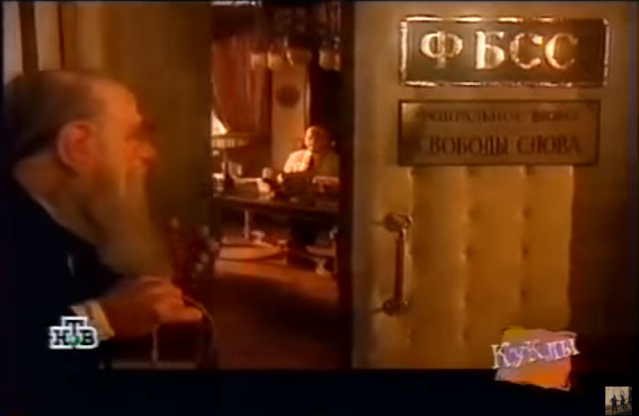
Kukly, 21 May 2000, "Freedom of Speech." Tolstoy visits the Federal Bureau of Freedom of Speech.
Screenshot from source.

We citizens of the USA live in the "land of the free," but some of us seem determined to enforce our own definitions of freedom at the expense of others.

White people are free to go to school without fear of encountering anything in history or literature classes that could upset us. (Black people must give up their freedom to learn about their historical experiences, except those that pass through that first filter.) Certain pastors demand the freedom to gather their congregations without masks in pandemic conditions, as John MacArthur's lawyers did in California, while denouncing religious freedom when it comes to religions other than their own. Don't get me started on the truck drivers' blockades in Ottawa and Windsor.

People on the political left are often guilty of self-serving definitions of freedom, sometimes doing their best to cancel lectures or shame public figures they disagree with. Despite the reliable flow of alarms from people like Andrew Sullivan (case study) about this inconsistency between liberalism in theory and censorship in practice, I still don't see it as equalling the authoritarian right in danger to public health and democracy. Some alleged examples of left-wing censoriousness are simply bumper-sticker idiocy or mean-spirited caricatures (see embedded tweet), not a serious encounter with actual accusations nor a sign of impending revolution. But in these exaggerations, in spite of their spite, so to speak ... is there a germ of humor?

On the University of Chicago Divinity School's "Sightings" page, William Schweiker posted a useful essay on this phenomenon of selective freedom, "Our Comedy of Errors?" Freedom is necessary, he says, for us to go beyond the grip of our own egos and seek justice for all.

Political freedom, rightly conceived, is bound to the demands and obligations of justice. And yet we are witnessing the morphing of such freedom into simple personal or group preferences. If one does not like an opinion or a statement or person, simply dismiss it, her, or him. If masks are mandated by the government, I need not heed it. In sum, self-interest and mob interest threaten to swallow our capacity for justice, causing the freedom that makes democracy possible to falter on every side of civil life.

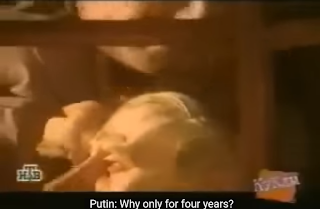
Kukly, 30 January 2000. Source.

Schweiker advocates irony and laughter to help break the grip of unreflective ego and "liberate constricted lives from their zealous quest to save the world, always in their own image." He reminds us of the Emperor's New Clothes; I remembered the Russian political satire show Kukly, which disappeared not long into Vladimir Putin's presidency.

If we can laugh at the exaggerations in our own defense of the liberties we prioritize, as well as at the inconsistencies of (say) the defenders of religious liberty, or others whose priorities we question, will we get a bit closer to cracking open our society's capacity to be reflective about freedom?

"The most realistic option for a change of power in the country." Found on vk.com in 2016.

Things that are easy for me to forget in the heat of controversy: 

When we try to look at each other's selective understandings of freedom, our tools also include simple curiosity. And we need to remember whom we are regarding -- all made in God's image.


In English, "freedom" and "liberty" are close synonyms, despite their different linguistic roots. Russian also has two words for the political and practical space to do what one wants, svoboda and volya. As the poet/bard Bulat Okudzhava explained,

What is a simple Russian inclined to do in his free time? Who knows? To reflect, to socialize, to drink. To drink not as an end in itself, but as a means of communication, merrymaking, oblivion. Inclined to free will [volya]; he doesn't give a damn about freedom [svoboda] but he loves liberty [volya]. It's as if he feels "nothing is holding me back." And when they say, "Here you are -- here's freedom [svoboda] for you," he does not understand. 

Here's historian and literary critic Leonid Batkin's version:

What is the difference between volya and svoboda? It is in the fact that svoboda is a positive and perfectly translatable concept. Whereas volya is absence of constraints (when the serfs were given letters of enfranchisement, this letter was called a volnaya), volya is when I do not have a yoke, when there is no authority over me, I do as I please, but there's no duty, no responsibilities. To get volya, people run absolutely anywhere, following their nose, to faraway lands, for example to the Cossacks. (But svoboda, you have to fight for it and treasure it.)

[Both texts are from 93 Untranslatable Russian Words by Natalia Gogolitsyna, which I wrote about here.]

I also remember the woman in a BBC documentary about Russia who said to the interviewer, "I already do whatever I want. Why do I need democracy?"


Another case study of the clash of freedoms: Timothy Snyder on the Canadian teamsters and their USA allies.

As we look north to the troubles of our Canadian friends, we can see familiar features, and recognize a general problem. It is perfectly legitimate for have different views on questions of public policy, and to express them. But social media and dark money favor the extremes against the center, and seem to whet appetite for violating the rights of millions of fellow citizens in the name of what turns out to have been a senseless idea.

Poet Nancy Thomas presents a new blog, Life in an Old Growth Forest: Reflections on Aging. "One of my purposes in initiating this blog is to explore the realities of aging, the highs as well as the voids, and learn to face it with courage and humor."

Tyler Huckabee remembers when Rich Mullins said hanging an American flag in church was "offensive."

A story for Black History Month from Haviland, Kansas, home of Barclay College. (Thanks to Jim Fussell via FB.)

Diana Ohlbaum (Friends Committee on National Legislation) on the Pentagon budget and the fearful "W-word."

Quakers, slavery, and sugar.

Eddington, Einstein, and "an expedition to heal the wounds of war." (The story behind the film, Einstein and Eddington, which we showed our students in Russia for several years.)


Another clip from Steve Guyger in Brazil:

24 June 2021

Why evangelicals should like CRT

 Our home (red marker) in my high school years, and our "nice" neighborhood. Source.
At the end of 1968, when we were still living in our apartment near one of Evanston's tacit racial boundaries (the city of Evanston is located on Lake Michigan, just north of Chicago, USA), my mother received $25,000 from her parents in Germany—enough at the time for a substantial down payment on a house. On July 26, 1969, we as a family went to a real estate office, accompanied by one of my father's colleagues, to begin house-hunting.

I don't know how much I was supposed to hear in the conversations among the adults, but I distinctly remember my mother making it clear that she intended to live in a white neighborhood. No problem, the agent said; the neighborhood we were considering would be perfect. I distinctly remember the words "nice people."

My mother didn't mention that her daughter Ellen was at that moment incarcerated in Chicago's juvenile jail, the Audy Home. My 1969 diary chronicles many of Ellen's run-ins with the law, as well as the general mayhem that transpired in our home on a near-daily basis. In between White Sox scores, Project Apollo coverage, and lists of unfinished homework, I regularly reported on the epic fights between my parents, some of which involved food being thrown about the kitchen and dining room. On one memorable occasion, my father threw my sister's copy of the Walker Report at me.

Obviously, we would fit right into a neighborhood of "nice people."

These are the memories that came back to me when I was reading Michael Gerson's op-ed, "I'm a conservative who believes systemic racism is real." His version of my story goes like this:

I grew up in a middle-class neighborhood of a middle-class suburb in a Midwestern city. I went to a middle-class high school, with middle-class friends, eating middle-class fried bologna sandwiches. And for most of my upbringing, this seemed not only normal but normative. I assumed this was a typical American childhood.

Only later did I begin to see that my normality was actually a social construction. By the time I was growing up in the 1970s, St. Louis no longer had legal segregation. But my suburb, my neighborhood and my private high school were all outcomes of White flight. The systems of policing, zoning and education I grew up with had been created to ensure one result: to keep certain communities safe, orderly and pale.

We're not just talking about the right to buy property among one or another group of nice people. Here's how the U.S. president, Lyndon Johnson, described how systemic racism sabotaged the basic right to vote, in his post-Selma speech to the U.S. Congress in 1965:

There is no reason which can excuse the denial of that right. There is no duty which weighs more heavily on us than the duty we have to ensure that right.

Yet the harsh fact is that in many places in this country men and women are kept from voting simply because they are Negroes. Every device of which human ingenuity is capable has been used to deny this right. The Negro citizen may go to register only to be told that the day is wrong, or the hour is late, or the official in charge is absent. And if he persists, and if he manages to present himself to the registrar, he may be disqualified because he did not spell out his middle name or because he abbreviated a word on the application. And if he manages to fill out an application, he is given a test. The registrar is the sole judge of whether he passes this test. He may be asked to recite the entire Constitution, or explain the most complex provisions of State law. And even a college degree cannot be used to prove that he can read and write.

For the fact is that the only way to pass these barriers is to show a white skin. Experience has clearly shown that the existing process of law cannot overcome systematic and ingenious discrimination. No law that we now have on the books—and I have helped to put three of them there—can ensure the right to vote when local officials are determined to deny it.

What was blatant in 1965 Mississippi may have been comparatively latent in middle-class suburban Chicago or St. Louis, but (here's the crucial point) the phenomenon of racism doesn't depend on the existence, disappearance, or conversion of individual racists. For a well-meaning white person to proclaim their own color-blindness misses the point.

[Related: Seeking to justify myself.]

Critical race theory, for example, is not a way to charge every white person with being racist. It is simply an analytical tool to help us go deeper, to explore why our neighbors continue to feel the effects of embedded racism, even if we personally do not. Is it the only tool? Probably not, but I cite it here because it is under such concentrated attack that, even if you are a loyal Fox News viewer, you must wonder sometimes how such a malignant danger could have struck such deep roots into mild-mannered legal scholars and sociologists! Isn't it possible that someone or something is benefitting from convincing you to distrust CRT? Are those critics of CRT describing something that its advocates are not actually advancing?

From an evangelical viewpoint, here are some ideas about that "someone or something."

First of all: Black people—and Black Lives Matter activists of all colors—are our neighbors, too! To many of them/us, the idea that our lives have all been made poorer by racism's long-time, persistent power to warp our laws and institutions is not new, and it's not rocket science. Don't we owe it to our neighbors to see if their perceptions are correct, and if they are, to work alongside them to confront this power? To reiterate this crucial point, the purpose is not to tag or shame anyone, because the problem is systemic, it weakens the whole community, and our individual virtue is totally beside the point.

Critical race theory is, by definition, unable to "essentialize race" for the purpose of condemning all white people, as some have charged, because CRT denies the objective, biological basis of race in the first place. Instead of encouraging us to look at people and judge them for their skin color, the tool helps us discover the systemic, embedded effects of looking at people that way.

Michael Gerson argues that studying systemic racism is consistent with conservatism because...

For me, part of being a conservative means taking history seriously. We do not, as Tom Paine foolishly claimed, “have it in our power to begin the world over again.” We live in an imperfect world we did not create and have duties that flow from our story.

There is an important moral distinction between “guilt” and “responsibility.” It is not useful, and perhaps not fair, to say that most White people are guilty of creating social systems shaped by white supremacy. But they do have a responsibility as citizens, and as moral creatures, to seek a society where equal opportunity is a reality for all.

Rather than slander the methods used to expose and explain the lack of equal opportunity, wouldn't it make sense to put that passion and urgency into questioning why that lack persists? After all, we have at our disposal the tools of "systemic anti-racism," as Gerson says. "We have documents—the Declaration of Independence, the Bill of Rights, the 14th Amendment—that call us to our better selves.... The response to systemic racism is the determined, systematic application of our highest ideals."

Evangelicals are the last people who should be shocked that sin has embedded itself in our laws and institutions. In an earlier post on perpetual war and biblical realism, I pointed out that "Biblical realism allows us to confront perpetual war by reminding us that the hearts of nations as well as individuals are inclined toward deceit, and the Bible doesn't make an exception for us." The same goes for all forms of socially embedded sin. Ecclesiastes gives us a vivid example: "If you see the poor oppressed in a district, and justice and rights denied, do not be surprised at such things; for one official is eyed by a higher one, and over them both are others higher still." (Ecclesiastes 5:8.)

Given its origins, persistence, and ability to confuse, confound, and stir up useless controversy, I personally have no doubt that racism has a demonic stronghold in the USA. All of us who believe in the nonviolent Lamb's War against the powers and principalities and forces of evil in high places can play a role in tearing down this stronghold:

  • We can reject false allegations about the tools and methods at our disposal, including CRT for those led to use it. We can courteously remind our alarmed neighbors that the Sword of the Spirit is the Word of God, not Fox News.
  • We can also confront the misuse of those tools, their exploitation to shame people for political purposes, or the temptation to idolize the tools instead of keeping our eyes on the prize.
  • We can create and maintain multiracial communities of struggle that, by their very existence, subvert the myths of racism.
  • If we are far from the obvious centers of struggle, we can still participate by prayer, study, correspondence, making judicious contributions.

If by our faithful struggle we begin tearing down the stronghold of racism, chances are we will also be well on the way to healing the polarizations that threaten to tear us apart. Those polarizations distract us from focusing on our common dangers—and I'm realist enough to believe that this is no accident.


Robert P. Baird, The invention of whiteness: the long history of a dangerous idea.

The idea of whiteness, in other words, was identical to the idea of white supremacy. For the three centuries that preceded the civil rights movement, this presumption was accepted at the most refined levels of culture, by people who, in other contexts, were among the most vocal advocates of human liberty and equality. ...

As though aware of their own guilty conscience, the evangelists of the religion of whiteness were always desperate to prove that it was something other than mere prejudice. Where the Bible still held sway, they bent the story of Noah’s son Ham into a divine apologia for white supremacy. When anatomy and anthropology gained prestige in the 18th and 19th centuries, they cited pseudo-scientific markers of racial difference like the cephalic index and the norma verticalis. When psychology took over in the 20th, they told themselves flattering stories about divergences.

Stuart Masters, A glimpse of heaven on earth—the roots of Quaker utopian communities.... (Russian translation of Stuart's article.)

Mark Buchanan, it's time to set some rules for talking to extraterrestrials.

How Mindy Roll came to love embodied prayer.


My James Harman tribute continues. Today—"Payback Time" from a pandemic-shaped streaming concert last summer, with the Rhythm Scratchers. (James Harman died last month at age 74.)