The third "No Kings Day" program of protest actions in the USA are being organized for this Saturday. We will be out of the country that day, but hope and pray for a peaceful day, and a good turnout. I'd love to see lots of creative messaging that will reach new audiences, and a minimum of stupid caricatures.
Some USA citizens here in the United Kingdom will be marching under a slightly different banner, "No Tyrants," since here there is an actual king. The king is styled "sovereign" but, ironically, in normal times the British sovereign has practically no political power in comparison to King Donald.
The kings and queens in constitutional monarchies do have enormous symbolic power in their roles as stewards of national identity and guarantors of continuity. They would quickly lose that legitimacy and its grounding in the affections of their people if they became kings in the ancient tyrannical model described by God to Samuel, who—in vain—passed that warning on to the people demanding a king.
Many actual monarchs, having more majesty than power, still have the use of grand palaces, elaborately decorated, and they participate in impressive rituals and spectacles. They may have buildings, organizations, and various projects named after them, and their pictures may appear on currency or on the walls of government offices, but, again, if they themselves were to decree these arrangements, their legitimacy would suffer.
King Donald wants both power and spectacle. May he get an unmistakable NO on Saturday.
My June 14 sign.
On his blog, Interrupting the Silence, Michael K. Marsh points out that this upcoming No Kings Day is on the weekend of Palm Sunday.
This Saturday, March 28th, is the third No Kings Day protest and Sunday, March 29th, is Palm Sunday, but here’s what I wonder:
What if Palm Sunday was the original No Kings protest?
What if Jesus, the disciples, and the crowd that follows Jesus are protesting violence, injustice, and imperial power?
Instead of protest songs there were shouts of “Hosanna!”, a cry for deliverance and liberation, a plea for change. Instead of protest signs there were cloaks and palm branches, symbols of joy, peace, submission, and the celebration of a new way.
Here's how Nancy Thomas has been using slugs in her writing. It reminded me of the tradition among some pastors and seminarians to challenge each other to embed some incongruous word in sermons they'll be preaching.
Philosophers, political scientists, and advocates of civil discourse are grieving the death of Jürgen Habermas.
Jeremy Morris tells us why he thinks "Paul D’Anieri’s updated Ukraine and Russia: From Civilized Divorce to Uncivil War is the single best book you can read to understand the domestic and geopolitical causes of the current war." He managed to persuade me to buy the book. I haven't started reading it yet, but I think Morris's post is interesting on its own ... as usual.
A couple of weeks ago, my therapist suggested that I write down some of my early memories, grouped chronologically. Maybe later we can discern some trends and common causes.
The task became easier when I reached the age of 14, when I began writing a daily diary, which I continue to this day. Still, I have memories from before that age ... many of which came back to me since I began assembling the list she suggested.
Judy is a volunteer at a charity shop in our neighborhood, and she primarily works with their used books. Coincidentally, the same day I accepted this memory-list assignment, Judy brought home a copy of Vladimir Nabokov's remembrances, Speak, Memory, which includes some of his earliest childhood memories.
Here's one of those memories:
Several times during a summer it might happen that in the middle of luncheon, in the bright, many-windowed, walnut-paneled dining room on the first floor of our Vyra manor, Aleksey, the butler, with an unhappy expression on his face, would bend over and inform my father in a low voice (especially low if we had company) that a group of villagers wanted to see the barin [that is, the master of the estate, Nabokov’s father] outside. Briskly my father would remove his napkin from his lap and ask my mother to excuse him. One of the windows at the west end of the dining room gave upon a portion of the drive near the main entrance. One could see the top of the honeysuckle bushes opposite the porch. From that direction the courteous buzz of a peasant welcome would reach us as the invisible group greeted my invisible father. The ensuing parley, conducted in ordinary tones, would not be heard, as the windows underneath which it took place were closed to keep out the heat. It presumably had to do with a plea for his mediation in some local feud, or with some special subsidy, or with the permission to harvest some bit of our land or cut down a coveted clump of our trees. If, as usually happened, the request was at once granted, there would be again that buzz, and then, in token of gratitude, the good barin would be put through the national ordeal of being rocked and tossed up and securely caught by a score or so of strong arms.
In the dining room, my brother and I would be told to go on with our food. My mother, a tidbit between finger and thumb, would glance under the table to see if her nervous and gruff dachshund was there. “Un jour ils vont le laisser tomber,” [“One day they’re going to abandon him,”] would come from Mlle Golay, a primly pessimistic old lady who had been my mother’s governess and still dwelt with us (on awful terms with our own governesses). From my place at table I would suddenly see through one of the west windows a marvelous case of levitation. There, for an instant, the figure of my father in his wind-rippled white summer suit would be displayed, gloriously sprawling in midair, his limbs in a curiously casual attitude, his handsome, imperturbable features turned to the sky, Thrice, to the mighty heave-ho of his invisible tossers, he would fly up in this fashion, and the second time he would go higher than the first and then there he would be, on his last and loftiest flight, reclining, as if for good, against the cobalt blue of the summer noon, like one of those paradisiac personages who comfortably soar, with such a wealth of folds in their garments, on the vaulted ceiling of a church while below, one by one, the wax tapers in mortal hands light up to make a swarm of minute flames in the mist of incense, and the priest chants of eternal repose, and funeral lilies conceal the face of whoever lies there, among the swimming lights, in the open coffin.
I love this piece of writing, which combines a child’s lack of full context with our childhood tendency to make fanciful associations, like the similarity between his levitating father in his wind-rippled white suit with the angels on cathedral ceilings, which he might have noticed during a funeral liturgy.
My home in grade school years. (Second floor, left.) Source: Google Maps, 2011.
In my family, such memories would have been unlikely to occur. We lived in an apartment building, not an aristocratic estate, and levitations of any kind outside our second-story windows would have been very hazardous. Furthermore, any mention of religion was strictly forbidden in our home, as I mentioned in this post a couple of years ago, so I would not have made any connections with angels on a church ceiling.
As I recalled in that post, I have a vivid memory from grade school, when our teacher asked us why we should be afraid to talk about God. (This was before the prayer-in-school controversy that began in 1962.) I found myself sitting there, strangely tongue-tied, and thought then that I would never be able to use the word “God” out loud in public. Still, I was fascinated that people who appeared normal could have such a discussion at all. It was as if God had very temporarily levitated above the windowsill of our schoolroom, as Nabokov’s father had when his tenants had lofted him into the air.
Another time that God briefly hung in the air in my childhood was when I found a Gospel tract on the floor of our building’s lobby. The author described something resembling what I would now call a conversion experience. This new believer had so fallen in love with the Lord that, in his daily walks in the city, he would go out of his way to pass churches so that his hungry eyes would see the name “Christ” on the church buildings.
A little later, but long before my personal conversion, I used to listen to a Sunday night church service on my favorite top-40 rock station, WCFL, the voice of the Chicago Federation of Labor. Normally, I would be listening to that station to hear Sam the Sham and the Pharaohs sing “Wooly Bully” or “The Hair on my Chinny Chin Chin,” or Herman’s Hermits sing “There’s a Kind of a Hush All Over the World Tonight,” or Tommy James and the Shondells’ unforgettable classic “My Baby Does the Hanky Panky,” or Wilson Pickett’s oh-so-suggestive “In the Midnight Hour.” Among my favorite memories of sheer escapism was the sublime chaos of Ron Britain's unique style of DJ'ing. I still remember this particular broadcast.
I also relied on WCFL for broadcasts of Chicago White Sox baseball games, via the voices of announcers Bob Elson and Red Rush. I dutifully recorded results in my diary, and was especially happy when my favorite relief pitcher, Hoyt Wilhelm, got credited with a save.
But Sundays at 11 p.m., something different was on the air. It was the weekly service of the First Church of Deliverance, with the warm, magnetic personality of the Rev. Clarence H. Cobbs leading the service. Years later, Rev. Jesse Jackson called Clarence Cobbs his “spiritual father.”
Obviously, I kept my being part of Rev. Cobbs’ radio congregation a secret from my family. I attended the First Church of Deliverance while in bed, listening with my little single earphone, with my head under the blanket. I loved the church's theme hymn, “Jesus Is the Light of the World,” which was my first exposure to Black Gospel music. I also remember "Jesus Is a Healer," "How I Got Over," "I'm going to Make It," and "Let Us Sing 'til the Power."
What really intrigued me was the pastoral prayer for “the sick, the shut-ins, the bereaved, the incarcerated, and all those who love the Lord.” Although I did not know intellectually whether I was included in those last words, they always gave me a distinct tingle.
My oldest memory of this kind was from sometime between the ages of two and four, during the years I lived with my mother’s parents in Stuttgart, Germany, before my parents came to claim me and take me to my new home in Chicago. I was sitting in my grandmother’s lap in our home at Robert Bosch Str. 104, and she was teaching me how to tie my shoes. And while she was doing that, she was talking to me about the Good Shepherd. I clearly remember that this was how she talked about Jesus. I like to think that these experiences of God rising into my field of vision for just a short time despite the obstacles, formed a golden thread that usually ran below the surface of my life until the day I came to know that I could trust that very same Good Shepherd, and eventually led to my being willing, even invited, to write and talk about God in public.
I used some of this essay in a sermon at Spokane Friends Meeting last Sunday. One of the slides I used that morning during the sermon was this painting by Willem Drost, sometimes interpreted as being a portrait of Timothy (recipient of New Testament letters from his mentor, the apostle Paul) and his grandmother Lois. I can't help associating it with my own grandmother, thanks to whom I caught one of my first glimpses of God.
Out of the many books on aging, Nancy Thomas has a specific recommendation.
(I continue to recommend John Yungblut's On Hallowing One's Diminishments for the specific aspects of aging he deals with. I wrote about that pamphlet here.)
Comments on the fourth anniversary of Russia's full-scale invasion of Ukraine ... from Heather Cox Richardson, and from Jeremy Morris. The latter writes about the typical errors of commentators on Russia and Ukraine, and summarizes what he himself got right and got wrong over the past few years. As usual, his dense prose rewards careful reading.
Meanwhile, Timothy Snyder says that Donald Trump is "failing at fascism."
Collaborate or collapse: Matt Hisrich points to a possible new path forward in an era of shrinking markets and closures in higher education.
Top three Winter Olympic teams judging by medals, snipped from this page.
This past weekend the 2026 Winter Olympics in Italy came to a close. Team Norway, as usual, did their (my) homeland proud. Among the other statistics describing the Norwegian triumph, I noticed something nobody seemed to comment on: Norway got 41 medals with a team of 80 athletes, while the USA got 33 medals with a team almost three times as large, 232 athletes. Here's The Guardian's rather routine analysis of Norwegian Olympic success. Timothy Snyder writes about watching the Olympic Games in Ukraine.
Now that I've got Norway's triumphs commented on, I can return to my usual conceit of being a citizen of the whole planet.
First Church of Deliverance is on the air! This recording takes me back to my teenage memories of listening secretly to these broadcasts. "Lift up your heads! Don't be afraid!"
Left to right: My mother Erika Maurer, me, great-grandmother Jenny Christine Maurer, my sister Ellen, my aunt Ada DenBraven, and, finally, Ada's brother, my father Harald Maurer. Evanston, Illinois. Late 1950's.
I've written before about how difficult it has been to grieve my parents. That inability has left a hollow place in me.
A little over a decade ago, at a retreat center for international workers, I promised a therapist that, after our month at this center ended, I would continue to work on this grief.
It's taken some time, but I'm glad to report that I'm finally saying goodbye—first to my mother. It involves speaking to her and my father directly, in the presence of a therapist (a trained and trustworthy witness is important to me)—that is, looking at the place in the room where I imagine my parents to be, asking them the questions I wish I'd had a chance to ask when they were alive, and saying goodbye.
I spent my earliest years with my father's parents in Oslo and then my mother's parents in Stuttgart, before going to Chicago to live with my parents and the two-year-old girl they'd had in my absence—my sister Ellen. Hence this sample from my questions:
"Did they send you photos of me? What did you think?"
I won't list all my questions here. My final questions to my mother: "How would you like me to remember you? What would you like me to remember about you?"
You may be among my readers for whom this kind of therapy is familiar territory. Maybe you've used a similar approach to address painful relationships or unresolved grief. In my case, even though this was my own initiative, I'll admit that I had to overcome some skepticism about the play-acting that seemed to be involved. To my surprise, the longer I stuck with the exercise, the more real it became.
I plan to continue.
I began the day thinking that today's blog post would be personal, and I could take a rest this week from the unfolding calamity of a rogue presidency. Then I saw the photo of five-year-old Liam Ramos, a photo you might also have seen in today's news. I first saw it in this article by the Washington Post's art and architecture critic, Philip Kennicott.
There was more shock to come. Asked about this case, vice president J.D. Vance said, "So the story is that ICE detained a five-year-old. What are they supposed to do? Let a five-year-old child freeze to death?" (Quoting from the CBC report.)
Did it really not occur to Vance or to ICE that there was another obvious option?—not to make the arrest! ... To use their better judgment. To have the humanity to leave these people alone! For God's sake, make a moral calculation (after all, you know where the family lives!!) in favor of the child and family and due process rather than an artificial urgency that inevitably leads to blatant public cruelty.
Canadian prime minister Mark Carney's remarkable seventeen-minute Davos Conference reality check. (And, sorry, PM, your invitation to the Board of Peace has been canceled!)
What strikes me most is how clearly this perspective exposes the spiritual sicknesses we too often mistake for holiness. As someone who loves Christ deeply yet hesitates to call herself a Christian because of how distorted the faith has become in practice, I feel this tension painfully.
Another perspective on distorted faith, from Peter Wehner: In case you were still wondering, "MAGA Jesus is not the real Jesus."
Jeremy Morris on Russia, Ukraine, and the "Western-culpability thesis," with Richard Sakwa as a case study.
John Calvi "had a small miracle occur"—see his year-end letter.
Blues from Canada: Whitehorse's version of "Baby, Scratch My Back."
Slim Harpo's original classic (including the chicken scratch) lives on! I've probably posted more versions of this song than of any other, but so many musicians find it irresistible. (More in coming weeks.)
In the aftermath of the seizure of Venezuelan president Maduro and his wife, political strategist David Brock urges Democrats not to give in to a familiar (he alleges) impulse to "oppose first, think later."
Not exactly Trump derangement syndrome, but the effect is the same. I understand the revulsion most of us feel toward President Donald Trump, but Democrats’ first obligation is not catharsis. It is political competence and survival.
If Maduro exported cocaine and cartel violence to the U.S., he belongs behind bars, not in a palace. A large share of Americans will hear “the U.S. captured the head of a drug ring” and think: good. They will not parse legal niceties. They will want to know two things: Did it make Americans safer, and will it stop there?
Who exactly "will not parse legal niceties"? Are they by any chance related to those for whom the U.S. president can do no wrong? Do "legal niceties" include the U.S. Constitution? Is it true that a "large share of Americans" are incapable of disliking a corrupt tyrant (Maduro in this case) while at the same time holding their own government accountable for its actions?
The people who believe that an all-powerful MAGA administration is what's best for the USA remind me of the book of the biblical judge/prophet Samuel. Frustrated by the inadequacies of Samuel's sons, the elders of Israel beg for a king. (1 Samuel 8:6-20; context.)
But when they said, “Give us a king to lead us,” this displeased Samuel; so he prayed to the Lord. And the Lord told him: “Listen to all that the people are saying to you; it is not you they have rejected, but they have rejected me as their king. As they have done from the day I brought them up out of Egypt until this day, forsaking me and serving other gods, so they are doing to you. Now listen to them; but warn them solemnly and let them know what the king who will reign over them will claim as his rights.”
Samuel told all the words of the Lord to the people who were asking him for a king. He said, “This is what the king who will reign over you will claim as his rights: He will take your sons and make them serve with his chariots and horses, and they will run in front of his chariots. Some he will assign to be commanders of thousands and commanders of fifties, and others to plow his ground and reap his harvest, and still others to make weapons of war and equipment for his chariots. He will take your daughters to be perfumers and cooks and bakers. He will take the best of your fields and vineyards and olive groves and give them to his attendants. He will take a tenth of your grain and of your vintage and give it to his officials and attendants. Your male and female servants and the best of your cattle and donkeys he will take for his own use. He will take a tenth of your flocks, and you yourselves will become his slaves. When that day comes, you will cry out for relief from the king you have chosen, but the Lord will not answer you in that day.”
But the people refused to listen to Samuel. “No!” they said. “We want a king over us. Then we will be like all the other nations, with a king to lead us and to go out before us and fight our battles.”
Back to the year 2026. I agree with the importance of Brock's two questions that he believes a large share of Americans will prioritize: Did the president's decisions make Americans safer, and will he stop there? But I do not believe that Trump's happy supporters will really ask those questions seriously. Will Americans be safer in an international context of imperial spheres of influence instead of the post-WWII rules of collective security? And is there anything in the MAGA movement's record that serves to assure us that it "will stop there"...?
In the future:
Will the Venezuela raid be a model for other left-leaning governments in Latin America (good or bad), or will those leaders whom Trump likes have nothing to fear? (Ex-president Juan Orlando Hernández of Honduras, for example.) What about other countries facilitating drug shipments to the USA? Wouldn't more resources for helping addicts reduce the scandalous demand for those drugs?
If the Venezuela raid was strictly a law-enforcement operation, how do we account for the 70-100 deaths of non-criminals killed in the raid? How heartless is it to boast of its success at that cost?
Another will-it-stop-there question: does it help international maritime behavior for the USA to confiscate ships and their cargo? Where's the line between unilateral embargoes and piracy?
Iran, Syria, Somalia, and Nigeria have all been attacked by U.S. forces under the president who wants a Nobel peace prize. Meanwhile, on a quieter note, the best deal proposed by USA's leadership for Greenland right now is for us to purchase the island rather than seizing it, despite repeated denials from Denmark and Greenland that the island is for sale. Where will it stop?
"He will take the best of your fields and vineyards and olive groves and give them to his attendants." I have not even touched the subject of self-dealing and corruption in the current administration, or its vindictive campaigns against critics.
David Brock urges us to display "political competence," by which he seems to mean concealing our ideals to earn the attention of those unwilling to follow his two questions all the way to their evident conclusions.
Timothy Snyder on the raid, its precedents and implications. (Link in original.)
In invading Ukraine, Putin deliberately exploited the language of law, claiming that his aggression was justified by the UN Charter. The point was not to affirm but to ridicule the principles of international law. Russia has worked hard to create a world in which everyone treats international law as a joke. The American government made no effort to justify its extraction of Maduro in terms of international law, which is an obvious Russian intellectual victory—even if the Kremlin itself might be displeased by the consequences in this particular case.
Administration officials’ indifference to facts, to due process, to the dignity of the deceased, and to basic human decency is remarkable. They could have pleaded for patience and said the incident would be investigated—the standard response in such circumstances. They could have even done so while defending the federal agents they have deployed to terrorize areas they perceive as Democratic Party enclaves. Instead, they proceeded to make ostentatiously dishonest statements that they knew would be contradicted by the video evidence available to anyone with eyes to see it.
Quakers Rock the Midwest: Western and Wilmington Yearly Meetings and the New Association of Friends present a retreat for 8th-12th graders, January 16-19, at Evanston (Illinois) Friends Meeting.
“Love your enemies, and pray for your persecutors….”
Reading these words, from Matthew 5:44, was the turning point of my life. The year was 1974. I was 21 years old, a university student in Canada. I felt like an exile from the USA, disillusioned by the war in Viet Nam and by President Nixon’s Watergate scandal. I had fled my violent and alcoholic family, but in leaving them I had abandoned my ten-year-old sister to their care, if that’s the right word.
How I came to be reading the Bible that day is a long story for another time, but those specific words from Matthew opened me up in an unexpected and unprecedented way. Underneath the printed words I could feel a voice saying, “You can trust me.”
From that moment forward, that promise of Jesus shaped my life in at least three ways. First, after the disillusionments that had shaken my life to that point, both in the world and in my own family, I desperately needed healing for my ability to trust. Bitterness and cynicism seemed very inviting alternatives. Instead, I had a new goal for my life: to relearn how to trust and to be trustworthy. I’m aware of my failures, but that’s still my daily goal.
Second, I wanted others to have access to that voice, especially those who’d also experienced disillusionment and betrayal. Some might discover it in the Bible, as I did, but I thought others might be reached through trustworthy communities, and the people that those communities empowered and sent out into the world. That‘s why the ideal and goal of “building a trustworthy church” became so important to me.
Finally, here’s the Quaker part. My path to Jesus began in an unlikely place: growing up in an anti-church family in which any mention of religion or mortality was forbidden. I felt blessed to hear his promise directly, cutting through the blanket skepticism I’d inherited from my parents. I knew right away that I wanted to find out more among people who would understand my hunger for that direct confirmation without unnecessary ceremonies or gatekeepers. I had heard about Quakers, and it seemed to me as a young seeker that maybe these were people who would offer that understanding.
On August 11, 1974, I decided to test this hope. I went to a Quaker meeting for the first time, and hope became reality. I joined the movement that took George Fox at his word, “Christ has come to teach his people himself,” and will be forever grateful that I found you.
My story would be very incomplete if I did not mention the role of my marriage in “what I’ve learned….” Judy has gifts of spiritual sensitivity that I lack. I’ve learned that our gifts supplement each other, and I’ve grown to rely on that.
I don’t want to be interpreted as saying that marriage is a superior state. I’m grateful for this partnership in my own case, but complementary gifts and partnerships are not confined to any particular relationship model.
Our healthiest meetings and churches recognize and liberate the gifts of all of us, so that our prophets and teachers, our helpers and treasurers, our evangelists and poets, our pastors and clerks, all encourage each other, and even our conflicts can become fertile and redemptive.
I originally wrote the text above as an exercise for our yearly meeting's Faith and Practice Committee. If I were asked to provide a spiritual biography of reasonable length, what could I come up with? This was my answer, for now.
Have you written anything along similar lines? If you're willing to share it, I'd be very grateful!
The title of my attempt comes from the opening paragraph for our slowly-emerging book of Faith and Practice—a preamble approved by our yearly meeting last June:
The Sierra-Cascades Yearly Meeting of Friends is a voluntary association of Quaker meetings, churches, and individuals whose worship, ministry, and service are centered in Christ, guided by Quaker testimonies and experience, and committed to the full participation of LGBTQ+ people in all aspects of the life and leadership of the Yearly Meeting....
This morning I attended an online meeting of the European and Middle East regional team of Friends Peace Teams. Among other important agenda items, we had a vivid and distressing direct report of conditions in the Gaza Strip as of today. If the text of the report becomes available for circulation, I'll add a link here. In the meantime, we already know the urgency of a ceasefire.
In the meantime, here is the most recent newsletter of Friends Peace Teams, covering much of the range of the work of FPT and its partners.
And ... Friends Peace Teams is hosting an Online Global Gathering, November 13-16, 2024. The gathering is for newcomers and long-timers, for justice and peace workers, facilitators, supporters, donors, inquirers, members of Quaker meetings and churches and their friends, to get to know and learn from each other, celebrate our work, and deepen our connections. Join us to celebrate and discuss our theme: Justice and peace are possible! What sustains our faith in justice and peace in the face of violence and war? Check out the program for information and registration.
Finally, the Europe and Middle East team is looking for a Volunteer Treasurer to manage our slowly growing funds as we work to build our regional efforts. The Treasurer works with our accountant and other regional treasurers to coordinate donations, spending, and our annual budget. For more information about joining our team, composed of Ukrainians, Iraqis, Palestinians, British and Americans, or about other aspects of these reports and plans, please contact Ann J. Ward, Northern Yearly Meeting representative and clerk of Friends Peace Teams - Europe and Middle East, or contact me, Sierra-Cascades' representative. (Or leave a comment on this post.)
Fordham University's Orthodox Christian Study Center is hosting an online panel presentation, The Plight of Gaza's Christians, this coming Sunday, Sept 29. More information at this page.
A Ukrainian Vision of Peace: a statement adopted by the Ukrainian Pacifist Movement on the International Day of Peace.
For Our Daughters: The Story of Abuse, Betrayal and Resistance in the Evangelical Church—the full version of this film became available on Youtube today. Here's a link to the study guide for viewers. Producer Kristin Du Mez explains the context of the film in this video.
Thanks to Jim Fussell (Quaker Theology Group on Facebook) for drawing our attention to this article on flowers at Quaker meetings. And here's Nancy Thomas on late bloomers. Nancy's newest poetry collection, The Language of Light, is on sale now.
A Steve Guyger rerun: Sonny Boy Williamson II's "Mighty Long Time." (Here's a Youtube audio clip of Williamson performing his song.)
Christians for a Free Palestine: screenshots from this evening's Zoom call. Clockwise: Erica Williams, Cole Parke-West, Rifat Kassis. Others involved in leading this evening's presentation included Margaret Ernst, SueAnn Shiah, Jonathan Brenneman.
We confess that Your message has been manipulated by those who claim Your name. Rifat Kassis (in prayer).
There are so many reasons to turn away, and we need you [Christians] to stay, Palestine needs you to stay. Rabbi Jessica Rosenberg.
This Lent we're not to GIVE UP anything, but to STAND UP. Rev. Erica Williams.
Just a short post today to report on this evening's interesting "mass mobilization call" on behalf of Christians for a Free Palestine.
I had found out about this call from friends who knew about my longstanding concern for Palestine. Having written on my blog last week about the use of "Christian civilization" as a justification for outright cruelty, I was relieved to learn about an effort to organize Christians to stand against one of the most blatantly cruel spectacles currently underway under the eyes of the whole world—the ethnic cleansing of the Gaza Strip.
That campaign has reached a place of lethal absurdity in Israel's demands that Palestinians evacuate Rafah, where over a million of them have sought relative safety after being driven out of points further north. Among the actions we took this evening was to leave voicemail messages with our elected representatives and senators, using the calling facilities of Jewish Voice for Peace and a suggested script:
In the slightly longer term, we were given links to join a regional community-building program, and encouraged to spread the word on a Day of Action at senators' and representatives' offices, planned for March 18. The next mass call will take place on the previous day, March 17.
There is absolutely no doubt in my mind that the hour is very late, and any credible campaign for Christians to rise up against the slaughter of Palestinians is worth considering. This evening's event had plenty of the signals I associate with the activist subculture, but my sense was that the prayer and the music and the appeals to mobilize were sincere, honest, and non-manipulative. For example, almost unbelievably, there were no images of the suffering and ruin to which we desperately desire to respond. The co-opting of our faith in the service of imperialism was very clearly denounced, but nobody aimed invective at any specific villains. Instead, we sang, "There is power in the Name of Jesus, to break every chain...."
I saw that this evening's call was recorded, and if a link to the recording is supplied, I'll update this post. Likewise, if I learn that my trust in this effort was misplaced, I'll also update.
In the meantime, consider joining a regional group through this link, and judge for yourself. But, in any case, in addition to praying without ceasing, let's make some noise! In particular, let's confront the heresies of white supremacy and Christian Zionism that encourage and compound these outrages, and spread the genuine Good News with humility and boldness in the strong name of Jesus, and without glibness or denial in the presence of suffering.
One of the participants in this evening's call pointed out that there are more members of Christians United for Israel than there are Jewish people in the USA.
The hyperbolic style is marked by a cluster of generic traits. First, it emphasizes its speaker’s, or else some other potential victim’s, vulnerability to harm, up to and including murder. Second, it relies on distant historical analogies meant to heighten its urgency. Third, it is hortatory, alarmed, exigent: Something needs to happen, and it needs to happen now. Fourth (and this is its most “academic” feature) it makes large but ambiguous claims about the structural or systemic aspect of one or another threat.
Madeleine Davies, a senior writer at Britain's Church Times, reviews Karen Swallow Prior's The Evangelical Imagination.
What is needed, she suggests, is nothing less than another Reformation. If the first concerned the truth revealed in scripture, this one must confront “the way and the life revealed in Jesus—and how the Church has failed to follow and embody it”.
Friends World Committee for Consultation, Section of the Americas, announces a new program of mutual learning and encouragement among Friends churches and meetings—Quaker Connect—and is seeking a new staff member to serve this new program. Note! Deadline for applications is March 1.
Martin Kelley considers the new Quaker histories ... and how expensive they can be. Do we need a movement toward open access among Quakers academics and their institutions? (By the way, since Martin mentioned JSTOR: I found out when researching Fairhope, Alabama, and the Friends community in Monteverde, Costa Rica, that our public library here in Multnomah County, Oregon, makes JSTOR available without charge to cardholders.)
A self-serving PS: Since I'm among those who cannot afford those expensive books (thought I've bought some slightly older books at used book stores), I find these scholars' blogs a helpfui way to stay at least somewhat informed. And here's a sobering thought: I've now been a Quaker for fifty years, which means that my own lifespan as a Quaker already spans almost 15% of Quaker history!
Here's something a bit different: a Russian rock musician's approach to what I think qualifies as blues (at least as far as the lyrics are concerned)—Konstantin Nikolsky's "When you understand with your mind." The lyrics and a translation appear after the video. At first glance, it's a bit of a gloomy and ironic song, not qualities I usually look for, but it's probably my favorite of his many hits.
By some miracle of timing, I once heard Nikolsky live. It was during the financial crisis of 1998, and he appeared in a small Moscow club with an audience of less than 20.
Константин Никольский, "Когда поймешь умом."
Когда поймешь умом, что ты один на свете,
И одиночества дорога так длинна,
То жить легко и думаешь о смерти,
Как о последней капле горького вина. Вот мой бокал, в нем больше ни глотка
Той жизни, что как мед была сладка.
В нем только горечь неразбавленной печали,
Оставшейся на долю старика.
Бокал мой полон, но друзей не стану
Я больше угощать питьем своим.
Я их люблю, дай боже счастья им.
Пускай они пьют воду из под крана.
Для мира сделаю я много добрых дел,
Во веки вечные их не забудут люди.
И если выйдет все, как я хотел,
То, боже милый, мир прекрасным будет.
Послав страдания на голову мою,
Послав отчаянье душе моей правдивой,
Пошли мне веру, я о ней спою,
И дай мне силы, Чтобы стать счастливым.
When you understand with your mind
that you are alone in the world,
And the road of loneliness is so long,
Then life is easy and you think about death,
Like the last drop of a bitter wine.
Here's my glass, there's not another sip in it
That life that was as sweet as honey. Now there's only the bitterness of undiluted grief, That remains as an old man's share.
My glass is full, but I won't make friends
I'll offer more of what I'm drinking.
I love them, God bless them.
Let them drink water from the tap. For the world, I'll do many good deeds, Forever and ever, people won't forget them,
And if everything turns out the way I wanted,
Then, dear God, the world will be wonderful.
Having sent suffering to my head,
Having sent despair to my truthful soul,
Send me faith, I'll sing about it,
And give me the strength to become glad.
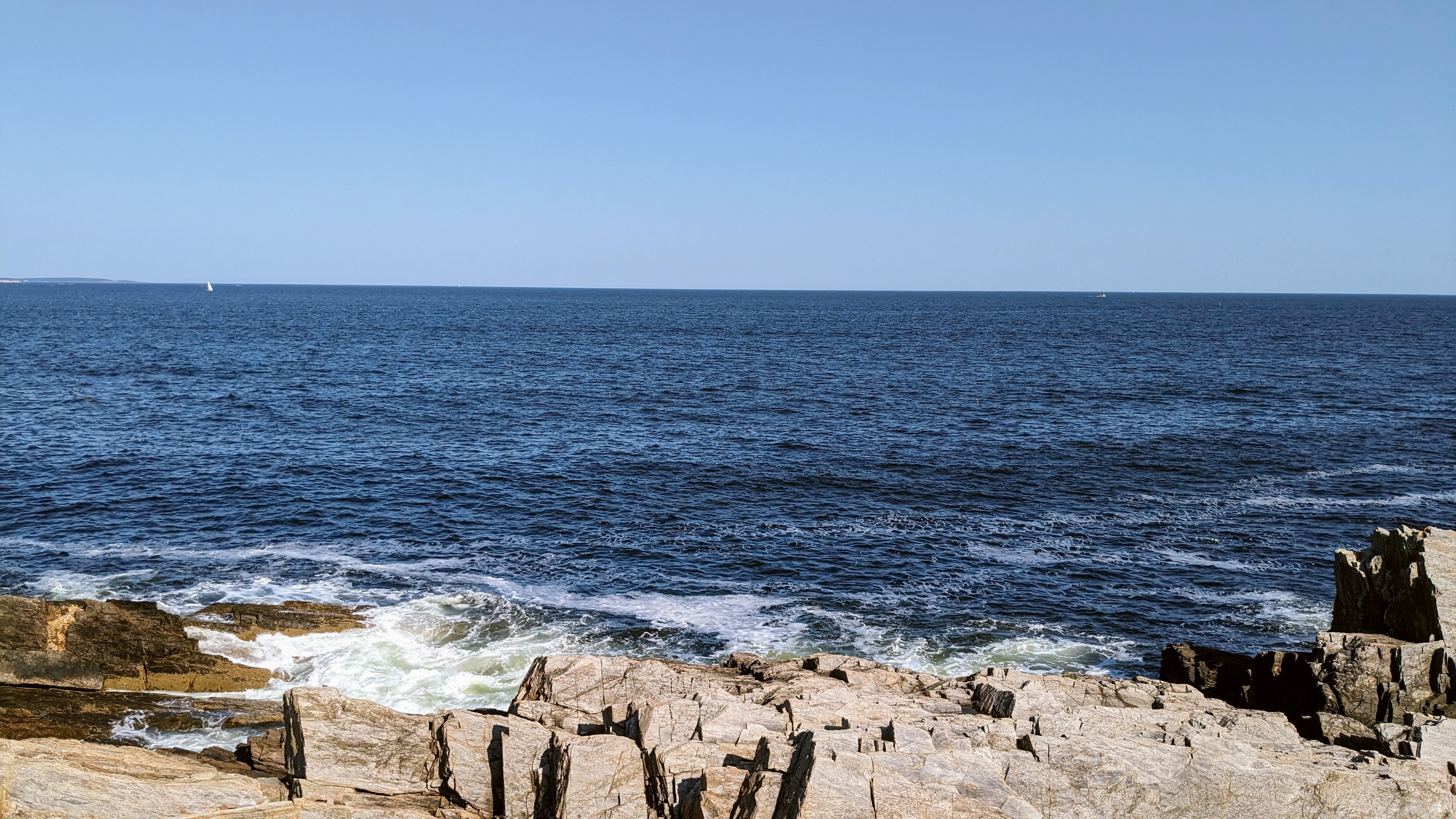
Giant's Stairs Trail, Bailey Island, Harpswell, Maine, USA.
As the year 2023 makes its way into the New Year's Eve harbor, it's impossible to ignore the wreckage it left in its wake. I'm having a hard time remembering the hopes and ideals with which I started this year's voyage. Many of them seem to have been drowned out by physical and verbal violence.
That's all true. But even so I want to think carefully about what to take aboard with me as 2024 prepares to get underway. As I try to refresh my stocks of hope and idealism (without ignoring today's realities here, for example, and here), I've been finding inspiration in a novel and a podcast.
The novel is Sun House by David James Duncan. Even though I've been reading it on and off the whole of this month, I'm only halfway through it. I find that this 775-page rollicking manifesto for love, ecstasy, healing, unpretentious mysticism, and honesty, and against (sooo against) cynicism, is just what I needed. But I cannot read it for too long at one sitting. I have to take some deep breaths and move, and chat about whatever, and then I can return to the book. I don't think a book has affected me like that since Daniel Stein, Interpreter, by Liudmila Ulitskaya.
As Judy and I sailed into the Norwegian fjords back in 2016, I remember thinking, these scenes are every bit as beautiful as they were advertised to be. Likewise, in the case of Sun House, those happy readers' paragraphs on the author's Web site do not exaggerate one bit.
The podcast is the BBC's 13 Minutes to the Moon, season two, a detailed but wonderfully conversational series telling the story of the Apollo 13 flight to the moon in 1970, and the onboard explosion that not only cancelled its moon landing but nearly killed the astronauts. The inspiration comes from the constant parade of life-threatening complications that the crew, mission control staff, and hundreds of backroom staff had to confront.
Many of these crises were unanticipated even in the rigorous simulation sessions that people and equipment had to undergo before flight, and most of the solutions had to be read up to the astronauts through the hiss and crackle of the radio connections, and copied down by hand. I had already listened to every minute of the Apollo 13 flight director's loop, but until I heard this BBC podcast, I really did not understand how risky the post-explosion journey was. Only the collaboration of a huge network of utterly dedicated professionals, all willing to fight the odds, and the prayer support of a whole planet, could have resulted in the amazing outcome of Apollo 13. It seems like a lesson needed now more than ever.
Finally, in preparing for 2024, I will refresh my commitment to Gospel Order, as we Friends refer to the way we pray and work to shape our reality into something resembling God's will for all of creation. We don't know exactly what it will look like when God's "will is done on earth as it is in heaven"; we can only take the steps we're shown, one by one, as we work together to build trustworthy communities that demonstrate Norval Hadley's vision of Quaker discipleship:
As I hinted last week, I'm curious about whether my own Christian chronology (conversion as an adult after growing up in an anti-religious family) helps explain why my faith and my doubts haven't yet led me through a deconstruction experience. If I wasn't socialized as a Christian in my earlier years, maybe that helps explain why I'm not disillusioned now. After all, I didn't have any experience of church politics, religiously-driven culture wars, pressures not to ask awkward questions, biblical malpractice, or most of the various alienating factors mentioned in McLaren's book. [Brian McLaren, Do I Stay Christian?]
However, this doesn't really let me (or the church) off the hook, because a church that teaches you unsustainable things is not really a trustworthy place for you in the long run. And if it's not trustworthy for you, then it's not trustworthy for me, even if I don't go through the same disillusionment.
After nearly six decades of activism, Rev. Al Sharpton has lots of admirers, and also many critics. The comments on the YouTube page with the trailer for [the film] Loudmouth include a sampling of typical reactions to this divisive figure. The Internet has an ample stash of harsh criticisms of Sharpton, some of them probably justified, but I see Loudmouth as a fascinating, coherent, very worthwhile presentation of his own side of the ledger—in the context of a country where racism, though weakened, remains embedded as a satanic stronghold. As a Christian minister in the Quaker tradition, struggling to reach the mountain top, I see Sharpton—with all his complications—as a mutual ally. His errors and excesses may be partly his own, but (for example, in the Brawley case), I see them also as an aspect of the smoke and chaos that racism continues to generate, that obscures the view and frustrates the designs of activists and observers alike. I'd rather have imperfect prophets than none at all.
Those that oppress us had the nerve to try and advise us on how we ought to try to get free from them. We are intelligent enough not to let you tell us what tactics that you are comfortable with…. (1986)
Shurik and Lida study for exams. Operation Y and Other Adventures of Shurik; screenshot, source.
I don't know of anyone who questions Graham's original intention—to shut down even a hint of the kind of impropriety that had obviously tempted many other public figures in the religion industry. (My term, not his!) However, over the years, the rule has come in for much criticism. Women have pointed out some of the implications of the rule: the not-so-subtle hint that women are temptresses, for example; and the professional and personal cost for women in public ministry because this theoretical risk has robbed them of mutually advantageous mentoring and collaboration; and finally and oh-so-familiarly, once again, men try to set all the ground rules.
In turn, others have noted that the rule reinforces the idea that men are so selfish and predatory that they must make unilateral rules to overcome their own weaknesses. Even if I intend to behave perfectly in my relationship with a woman friend or colleague, the onlooker might still assume "boys will be boys." Kristin Kobes Du Mez's book Jesus and John Wayne documents how this view of man-as-selfish-predator even served the cause of telling evangelical women to cater to their husbands' sexual whims: quoting from the LaHayes' book The Act of Marriage, "Few men accept bedroom failure without being carnal, nasty, and insulting." Really?
Two cautions about giving and receiving compliments that should be acknowledged but should not be controlling:
First, let's be real about our motivations. Compliments should be given out of genuine appreciation; there should never be a manipulative or ingratiating intent.
The second occasion for being real: learn to receive compliments with directness and appreciation and then getting on with life. There's no need to be self-deprecating or to minimize a sincere compliment, just as there is no need to develop an unhealthy dependence on getting praised. There will be times when you and I get no compliments precisely because we said or did the right thing at the right time.
Screenshot from Muscle Shoals.
Kind words can change lives. About two years ago, in the links section of my blog, I wrote about the Swampers' drummer Roger Hawkins, who had just died. I linked to the point in the film Muscle Shoals where Hawkins and his fellow musicians reminisced about the time Hawkins received this compliment from veteran producer Jerry Wexler:
Wexler: Roger.
Hawkins: Yes, sir.
Wexler: Roger, you're a great drummer.
Hawkins [to the interviewer]: And all of a sudden it just, I just kinda relaxed, and became a great drummer, just like he said I was.
It's not a long article, and it's well-organized, so if you have a few minutes, please take a look at it. You may enjoy it so much that you forget to come back to this blog post, which would be a very satisfactory outcome! ...
Canby exemplifies a typical Quaker approach to theology: it's often functional. He doesn't spend time defining "light," he finds the distinction between "natural light" and the Light of Christ unhelpful; he doesn't cling to or generate doctrines. Instead, he describes how the Light of Christ actually seems to work in our lives.
In linking Light with spiritual diagnosis, exposure of sin and evil, repentance, and so on, Canby doesn't associate Fox's teachings with any sense of primordial depravity. There's no shaming us, there's simply the bald fact that without the Light we wander into disobedience, but we are not trapped there. We always have the choice of turning to the Light, which has the power to graft us into unity with God and each other.
In two weeks, here in London, Charles the Third will be crowned king of Great Britain and Northern Ireland. If the model of the two previous coronations will be followed, at some point during the ceremony, Charles will be anointed with holy oil, while the choir sings, “Anoint and cheer our soiled face / with the abundance of thy grace.” In fact, God’s grace will be invoked several times during the coronation. What is this grace that they’re singing and talking about, that is apparently essential to sealing the deal for Charles to be the king?
When I was in seminary, I had Tom Mullen as my preaching professor. I have lots of Tom Mullen stories, and maybe some of you do, too. He was an excellent speaker himself, so of course we students were all eager to do well in his course, and at the same time knew we had a hard act to follow.
I think HE thought he was making it easier when he told us, “There is really only one truly Christian sermon theme, and that is ‘grace’—but that gives you enough material for a lifetime of messages.” I suppose I should have been comforted by the idea that I really don’t have to search for new topics every time I speak, but there really is a problem: thinking about “grace” is a little like looking directly at the sun. It seems much safer to skirt around the issue than to dare to look directly at God’s unconditional love poured out on us.
Howard's book represents a great expression of what I've called "biblical realism," the Bible's unblinking portrayal of reality in the light of God's love. There are at least two dramatically different obstacles to a deep encounter with the Bible: one is a sort of pious trance that causes our eyes to skate on the surface (I think this is Mary Morrison's metaphor) of those ancient texts, both familiar and puzzling. Another is the skepticism, even scorn, that can result from apparent contradictions within and authoritarian biblical malpractice without.
Howard gets us through these obstacles with his calm and very direct focus on the humanity of the prophets, a humanity that is a sufficient antidote for both the pious trance and the skeptic. Sure, there is a distance of two or three millennia and wide cultural gaps between then and now; there's also the concentrated lyricism of poetry and the intense drama of street theater, depending on the prophet and the occasion. After all, in the words of Abraham Joshua Heschel, these are "some of the most disturbing people who have ever lived."
But the warnings and ethical demands of the prophets are not at all obscure....
Russian historian Tatiana Pavlova was the person around whom the Friends community in Russia gradually developed, starting in the late 1980's. She herself was strongly Christian (I interviewed her about her faith in Quaker Life magazine back in 1999) but the meeting did not require an explicit Christian commitment for participants, and its diversity reflected some of the spiritual ferment and experimentation that abounded in those early post-Soviet years.
Tatiana Pavlova herself was uneasy with some of that variety. Once she said, "When I sit in worship, I want to know that the person next to me is worshipping the same God."
I understand and sympathize, but I'm not quite ready to make the same sort of firm statement. On the one hand, I love the mutual inspiration and encouragement we can get from worshipping with a group of people who fully expect that (in George Fox's words) "Christ has come to teach his people himself." It's this experience that, to me, makes us Quaker, makes us ready to reject the world's reliance on power, violence, objectification of others, and social bondages of all kinds, in favor of trusting in God's leadership.
On the other hand, how will we provide access to this mutual inspiration and spiritual freedom if we don't dare let anyone in who doesn't already speak in Quaker terms?
Once upon a time, I was a Quaker denominational leader, emotionally invested in our structures and their missions. One weekend, I was visiting a Friends church in an evangelical yearly meeting. I stayed with a delightful family in the city where the yearly meeting's office was located, and I went with them to their Sunday morning meeting for worship.
The church was impressive, both in the size of its building and the breadth of its programming. Aside from the variety of Sunday morning options for all ages, there were programs for every day of the week, ranging from Bible studies to family finance seminars to Christian aerobics.
My hosts were very knowledgeable about these programs, which clearly had become a social and spiritual base for their family. They gently let me know, however, that they had never heard of my organization. As it turned out, they also knew nothing about their own yearly meeting or any of its wider affiliations, even though the yearly meeting office was in their own city. The word "Friends" meant little to them beyond the fact that it was in their church's name, and the word "Quaker" even less.
Israel uses the language of "war" as if the Gaza Strip were an independent, sovereign country, which it is not. The civilian population of Gaza depends on Israel for its security and well-being, and Israel's government has made it very clear that these people and their security and well-being have no priority in comparison to the rest of Israel's territory. Their lives don't count in the same way.
Israel's allies who see the danger of this moment for the people of Gaza are pleading for concessions such as the restoration of water and electricity (water alone is not enough; water pumps require electricity, water trucks require fuel) and the opening of the Rafah crossing point with Egypt. Whether or not any of these pleas get satisfied, the overall context remains: Gaza is still a zone where Israel corruptly believes it has the right to ignore international law.
Hamas, Palestinian Islamic Jihad, and several other militant groups claim to provide the defense and protection that Gaza would have if it were a country. But they too do not carry out the function of a protective force within international law. In opposition to the Palestinian Authority, they reject any collaboration with Israel, and in fact claim to be pursuing the mythical goal of eliminating Israel altogether. They too show no concern for civilian life.
For Palestinians who are have little hope for a future under Israeli occupation, it's understandable that they might see the militants as the only people actually showing some resistance. For this symbolic comfort, they are apparently willing to let millions of their own neighbors suffer as the militants' fake armies poke Israel in the eye in the service of their myth. So they poke, and Israel bombs, and they poke again, and Israel bombs again, and innocent people die.
In 1947, the Nobel Committee of Norway's parliament awarded that year's Nobel Peace Prize to the Quakers, "...represented by their two great relief organizations, the Friends Service Council in London and the American Friends Service Committee in Philadelphia."
In his presentation speech at the award ceremony, Gunnar Jahn cited Quakers' role in peace and relief work in many countries, including Russia: "It is through silent assistance from the nameless to the nameless that they have worked to promote the fraternity between nations cited in the will of Alfred Nobel." (My emphasis.)
At the peak of the famine relief work, over 400,000 Russians were depending on Quaker food rations to stay alive. 20,000 to 30,000 people a month were treated in their malaria clinics in Buzuluk. In the history of this campaign, many people involved will indeed remain "nameless." We will not know most of the people whose lives were saved from starvation and disease through Quakers' efforts, and most of those who provided prayer and money to this work will also remain unknown. Thanks to Sergei Nikitin's book Friends and Comrades, however, the full scale of this effort, and the names of many of its central figures, are made known and brought to life.
But even if the shooting stopped this very night, from all sides, almost 20,000 (including victims in Israel and the rest of Palestine) have already died in this cycle alone. These people, the vast majority of whom were not soldiers or terrorists, have already paid the ultimate price for the lethal failure of national, regional, and international leadership to agree on a peaceful resolution of this running conflict and its utterly predictable eruptions, either through a genuine two-state solution or a non-discriminatory one-state solution, or some third path.
Yes, there's plenty of passion among activists and ordinary people in favor of peace with justice, but we have not found a decisive way to make it plain to decisionmakers that we have seen the cost of their inaction and obstruction, and they have lost their moral authority. I wonder if this most recent wave of mass violence in the face of the whole world is finally breaking through.
That breakthrough might bring some comfort to those grieving for those 20,000 and counting. I take comfort from Martin Luther King, who referred to the Book of Deuteronomy in a speech on the evening before his assassination: "I may not get there with you. But I want you to know tonight, that we, as a people, will get to the Promised Land."
And ... the last time (I promise) that I will make this announcement/plea: if you haven't told me whether you prefer the term "Quaker" or the term "Friend," here's the survey. I will stop counting in a few days, and see whether there are any interesting patterns to report.
Another rerun: Eric Bibb. A good admonition to take on board for 2024: