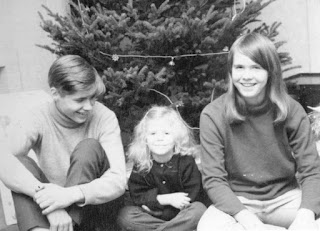
(left) Harald with Ellen and me, 1961; (right) Harald at his Skokie Park District office, 1978.
My father Harald Maurer and I were reunited in a vivid dream last night.
In my dream, he and I were standing on a street corner in Evanston, Illinois, having a very normal, peaceful conversation. Looking down the length of this residential street, we could see the skyscrapers of Chicago in the distance. Pointing at them, I said, "You know how I go on those four-hour-long walks sometimes? That's where I go."
(Actually, I oftens took long walks, but not that long and not to Chicago. It would take four hours to walk one-way from our home in Evanston, the one in my dream, to get to downtown Chicago. And the city's skyscrapers couldn't be seen from our street.)
My dream went on to other scenes, more contemporary, and my father wasn't in those scenes. However, just before I woke up, I saw him again at that same corner, and I walked back to him. As the dream faded and I woke up, I had the strong impression that, during those in-between scenes he had died, and at the end of my dream he was returning from the dead to say goodbye.
Today, my mind—maybe yours, too—has been in Uvalde, Texas; also in Ukraine and Russia; also with the Southern Baptists. (See links below.) But as I sat down to write this evening, I felt a strong desire to write about my father.
If you've been visiting this blog for a while, you've met several members of my family, and they don't always appear in the best light. Four years ago I wrote about how grief for my dead parents just doesn't seem to come; something is plugged up. I've described, occasionally and vaguely, what it was like to grow up in an household full of emotional minefields, where any references to religion or mortality were strictly forbidden, where my mother's racism was given frequent expression, where discipline could be completely absent one day and enforced with beatings the next, and how things became even more chaotic when my sister Ellen began running away from home. Grief for Ellen, when she was shot and killed on the southwestern edge of Chicago, came instantly; after all, in our crazy home, we were partners in survival.
My memories of growing up are dominated by my mother, who was certainly an addict but probably also suffering from mental illness. Her racism may have originated in her school years; during at least some of the Hitler years, the Nazi party was an active partner of the German school she attended in her home town of Kobe, Japan. I mostly coped with this stuff silently, but Ellen rebelled openly, and the resulting family drama became a frequent theme in the diary I started keeping as a high school freshman in 1968.
In these memories, my father is often in the background. That may be why he hasn't taken up much space in my writing. (This post is intended to even things out a bit.) Amiable and mild-mannered, he was quite a contrast to my mother. I remember his constant advice to us kids: don't irritate your mom! However, of my two parents, he might have been the bigger influence on my future: his undergraduate education was in political science, specializing in international relations. He had an LL.B./J.D. degree but never practiced law; he worked instead in insurance. The year Ellen died—1970—was the year his last insurance job ended. I know no details, but it can't be a coincidence: how would you hold on to a job when you're constantly looking for your runaway daughter, or dealing with the police in connection with her, or—as on March 28, 1970—summoned to the county morgue to identify her body?
From 1970 to 1978, his resume reads as follows:
TRANSLATIONS AND RESEARCH, Independent. Illustrative examples of activity, in part freelance and in part through the Berlitz School of Languages and other agencies, are: translations of articles in Norwegian, Swedish and Danish publications into English; other general, legal, or technical translation work, case research and correspondence for companies and individuals; lessons in the Norwegian language.
I was asked to leave home a day or two before my high school graduation in 1971, and a year later I was on my way to university in Ottawa, Canada, so I can't comment on how accurate this work history is. I do know that he was coping with an increasingly erratic spouse, one who (for example) in 1977 posted a swastika on their lawn during the Nazi parade controversy in Skokie. Right around then, my father and I succeeded in bundling my mother off to an inpatient alcoholism clinic. (At the intake interview, my mother told the clinician that Germans handle alcohol much better than Americans. It was a priceless moment when he contradicted her in German.) This was the one of the few occasions when my father and I formed a strong alliance in the face of a crisis.
It was also around this time that my father confronted his own addiction, and sobered up to the point that he could again be on the job market. He worked as safety coordinator for the Skokie Park District for two years, and then worked for Catholic Charities as a senior citizens' job developer for the rest of his life, until his career was ended by the last stages of cancer.
His low point may have come the summer after I left home. I was at my job as cook and dishwasher at Andy's Hamburgers on Green Bay Road in Evanston, when my father walked in. I wasn't sure how to react; after all, he had so recently put me out on the street. Or, rather, he had not intervened when my mother put me out on the street. In any event, at the restaurant I could not begin to read his face. To my surprise, he handed me his watch and asked me what I would be willing to pay for it. I was making a dollar fifty an hour and was only paying $12 a week for my room, so I had some money, and (much to my boss's disapproval) I gave it to him. I find it very hard to imagine what things must have been like at home, for him to face me in that situation.
My father's baptism certificate. He was born Lutheran in 1930, died Eastern Orthodox in 1995.
There must have been some major high points toward the end of his working life, because he loved his job at Catholic Charities, and the people he met there gave him crucial support as the end of his life came near. At his memorial meeting, one of his clients took me aside and said, "Listen, I hope you know that your father was a great man." Actually, up to then I didn't know it, but those words did find a place in my heart.
Thanks to that dream last night, grief seems to be a bit closer.
Hunting’s decline made it harder to succeed with reasoned gun control arguments that protected the sport. It also caused the overall number of gun-owning households to shrink. Which, counterintuitively, increased political resistance to gun control.
....
Since the Columbine High massacre in 1999, at least 185 children have been killed in school shootings, according to The Washington Post. How many more children will die before things change? It’s my duty to inform you, future victims, that 185 isn’t going to be enough. Your blood will have to be spilled as well.
Meanwhile, Russian children are pressed into service as propagandists. (We remember a similar campaign in a Wilmington, Ohio, school during Operation Desert Storm.)
What is this patriotism? As a grateful immigrant, I have some views on this question, but they're certainly not original to me. Once again I turn to the journalist John Gunther, whose introduction to his book Inside U.S.A. (1946) calls the USA "a country deliberately founded on a good idea." Our founding documents make that good idea clear: we were all created equal; and our rights to life, liberty, and the pursuit of happiness are derived NOT from a ruler's indulgence or from social rank, but irrevocably granted by our Creator! Abraham Lincoln expressed in the simplest terms how such a free people are to be governed: through a "government of the people, by the people, for the people...."
Every aspect of this "good idea" has vulnerabilities, and our nation has tested them all. Do we really believe that we're all created equal, or can we cut some corners to the advantage of those we identify with most? Can we really govern ourselves, or are there some tacit standards of wealth, education, good connections, or other badges of entitlement that represent shortcuts to power? When our inevitable conflicts arise, do we have trustworthy mechanisms to discern justice, or do the loudest or most resourceful communicators prevail? Do we prioritize the fair distribution of opportunities to pursue happiness, or do we (as John Fea suggests) rely on the manipulative power of a mythical nostalgia?
Cities with significant numbers of arrests on January 31. (Update: OVD-Info's Web site has been ordered blocked in Russia.)
My purpose in reporting my friend's words is not to assert that his cry of despair at this moment in history is, as a sample of one, an accurate and adequate overview of all that Russia offers its people and the rest of the world. For all the years I've been writing this blog, I have striven for balance, opposed Russophobia, and indulged in my share of compensatory "whataboutism" with respect to my own country's failures and blind spots. I have pointed out when I thought Vladimir Putin was operating from weakness rather than the ruthless strength Westerners sometimes credit him with. I have harshly judged commentary about Russia that struck me as cold, professional one-upmanship rather than being grounded in love and respect for the people of Russia.
Above all, I have sought to document that Russians don't need to be told by the West what is wrong with their country. There are Russians who already know! They employ anger and humor (sometimes simultaneously) and great passion, in the service of self-diagnosis. I've shared examples of this, despite my misgivings that Russians might resent having these conflicts exposed (Pushkin said "I despise my country from head to toe, but it really gets on my nerves when a foreigner shares these views"), because it testifies to an important capacity for self-correction.
I believed then, and still believe now, that whatever decline the church is suffering (and it certainly is!), this decline does not come from some stubborn church-wide insistence on superstition. There are very lively conversations going on among theologians and scientists, many of whom in the 21st century are drawing on insights ranging from biology to cosmology and quantum mechanics, all challenging the conventional boundaries between theology and science. Biblical scholars have equally fertile dialogues on the composition and ratification of the Scriptures, and sometimes even deign to tell the rest of us what they're talking about in language we can understand. Eastern and Western Christianity challenge each other's conceits, while both learn how to relate with the rest of the world's faiths, and with the atheists whom God loves as much as any of us.
The scandal that repels and expels people from the church is not its ability to express mystery and hope, nor its claim that we can have a meaningful relationship with the Creator who desired us into existence. It is our willingness to hide all that amazing stuff in the background in favor of our cutting and one-upping each other, cruelly exiling those we don't approve of, and straining all that is holy to ingratiate ourselves with the powers that be.
It's been a rough few days. On Saturday morning, I learned that Misha Roshchin, my oldest friend in Russia, had died just a few hours earlier in Moscow. Then, just yesterday, as I was planning what to say here about Misha, I was hit with the news that my dear cousin Johan Fredrik Heyerdahl had died earlier that morning, Oslo time.
I'm not the right person to provide formal biographies or eulogies for either Misha or Johan Fredrik, but I can't let the week go by without saying something. So here are two tributes based on my own personal recollections of these two, and the influences they have had on my life.
During our Russia years, we often found it difficult to convey what the word "church" meant to us. This was true among our students, and also among some of the attenders of our Quaker meeting. Many were generations removed from traditional parish involvements. Instead, sometimes the most obvious models were discussion groups, peer support groups, and self-help or self-improvement groups.
...
Back in the mid-1970's, Avery Dulles wrote the first version of his book Models of the Church. The "models" he describes are helpful and evocative, and together they build up a sense of the inclusivity and continuity of the Body of Christ. However, the language of these models might be a bit dense and abstract for those who have never connected with church as we understand it. My own most basic understanding of church in a Quaker context is this: a church is a group of people who gather around Jesus, learning (and helping each other learn) what it means to live with him at the center of our lives, including the ethical consequences. My three metaphors are intended to illustrate what this might mean in real life.
Critical race theory, for example, is not a way to charge every white person with being racist. It is simply an analytical tool to help us go deeper, to explore why our neighbors continue to feel the effects of embedded racism, even if we personally do not. Is it the only tool? Probably not, but I cite it here because it is under such concentrated attack that, even if you are a loyal Fox News viewer, you must wonder sometimes how such a malignant danger could have struck such deep roots into mild-mannered legal scholars and sociologists! Isn't it possible that someone or something is benefitting from convincing you to distrust CRT? Are those critics of CRT describing something that its advocates are not actually advancing?
...
Evangelicals are the last people who should be shocked that sin has embedded itself in our laws and institutions. In an earlier post on perpetual war and biblical realism, I pointed out that "Biblical realism allows us to confront perpetual war by reminding us that the hearts of nations as well as individuals are inclined toward deceit, and the Bible doesn't make an exception for us." The same goes for all forms of socially embedded sin. Ecclesiastes gives us a vivid example: "If you see the poor oppressed in a district, and justice and rights denied, do not be surprised at such things; for one official is eyed by a higher one, and over them both are others higher still." (Ecclesiastes 5:8.)
Yesterday was my sister Ellen's birthday. She would have been 66 years old. I'm going to indulge myself with a few reflections. It's possible this post is just for me, but if you have a moment, please get to know Ellen and her context a little better.
Last week, in describing how suitable my family was for life in a neighborhood of "nice people," I mentioned that, at the very time my parents and I were at the real estate office, Ellen was in "Audy," Chicago's juvenile jail.
She was fourteen years old.
I severely compressed a lot of history last week by saying that "my 1969 diary chronicles many of Ellen's run-ins with the law." Those run-ins actually started in in 1968, the first year I began keeping a diary.
Of all the explanations and excuses I've heard in the last few hours concerning the Kabul airport tragedy, two comments ring out to me with special clarity.
Veteran Democratic Party strategist James Carville (video): "... There's no elegant way to lose a war. We lost this war fifteen years ago; all Joe Biden was doing was telling us what time it is. ... When you lose a war you don't look good."
U.S. Senator Chris Murphy (Twitter): "It took me a few years in Washington to understand how much of this town runs on war. Some of this is driven by raw profit motive, but much of it is simply due to the laudable but fatally faulty belief that there is no problem in the world that American intervention can’t solve."
There is a particular form of pseudo-patriotic American self-deception that seems to dominate commentary about the situation, including today's terrorist bombings near the airport.
It’s as if we are in the audience in a play. It’s a long, long play, and we discuss it with each other and with each passing year, we understand more of it. However, some of us hear bumps and noises or smell things that contradict what we perceive is happening on the stage, but we assume those noises aren’t not important because, well, what we don’t understand doesn’t really exist. Or that in the decades to come, science will be able to explain all that is important. If anyone in our little discussion groups in the audience focuses on those bumps and noises and smells then we say that these people are nutcases. We can’t even prove they are hearing those things! So they must not exist. Oh, if you want to believe they are real noises, go ahead, it won’t do any harm, pat-pat-pat on the head but don’t expect those noises to explain anything about the play or have any substantial impact on life.
We in this audience, especially those sitting in the west side of the theatre, want to think of ourselves as rational and analytical. We are confident that the only way to understand more about this play is to test and observe, to collect data and analyze it. If it's not testable and observable, then it’s not happening, or at least is not very important to the play.
And I’m here to whisper to my audience members, “you forget that you are seeing this play with your limited human mind. We have to test and observe with our limited human minds. Maybe there is a whole different way of knowing that is not limited by a human mind. Maybe we should just sit with the great unknowables and admit we can not now, and probably never will be able to, explain them. And let us enjoy the mystery, enter into it, let it inform our beings, our lives.”
After a few years of adjusting, and getting to know Russians, I found myself sitting in the Russian section of that audience. Russia and its section is somewhere between East and West, not fully either but fully itself.
If you've been reading this blog for a while, you know that I describe a fair amount of family dysfunction in my growing-up years -- violence, alcoholism, racism, and then the tragic story of my sister who repeatedly ran away from home to escape those things, and was murdered by a drug dealer. In telling these stories, I've permitted myself a number of unflattering descriptions of my parents. Should I repent of those descriptions?
For years, I've angrily rejected the cliche "your parents did the best they could," partly because they seem to have made deliberate choices that harmed us children. But reading Whitfield's story made me wonder how an experience like Whitfield's would change my perspective. For example: what if I could have experienced, for a NDE-like moment, what it was like to grow up in Japan during World War II, as my mother did? What was it like to see her city bombed by waves of American bombers? What was it like to be brought up in a Nazi-influenced school? What was it like to be formed by, not just one, but two cults of obedience -- to Hitler and to a divine emperor?
In the absence of a near-death experience, could I voluntarily undertake this exercise in empathy? Can I pray for God's help in doing so? I'm not giving any quick answer to this, but at least I'm asking myself the question.
One of the numerous variations of this fake quotation.
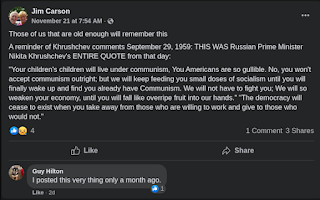
I hadn't heard this particular piece of false witness before I saw it in my own relative's post on Facebook:
A sobering reminder. Almost exactly sixty years ago since Russia's Khrushchev delivered his Do you remember September 29, 1959? THIS WAS HIS ENTIRE QUOTE:
"Your children’s children will live under communism. You Americans are so gullible. No, you won’t accept Communism outright, but we’ll keep feeding you small doses of Socialism until you will finally wake up and find that you already have Communism. We won’t have to fight you; We’ll so weaken your economy, until you fall like overripe fruit into our hands." "The democracy will cease to exist when you take away from those who are willing to work and give to those who would not."
...
I realize that using fake or artfully edited quotations to slander political opponents is not new. What fascinates me is how eager their audiences are to accept them and recirculate them. It's ironic to me that the real "gullible" Americans are not the ones mentioned in the fake Khrushchev text; it's the Americans who believe these sorts of campaigns, whatever side they come from.
On a personal and emotional level, that defense still stands. However, I'm increasingly disappointed and disillusioned with USA evangelicalism in all its institutional ugliness, particularly among white Americans. A movement that once declared the unity of individual righteousness and social justice now barely makes a peep as celebrity preachers and their political allies trash the reputation of the Gospel in favor of "Christian" nationalism. Up with tax breaks for wealthy people and impunity for Israel; down with any honest accounting for systemic racism; down with elementary public health measures in time of crisis. Left in the dust: any winsome presentation of the promises of God in Jesus; any invitation to experience "the riches of his glorious inheritance in his holy people" (from Ephesians 1:18; context); any vision of how we could be a blessing to everyone everywhere.
Of course there are millions of evangelicals in the USA who are not happy with this situation. But institutionally they (we) seem invisible and inaudible compared to the toxic anti-evangelistic message that threatens to become Christianity's public face in the USA.
Does all this rob the label "evangelical" of all publicly useful content? Here are some thoughts....
If this seems too gloomy a post to end this year's review, maybe you'd prefer this one: Trustworthy, part five: we offer what we have. But I'm not going to lie. It's been a difficult year. Thank God for family, friends, ... and God.
Brother and sisters: Johan, Renee, Ellen. Christmas 1968, the last Christmas the three of us had together.
People tell me I'm smart, intelligent, talented.... It seems like I should be fairly well off—but as I sit here in Audy, on October the fifteenth, 1969, after ruining my chances in a foster home, I realize I haven't got anything ... and I wonder, should I give up—or not?
-- Ellen Maurer
Yesterday was my sister Ellen's birthday. She would have been 66 years old. I'm going to indulge myself with a few reflections. It's possible this post is just for me, but if you have a moment, please get to know Ellen and her context a little better.
Last week, in describing how suitable my family was for life in a neighborhood of "nice people," I mentioned that, at the very time my parents and I were at the real estate office, Ellen was in "Audy," Chicago's juvenile jail.
She was fourteen years old.
I severely compressed a lot of history last week by saying that "my 1969 diary chronicles many of Ellen's run-ins with the law." Those run-ins actually started in in 1968, the first year I began keeping a diary.
On June 19, 1968, I wrote, "B---- [her family nickname, which she hated, so I won't use it here] appears to be seriously considering running away."
On July 5, I may have been trying to reassure myself: "B---- has been talking, not too seriously, about running away." The very next day she actually did run away around 7:30 p.m.—and was picked up by the police about twelve hours later. With her was "a Negro laborer," who (my father ominously but obscurely said) "could get from 60 days to 30 years."
That last detail links to an undercurrent of racism that sometimes rose to the surface when my mother lost her temper—often because she was irritated by a neighbor or a school board decision or her "serves him right" reaction to Martin Luther King's assassination. But the worst effect of all was the alienation between her and Ellen, when she found out that Ellen had a black friend in middle school.
These hints sometimes got recorded in my diary. On June 22, I wrote "Yesterday Mom showed herself to be a sort of 'intellectual racist.' I wonder where she picks up the sort of garbage she talked about." I may not yet have put together all the clues I know now about her German school in Japan and its Hitler Youth connections in those years. A few days later, on the 26th, I wrote "Mom really seems to dislike B---- and me. She hit me when I told her she hates Negroes, and she yanked some toys from Renee that B---- had given to her, and then threw them out."
Am I revealing too many family secrets? Maybe it's compensation for all the secrets I kept at the time, all the things I knew about our family violence, but did not divulge when neighbors and teachers anxiously asked me what was going on at home. But my biggest motivation today is to put Ellen's incorrigible rebelliousness into some kind of larger picture—because she was, at age 14, a very memorable person. I can't imagine what additional impact she might have made.
The truth is, only after she began leaving home did I fully realize how much pent-up creativity she had in her. During her hours, days, and months of incarceration and involuntary hospitalizations she wrote ceaselessly. Her response to the racism at home was, in part, to embrace black culture. Her output included many songs and poems, and two novels, all eventually left in the care of my parents, and apparently now lost. But I saw much of this output with my own eyes. If I had known that I was to be terminally evicted from our family home in "nice" northwest Evanston in June 1971, I would have smuggled them out to take with me. As it is, all I have are three letters and a few scraps of writing.
My family nickname (which I ditched as soon as I began high school) was "Fred," from middle name Fredrik.
In reverse chronological order, here's a quick digest of some of my previous posts that help me remember her:
My sister Ellen, who began running away from home at age 13 (in 1968), spent much of the year 1969 behind bars. At least three separate times she was in the Audy Home (Chicago's juvenile detention facility at the time); most of the rest of her detention was in psychiatric hospitals. Of all the people in our family, she was probably the most mentally healthy, but those psychiatric confinements provided a relatively safe alternative to jail.
March shorts (an excerpt from my testimony at an Indiana Senate hearing on the death penalty, February 17, 1999)
My father attended Tyrone King’s murder trial [King was ultimately convicted of murdering my sister Ellen], and mentioned meeting his mother, who attempted to give him a Gospel tract. I feel sure that God did not create the child Tyrone King to murder my sister. What happened to twist a little boy into an adult murderer? Don’t get me wrong: Tyrone King, and not his environment, bears responsibility for pulling the trigger. However, putting him to death would have been far too convenient a way for society to avoid the difficult questions about how innocent children can be overcome by evil as they grow up. It is too easy to kill the murderer and wash our hands of these dilemmas.
Until the last year before her death, a year in which she ran away from home repeatedly, and was in either police or mental health custody much of the time, we were constant companions and co-conspirators. Our parents were constantly drinking and fighting, so we had to make our own world.
(Read on to find out how we repaired a television together.)
Losses, part two (how three novelists helped me through my grief)
For years after my sister Ellen was murdered, I dreamed about her. The dreams were always the same: she came back from wherever she had been hiding to tell me that it had all been a big mistake. She hadn't been killed—how could I have thought that!?—she'd simply disappeared to have some time for herself, or, in another variation, she'd been away at camp. Since, in real life, she had run away from home more than ten times, and had also run away from a foster home and a hospital, it was entirely believable, until I woke up again.
The terrible alienation that drove Ellen from our home over and over again began when she made a new friend at Nichols. That girl was black. Somehow I had subconsciously known to keep my interracial school friendships out of my mother's field of vision, but that kind of caution would not have been my sister's way! But in any case, how could she have anticipated such a devastating response from her mother? The warmth instantly drained out of their mother-daughter relationship, my father did nothing to intervene, and Ellen and I became conspirators for sanity in our own home.
From her hiding place somewhere in Chicago, she phoned on my birthday. It was the last time I heard from her. What happened in the next five days is not altogether clear. She was found dying of gunshot wounds on a canal bridge in Chicago. The first we heard about it was a phone call asking my father to come to the morgue to view a body.
More letters another time...
Screenshot from Day of Rage.
The just-published New York Times video on January 6: Day of Rage.
The Marafiki organization (on whose board I serve) has just announced the creation of the Allan Afanda Memorial Fund, to honor the late son of Marafiki partners John and Rose Muhanji, and to advance the work he cared about.
Today's clip is from this exact period of my life. Blues music was my companion in my worst times, especially after Ellen died and I wondered why I was the one who was spared. This tune, "Too Much Alcohol" by J.B. Hutto and his Hawks, is from the first blues album I ever owned. This was the track I used in my high school television production class to make my first music video before I even realized that music videos were a thing.
If you've been with me so far, you won't be surprised that my teenage fascination with this music was something I had to keep concealed from my family.
Once upon a time there was a live-performance video of this song, but it has apparently disappeared. (Here's a brief documentary glimpse of the great J.B. Hutto.)
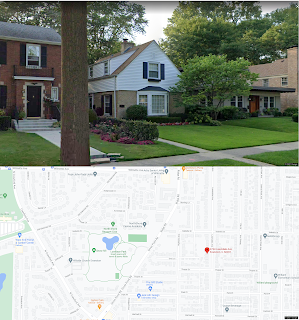
Our home (red marker) in my high school years, and our "nice" neighborhood.Source.
At the end of 1968, when we were still living in our apartment near one of Evanston's tacit racial boundaries (the city of Evanston is located on Lake Michigan, just north of Chicago, USA), my mother received $25,000 from her parents in Germany—enough at the time for a substantial down payment on a house. On July 26, 1969, we as a family went to a real estate office, accompanied by one of my father's colleagues, to begin house-hunting.
I don't know how much I was supposed to hear in the conversations among the adults, but I distinctly remember my mother making it clear that she intended to live in a white neighborhood. No problem, the agent said; the neighborhood we were considering would be perfect. I distinctly remember the words "nice people."
My mother didn't mention that her daughter Ellen was at that moment incarcerated in Chicago's juvenile jail, the Audy Home. My 1969 diary chronicles many of Ellen's run-ins with the law, as well as the general mayhem that transpired in our home on a near-daily basis. In between White Sox scores, Project Apollo coverage, and lists of unfinished homework, I regularly reported on the epic fights between my parents, some of which involved food being thrown about the kitchen and dining room. On one memorable occasion, my father threw my sister's copy of the Walker Report at me.
Obviously, we would fit right into a neighborhood of "nice people."
I grew up in a middle-class neighborhood of a middle-class suburb in a Midwestern city. I went to a middle-class high school, with middle-class friends, eating middle-class fried bologna sandwiches. And for most of my upbringing, this seemed not only normal but normative. I assumed this was a typical American childhood.
Only later did I begin to see that my normality was actually a social construction. By the time I was growing up in the 1970s, St. Louis no longer had legal segregation. But my suburb, my neighborhood and my private high school were all outcomes of White flight. The systems of policing, zoning and education I grew up with had been created to ensure one result: to keep certain communities safe, orderly and pale.
We're not just talking about the right to buy property among one or another group of nice people. Here's how the U.S. president, Lyndon Johnson, described how systemic racism sabotaged the basic right to vote, in his post-Selma speech to the U.S. Congress in 1965:
There is no reason which can excuse the denial of that right. There is no duty which weighs more heavily on us than the duty we have to ensure that right.
Yet the harsh fact is that in many places in this country men and women are kept from voting simply because they are Negroes. Every device of which human ingenuity is capable has been used to deny this right. The Negro citizen may go to register only to be told that the day is wrong, or the hour is late, or the official in charge is absent. And if he persists, and if he manages to present himself to the registrar, he may be disqualified because he did not spell out his middle name or because he abbreviated a word on the application. And if he manages to fill out an application, he is given a test. The registrar is the sole judge of whether he passes this test. He may be asked to recite the entire Constitution, or explain the most complex provisions of State law. And even a college degree cannot be used to prove that he can read and write.
For the fact is that the only way to pass these barriers is to show a white skin. Experience has clearly shown that the existing process of law cannot overcome systematic and ingenious discrimination. No law that we now have on the books—and I have helped to put three of them there—can ensure the right to vote when local officials are determined to deny it.
What was blatant in 1965 Mississippi may have been comparatively latent in middle-class suburban Chicago or St. Louis, but (here's the crucial point) the phenomenon of racism doesn't depend on the existence, disappearance, or conversion of individual racists. For a well-meaning white person to proclaim their own color-blindness misses the point.
Critical race theory, for example, is not a way to charge every white person with being racist. It is simply an analytical tool to help us go deeper, to explore why our neighbors continue to feel the effects of embedded racism, even if we personally do not. Is it the only tool? Probably not, but I cite it here because it is under such concentrated attack that, even if you are a loyal Fox News viewer, you must wonder sometimes how such a malignant danger could have struck such deep roots into mild-mannered legal scholars and sociologists! Isn't it possible that someone or something is benefitting from convincing you to distrust CRT? Are those critics of CRT describing something that its advocates are not actually advancing?
From an evangelical viewpoint, here are some ideas about that "someone or something."
First of all: Black people—and Black Lives Matter activists of all colors—are our neighbors, too! To many of them/us, the idea that our lives have all been made poorer by racism's long-time, persistent power to warp our laws and institutions is not new, and it's not rocket science. Don't we owe it to our neighbors to see if their perceptions are correct, and if they are, to work alongside them to confront this power? To reiterate this crucial point, the purpose is not to tag or shame anyone, because the problem is systemic, it weakens the whole community, and our individual virtue is totally beside the point.
Critical race theory is, by definition, unable to "essentialize race" for the purpose of condemning all white people, as some have charged, because CRT denies the objective, biological basis of race in the first place. Instead of encouraging us to look at people and judge them for their skin color, the tool helps us discover the systemic, embedded effects of looking at people that way.
Michael Gerson argues that studying systemic racism is consistent with conservatism because...
For me, part of being a conservative means taking history seriously. We do not, as Tom Paine foolishly claimed, “have it in our power to begin the world over again.” We live in an imperfect world we did not create and have duties that flow from our story.
There is an important moral distinction between “guilt” and “responsibility.” It is not useful, and perhaps not fair, to say that most White people are guilty of creating social systems shaped by white supremacy. But they do have a responsibility as citizens, and as moral creatures, to seek a society where equal opportunity is a reality for all.
Rather than slander the methods used to expose and explain the lack of equal opportunity, wouldn't it make sense to put that passion and urgency into questioning why that lack persists? After all, we have at our disposal the tools of "systemic anti-racism," as Gerson says. "We have documents—the Declaration of Independence, the Bill of Rights, the 14th Amendment—that call us to our better selves.... The response to systemic racism is the determined, systematic application of our highest ideals."
Evangelicals are the last people who should be shocked that sin has embedded itself in our laws and institutions. In an earlier post on perpetual war and biblical realism, I pointed out that "Biblical realism allows us to confront perpetual war by reminding us that the hearts of nations as well as individuals are inclined toward deceit, and the Bible doesn't make an exception for us." The same goes for all forms of socially embedded sin. Ecclesiastes gives us a vivid example: "If you see the poor oppressed in a district, and justice and rights denied, do not be surprised at such things; for one official is eyed by a higher one, and over them both are others higher still." (Ecclesiastes 5:8.)
Given its origins, persistence, and ability to confuse, confound, and stir up useless controversy, I personally have no doubt that racism has a demonic stronghold in the USA. All of us who believe in the nonviolent Lamb's War against the powers and principalities and forces of evil in high places can play a role in tearing down this stronghold:
We can reject false allegations about the tools and methods at our disposal, including CRT for those led to use it. We can courteously remind our alarmed neighbors that the Sword of the Spirit is the Word of God, not Fox News.
We can also confront the misuse of those tools, their exploitation to shame people for political purposes, or the temptation to idolize the tools instead of keeping our eyes on the prize.
We can create and maintain multiracial communities of struggle that, by their very existence, subvert the myths of racism.
If we are far from the obvious centers of struggle, we can still participate by prayer, study, correspondence, making judicious contributions.
If by our faithful struggle we begin tearing down the stronghold of racism, chances are we will also be well on the way to healing the polarizations that threaten to tear us apart. Those polarizations distract us from focusing on our common dangers—and I'm realist enough to believe that this is no accident.
The idea of whiteness, in other words, was identical to the idea of white supremacy. For the three centuries that preceded the civil rights movement, this presumption was accepted at the most refined levels of culture, by people who, in other contexts, were among the most vocal advocates of human liberty and equality. ...
As though aware of their own guilty conscience, the evangelists of the religion of whiteness were always desperate to prove that it was something other than mere prejudice. Where the Bible still held sway, they bent the story of Noah’s son Ham into a divine apologia for white supremacy. When anatomy and anthropology gained prestige in the 18th and 19th centuries, they cited pseudo-scientific markers of racial difference like the cephalic index and the norma verticalis. When psychology took over in the 20th, they told themselves flattering stories about divergences.
My James Harman tribute continues. Today—"Payback Time" from a pandemic-shaped streaming concert last summer, with the Rhythm Scratchers. (James Harman died last month at age 74.)
Twitter discussions are often unproductive, but Lilith's accusation reminded me of old pre-Twitter conversations on religion and cruelty:
Then why is it that religious believers collectively, including #Christians, are overwhelmingly more cruel, less merciful, and more dishonest than non-believers? If you’ve never asked or immediately discount it without consideration that’s #ChristianPrivilege
A few minutes browsing the Internet reveals the perennial fascination of this debate, but nothing that qualifies as conclusive. The most sobering insight that comes to me is this:
the human species has, throughout its history, included many violent members;
religious or anti-religious identification doesn't seem to affect this reality.
Religious identity is just one of the influences that shape our behavior; many other influences may spring to the surface when we (consciously or instinctively) choose to act violently or nonviolently, cruelly or kindly, in response to the stimuli we're receiving.
In other places, I've written about the impact on my teenage self of discovering the book War: The Anthropology of Armed Conflict and Aggression, on Evanston Public Library's "new books" shelf. As my eighteenth birthday neared, and its related deadline to register for the military draft, I was reading a lot about war and aggression, and these books went a long way to helping me understand how violence seems to be part of who we are as animals. All this was before my Christian conversion, but already I was being prepared to be radically skeptical of any attempt to link violence with high ideals. And isn't it true that almost all religions try to motivate us with high ideals?
In any case, the debate over who is more cruel -- religious people or non-religious people -- is unproductive without definitions and without honesty about the debaters' motives. I'm more interested in promoting integrity among the people I know best -- believers. Does our faith open our eyes to the actual biological roots of violence or mask those roots with pious justifications (whatever rationalizations we're receiving from the principalities and powers)? Does it help us understand and practice the love it claims to embody?
(And ... could our behavior as believers undermine the skepticism of non-believers, even to the point that they might want to peek inside our communities and test our claims, to their eternal advantage? Are we ready to greet them with honesty and love, rather than the snarky arguments I often find on the Internet?)
All of these thoughts reminded me of a blog post I wrote shortly after Saddam Hussein's execution:
My favorite icon, one that overlooks the stairs down to my home office, is a very plain paper-on-board icon I bought in Zagorsk, USSR (now Sergiev Posad, Russia) in 1975. Jesus is holding the Gospel open at the words, "I give you a new commandment, to love one another."
As I searched for redemptive meaning in the vindictive death-scenes of Saddam Hussein's execution, the words of Jesus came to me with fresh force. The particular scripture (John 13:34) is addressed to his closest friends, but there's no doubt in my mind that the love we practice among those in our community truly is practice, so that we can love in wider and wider circles, even to our "enemy."
Almost anyone who talks about Saddam Hussein in the context of peacemaking feels bound to stipulate to his numerous crimes, including mass murder, not to mention summary executions of his political enemies. Where does love fit in? Just as C.S. Lewis advised not tackling the Gestapo as lesson one in learning to forgive, we do not have to lapse into sentimentality in considering how to love a tyrant. But how is this for a start? Resist the ancient temptation to kill him!
Why resist when the target is so juicy? Why not just let the drumbeat of "duly constituted authorities," the soothing rhetoric of "this young democracy" lull us into shrugging off another deliberate extinguishing of a human life?
Here's what I'm starting to realize. As a species, we have so little practice in resisting this ancient temptation. It's time to advocate and spread a "new" ethic: turn away from that urge to kill. Resist! When the desire to turn a human being into a sack of bones and guts arises, turn within and ask where that impulse is coming from.
Those of us who are protected by the buffers of middle-class gentility from the world's bloody reality still need to be in on this campaign. Our passivity too easily licenses our government's participation in the Saddam Hussein debacle; we can pretend not to see that the legal fiction of his execution is only a few steps removed from the common practice, in that same country, of methodically sawing off the heads of one's militia's enemies. (Clips of these "executions" are also provided on Internet video sites.) Neat distinctions between the gallows (that death facility in Baghdad that was made so notorious by Saddam himself) and the less formal executions only serve to obscure this imperative: even when we feel fully entitled to kill, we need to put an end to this practice. We need to demand that our foreign policy not bless others' willingness to continue practicing the ways of death. We need to oppose militarism, capital punishment, abortion, and every other deadly compromise, not from sentimentality, but because every time we end a life, it makes the next time easier.
Dale Aukerman, among others, has written movingly of the impulse to kill as a persistent reflection of the Fall. In Darkening Valley, he wrote these words (pp. 21-22):
Jesus said in one of his most drastic images, "If your right eye causes you to sin, pluck it out and throw it away; it is better that you lose one of your members than that your whole body be thrown into hell" (Mt. 5:29). As we sense the incipient dynamism of sin within ourselves, we must, rather than yielding any further, make the most determined move imaginable for breaking with it. It can be seen throughout our world how much that call and warning of Jesus applies to readiness for war. Where there is not the determined plucking out of the eye that looks, however hesitatingly, toward killing, the whole person and the whole society are plunged toward the inferno of thermonuclear murdering and being murdered.
Theologians who have reiterated a just war or a war-of-liberation position have not adequately reckoned with this dynamism. For them a limited sinning (for which grace abounds) is permissible when a preponderantly good outcome is to be expected. Such positions have often been elaborated in the context of declaring with great emphasis the sin and guilt of all human beings. Because the sin and guilt are so encompassing, it is supposedly necessary, proper, and forgivable to add to them at times by going to war. Such positions are possible only for those who have no real comprehension of the biblical understanding that in sin and sinning a mighty dynamism strives for total dominion over those who in any way choose to commit sin and that God's grace moves not only to blot out guilt but, even more crucial, to hurl back that dominion. The history of our [20th] century, probably more than that of any other, corroborates the biblical awareness of sin's dynamism. Jesus said to the adulteress, "Go, and do not sin again." Only as we strive to hear and obey that directive with regard to our readiness to kill, can we be freed from this aspect of sin's dominion.
A prominent American clergyman asked me once, "What's the matter? Are you afraid of getting a little blood on your hands?" I am -- not because I'm so good, but precisely because I'm not. I am in jeopardy, exposed before the power of evil impinging upon me and lurking within me, the little blood on my hands would inevitably become much, much blood.
The hard work of obeying Jesus' commandments concerning love does not involve getting misty-eyed over murderers and tyrants. It involves inner work: building the capacity to resist objectifying anyone who bears the image of God, and then confronting the dilemmas involved with organizing alternative approaches. Not killing the murderer is just the first step. We still need to find out what makes people into murderers, how to safeguard society from future danger, and how to heal the wounds their crimes have left. But wait a minute -- we had those same challenges before, even when we felt free to obliterate our enemies. But too often we just dealt with the symptom and, apparently, made no progress with the disease.
To what extent is advocacy of nonviolence a luxury for me? As I said once before on this blog, when I was an editor with Quaker Life, I checked the subscription records once to see if any copies of the magazine went to the zip codes around the area where my sister Ellen was murdered. After coming to the USA, our family lived in Evanston, Illinois, and that was where my sister lived nearly up to the time she was kidnapped and killed. Quite a few copies of the magazine went to Evanston's zip codes. But not a single copy went to the area where Ellen died. True, I grew up in an alcoholic and occasionally violent family, and my mother reinforced that I was from "officer class" stock on my German side. Some of my warmest childhood memories were the times I'd sit with my father while he cleaned and oiled his guns. I can still remember the smell of the oilcloth. Still, my own survival never appeared to depend on willingness to use force.
What I long to do is to withdraw my consent from the conventional wisdom that blesses killing under the "right circumstances," which functionally means anytime we as a society don't have the will or imagination to find another way. I really hope that the worldwide revulsion at the the Saddam Hussein spectacle might be a moment of conversion for human beings -- this is what it does to our soul to choose deliberately to end a life.
There's plenty for all of us to do who want this conversion. Those of us who live in relative safety don't need to feel guilty or useless; let's work to expand the zones of safety. Those of us who love to use words should consider whether we enjoy killing the reputations of others; let's not drop one syllable of our opposition to bad policies, but without trashing the human beings behind those policies. Some of us are gifted to discern the forces that link militarism, economic exploitation, and racism; please help the rest of us get a handle on the implications for the way we live, vote, and spend. But sooner or later, a few of us will actually know when a life is literally in our hands. Maybe the ancient temptation will have lost its force.
(Original 2007 post, with original comments, is here. By next week, I expect to be back home and depending less on old material to meet deadlines.)
In my Internet wanderings around the "who is more cruel" debate, I re-encountered this helpful essay from Martin E. Marty: Varieties of unbelief.
Patricia Dallmann on prayer, self-preservation (or not) and shooting the moon.
Ukraine's Soviet-era archives are opening up, with consequences for memory politics. Research can be emotionally draining for staff as well as visiting families:
When you work in an archive related to state repression, you can’t take documents too close to heart, says Andriy Kohut.
“We had a new member of staff,” Kohut tells me. “We started giving her files to catalogue – to put document descriptions together. I called in her office and she was crying: she had begun to read the case histories and it was too much for her. People who have worked here for a long time try to distance themselves: they just note the key data and ignore everything else. She had started reading a file, rather than processing it.”