Showing posts with label judy. Show all posts

03 April 2025

"I cannot cut the connection" (guest post)

The author crossing her front yard.

Sixty years later...
I cannot cut the connection

It began as a normal afternoon in my schoolyard—no reason for it to stand out in my mind. I was racing around playing with water balloons. We filled them part way and then squirted the water out. No use wasting an entire balloon full of water on the Arizona desert by filling water balloons and breaking them.

It was late spring, when a squirt of water would dry easily in the sun. Squirted children then grabbed a balloon for themselves and joined the race around the schoolyard. I spied one girl walking alone. Her dress was temptingly still dry. I squirted her. She turned around, face full of rage, and tried to pull my hair and scratch me with her fingernails. I dodged her. I was shocked. She turned away.

Later I walked home through the desert, between the trees whose branches my brothers had long ago flagged with plastic ties, so I could follow the ties to find my way home. My brothers were off to boarding school and college by then, and I expected an empty house at the end of the path. I was surprised to find my father writing at the dining room table.

I told him what happened. I asked him why she had lashed out. He grew very serious, and said, “I remember walking up to her house, knowing I had to tell her mother that her husband had died.” My father had been the pastor in that little town with maybe 80 kids in the district’s one grade school. I knew the story—her father had died suddenly, leaving four children and a widow. Nancy was the youngest, two years old at the time.

My father leaned down, looked me in the eye and said, “I want you to take care of her, Judy.”

It’s been sixty years now. She puts messages on Facebook like an image of flag-draped Trump saving our planet, with the tagline “On a mission from God.” Another asks for God’s protection because “with every fiber of his being, Trump is trying to protect our Land.”

I carefully weed out these messages, congratulate her on another grandchild, heart the flowery memes. Occasionally I try to offer facts in her pro-Trump posts. However calmly or kindly I word the facts, it doesn’t seem to make an impact.

It all drives me wild, but I do not unfriend her. Every time I think about it, I remember my father’s words. It’s not that she needs me to take care of her anymore. It’s that I simply cannot cut the connection.

I don’t know if she or anyone else in her family now needs Medicaid or the Obamacare subsidies. I don’t know if they are on food stamps. Did anyone get student loans? Has anyone she loves lost their federal government job? And did Republicans tell her all this would happen if she supported Trump?

Will it all come crashing down at their feet, without warning?

I’ve read posts on X ridiculing Democrats’ “hysteria” that Medicaid will be cut. How silly they are, the posts say. They ignore that the GOP has already passed a plan that will necessitate that. What will happen when their food stamps are cut, when student loan applications can’t be processed, when they have no medical insurance? It pulls at my heart.

The nonpartisan Center for Budget and Policy Priorities says the GOP plan just passed requires a minimum of $1.5 trillion in cuts through 2034. Also according to the Center, 45% of the federal budget funds Social Security and health insurance programs, including Medicaid. How could these programs not be cut after a massive tax cut?

Last week I realized with shock that a progressive friend of mine sincerely believed disinformation from the left. The news for the left is bad enough; why make it all worse by spreading lies? Probably for the same reason the top layer of the right-wing purveyors of disinformation do—to gain power and money for themselves.

I’ve been reading Steven Hassan’s book on cults: Combating Cult Mind Control: The #1 Best-selling Guide to Protection, Rescue, and Recovery from Destructive Cults. I’ve also gotten involved in Indivisible’s Truth Brigade. Their webinar on their grass-roots efforts to counter disinformation was inspiring and well designed. They said their strategies were research-based, but they did not give us sources.

Indivisible pressured us to use a formula for responding to disinformation. It’s hard for me to follow other people's formulas without understanding more of the context. So I searched for the research and best practices on my own. I found a summary of research findings (here) about disinformation that was very helpful. It was well written for an academic piece, but it was the usual thicket of complex sentences, passive verbs, and precise but uncommon English words. I took up my courage and a compass. I navigated my way through the underbrush of words.

I read and re-read a section titled “counter-messaging strategies.” It explained that my factual posts would have little impact on my friend. “There is strong evidence that truthful communications campaigns designed to engage people on a narrative and psychological level are more effective than facts alone.”

Of course. Another word for “narrative” is story. How could I, coming from a long line of story-tellers, have missed that people respond better to story than to a recitation of facts?

Another sentence leapt out at me, too. “Promising techniques include communicating respect and empathy, appealing to prosocial values, and giving the audience a sense of agency.”

Communicate respect and empathy

Of course. Genuine respect and empathy. It’s backed by twenty-first century research, and it’s ancient wisdom as well. Jesus said, ”You shall love your neighbor as yourself.” One can not have empathy without love and respect first. Love and respect opens the way to empathy.

Appeal to prosocial values

I had to look up what “prosocial values” meant. It’s values that “promote the concern and care for the welfare of others.” It’s kindness, helping, sharing, cooperation—that sort of thing. It’s ancient wisdom as well.

Mark Condo, pastor at Reedwood Friends, opened this up for me on a Facebook post, of all places. In the comment section, a friend asked Mark, “How do we follow this scripture in this day and age when thousands are losing the support and sustenance they need because of POTUS?”

The scripture was “Christ is all and in all. As God's chosen ones, holy and beloved, clothe yourselves with compassion, kindness, humility, meekness, and patience."

Mark replied to my friend’s question, “I've often wondered what my role is at this time. For me, what resonates most deeply and clearly within me is universal compassion. I was struck by this scripture today during my quiet time—just how essential compassion and prayer are right now, as both inward and outward practice, to allow them to flow in my own life, toward my family, Meeting, stranger, neighborhood, city.…”

Allowing compassion to flow sounds remarkably prosocial to me. Clothing yourself in humility would help the left, as well.

Give the audience a sense of agency

I love the word “agency.” It means “the power to think, choose, and act for oneself.” A grace-filled faith will in itself encourage choices. Philip Yancey in What's So Amazing About Grace? wrote, “Grace means there is nothing we can do to make God love us more. ... And grace means there is nothing we can do to make God love us less. ... Grace means that God already loves us as much as an infinite God can possibly love.”

We cannot earn God’s love by following a strict list of things to do. The Gospels do not give much in the way of formulas to blindly follow. For example, the Beatitudes are more about opening one’s heart and mind. In Matthew, we are told to “welcome the stranger,” but not a strict formula for standing on street corners finding strangers to welcome.

I admit that we humans have difficulty giving each other—and ourselves—grace, so over the centuries Christians have created complex formulas to follow, instead of choices about how to love one’s particular neighbor.

Quakers are not immune from this. It’s only that the rules for how to be a “good Quaker” are more unspoken—keep quiet about it if you just bought a new Cadillac, don’t bring a side of beef to meeting potlucks, etc.

Still, we can call ourselves back to grace. We can ground ourselves in grace, and incidentally encourage agency.

I point this out because I believe that the progressive church in the US can have a profound effect on the political climate today. With so many changes, people need community more. We can be that trustworthy, grace-filled community.

We know in our bones how to communicate respect and empathy, appeal to prosocial values, and give the audience a sense of agency.

We just have to be louder about it, and follow our own ancient wisdom. It works.


Reposted with permission from the March 30 issue of the Newsletter of Sierra-Cascades Yearly Meeting of Friends. Judy van Wyck Maurer (she, her) lives in Portland, Oregon, with her husband Johan and two cats. She is the editor of the Newsletter and clerk of Sierra-Cascades Communications Committee.

Follow this link to subscribe to the Newsletter.

From the same issue, here are more ideas on communicating with respect:


Too much disinformation on the menu?
Make a truth sandwich!

Indivisible and other organizations recommend responding to disinformation with a “truth sandwich.” It’s based on the same research referenced above. The graphic is from Indivisible’s Truth Brigade.

  • First, find and express common ground. “I’m also concerned about…” Or “I agree that ____ is important.”
  • Second, help engage the person’s critical thinking, perhaps by posing questions with good information.
  • Third, go positive with a shared sense of a good future.

Here’s a good how-to from the Truth Brigade on making your own truth sandwich.

Here’s a different take on the truth sandwich from National Education Association.


The first Sunday of April is coming up, which means that Bremerton Friends Worship Group, Bremerton, Washington, USA, will be gathering again.

A "silent but not subdued" Quaker response to the police raid on Westminster Friends' meetinghouse in London. (My note of cautious support for the political use of public worship.)

Micah Bales: "What does it look like to bear fruit in this time of deepening national disaster?" Consequences are coming for us all

Timothy Snyder, "recent Toronto transplant," has seen tyrants before ... an interview in Maclean's.

Heather Cox Richardson inventories the situations we seem to be facing on the USA's so-called "Liberation Day."

The reality of Starliner's flight to the International Space Station was "far wilder than most of us thought." Eric Berger (ars technica) has the "harrowing" details.

More from space:

Fram2 mission patch (source); Amundsen and team's tent at South Pole (replica); the original Fram.

Stephen Clark reports on the Fram2 mission—the first human spaceflight to orbit over the North Pole and South Pole. The mission is named in honor of the historic ship Fram, used by Norwegian polar explorers. Mission updates.


Rick Estrin is tired of "Living Hand to Mouth." (Rick, don't look to "Liberation Day" for help!)

21 November 2024

Valiant for the Truth (guest post) and first principles

Near Firbank Fell, Cumbria, England. Photo by Judy Maurer.

Valient for the Truth

by Judy Maurer

The day after the presidential election was called, I had lunch with a good friend. In pain from a recent injury, she had misjudged the distance and was very late. I was good with that because I needed time to simply calm myself and sit for a long while. A Thai restaurant in Milwaukie, Oregon, served that purpose well.

Over pad Thai, my friend pointed out that the Quakers who were conscientious objectors in World War II knew what to do when the system was against them: they networked. They knew each other well.

Quakers were also active in Germany in the rise of Nazism, in helping Jews escape and caring for those who were left. As the war progressed and France was occupied, Quakers remained to help. By then, Quakers had to tread carefully on both sides, Allies and Nazis, if they wanted to feed the hungry rather than join the military. Both systems were against them.

My point now is that we have been here before. In the coming years, our commitment to welcome and uphold the rights and safety of LGBTQIA+ people inside and outside of our community will mean the system will be against us.

In 2022 we as a yearly meeting approved the following statement: “We recognize the unequal burden Black, Indigenous, and People of Color have suffered historically and presently. We will make restitution to Indigenous and African American people. We will renounce white supremacy and learn to live in peaceful ways with our environment.”

Living into that commitment will mean that the system will be against us.

Daniel Hunter, in his excellent article on the Waging Nonviolence website, stated that one of the keys to resisting an autocrat’s goals of “fear, isolation, exhaustion, and disorientation” is nurturing community. We know how to do this. We, as the Society of Friends, have been in times like these before.

Indeed, Quakerism was forged in times like these.

The Fells' Swarthmoor Hall. Photo by Judy Maurer.
In the middle of the violence and chaos of the English Civil War, new religious ideas around egalitarianism were floated, and some took root. In 1650, an itinerant trader who had emerged from a period of profound depression heard a voice telling him there was a “great people to be gathered.” Several years later, George Fox met up with Margaret Fell, a spiritually restless woman of the landed gentry at her estate in northwest England (see photo)

The collaboration from that relationship, and the protection given by her husband, a judge, meant that the great people to be gathered were organized into the Society of Friends.

We had strange ways. Women were prominent leaders in the movement. We would not swear in court, because stating the Truth should be enough. Men refused to take off their hats to honor the nobility. In those days, one was supposed to use “you” to address those with high status. We insisted on saying “thee” and “thou” to all, “without any respect to rich or poor, great nor small,” as Fox said. Pronouns were important then, too.

In 1649, Charles I, King of England, Scotland, and Ireland, was beheaded and the monarchy ended. Oliver Cromwell was pronounced Lord Protector; he ruled more or less like a king, although with a parliament. Cromwell was a Puritan, but he gave some measure of protection to Quakers.

Then the political winds shifted. In 1660, Charles I’s son, Charles II, returned from exile and was crowned. By then, the people were longing for stability. Charles II wanted loyalty. Puritans and the Church of England wanted control over the religious lives of the English. The nobility wanted to keep their top spot in a “well-ordered society” that happened to have them as the chosen-by-God elite. Quakers’ strange egalitarian ways were seen as a threat to all of that.

Public humiliation, family splits, loss of property, imprisonment, and deaths resulted. Meetings for worship were declared “unlawful assemblies.” The jails were so bad that a sentence of a month or so often became a death sentence from dysentery and other diseases. In 1660 alone, about 300 Quakers died from the persecution.

To endure, Quakers knew to stick together. Individual Quakers volunteered to substitute themselves for other Quakers in prison, to give them respite to regain their health. They actually went to prison for each other. Now that’s community! There are reports that in some meetings, all the adults were imprisoned, so the children carried on the work of their homes and meetings.

We endured, we persevered, then we did good things for the wider society with what we learned while enduring.

In a book forthcoming from Barclay Press, Ben Richmond has versified many of Fox’s epistles. Here’s one written in 1663:

Sing and rejoice,
ye children of the day and of the light;
for the Lord is at work
in this thick night of darkness
that may be felt.

And truth doth flourish as the rose,
and the lilies do grow among the thorns,
and the plants atop of the hills,
and upon them the lambs do skip
and play.

And never heed the tempests
nor the storms, floods nor rains,
for the seed Christ is over all,
and doth reign.

And so be of good faith and valiant for the truth:
for the truth can live in the jails.
And fear not the loss of the fleece,
for it will grow again;

and follow the lamb,
if it be under the beast's horns,
or under the beast's heels;
for the lamb shall have the victory
over them all.

---

Now in our own thick night of darkness, we remember that we are children of the day and of the light.


Judy at Firbank Fell.
"Valiant for the Truth" is crossposted from the Newsletter of Sierra-Cascades Yearly Meeting of Friends. Links to the Sierra-Cascades newsletter archive (and a subscription link!) are here.

Judy van Wyck Maurer lives in Portland, Oregon, USA, with her husband Johan. She is clerk of Communications for Sierra-Cascades and editor of the yearly meeting's newsletter. Other guest posts by Judy on this blog are here


First principles 2.0

I was glad that Judy wrote the essay above for our yearly meeting's newsletter, and allowed me to repost it here, because in my search for a new set of first principles for Donald Trump's second term as U.S. president, I found a core principle right at the heart of George Fox's psalm.

T. Canby Jones. Source.
And so be of good faith and valiant for the truth:
for the truth can live in the jails.

(Maybe some of you who have memories of our late Friend T. Canby Jones, can picture him smiling in the background, saying "... and the nonviolent Lamb shall have the victory.")

I think, by and large, my first principles 1.0, from the eve of Trump's first inauguration in 2017, remain useful—especially if you help improve them. Briefly summarized, and with a few edits, here they are:

  1. Don't hide from the truth. We mustn't let either denial or cynicism do our thinking for us. Remain sober, clear-eyed, and vigilant, drawing intelligent conclusions from the evidence. Recognize the differences between the chaos of 2017-2021 and the planning that has already gone into 2025-2029, even though the potential for utter chaos is still there, too.
  2. Do not divide the USA into pro- and anti-Trump populations. To me, this is part of what "good faith" means. Listen with grace and curiosity, respond from your center to the actual human you're with, not a caricature. (And the political scientist in me has an intriguing reminder: only 64% of eligible voters cast ballots in November 2024. The non-voters far outnumber the tiny plurality of Trump's victory.)
  3. Resist the degradation of civil discourse. Do not use condescending mockery of anyone, or of their diets, appearance, or class origins. Don't mock their faith communities, although it's perfectly fair to propose contradictions between their publicly-proclaimed faith and their behaviors or policies.
  4. Finally, count the cost of protracted resistance, and organize accordingly. Some of us are Quakers in part precisely because we dislike any kind of combativeness. We will probably need to help each other learn some new skills and disciplines in the area of a dignified ferocity and persistence in engaging in needful conflict for the sake of the Cross. In the division of labor that's inherent in the New Testament concept of spiritual gifts, I hope some of our pastorally-gifted Friends will stay mindful of the psychic cost of being in nearly constant conflict. How will it affect those of us who are naturally inclined to rage, or are even addicted to rage? How will it affect those of us who are totally conflict-avoidant?

What additions, improvements, and implementations can you contribute? Robert P. Jones, sociologist of religion and a member of The Convocation Unscripted podcasters, provided a possible example of the first and last points above. In a recent podcast, he advocated "... deciding ahead of time what [our] bright lines are.... If they come to round up immigrants in our community, we show up. ... If they are targeting Muslims in our community, we are showing up." It is hard to believe that a mass deportation plan could ever work, but even a partial attempt would involve much conflict and cruelty. I want to establish ahead of time what, in the name of Jesus, my response would be if the attempt were made. For the truth, we are told, can live in the jails.


Steve Rabey on the death of a remarkable evangelist: Sunday came for Tony Campolo. In Christianity Today: Champion of 'Red Letter' Christianity. Tony Campolo in Quaker Life.

Rebecca Solnit in The Guardian: Do not give authoritarians what they want.

Beloved Spear asks: Who might be the largest group caught up in a deportation net? Answer: Conservative Christians.

Craig Mokhiber in Mondoweiss: Arrest warrants are issued for Netanyahu and Gallant, but the fight is far from over.

In doing so [issuing the warrants], the judges have given the world a glimmer of hope that the international legal system is not dead yet, that Israel is not above the law, that the abusive power of U.S. empire is not without challenge, and that justice may indeed be on the horizon. But if that justice is to prevail, all who believe in justice must remain vigilant.

The ICC warrants were issued after the longest delay in the Court’s history, during which Israeli and U.S. persecution of the court, slander of the Court by pro-Israel media and lobby proxies, and personnel shake-ups, were also unprecedented.

But the glare of global public attention, its demands for justice, and the principled convictions of the ICC judges prevailed, at least for now.

Victoria Barnett: There's no such thing as a Bonhoeffer moment.


Ending on a warm note... Steve Guyger in Vienna, "So Glad You're Mine."


23 December 2021

When grief calls your name: a guest post by Judy Maurer

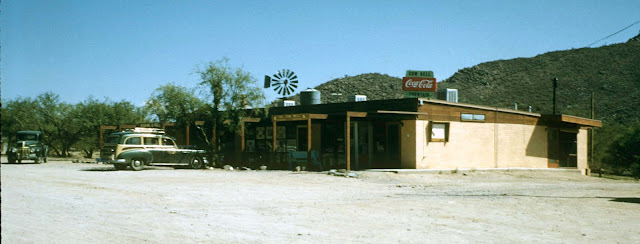
Cave Creek, Arizona, 1957.

I grew up in a one-church, two-bar town, in the first set of mountains north of Phoenix. It was a quirky little town, and it was a mystery to me why all my friends’ dads could fix pickup trucks and build concrete floors, but my dad could only read ancient Greek. He was the pastor in that one church, and for a while had been a denizen of one of those bars.

Then, mercifully for me, he joined AA instead. But I did not understand that then. All I knew is that he no longer smelled sticky and sweet when he picked me up, and his powerful voice no longer used to scare me into diving under the table or behind my older brothers. When he came home, we used to listen for his beautiful whistle. He would whistle Bach cantatas but only when sober. It was a very good sign when we could hear the engine shut off, the door open and close, and -- wait for it -- Bach in the clear desert air. But after a few years I just learned to enjoy the whistle. Unlike many of my grade school classmates, I could rely on the fact that my dad would come home that evening, sober.

Still, though, his head was generally in the needs of his congregation, or the complexities of Greek verbs, and not the physical exigencies of pickup trucks. There was, however, one night in the year when I could be sure that my dad’s abilities were of practical use. Just before Christmas, out where huge boulders had tumbled down the mountainside eons ago, I’d huddle next to my best friend, always in the children’s choir, I‘d see his profile in the candlelight, rocking slightly on his feet. I’d listen for his booming liturgical voice say, “And the angel said unto her, Fear not, Mary: for thou hast found favour with God.” It was the town’s Christmas pageant.

As he spoke, one of the older girls would stand on the path just above a huge boulder and stretch out angelic arms. A young woman would be walking underneath, past boulders nestled into the ground. The young woman would feign terror, then awe, while my father’s voice still boomed out the words of Luke’s Gospel. She was always accompanied by the littlest angel, my coveted role. The year I was about the age for it, the women organizing the pageant -- it was always women -- chose a little girl with lovely red curls who had lost her baby sister in one of the valley’s floods. The baby had been born after her father died of cancer. Even I understood why she needed to be the littlest angel instead of me.

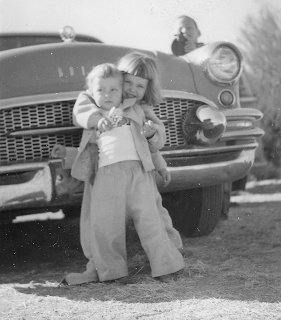
Dianne and Judy
So my bestie Dianne and I stayed in the choir. We sang “Away in a Manger,” “O Little Town of Bethlehem,” and when it was all over, everyone, adults and children, belted out “Joy to the World.”

My brother says that the Christmas after I was born, my mother wrapped me in so many blankets she was afraid I couldn’t breathe. “Check the baby! Is she still breathing?” my brother said she repeated all the way through the pageant. It was the last time I was warm at the pageant. All through the pageant, year after year, Dianne and I would stand next to each other, probably for warmth. The setting sun stole all the warmth from the air, as the mid-winter desert night grew cold. It gave me some appreciation for the first-century shepherds out in the fields by night, as well as for my brothers, draped in serapes or whatever blankets were at hand, playing shepherds in the pageant.

At the right time, with my father’s voice, they would cross the area between piles of boulders just large enough for a stage. A huge pile of smaller boulders formed the audience’s bleachers, and the huge ones opposite were the huge boulders that one’s imagination transformed from an angel’s platform to an inn to a manger scene as my father’s voice rang out the Christmas narratives from the Gospels.

The audience, mostly from Phoenix because most of our town had to be in the pageant or helping with it, had been guided in by luminarios -- paper bags half-filled with sand with lit candles embedded in the sand. The luminarios lined the road out of town on both sides, for miles. I thought they were magic.

They were not. When my other brother was in middle school, he and the other kids would ride on the back of a pickup with the sand and the bags and candles. They’d hop off, fill up a few bags, drop them off with candles, and then hop back on the pickup. When the sand got low, a guy named Montana, the town’s heavy equipment operator, was supposed to come out and fill the pickup with sand again. But it was a long day’s work, and as it stretched out, Montana wanted a drink. So he stopped off at the bar. When they reached him at the bar -- everyone would have known which one to call him at -- he was well-settled in and didn't want to leave. No problem -- in our town, most of the ground was sand, with outcroppings of granite. So Montana simply went outside, dug a hole with his backhoe, and loaded up another pickup. Right in the middle of the bar’s parking lot.

In between Christmas pageants, Dianne and I faced the woes and joys of childhood together. Our mothers were best friends; I met her first when I was a babe in arms, and she was in her mother’s womb. I spent many an hour playing under the kitchen table with Dianne as our mothers plotted the next community event or way to fund the next school project -- milk for children’s lunches or playground equipment. School money was sparse in Maricopa County then. Probably still is.

My parents were New Englanders, and I was packed off to boarding school in Massachusetts at 14. As the years went by, I lost touch with Dianne. Then one day, when my children were the age to be in the choir themselves and we were living in Indiana, my brother called me. Dianne’s 13 year old daughter had died in a car crash. I wasn’t able to make it for the funeral, but came home some months later, when the grief and loss had sunk in, terribly. In those months, Dianne had begun transforming her grief into a profound life change. I do not know how one finds the strength to do that; I admired her deeply for it.

Sea of Cortez. Photo by Judy.
We went to her family’s cabin in Mexico on that visit. I sat on the bed in my brother’s house in Flagstaff afterwards and wrote this poem:

Dianne and the Sea of Cortez

We saw only sea when we sat down. Tiny points of rock
pierced the waves. Water over the sandbar calmed, and the sea
sought its escape in a blue-green strait alongside.

The rocks rose into reefs. A land bridge to the estuary surfaced,
grain by grain. I listened to you as the sea
lost its arrogance, a retreat hidden
in each break of wave on wave.
Sandpipers skipped
along pools of water. A heron
stared at fish in newly-shallowed pools. I listened to you
as the current released its treasures to the sand.

When it was done,
when Venus hung over the new moon and sunset
showed us peaks across the sea, you finished telling me
how your daughter died. And I said,
"I won't be twenty years
coming home again."

Dianne Reichenbach. Photo by Judy.
I kept my promise. I kept in touch this time, coming back to visit every few years. We had a different partnership. She still lived in our hometown, and longed for traveling adventures. I yearned to stay put somewhere for awhile. We dreamed of a time we could travel together. East Africa’s Serengeti was at the top of our list. I was sure she and I, after everyone else was gone, would sit under a tree and reminisce. She had been first into my life. I had assumed she would be the last out of my life.

But no. Her sister called me one day and said she was in the hospital, with cancer throughout her abdomen. She was 55. “It doesn’t sound good,” her sister said. In the next few years, I came home when I could, in August and January, because that’s when I’d be back from Russia. There is no greater love than visiting someone in August at the far northern reach of the Sonoran Desert.

I called her from the airport. “I’ll be asleep by the time you get here,” she said. “I hope you have a flashlight. The light is out and there are rattlesnakes under the porch.” I’m home, I thought, I’m home! I had known to pack a flashlight. Rattlesnakes love the sundown in the summer as much as humans do. In those circumstances, flashlights come in handy.

Photo by Judy.
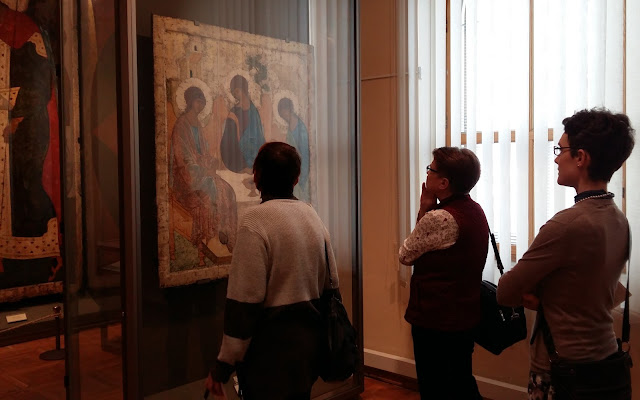
I drove out to her house. With some trepidation, I stepped onto the porch. I crossed it with my breath in. I opened the door and struggled for the light switch. I almost knocked a small frame off the wall in my search for it. I turned on the light, and realized that hanging on her wall was a print of my very favorite icon from the Tretyakov Gallery in Moscow, near where Johan and I had been living.

I loved her house. While not in the best repair, its walls had bright bursts of color, turquoise and gold and oranges tumbling into each other, Mexican-style. She made old wooden pallets into a display case in her backyard. She coaxed flowers out of the desert sand and granite. The town had completely changed; from a quirky town it was now a quirky suburb with a wealthy retirement center nearby. But her house, for me, was home.

As she grew weak, she kept more and more to her bed, which had a beautiful view of dawn and a palo verde tree. I noticed on her dresser a framed copy of my poem, and a photo of the two of us at about 5 years old.

When I was leaving the last time, she said as a goodbye, “Vaya con Dios.” She had thought carefully about how to say goodbye. We knew we would not see each other again.

I tell you this now because when I hear “Joy to the World,” I do not think of how the Savior reigns. Instead, a grief wells up from deep inside me. When I hear “O Little Town of Bethlehem,” I do not contemplate the town’s deep and dreamless sleep. I am too busy fighting tears.

My father is gone now as well. Born on Christmas Day after the close of World War I, he died on Good Friday, 2005. While I love Christmas morning, there’s always a bit of emptiness gnawing at me without the birthday cake and candles, his voice, and of course, the whistle. He loved giving the Christmas day service, because only the most faithful showed up. So we would wait, in some agony, until he arrived back home. By the time I was coming home from boarding school or college, he was serving at a large church in Phoenix.

I wouldn't give away for a moment my connection with Dianne, but it does make the holiday season tough. Why pretend otherwise? Jesus of Nazareth did not sugar-coat, which the Pharisees learned to their surprise. Why then should we cover our grief at Christmas with a dusting of candies and sugarplum fairies? Christmas is to celebrate the birth of the Word become flesh, who said, “You shall know the truth and the truth will make you free.” So why do many of us have this idea that it’s wrong to feel our emotional truths, including sorrow and loss, at Christmas time?

Although it’s uncomfortable and perplexing, and infuses your being with a sense of helplessness, grieving is a good and life-affirming thing. When grief calls your name, the only thing left to do is answer.

Paul says to “rejoice with those who rejoice; mourn with those who mourn.” It applies at Christmas time as well. Jesus honored Mary and Martha’s tears. He will honor yours, as well, in whatever season of the year they fall.

Judy (middle) at the Tretyakov Gallery.

Judy and her dad.
Judy Maurer is a recorded minister in the Sierra-Cascades Yearly Meeting of Friends. She is a member of Camas Friends Church (Washington state, USA) and Moscow Friends Meeting (Russia).

Her previous guest posts are here:

Sitting in the Russian section.

When fear is a gift.

Accents, eggnog, and foreigners in our midst.


Shari Lane on sadness.

Mike Farley on another kind of hope.

Rosalie Ruetz on climate doomism, its danger, and its silver lining.

Jackson Wu on deconstruction, reconstruction, and arguing in good faith.

Alexandra Petri's Advent.

“The world is very bleak,” Mary went on, “generally inhospitable to refugees and the poor, and everybody is competing for resources that aren’t distributed well.”

“No,” Joseph said, “they aren’t. I don’t get any parental leave at all.”

“I was going to count on my cousin to help out, but she just conceived,” Mary said.

Brian Bantum: SpaceX, Meta, and the Christ Child.

In the midst of this allure of escape, I am reminded again of the sheer wonder of Christmas. In the face of all our many ways of saying no to a life with God, God chooses to say yes to us again.

Colleen Dunne's inside view of Dorothy Day's canonization process.


Al Green, "Pass Me Not." (From Robert Mugge's film Gospel According to Al Green.)

This video can't be embedded, so please click on this link to view the video on Vimeo -- and explore other videos in Mugge's fantastic Vimeo catalog.

Screenshot from "Pass Me Not."

16 September 2021

Sitting in the Russian section: a guest post


We knew something big had happened. She sat down during our student tea, looked at us to be sure she had our attention, and then said in a serious tone, “No one has died….”

We’d been teaching English outside of Moscow, Russia for a few years by then, without benefit of long-term work visas, hopping in and out of the country every three months when our visas ended. It was nice at first to hop into Latvia or Ukraine or whatever handy European country to renew our visas, but then we tired of all the times we had to miss birthday parties, anniversaries, special celebrations because our visas had run out.

Every Friday that we weren’t out of the country hunting visas, we held a tea for students. We taught words like “muffin” or “cookie” by the things I brought for them. Our students didn’t realize that they served as a testing ground for me. I’d consider what flavors Russians would probably like of what I knew to cook, and brought them to the teas. The students, traditional college age, had more adventurous tastes than our teaching colleagues, so I’d try out various recipes and bring the results along to the weekly teas. Lemon muffins, reduced sugar to bring out the tartness, were a hit, and so were chocolate cherry cookies. Girl scout cookies, thin mints to be precise, were not. Johan and I faced the terrible prospect of eating all three packages of thin mints I had brought in my carry-on from Oregon, until I discovered one Friend who loved them. She giggled happily as I handed over one full box.

On the day of that student tea we were within sight of a yearly renewable work visa instead of those three-month visas. The paperwork was vast and the bureaucracy arbitrary, with no appeal but bribery, and even that was uncertain. But we all had chugged our way through the process, and just maybe….

We knew by then that the director never swept students away from us, whether in class or in hallway conversations, unless it was absolutely necessary. So the evidence that something had gone very wrong was before she said, “no one has died.” I knew something was up because she dismissed the students. The tea was over.

We stared as she explained that one of her employees had filed the wrong paperwork for our temp visas, and the college faced a $20,000 fine. The immigration official who gave her that news had an offer -- if we could be out of the country by midnight that night, and that we arrived back in with a new, fresh clean entry on our passport -- and the correct paperwork --  by 9:00 am Monday morning at her office, she would process the paperwork without the fine, on the basis of the new entry stamp.

It was 4:00 pm Friday afternoon. She wanted us to go to the airport and take whatever flight would get us out of Moscow by midnight. But I was leary of last-minute plane delays. I had also noticed that Russian immigration officials on trains seemed in better moods than the ones having to do entire shifts inside the cubes/kiosks in airports. Because of the snafu, our paperwork even for exiting Russia would not be perfect. Curiously, Russian immigration officials often wouldn’t let foreigners even leave without perfect paperwork. If not deemed perfect, your paper and your person has to stick around Russia for a few days until you can present again, without flaw. So I suggested a train to Kyiv, Ukraine, instead.

The director agreed, put our passports on the table, spread out the paperwork and said, “don’t lose this piece of paper. It will show them that...” well, I don’t remember what it would have shown them. I can’t stand to think of it now.

A train out of Moscow to Kyiv that evening would cross the Ukrainian border by 11:00 pm or so. We could still catch it. Johan took a cab to the Elektrostal train station to get tickets for us; I subbed for him in his classroom. He bought us a ticket overnight to Kyiv that Friday night, and overnight back to Moscow on Saturday night. It would be a weekend of trains, ending up back where we started.

On the commuter train into Moscow, we discovered we had lost that piece of paper. It had probably been left in the Elektrostal train station ticket booth. Terror surrounded us. We had one job that evening -- to get out of Russia -- and would we be able to do it? It didn’t seem likely.

We lost valuable time in the train station in Moscow trying to find the missing document, calling the director to see if she had a copy, calling the Elektrostal ticket office to see if they would fax it to Moscow. Finally we had to give up. We lost a few extra minutes finding the train, and by the time we found it the final call was sounding. I could barely breathe from running with a suitcase, but we had to run to find our car. A kind conductor yelled, “Come in here. You’ll miss it if you don’t!” We threw ourselves and our suitcases in, and the train began to roll.

But we were still in Russia. Friends of ours had still been stranded at rural outposts, left at the last station in Russia because their documents weren’t in order. And we didn't have that piece of paper. We decided to play it cool. The immigration officer came in just before the border. He reminded me of the Nazi boyfriend in The Sound of Music who turned out to be a snitch. I tried hard to act unconcerned, like it was a routine thing for us, just another trip to Kyiv. He took our passports, looked carefully at each page, one by one, asked a question, and without moving a muscle on his face, stamped the exit stamp in our passports. One more station stop, and then the Russian forests would yield to Ukrainian wheatfields.

At Kyiv Station
It took a long time for me to relax enough to sleep. I was groggy when the train pulled in to Kyiv.

Then we had nothing to do until the train took us back to Moscow that night. Breakfast is my favorite meal to eat out, so we celebrated achieving our exit from Russia by having breakfast in a restaurant near the station. Its decor intermingled old Soviet-style posters and propaganda with Madison Avenue poster ads from the 1950’s. Each booth had its own wallpaper from the Soviet Union or the US in 1950. Soviet leadership and Madison Ave had curiously similar styles at the time -- The New Soviet Man and the ideal 1950’s American housewife looked like a perfect match.

And after breakfast, then what? What to do in Kyiv with no planning and not much sleep? We went to the parking lot where city tour buses gathered. We chose one randomly and paid for a three-hour tour.

I learned Spanish in Spain in high school; Russian never came so well to me, having put off learning until my mid-fifties. Tracking a lecture or tour guide required intense concentration, if it was possible at all, and that day, with no sleep, a warm bus and a down coat, I didn’t have any concentration left to spend. So I wasn’t paying the tour guide any mind as she prattled on, I thought. We were on a serpentine road going up a steep hill.

“Hey, listen to that!” Johan elbowed my side to get me out of my reverie. “She’s using new-age words to reach non-believers about prayer!” Then he began interpreting, “There’s a spot at the convent --  people come for it as a zone of healing with cosmic forces. When you’re there, be sure to feel it for yourself. And think about the people you care about, and what you wish for them.” She probably described where it was, but my Russian failed me and Johan didn’t interpret. I mulled over her words reaching out to new agers about prayer, but that was all. The bus stopped at the convent and she told us in no uncertain terms to be back at the bus in 45 minutes.

We walked around the convent, mostly outside. There was a wide walkway up a short slope, with large concrete landings instead of steps. A little chapel that looked more like a greenhouse, some shrubs and greenery. Then I felt it -- a sensation I can only describe as more real than real -- not in this world, but in the next; a sense of looking into that world, but more like feeling into that world. As if all my senses were attuned, sharp, and showing me a look into the next world. But it wasn’t sight; it was sensation. A sense of contentment beyond contentment, a sense of real beyond real. I stopped short.

“Where did she say that spot was?” I asked Johan.

He looked around, considered for a moment, and said, “right here.” I sat down. I never wanted to leave. Ever again.

St. Helen's grave is in the green chapel. Kyiv, Ukraine. Source.
The little greenhouse looking chapel held a plaque. It said that in the 1830’s, a nun would sit there and a line would form and she would pray for healing, and people were indeed healed. She would sit in that exact spot where I had sensed it. Later, this little chapel was built around her grave.

I had felt that sensation of real beyond real only once before, when a good friend of mine faced a crisis; her son was about to lose custody of his children to an ex-wife who had been neglectful and physically abusive of her grandchildren. A few close friends were with us, and we prayed like we never had prayed before. I felt something opening; I felt the forces of evil and the forces of good, and I felt something change. I stayed in that feeling for 24 hours or so -- the sense of the spiritual world being more real than real. I knew my boss would have experienced that, too, given her fervent prayers each week in our office.

I described the sensation and she said yes, she knew exactly what I was talking about. She told me of a specific time, too. “If we focused on this, Judy, the truth is that we could heal the dead.” In the years that we worked together we had prayers regularly. These weren’t the “guide the hands of the surgeons” sort of prayer, or “give the doctors wisdom” prayers. They were out and out prayers for healing, intercession of the Holy Spirit and Jesus kind of healing.

I was stunned at how many people we prayed for who had remarkable recoveries. They went to the doctors, took medication prescribed, etc etc -- and yet often the results were far better than I had ever expected. It wasn’t that no one died, or became chronically ill, but that I heard news of healing well beyond medical expectations, on a regular basis.

And yet she thought we were not being intense enough about our prayers.

During my years in Russia, I realized that generally, we in the West are trained to believe that good people are rational, analytical people. Good, reliable people only know what they should know, and that knowledge comes from a place or practice that they know and can name. If we have knowledge that is good and useful, then we know how we came by that information. Even with dis-information being rampant, we know where disinformation comes from, or is alleged to come from.

Mystery makes us uncomfortable. Mystery, unexplainable, is an ant at a picnic -- snuffed out or about to be, undesirable. Mystery, unexplained, is failure.

I agree with the scientific approach. I am fully vaccinated against covid-19, and against every other disease on the CDC plan for my age group. I am not anti-science! I believe that covid-19 is NOT a hoax, I believe that ivermectin is good only to treat parasites, etc, etc. I just don’t believe that science is the only important way of understanding the universe.

It’s as if we are in the audience in a play. It’s a long, long play, and we discuss it with each other and with each passing year, we understand more of it. However, some of us hear bumps and noises or smell things that contradict what we perceive is happening on the stage, but we assume those noises aren’t not important because, well, what we don’t understand doesn’t really exist. Or that in the decades to come, science will be able to explain all that is important. If anyone in our little discussion groups in the audience focuses on those bumps and noises and smells then we say that these people are nutcases. We can’t even prove they are hearing those things! So they must not exist. Oh, if you want to believe they are real noises, go ahead, it won’t do any harm, pat-pat-pat on the head but don’t expect those noises to explain anything about the play or have any substantial impact on life.

We in this audience, especially those sitting in the west side of the theatre, want to think of ourselves as rational and analytical. We are confident that the only way to understand more about this play is to test and observe, to collect data and analyze it. If it's not testable and observable, then it’s not happening, or at least is not very important to the play.

And I’m here to whisper to my audience members, “you forget that you are seeing this play with your limited human mind. We have to test and observe with our limited human minds. Maybe there is a whole different way of knowing that is not limited by a human mind. Maybe we should just sit with the great unknowables and admit we can not now, and probably never will be able to, explain them. And let us enjoy the mystery, enter into it, let it inform our beings, our lives.”

After a few years of adjusting, and getting to know Russians, I found myself sitting in the Russian section of that audience. Russia and its section is somewhere between East and West, not fully either but fully itself.

Russians tend to be comfortable with the unknown and the unknowable. For them, all the bumps and smells and noises we can sorta see and feel but can’t possibly understand are an integral part of the play. Science is also considered an excellent way of understanding the play. I once gave what I thought was a difficult question on an exam after showing our class a movie on Einstein: “Explain time in the context of the theory of relativity.” Every single student explained it concisely and accurately, in English, a non-native language. I learned that while foreign language instruction in Russian public schools is below even the level in the United States, which sets a remarkably low bar, science instruction in Russian schools has historically been excellent. Remember Sputnik, and how in the early years of the space race, the Soviet Union pulled way out ahead of the US?

But, the western reader protests, I believe in God! I can’t prove God exists, but I believe! The problem is that many of us believe with our Western, only-what-can-be-measured-is-real minds. We miss so much! For example, consider the feeding of the 5,000, in which Jesus has compassion on the crowds that have followed him out into a desolate land. He takes a boy’s lunch of five small loaves and two small fish, blesses it, and it feeds the whole crowd -- of 5,000 men and an uncounted number of women and children.

I’ve often heard argued in progressive circles that Jesus was only encouraging the crowd to share their own lunches. Think about -- in a society in which community is paramount, and hospitality is considered a sacred responsibility, is getting a large crowd to share their lunch really anything to write home about? Much less write in all four gospels? If the crowds had been Americans, with our emphasis on individual rights and lives, then yes, it would have taken a miracle to get us to share. But not a communal society in an arid land.

We westerners like to brush aside the miracle. Instead, let’s descend into the miracle, into the mystery. God is mystery, and what God does is mystery. On this side of heaven, we as humans will never fully grasp God and God’s mystery, but we are given glimpses. Let's admit that what our human minds can not measure, analyze or even confirm can still exist, and be a major part of life and the universe.

Matthew 9:35 says, “Jesus went through all the towns and villages, teaching in their synagogues, proclaiming the good news of the kingdom and healing every disease and sickness.” Jesus went through Galilea, teaching, preaching and healing. One third of what he did was healing. Are we to deny the reality of a third of what Jesus did?

-- Judy Maurer


Judy and I taught English, American studies, and mass media in Elektrostal, Russia, for nine years. Judy is a member of Camas Friends Church (Camas, Washington, USA) and Moscow Friends Meeting (Moscow, Russia), and a recorded minister in Sierra-Cascades Yearly Meeting of Friends.


A mental health study of 10,000 young people and climate change: 75% are frightened by the future.  Over half feel that "humanity is doomed."

It's not hard to be labeled a foreign agent in Russia -- especially in election season. (And here are a few voters' voices.)

Can patriotism be reclaimed? Charles Scriven reviews Steven B. Smith's new book.

Diane Randall of the Friends Committee on National Legislation is interviewed by the editor in chief of the Bulletin of the Atomic Scientists.

Meanwhile, a modest proposal: fire the generals!

After the Pearl Harbor attack of December 7, 1941, the top U.S. commanders in Hawaii — Admiral Husband Kimmel and Lieutenant General Walter Short — were summarily relieved of their posts, reduced in rank, and retired. The action might not have been altogether fair, but it was necessary. Unless failure has consequences, further failures are all but guaranteed — a dictum as true in war as in business or sports or any other competitive enterprise.

Cosmonaut Sergei Krikalev: the last Soviet citizen.


Albert Collins!

21 May 2020

When fear is a gift // a guest post

Judy Maurer is this week's writer. She is a recorded minister in the Sierra-Cascades Yearly Meeting of Friends.


The college brochure said the campus was on a bluff overlooking the Rock River. It didn’t mention that just to the north of campus, also overlooking the bluff, was a steel foundry. Beyond that was a massive complex for the making of engines. The foundry belched clouds of sulphur across the campus every Wednesday afternoon. A friend who was allergic to eggs had to shut herself up in her room.

On other days, it was a nice campus, with classrooms and the library at one end and the dorms at the other end. Linking the two ends was one street of frat houses, largely unpopular and unpopulated. The college was innovative and international, and the town was small and leafy-green Wisconsin. Fresh from my senior year in high school in Barcelona, I was still deep in reverse culture-shock in the days when people didn’t recognize the problem. I thought I was the only one to feel so crazy. I only felt normal in my Spanish lit classes. I took as many as I could, and ended up with an accidental major in Spanish.

Source.  
Even as a new arrival on campus, I recognized the signs of danger. With the college classrooms, library and student union on one end of the campus, the walk from the library to my dorm late at night tended to be a solitary one. It was a long, dark, lonely walk. Walking home from visiting a friend off-campus was dark, too - all those large, lovely trees hid the street lights, and townspeople tended to close up shop and stay home after around 9:00 pm.

That first year, I would refuse to walk alone after 9:00 pm or so, early hours for a college student. My female friends would tell me not to be silly. I was very shy in other ways, not tending to bother others. But in this I was resolute. I would not visit them late, nor leave a party alone. I remember my friends’ impatient reponses. My fear was unpopular; it was regarded as stupidity, and bending to it was a sign of weakness.

By my third year, it had all changed. A wave of rapes had hit campus. One of my friends escaped an armed rapist. A male friend of mine was inconsolable when his date had gotten angry with him, had stormed out, walked home alone and was raped. It was terrible.

But I was not one of the victims. I had listened to my fear. Sometimes, fear is good.

I remember this now because I have, like many, endured social media messages denigrating those who are cautious about covid-19. Here’s one that sent me over the edge: In a discussion about whether restrictions are unconstitutional, a friend of a friend wrote, “I totally respect your right to live in fear and stay home as long as you feel it’s necessary.” The underlying message -- “I am so much better than you because you are giving in to your fear.”

Sometimes, fear is good. Sometimes when fear whispers to you, all you need to do is obey. It’s your gut saying, “there is something very wrong here.”

We tend to think of Jesus as being totally fearless. If he ever felt fear when going up before the Sanhedrin or Pilate, he didn’t give into it. He knew the result would be an excruciating death, but he continued toward it.

However, there’s one passage that tends to be skipped over. It’s right after he raised Lazarus from the dead. That really caught people’s attention, and his increased popularity was a direct affront to the leadership. After the first century equivalent of a zoom meeting of the chief priests and Pharisees, “from that day on they planned to put him to death.”

Here’s Jesus’ response:

“Jesus therefore no longer walked about openly among the Jews, but went from there to a town called Ephraim in the region near the wilderness; and he remained there with the disciples.”John 11:54

If you want to be like Jesus, pay attention to your fear, and do not walk openly about.

There are other types of fear, of course. When I was eight months pregnant, the bulk of the baby who is now 36 and living in London, was weighing on me so much that I couldn’t sleep well. We lived on a busy street, and each time a motorcycle went by I woke up, alert to the danger of… of what? I didn’t know. I only knew I woke up in terror. When a motorcycle came up behind my car as I was driving, I’d grip the steering wheel tightly until it would catch up with me and pass me, and I’d be able to breath again. I thought I was crazy.

Then my mother came to visit, and she happened to say to me, “Do you remember when Paul would come out and visit us on his motorcycle?” Paul was an old family friend I should never have been left alone with. But I was left alone with him, at the age of three.

I thought, “I remember, Mom. I remember.” When I heard his motorcycle coming, I knew to be afraid, and that fear stayed implanted in my brain, long after he was no longer a threat. My brain enlarged its alert state to include all motorcycles coming up behind me, ever and always. It was my body remembering.

I've learned that this strange, unrelated fear is common among assault and other trauma survivors. It makes you feel crazy, but you’re not. It’s merely an evolutionary mismatch. If an early human witnessed a lion attack, all the details of the lion attack would be warnings of the next one -- the lion’s roar, the quiet sound of the switch of the tail, for example. These days, all the things that happen at the same time as a trauma are not harbingers of the next one -- we just feel like they are.

If an old Beatles song was playing on the radio when you witnessed a knife fight and someone you love got hurt, then for the next forty years, your brain will tell you to be extra vigilant when you hear “when I get old and losing my hair, many years from now...” Just a few bars from that harmless song will make you feel very afraid. It can be paralyzing, or cause you to explode in anger.

The good news is that these days, science can explain these reactions. Here’s the classic read on the subject: Bessel A. van der Kolk’s The Body Keeps the Score: Brain, Mind, and Body in the Healing of Trauma. There are also good ways, such as EMDR, to help the body store traumatic memories so that they no longer have that sort of hold over you.

Therefore, this kind of fear -- a trigger from PTSD -- is another reason not to denigrate those who are afraid. Many of us have earned our fear the hard way.

There’s also a fear that comes from a sense of helplessness and uncertainty. Familiar ways of understanding things are gone, and it’s downright scary. That is a mindless kind of fear. Jesus healed a man who came to him who was living naked among the tombs, without any restraints -- he could break off any shackles put on him. “Night and day among the tombs and on the mountains he was always howling and bruising himself with stones.” Mark 5:5 This must have been a rather frightening thing for newcomers -- a mad man was living naked near the city, and was so strong he couldn’t be restrained. Townspeople had probably grown used to it.

Then Jesus healed him, and the unclean spirits went into a herd of pigs, who raced to the cliff and died. When the townspeople saw him sitting there “in his right mind and clothed,” what was their response? Gratefulness? Awe? Nope. Fear. Mark 5:15: “and they were afraid.”

They were afraid of the man only when he was in his right mind and wearing clothes? That’s what the scripture says. But what comes next is worse. They didn’t make very good decisions. Mark 5:17: “Then they began to beg Jesus to leave their neighborhood.” They could have had Jesus among them -- healing, teaching, inspiring, loving. But no, they responded to their mindless fear of something they didn’t understand by begging Jesus to leave.

I have done that, too. In the beginning of the pandemic, I was in a grocery store when suddenly I was very afraid of all that could happen. I let the darkness into my mind, all the “what if’s” gripped me, and I could no longer think clearly. I was seized with a desire to protect my family - by buying out the store. It would not have been a good decision! Fortunately for my bank account, I recognized the moment. I let myself breathe, counting the breaths in and out. When I got home, I sat in a comfortable chair, read the Bible, and then sat in prayer, repeating a favorite scripture, over and over.

After 20 minutes or so, I felt a deep connection with God envelop me. I felt restored to myself. In Mark 5, the person who was not afraid of Jesus, and who made the best decision, was the one who had been closest to Jesus -- the man who Jesus had healed. As Jesus gets back into the boat, he begs Jesus to let him come along. But Jesus tells him “Go home to your friends, and tell them how much the Lord has done for you, and what mercy he has shown you.”

Many times as the darkness begins to grip me, and my mind seems trapped in a circle of “what if?”, prayer and meditation connect me to God and restore my soul. It’s just like Psalm 40:2-4 describes:

He drew me up from the desolate pit,
    out of the miry bog,
and set my feet upon a rock,
    making my steps secure.
He put a new song in my mouth,
    a song of praise to our God.
Many will see and fear,
    and put their trust in the Lord.


Doug Bennett speaks to Durham Friends (Maine, USA) on what it means to be alive.

Among those pushing to reopen the USA are large numbers of Republicans. What's the evangelical role in this pressure?

Speaking of evangelicals ... an interview with Mark Noll.

Reinventing Pendle Hill's daily Quaker worship in the Zoom era.

Slate on Little Richard and the music he shaped: Jack Hamilton. Tom Scocca.


Little Richard appears on Granada TV in 1964, with Sounds Incorporated and the Shirelles. Note his rendition of George W. Cooke's "Joy in My Heart," starting at 9:51.

10 January 2019

Judy Maurer: Accents, eggnog, and foreigners in our midst

This week, I’m delighted to welcome my wife Judy Maurer as guest blogger.


A few days before Christmas, a well-dressed woman in Winco approached me with a bottle of Irish creme in her hand. “Is this drink for the Christmas?” she asked.

I squelched the desire to quiz her about her native language and how it navigated without articles like “a” and “the”, since the use of those tiny words was clearly not intuitive for her. But like my students in Russia, she was able to get her point across well, without being able to land exactly on where one used a “the” or an “a”. Normally, it’s not a problem -- unless you want to say, “My husband has the money” and you end up saying, “My husband has money.”

But I left all that aside and said, “If they’re Irish-American, it would be perfect.”

“I want traditional drink” she said. Again I squelched a desire to explain that in America, what one perceives as traditional at Christmas flows from your parents or grandparents’ ancestry. Lefse for Norwegians, stollen and marzipan for Germans, and all that. I also didn’t explain that usually, the ones with English ancestry got to decide that their traditions would be mainstream traditional in the US. I’m not entirely sure why that is, since Spaniards were first in to invade North America in any numbers, and then the English.

Instead I just tried to explain about “eggnog”. I wrote it out on my smartphone for her, because what is a “nog”? How would she know how to capture that in her memory? She seemed perplexed that she should look for it in the dairy section.

After nine years in Russia, it’s a familiar point of stress for me. Going to a social gathering as a foreigner means trying to figure out what is the accepted practice. Everyone else knows it, accepts it as gospel truth as the-way-it-should-be-done, but you have no idea, and even have to set aside your own sense of the-way-it-should-be-done which is so embedded in your view of life that you don’t realize it is just your culture’s sense of the-way-it-should-be-done. So what the others think is the civil and polite thing to do may seem at the least perplexing. So my worry tended to be: “when I stumble over a social obstacle, will the others think my cluelessness is charming, or rude?”

Asking a stranger in a grocery store is a good tactic. I told her that the Irish creme in the fancy bottle would be a very good thing to bring to a party in America, but she repeated that she wanted to bring “traditional drink.”

Painful things have happened since I left the US to go to Russia in 2008. In 2017, I came back to a country in which people speaking English with accents are no longer as willing to engage in a conversation about where they are from. But I hoped I had built up enough rapport with her so that she would be willing to talk. So I asked.

“Iraq,” she replied.

“Good. I’m glad you’re here.You’re safe.” She seemed surprised, but when she caught my eye again while quizzing grocery store employees, probably about traditional drinks, she beamed.

During the worst of the Ukraine crisis, when Russian media blamed the “decadent West” for everything that went wrong, I felt vulnerable in Russia as a westerner. State media is dedicated to telling the news in just such a way to make people more compliant with what the leadership wants to do anyway. (I know. This never happens in the US, right?) Blaming foreign countries, and foreigners in their midst, is always a good strategy for deflecting blame away from the realities of this country. This tactic works particularly well if there is significant corruption among the political leadership, but what would we in the US know of that, right?

In the spring of 2014, when pro-Russian separatists took over parts of eastern Ukraine, the Russian leadership was in desperate need of these tactics. Stereotypes are particularly useful in these times, and state media trotted them out. They flooded state and social media with reports of the “Godless West”.

I grew up in a very conservative area of the US southwest, and was regularly subjected to films in school about “Godless Communists”. So as Yogi Berra said, it felt like “deja vu all over again,” but with a mind-numbing twist: I was now defined as the enemy. A wise Russian friend told me that the easiest way to rile people up against the enemies of Russia was to dust off and use again the Soviet-era stereotypes of Americans, as we had been the most frequent targets during the Cold War. It would have been a farther reach to enrage the populace against western Europeans. State media was just doing what came easier.

It was particularly painful when our good friends bought into these stereotypes. In my own living room, an old friend asked with wide-eyed wonder, “Can a man find a woman who would take care of her husband in America?”

I felt like saying, “you’ve seen with your own eyes how I take care of Johan -- and he takes care of me. Do you really think I’m the only American woman who takes care of her husband?”

The cold-war stereotype in Russia is that American women are selfish, independent feminists who won’t lend a hand to their own families. Another good friend insisted to me that I must have learned to cook in Russia, after I left the US. The unstated part was, “everyone knows that women in America don’t bother to cook for their families.” Since I had just provided a yummy home-made treat for the teachers’ lounge, then it stood to reason that I had learned to cook in Russia. Really? One learns to make apple crisp in Russia? In most of these cases, I was too stunned to argue.

While our friends believing in Soviet-era stereotypes was the most painful, being outside their care, as foreigners in public, was the most frightening. I polished my public Russian image so I could blend in. In addition to my black leather coat, silk scarf, brick face without smile in public, I stuffed an orange and black -striped ribbon in my purse so I could whip it out and tie it on at a moment’s notice. This ribbon was the Russian nationalists’ symbol; I would look safely like a Russian nationalist with a St. George’s ribbon on my purse.

Once when I was in Moscow I called home and said, “Johan -- I forgot to tell you. I moved that carry-on suitcase -- the one to take if they knock on our door.” High-profile deportations of westerners -- politicians who were proving their mettle by deporting hapless English teachers -- were enough of a thing that I put everything I would need for a sudden deportation back to the US right next to our front door. Some of our students believed it was enough of a threat that they described for us what cars the immigration service would use - the Russian equivalent of an FBI Black Maria.

And I resolved, once I returned to the US, to help individual foreigners in the U.S. feel welcome. In the Old Testament, the foreigner is sometimes an example of a marauder, but more often of the vulnerable, as in Deuteronomy 24:17-19 “Do not deprive the foreigner or the fatherless of justice, or take the cloak of the widow as a pledge. Remember that you were slaves in Egypt and the Lord your God redeemed you from there. That is why I command you to do this. When you are harvesting in your field and you overlook a sheaf, do not go back to get it. Leave it for the foreigner, the fatherless and the widow, so that the Lord your God may bless you in all the work of your hands.”

Even back then, foreigners were vulnerable, without status or protection, and God told Israelites to treat them well. That part has not changed. We must treat the foreigners among us well, particularly if our country had much to do with making their country a dangerous place to live in. While we’re at it: What national problems might be hiding behind these “enemies” and distractions being thrown at us? What does our political leadership not want us to see? Let’s focus on those problems. Let’s reject fear, so that God might bless us in all the work of our hands.

Judy Maurer is a member of Moscow Friends Meeting, Russia, and Eugene Friends Church, USA. From 2008 to 2017 she and Johan taught English at the New Humanities Institute in Elektrostal. Before leaving for Russia she was a publicist and fundraiser for ARMS - Abuse Recovery Ministry and Services. She is writing a book on anger and angry people.

Photo: at Cathedral of Elijah the Prophet, Yaroslavl.


Mike Farley: The heart being the place where God's love meets us (Romans 5.5-6) it meets too there the one whom we are holding in our heart.

Red Cross photos from Russia of the Civil War era. (Last two photos are from the region where Friends worked in famine relief.)

Bridget Collins in The Guardian on the top 10 Quakers in fiction. (Thanks to Martin Kelley for the link.) I would have included the Birdwell family in Jessamyn West's The Friendly Persuasion, particularly Eliza, among my own top ten. What do you think of the list?

Remembering Lamin Sanneh and Friend Samuel Snipes.

Jackie Pullinger warns us that we're going to feel stupid for eternity if ...

And to add to our current season of major space exploration stories, could these repeating fast radio bursts be from aliens?


One more time for this delightful blues collaboration with James Harman at the BluesMoose Cafe: