Showing posts with label internet. Show all posts

05 February 2026

The problem with AI ... according to AI

Source.  

It's been nearly 13 years since Gmail offered automatic classification of e-mails (sorting them into "Primary," "Promotion," "Social," etc.). I appreciated the way this organized my in-box, and I soon began creating filters that would override Gmail's decisions when necessary. Even so, I wondered what Google was doing with the data it must have been collecting to do that sorting of my mail.

More recently, Gmail has been trying to finish my sentences, and has been offering summaries of my incoming mail and my e-mail conversations. It offers to help me write letters.

I posted the following query into Google's search engine:

"Examples of unwanted and uninvited use of AI in our everyday Internet-based tasks (e-mail, for example)." I'll let AI speak for itself (but I'll return at the end).

Note: Google provides the sources of the information and advice in this essay through links in the actual Google-constructed reply to my request.


Platforms are moving from simple "tools" to "collaborators" without always being asked.

It’s a fascinating (and sometimes frustrating) time to be online. We are currently in the "opt-out" era of the internet, where AI features are often pushed live first, leaving users to figure out how to disable them later.

While some find these tools helpful, many users experience them as "feature creep"—unnecessary clutter that interrupts flow or compromises privacy.

1. Communication & Email

This is where most people encounter unwanted AI daily.Smart Compose & Predictive Text: Gmail and Outlook now suggest the end of your sentences. While it saves seconds, many feel it flattens their personal voice or makes emails sound robotic.

AI-Generated Summaries: Some email clients now place an AI-generated summary at the top of long threads. If the AI misses a nuance or gets a deadline wrong, it can lead to costly misunderstandings.

Priority Inboxes: Algorithms decide which emails are "Important." If the AI "hallucinates" that a bill or a personal note is "Promotions," you might miss it entirely. [This happens to me frequently.]

2. Search Engines & Information

The way we look for facts has fundamentally shifted in the last year, often removing the "human" element of the web. 

AI Overviews (SGE): Google and Bing now place an AI-generated answer at the very top of search results. This pushes actual websites (written by humans) further down the page and can sometimes present "hallucinations" as factual truth.

Chatbot Sidebars: Many browsers (like Edge with Copilot) now have persistent sidebars that analyze the page you are reading, even if you just wanted a clean reading experience.

3. Social Media & Content Creation

Social platforms are using AI to keep you scrolling longer and to fill gaps in original content.

AI-Generated Commenting: LinkedIn and other platforms now suggest "AI replies" to posts. This can lead to comment sections filled with shallow, automated praise rather than genuine networking.

Feed Manipulation: Algorithms have moved beyond "who you follow" to "what the AI thinks will keep you hooked," often surfacing AI-generated "slop" (synthetic images or low-quality AI articles) in your main feed.

Invisible Editing: Instagram and Facebook have integrated AI tools that can "expand" your photos or remove people from backgrounds automatically, sometimes blurring the line between reality and digital fabrication. 

4. Workplace & Productivity Tools

The "Software as a Service" (SaaS) world has integrated AI into almost every text box. 

The "Ask AI" Pop-up: In tools like Notion, Slack, or Google Docs, highlighting text often triggers a "Write with AI" button that can get in the way of manual editing.

Meeting Transcription Bots: You may join a Zoom call only to find an "AI Note-taker" bot joined too. This can feel like uninvited surveillance, especially if the host didn't ask for everyone's consent first.

Why this feels "unwanted"

The tension usually comes down to three things:

  1. Cognitive Load: Having to constantly dismiss pop-ups or "X out" of AI suggestions is exhausting.
  2. Privacy Concerns: Users often worry that their private drafts or emails are being used to "train" the next version of the AI.
  3. Loss of Agency: When a tool suggests how you should finish a sentence, it subtly influences your thoughts and communication style.

Even more unwanted! Google's sources did not mention perhaps the most disastrous aspect of AI's invasion into our online lives: the electricity it takes to make those often-unwanted features possible.

I asked Google, "How much additional electricity (beyond what would be used simply by the Internet) is required to power AI?" Here is its full answer. In brief,

AI-optimized data centers require 3–5 times more power per square foot than traditional facilities, with a single AI server rack consuming 50–150 kilowatts compared to 10–15 kW for conventional computing. AI searches use roughly 10 times more electricity than standard, non-AI internet searches, driving a potential 10%–20% increase in total U.S. power demand by 2030.

I admit that I appreciate that AI is probably helping Google process the questions I ask it. Instead of guessing at the best key words and their best order, as I used to do, I can frame my queries in natural language. However, my occasional and voluntary use of AI in this direction is not the same as having it intrude when not invited.


At the end of the original response to my query, Google asks, "Would you like me to show you how to disable some of these specific AI features in Gmail, Google Search, or LinkedIn?" I answered "yes," and it linked to these suggestions.


In the context of ICE and other U.S. Homeland Security officers' abusive behavior, it's not surprising that audiences yearn for evidence that justice is on the way. A whole new AI-powered trope has arisen to meet this hunger: videos of officers making ludicrous and cruel arrests (it happens!) and then getting scolded by angry citizens, business owners, local police, and judges. Here's a YouTube channel specializing in such videos. The channel's front page makes it clear that every video is fictional, a similar note is on each video's individual page, and the videos themselves bear all the typical features of fakes, but the vast majority of the comments on many of these videos are cheering on those righteous resisters. Occasionally there's a plaintive "It's probably AI but I wish this were true."

Other AI-generated videos tell stories of miraculous landings of stricken airplanes, or detailed accounts of Ukrainian drone strikes, and no doubt far worse material ... and we're all paying for the power that's needed to compose these AI fakes, and the mental and spiritual pollution they spread, just when civil society needs true discernment more than ever. Among the names of the early Quaker movement were "Publishers of Truth" and "Children of the Light"; I guess we're still needed, if we're up to it!


Was it inevitable? AI agents have their own social network?? Benj Edwards on Moltbook.

Micah Bales on the humility of God. "Be encouraged, brothers and sisters."

Sunita Viswanath: The "theology of showing up" is making Minneapolis a holy place.

Artemis II's lunar mission is delayed. Amy Shira Teitel's sad and blunt commentary on this rocket and its ultra-expensive path to irrelevance: her video and article.

A Guardian report on Dezer Development and Palestinian deportations: an infuriating glimpse into the world of wealthy presidential friends who earn big fees by transporting deportees and treating them as utter nobodies.


One of my favorite versions of "Baby Scratch My Back" ... Jason Ricci with John Lisi, Sam Hotchkiss, Andy Kurz, and Adam Baumol.

06 November 2025

Insane clickbait? Game over!!! Some thoughts on manipulative exaggeration (partly a repost)


"By far the greatest Cafe the world has ever seen."

I was walking past a familiar storefront this afternoon, the Classic Football Shirts London shop, and happened to notice this claim in huge letters (how could I not?) on the front glass.

The cafe at this store is indeed nice, as Judy and I have experienced more than once. Does it live up to that claim? (Is it even in the same class as Chapters in Newberg, Oregon?) 

I'd rather ask, does it matter? 

My theme this evening is manipulative exaggeration. The "greatest Cafe the world has ever seen" may be exaggerated, but it's not manipulative. It's so over the top that nobody is likely to argue the point.

"Communist, not socialist. Communist."
Screenshot from source.

A few days ago, I watched a video clip of the USA's president say straight into the camera that New York City mayoral candidate is a "... communist, not socialist. Communist. He's far, he's far worse than a socialist."

I realize that as a rule the current U.S. president is not a reliable source of facts nor a defender of the biblical commandment against false witness, but I want to stick with this one case for a moment. Trump's assertion is an exaggeration (yes, Mamdani is on the left end of the USA's political spectrum, but not that far!) but also an outright falsehood (Mamdani is not a Communist either politically or philosophically, and this is a matter of public record).

The leader of what we used to call the Free World is guilty of manipulative exaggeration.

I realize that he's not the first U.S. politician to engage in this variation of false witness. As just one case study, I've just spend some time in a mixed experience of fascination and horror, reading about the 1884 presidential campaigns of Grover Cleveland and James Blaine. As American Heritage summarized it, "Grover Cleveland had seduced a widow; James G. Blaine had peddled influence [and] lied about it. In 1884, voters had to choose between two tarnished champions."

(My favorite line from Cleveland supporters: "We should elect Mr. Cleveland to the public office he is so admirably qualified to fill and remand Mr. Blaine to the private life he is so eminently fitted to adorn.")

Compared to the raging MAGA bulls in the china shop of democracy, it may seem like indulging in trivialities to point to the cesspool of manipulative exaggeration that makes up much of the Internet. But is this wider context just making it harder to raise a red flag when the president himself indulges? Might we become so cynical that we give up on seeking truth and unmasking manipulation even when it's conducted by our chief executive? And ... when it's conducted by "our own side" as well?

I'm sad to see that people on the left, where I generally find myself, are now constantly using these techniques of manipulative exaggeration, often in the form of "clickbait," in the supposed service of getting our attention for their message. My e-mails and my phone's text messages feature such lines as...

  • Re: Taylor Smith...Donald Trump's DISGUSTING rant.
  • re: Portland's polling location [Johan won’t respond??] (Portland, Oregon, doesn't have polling locations! Only drop-off points for our ballots, which can also be mailed in.)
  • We can't believe you're a Republican!!!
  • NOT asking for money, just your signature. (For the record, they did ask for money, too.)
  • Impeachment COMING SOON [MUST READ >>]>

And in addition, there are those frequent "surveys" and "polls" which both major parties send out constantly, with questions worded to make it obvious how we should answer.

He is starting to worry about me.

If there's anything unique about the text messages and e-mails from the Republicans, it's how stupid they think their audience is. A frequent theme: the president has been checking with his staff to hear how I've personally responded to their latest plea.

If there's any blessing in this Internet/phone blizzard of manipulative exaggeration, it might be that the formulas (including senders' addresses, CAPITAL LETTERS, shocking headlines, etc) are so absurd that we're probably all learning how to filter them out. The sheer volume of such traffic may also reduce my patience with even using these devices as much as I've done in the past.  SHOCKING! It's WIN-WIN. GAME OVER!


Four years ago, I posted the following essay on clickbait. I find my YouTube feed to be slightly calmer these days. Is it because I've somehow trained it to reduce this kind of traffic, or are content providers themselves realizing we're burning out on manipulative exaggeration?


Youtube has figured out that I like videos about space travel, so they serve me up with lots of suggestions about the latest rockets and their builders.

Many of those videos have calm, interesting titles and descriptions, and the day is not long enough to view even a small portion of those. That's especially true for a video like this, modestly entitled "Crew-3 Mission | Approach and Docking," that takes more than six hours to watch from beginning to end.

Six hours may seem like a long time, but it's a lot shorter than the preceding video, "Crew-3 Mission | Coast and Rendezvous," which clocks in at nine hours. Strangely enough, that title completely omits the dramatic centerpiece of the video -- the launch!

Many of the videos I'm invited to watch are exactly the opposite: the titles are far more dramatic than the content. Often the titles reflect today's equivalents of the overused superlative "extreme" of a couple of decades ago.

These overly dramatic titles and descriptions are sometimes called "clickbait." This word entered the Oxford English Dictionary in 1999, longer ago than I realized. (According to the OED, clickbait is "Internet content whose main purpose is to encourage users to follow a link to a web page, esp. where that web page is considered to be of low quality or value.")

In our classes at the New Humanities Institute in Elektrostal, Russia, we occasionally presented our students with carefully curated cutting-edge lists of buzzwords and jargon (and sometimes asked them to predict whether those words and phrases would still be in use in five years), but I don't remember "clickbait" being in those lists. I think one of the last classes we did on this topic included the word "binge-watch" ... in case that helps you deduce what years I'm talking about.

Far from exciting my interest, clickbait titles and descriptions of videos relating to space travel usually repel me. Here are the top five words and phrases practically guaranteed to prevent my click:

game over! (which it never is!)

insane! (meaning, as far as I can tell, audacious)

humiliated! (usually comparing one tech entrepreneur/celebrity's success to another)

this is huge! (probably not)

it's happening! (and so is everything else)

I watched one of these videos, out of sheer curiosity and to maintain a shred of integrity for this screed. (What if it really was "game over" and my protests were just ill-informed?) 

GAME OVER! Elon Musk & Google's INSANE Partnership Will Change EVERYTHING 🔥🔥🔥

The video on the "insane" partnership of Elon Musk and Google was underwhelming. The commentator simply described the Starlink/Google collaboration, which was already public news five months earlier, using video clips that were only vaguely related to the narrative, not a single voice other than his own, and no analysis that could not be found in corporate press releases. Youtube doesn't mind, of course -- the video was preceded by two ads.

More samples from one evening's Youtube browsing:

Original post and links for that day, November 11, 2021, are here.


A History of Rock and Roll in 500 Songs. Many thanks to Steven Davison for writing about this podcast. I've been sampling it. It lives up to Steven's praise. And if you think that rock music is a bit of a trivial subject for our difficult times, I can point out how multidimensional the podcast's coverage is, taking into account racial politics, business ethics, technical innovations, generational influences, in short, all the ways that music reflects life. What's more, we may need a thoughtful podcast on rock music while we're in detox from all that manipulative exaggeration.

While I'm at Steven's blog, here's a more typical post: a new look at "that of God" through the eyes of George Fox (of course), Lewis Benson, Rufus Jones, and Michael Langford.

What's going on in Richmond, Indiana? Two institutions closely related to Friends report troubling financial news. Here's an item on Earlham College and another on Friends United Meeting. (Part two of the FUM document is here.) 

According to FUM's Weekly E-news, FUM has scheduled an online information session on the financial situation and the 2026 budget on Thursday, November 13, at 7:00 p.m. Eastern Time. Register here. Lloyd Stangeland, FUM’s Acting Chief Financial Officer; Shawn McConaughey, Clerk of the Finance Committee; and Emily Provance, Clerk of the Advancement Committee, will facilitate the session.

"Responding to the calls of Palestinian Christians": a statement and petition campaign arising from the 2025 Church at the Crossroads campaign. Thanks to Kristin Du Mez for the link.


Blues from Brazil: Little Walter's "Sad Hours" performed by Sacha Gamarra. Below: From Dnipro, Ukraine, Kostiantyn Kolisnychenko with the same instrumental.


05 December 2024

Twitter and its rivals

From top: home screens from Threads, Mastodon, Telegram.

Back in 2018, when data harvesting and the manipulative use of social networks were attracting lots of attention, I wrote this blog post about Facebook and Vkontakte. I described and defended my use of these services, and listed some of their virtues and hazards. I still use them in more or less the same ways.

A year or two earlier, while we were still living in Russia, I had joined another service, Twitter, where I expressed political opinions I usually didn't post on Facebook and Vkontakte, the services that I relied on for news of family and friends. Part of the thrill of Twitter was seeing news stories and opinions fresh from journalists' and commentators' keyboards, before they had been sanitized and published (or sometimes even verified!). I abandoned Twitter shortly after it became X, not because my own feed had become appreciably more toxic, but because of the way its new owner treated employees and critics. Still, I admit that I missed that outlet, and still do.

Some of that craving is taken up by Telegram, which I joined shortly after leaving Russia. Telegram combines elements of instant messaging, microblogging, interest groups, and news feeds. Those news feeds include such users as The New York Times, Washington Post, TVRain (Дождь), the BBC (and its Russian service), and numerous Russian-language and Ukrainian channels—media outlets and individual journalists and commentators. 

Telegram is also a platform for personal messaging, but so are many other platforms. I'd just as soon stick with the reliable (so far) channels for that kind of communication (e-mail, Facebook and FB Messenger, Vkontakte, and phone-based texting) and, less often, Whatsapp (important for overseas contacts), and not have to cover every possible channel. There are some apps and clients that promise to combine personal messages from a number of sources, but I've never found that covers all of them, and most are not Web-based. (If you have suggestions for cross-platform message handlers that are browser-based or Linux-compatible, please comment! I prefer desktop platforms, not services that are exclusively phone-based.)

Back to news and opinion: Threads, Mastodon, and Bluesky are among the services that may take over Twitter's place in my search for fresh news and opinions. So far I've found a number of my favorite authors on all three of them. In a promising development, all three services are finding ways to become mutually accessible. For example, here's the way to bridge Mastodon and Bluesky; and you can authorize Threads to share posts in the larger fediverse.

The days are not long enough to camp out at all of these various sources, and it remains to be seen whether their cultures remain as mellow as they mostly are now. (Well, Telegram can't exactly be called mellow, but in my chosen feeds, it's not snarly!) How well might they resist external predators and internal exploiters? In the meantime, dipping around in each of them for brief visits seems more productive than developing a premature loyalty to any one in particular. However, if you've become committed to one or two platforms out of all these choices, and would like to tell me why, I'd love to know.


Here are a few other overviews of these various platforms, their similarities and differences:


The latest Humanitarian Situation Updates for Palestine from the United Nations:  Gaza Strip; West Bank.

Chimène Keitner of Lawfare on the Netanyahu/Gallant arrest warrants.

The Haaretz newspaper’s editorial board described the ICC’s decision as an “unprecedented moral nadir” for Israel. (Netanyahu responded to Haaretz’s coverage of the war by sanctioning the newspaper.) Hungary’s Victor Orban greeted news of the ICC warrant with an invitation for Netanyahu to visit, deepening cleavages between European countries committed to the rule of law and those challenging the “liberal international order.” Absent a change in leadership, Israel’s international isolation from that order will continue to deepen. Even if the Israeli government changes course (which is highly unlikely, especially given the results of the recent U.S. presidential election), the damage to Israel’s standing and reputation—with ripple effects on Jews in the diaspora—will take decades to repair. Meanwhile, the human toll is irreversible, and rebuilding Gaza will take decades, if not centuries.

John Crace of The Guardian on the UK House of Commons debate on assisted dying: "...ultra-rare Commons sight: intelligent debate." You can see the debate itself on parliamentlive.tv.

Human rights defender Olga Karach doesn't want to "disappoint" Lukashenko.

William Barber on CNN: here's what Trump's second coming tells us about the country and the future.

But what you saw election night is not the whole of America. It’s a part of America in a particular moment around the election. You have to stop and say, wait a minute, this is the same America that I went to sleep in the night before. It’s not some strange America. This is part of America. America has always had multiple stories running at the same time.

Austin John and McKinley James perform B.B. King's "Ruby Lee." Enjoy the whole set; they're fine musicians.

27 October 2022

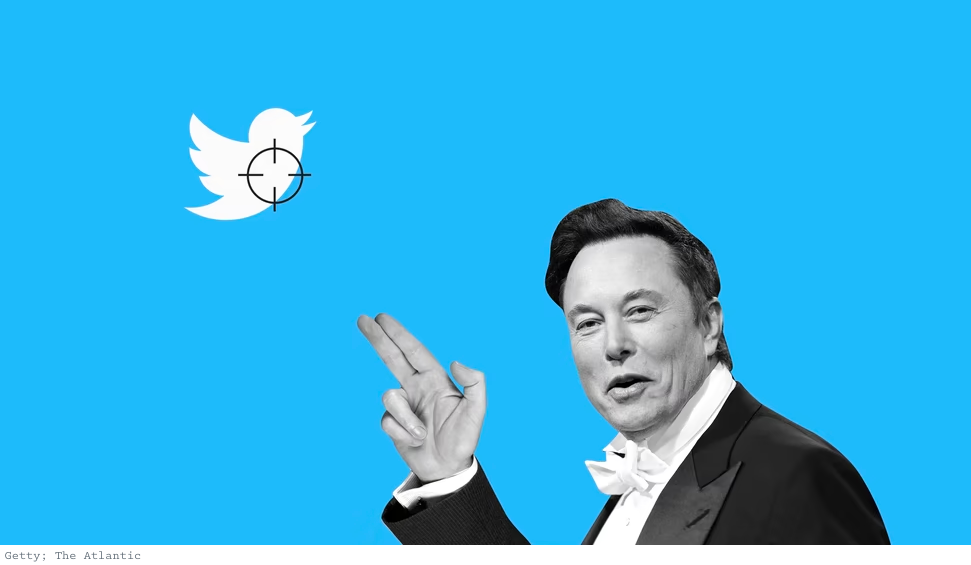
Elon Musk and Twitter: Why should I care?

The Atlantic graphic accompanying this article:
"How Elon Musk could actually kill Twitter."

"Elon Musk reportedly fires top Twitter executives as he takes over company": an online Guardian headline this evening.

A similar headline was the top item in this evening's Washington Post online edition. You don't need me to list the world and regional news stories that a reasonable person might judge as outranking the corporate drama at Twitter in importance.

I've been on Twitter for about five and a half years, and over that time I've had two uses for it. The high-minded use is this: it's a handy feed for news articles, sometimes directly from the journalists writing them. It's convenient then to pass good links on to others I've come to know in Quaker Twitter and Russian Twitter, and in turn to receive their recommendations.

But it's hard to deny that Twitter also been a source of entertainment, a peek through the bars of our political zoo. There's a sadness to this, too, of course, as we see how little regard for nuance there is in this arena. In any case, when I read about all the rude, vicious, and aggressive behavior on Twitter, I realize that my experience is nothing like that. Not that those observers are wrong, but I've subscribed to the people and organizations I want to follow, and so I probably live a sheltered life on that site.

A couple of years ago, I joined another online network, Telegram. Many Russian journalists and news organizations are now on this network, and since February 24 it's become my only online link with some of our contacts from our years there. Telegram offers many of the personal communication features of other social networks, but (aside from those few individual contacts in Russia) I only use it to read news and commentary. It has become much more important to me than Twitter for that purpose.

With Telegram for news and (yes, still) Facebook for relatives and friends, I imagine that Twitter will fade away for me. If so, why should I care about today's headlines? Does the takeover of Twitter by one eccentric billionaire threaten us in ways I've not personally experienced? Does Twitter help to cause, or does it simply display, our country's (and world's) bitterly polarized public space? And how far do those influence ripple beyond Twitter's own active participants?

As Victoria Scholar noted on BBC Newshour today (the segment, mainly about Meta and Facebook, starts at 26:30), "Consumers of social media switch from platform to platform very quickly." That's me ... I started with forums on CompuServe and mail list services (remember Quaker-L?), then went to MySpace and LiveJournal, then abandoned them in favor of starting my own blog. I eventually added Facebook to stay in touch with people during our years in Russia, then added Russia's own near-clone of Facebook (Vkontakte) to connect with many of our students, and now I'm on Telegram. But I never got involved with Instagram and TikTok and probably never will. Nevertheless, Scholar's point is valid: these platforms inevitably cycle in and out of popularity. Charlie Warzel's article in The Atlantic, "How Elon Musk could actually kill Twitter," lists any number of ways Twitter's new owner could contribute to its demise.

(I've not mentioned YouTube, but it's in a somewhat different category, at least for me. I use it for content, not socializing.)

It's tempting to simplify dilemmas around social media by making their wealthy founders and owners outsize heroes or villains, when it might be more important to learn, and help each other learn, how to exercise healthy oversight over their channels' behavior—and over the influence we allow them to have on us.


Left side: When they murder you, when they rob you,
when someone is being raped.
Right side: When someone wrote a comment in VK,
when someone reposted something,
when someone downloaded a picture.
Vkontakte, VK for short, used to be a lively place with lots of activity from our students and friends in Russia, and their peers. However, these days it seems to have dried up. 

I have 426 people and organizations on my list of "friends," but now only about half a dozen of my individual contacts post regularly, along with a few groups—the public library in Elektrostal, one of the local weekly papers there, the local television station, a Doctor Who fan channel and a few other topical channels, an amateur theater group in Noginsk, and that's about it.

I suspect (but have no evidence) that among the reasons for this decline is self-censorship, in view of the risks of posting unfashionable political views. Equally likely, I suppose: just as with LiveJournal and Myspace, tastes change. And there are lots of other places now for posting cute pictures and videos....

If you're a current or former VK user, I'd love to know how things have or haven't changed for you.


From Mark V: The Opera. Source.
Pew Research Center: "64% of Americans say social media have a mostly negative effect on the way things are going in the U.S. today." As for their effects on mental health, here are some comments from Columbia University's Claude Mellins and Deborah Glasofer. In this article on the Wharton School Web site, marketing professor Jonah Werberg comments on an important risk factor:

... [T]here is an addictive quality to social media, and that is a big issue, says Berger. “Social media is like a drug, but what makes it particularly addictive is that it is adaptive. It adjusts based on your preferences and behaviors,” he says, “which makes it both more useful and engaging and interesting, and more addictive.”

Speaking of addictive, the Martin Marty Center at the University of Chicago gets its own Internet home. (I don't apologize for this particular fascination.)

In Friends Journal, Keith Barton says that the Bible and early Friends cautioned us against the misuse of images. Nowadays, we're drenched in images. "The chief question we can reasonably ask, then, is whether this visual bombardment in the modern world is salutary or destructive."

More images! Barclay Press publishes its first graphic novel, Derek Lamson's Mark V: The Opera, with collaborators John Williams and Brandon Buerkle. Update: My review is here.


Night and day, Albert Collins sings about the "Same Old Thing." Incredible musicians! (These are both reruns on my blog, but who remembers stuff like that?)

19 May 2022

The blogging rules I usually break

Finsbury Circus Gardens ... a nice place to take a break while blogging.

On Saturday, two days from now, I'll be one of the three bloggers participating in a panel that is part of the annual meeting program of QUIP—Quakers Uniting in Publications. The panel will be hosted by Natasha Zhuravenkova of Moscow Friends Meeting (and on the staff of Friends House Moscow). The other panelists will be Robin Mohr of Friends World Committee for Consultation, and Nancy Thomas, poet, theologian, and historian.

The most important part of the "Friendly Blogging" panel presentation, from my point of view, is what you and other participants might want to ask us or advise us. We have some starting points for our contributions, as shown on the programwhat are the joys, sorrows, motivations, and effects of blogging? How to keep a blog engaging, revealing and safe for years to come. In correspondence, Natasha also asked us a question which I find particularly chewy: How can an introvert be a blogger?

One question that Natasha kindly did not ask was "What blogging rules do you usually break?" I wish I had put that question in my readers' survey! (More about the survey below.) In any case, I have my own somewhat sheepish list....

Old templates (2004, 2007).
  • My posts are too long. According to blogging wisdom, this very post is about to exceed the advised limit!
  • I don't consistently focus on one theme or niche. What does Quaker theology have to do with Russian politics or blues?
  • I don't pay enough attention to design elements. Not enough photos, bullet points, or other elements of visual interest. It has been about twelve years since I even changed the template!
  • One list of blogging rules says Get personal! That's easier said than done, especially in the tiny Quaker world where what I say about myself and my experience may affect directly implicate others. However, I confess that I love reading other people's personal stories, so I do push myself from time to time. And, thank God, Judy is a great storyteller. No wonder her guest posts consistently outrank almost all of mine!
  • I don't plan ahead. Most of my work writing a blog post happens on the Thursday of publication, which means that I rarely allow myself enough time, for example, to ask permission of others to quote them. As a result, a lot of good material doesn't make it into my posts. (But they're already too long....) And I spend 90% of my blogging day fact-checking, and searching (usually in vain) for the perfect visual elements for the post, and 10% actually writing.

Despite all these defects, you are here! Believe me, I'm grateful.


This is a good moment to report back on the readers' survey I mentioned above. I got 21 responses, which is too few to make statistically valid generalizations. However, many of those 21 came with fascinating and instructive feedback, so here goes:


Here's the full survey (unfortunately, some answers are clipped short in this format, but you can usually guess the missing bits, and many are quoted in full below)....

Among the open-end responses, I particularly appreciated these:

The themes and topics of most interest to you are: (check as many or as few as you want)

  • ALL OF THE ABOVE!
  • There's nothing I would omit as long as you trust your Light about what to post
  • Any topics you touch upon.
  • All of it.

My comment: Take that, you one-theme blog experts! (I seriously cherish the implied trust.)

In the future, I should ... (A question about whether the blog should continue. This is post number 974 today, so I'm tempted to ask, "Would a thousand total be a good number to retire on, God willing?")

  • Trust your Light. If you need to lay it down, lay it down. If you want to publish individual sections as their own posts on an irregular schedule and maybe think about a keyword schema....
  • How are you led?  I'll read most of what you blog on and all that you tweet in English.
  • Do you want release?

I'm also curious about these points....

  • The posts are exactly as long as they need to be, and you should continue to share your musings without concern about heresy!
  • Too much policy :))) I prefer you to be a speaker of Christianity, which is too far from policy, sorry
  • Not enough heresy., Ha ha, just kidding
  • Sometimes I love the thematic range that you work into a whole post. Sometimes I wish for pieces that stand alone. 

My comment: That last point mirrors a process that sometimes happens when I write: At some point I realize that the post has grown beyond itself, so to speak. I then face a question: do I edit it into more than one post, even though the same impulse drove the whole thing, or do I swallow my doubts and keep it all in one? Sometimes I answer one way, sometimes the other. Thanks for the perceptive observation.

How many blogs do you read? (Most respondents chose from the ranges in the survey, but some added comments.)

  • There are too many wonderful things to read and too little time. I click on a link when I see it and have time to read.
  • I basically don't follow blogs.
  • I read a mishmash of blogs, twitter, and email lists so I have no idea what would be helpful here

You wish I would ...

  • ...better explain the reasons you choose to be a Quaker - for those who does not. But maybe I missed these post or they were published a long ago?
  • Write more about Q universalism & /or non-theism
  • See my comments above. [Trust your Light....] Do you have an anchor committee? Sometimes the process of how Quakers support ministry interests me and occasional reports on how this works for you might be of interest to others.
  • I look forward to your blog each week. You are truly looking at injustice with Christian eyes instead of faux-Christian words that are really political. Giving a Russian perspective helps with a vision of greater breadth. I like both yours and Judy’s personal stories. I know it is a lot for you but you are providing a needed service.
  • Become Quaker Dictator For Life...   but...  it's clear you're never going to... so I had to let go of that...

My comment: That first observation, that I should do a better job of explaining why I choose to be a Quaker, is just. I probably said something about that in these past 18 years, but now I think I need to do a fresh job. Thanks very much for the idea! To be continued....


Beethoven 7.2, "a prayer meeting in A minor."

2,000 years ago in the midst of the brutal Roman occupation of their homeland and the violent Zionist uprising, the followers of Jesus of Nazareth asked him how to pray. He responded with the Lord’s Prayer, a prayer of gratitude, devotion and forgiveness, a response to the turmoil of his time.

200 years ago Ludwig van Beethoven responded to the defeat of Napoleon and his oppressive domination of Europe with the completion of his 7th symphony in 1811. Most of the 7th Symphony evokes a jubilant celebration with “dancing” rhythms and melodies. The second movement, the Allegretto, is more metaphysical and prayerful. At the premiere performance in 1813 the audience demanded that the Allegretto movement be encored immediately, and it has remained internationally popular ever since. 

This piece was conceived, written and recorded as a prayerful response to our trying times. 

John C Peterson MD (Doc)...physician, composer, arranger, performer (all instruments), co-producer; Nick Melander...digital consultant; engineer, co-producer; Cynda Williams...actress, vocalist, soprano vocals; Amanda Hummer...actress, vocalist. alto vocals; Kyle Ivy...percussionist, vocalist, tenor vocals; Craig Priebe...retired vocal music professor, bass and baritone vocals.

How politics poisoned the evangelical church: the very opposite of disinterested journalism, and the more powerful for it. I would love to believe our Quaker churches are immune from this poison, but I doubt it. Even if we all fell on the (to my mind) healthier side of this divide, do we just accept this alienation from our brothers and sisters? Do we fall victim to yet another brand of elitism? Even so, I get very weary of dealing with still another way of completely misrepresenting the Gospel!! The recent tragedy in Buffalo shows us the stakes.

Roger E. Olson remembers a different era.

Abu Aram v Ministry of Defence: another case of Israel v international law, another lamentable loss for law and for justice.


Taj Mahal and another amazing transcontinental band (and just count the islands) in Playing for Change's version of "Queen Bee" ...

03 March 2022

Information

"Dear viewers, we will not let you down." Source.
"It's not the end. It's just the end of Season One."
"As they say, the last one who leaves turns out the lights."

This evening, Moscow time, Natalya Sindeyeva and her team at Russia's "optimistic channel," Dozhd' (Rain) suspended its work and went into hibernation after a final, very emotional goodbye broadcast. I defy anyone to watch this program (in Russian, or through the auto-generated subtitles in your language) without tears.

Among those who spoke at this final broadcast was Vera Krichevskaya, co-founder of Dozhd' with Sindeyeva and director of the new film F@ck This Job (based on the history of Dozhd'). She summed up in three sentences why the channel had to stop: "In the last several days, the Russian Federation adopted new laws. These laws obligate us to tell falsehoods. If we have to choose between telling falsehoods and temporarily turning off our signal, we choose to turn it off...."

I have been a Dozhd' viewer and subscriber practically from its beginning. My current subscription supposedly runs for another 632 days. I've even gotten used to the legally required disclaimer, in big letters, that for the last half-year has described the channel as a "foreign agent."

Among the new laws and regulations are a requirement that all statements about the "special operation" launched in Ukraine last week must come from the Russian military, and that the word "war" must not be used. All words and images that the government designates "fake" are outlawed on threat of fifteen years' imprisonment.  This is a dramatic escalation of a process that began with the new century and its new Russian president, gradually squeezing the air out of Russia's independent mass media and causing an impressive stream of Russian journalists and commentators to flee the country, including Dozhd's own editor-in-chief Tikhon Dzyadko just yesterday. Almost every prominent independent voice in Russia's mass media has now been driven off its normal channels, forced to use such platforms as Youtube, Twitter, Telegram, and Instagram, which themselves, to varying degrees, are under threat of suppression.

I remember sitting in our car back in Richmond, Indiana, around 1987, listening to the news, when I heard a startling story: The USSR's KGB had come in for public criticism in the Soviet press. I was genuinely amazed; this was my first concrete evidence that Gorbachev's policy of glasnost' (transparency; openness) was real. When I began my regular visits to Russia a few years later, the difference in journalistic freedom was evident everywhere I looked. (Here's a sample.) That era has emphatically come to an end.

President Putin has claimed that all media worldwide dance to the tune that the pipers (those who finance the media) are playing, so why point the finger at Russia? Of course there is a lot of truth in this, but he was not arguing for a reform of this reality. He was simply deflecting the attention being paid to the fresh waves of repression in Russia. Rather than do a case-by-case comparison of the reality in Russia with the reality elsewhere, I think it is fair to compare today's reality in Russia to the era of glasnost', to 2000, or even to 2014.

Of course there are many informal channels of information that operate in Russia, as everywhere else. Frank face-to-face conversations, especially in kitchens, went on even during Stalin's repressions. We had plenty of those conversations in our own kitchen in Elektrostal! Telephones and the Internet serve ordinary people as before, subject to the constant awareness that someone might be listening or recording us. The government cannot suppress all individual dissent; its main priority is to suppress effective mass dissent. Those who post or repost anti-war or anti-leadership texts and memes within their own social-network circles will usually get away with it; the government will arrest a few to discourage the rest, but most of the repression is reserved for those the authorities believe have wider influence. 

UPDATE: It looks like more people are getting police attention for signing petitions, so my optimistic comment that most protesters "will usually get away with it" may now be out of date.

No mass media or Internet channel delivers a perfect stream of pure information -- defined as objective facts or fact-based recommendations that any member of the audience can rely on to make judgments and decisions. For me, there is another form of valid information: finding out what others believe to be facts, and what they believe to be persuasive arguments, along with enough context that I can make my own evaluation of those assertions. I want to hear the Russian government officials' points of view. I want to hear their opponents' points of view, and the evidence of ordinary people who must endure the consequences of all those decisions.

For example, these days I'm following news from Ukraine on a variety of channels on Telegram. Much of what I hear seems unlikely to be the whole picture, and most of it is obviously intended to influence rather than simply inform me. Often the various channels are simply quoting each other rather than each delivering fresh news from their own sources. However, taken cumulatively, I can form a reasonable, if tentative, impression of what's going on -- good enough to help shape my prayers.

There's also another form of information that is extremely valuable to me: what are the relationships and interdependencies among all these actors? Who treats whom with kindness or cruelty? Who keeps their promises, who breaks them, and what are the consequences? I want the evidence of these relationships and interdependencies to be sufficiently visible for me that I can consider how to fulfill my own obligations as a citizen of the world and of the Kingdom of God.

In any case, I believe I can tell the difference between "information" and "instruction." Russia's leaders have chosen the latter. Hence the very sad reality of today's last (for now) studio program from Dozhd'.


Update: Here's the Washington Post's summary of the media situation in Russia.

(Also see this post from July 2022, in which Dozhd' returns to the air—but in exile.)


Source: Ebay.  

When I was growing up, our family had a shortwave radio, a Hallicrafters S-120 receiver, which my sister Ellen and I listened to frequently, trying our best to search out faraway stations with unfamiliar languages and accents. We knew that, during World War II, my father's family had a radio that they used (at great risk of discovery by the German occupiers of Norway) to hear what was going on beyond the Nazi curtain. 

I was a shortwave radio user right up until the early 1990's. Toward the end I had a small shortwave receiver that I used to carry around the streets of Richmond, Indiana, and Wilmington, Ohio, listening to the BBC World Service through earphones on my evening walks. That's how I followed the day-to-day drama of the end of the Soviet era and the birth of today's Russia.

For all but the community of shortwave enthusiasts, the Internet has replaced radio as a way to listen to faraway broadcasters. If the Internet ends up, in some places, becoming a gated resource for those who prefer to instruct and control rather than inform, I wonder whether we'll see a rebirth of shortwave.


Do you remember ambassador Marie Yovanovitch? David Remnick interviews her.

Sergei Chapnin on Russian Orthodox Patriarch Kirill and Vladimir Putin's "two wars."

Tomorrow, March 4, is the World Day of Prayer. Many years ago, I participated in planning an ecumenical service for this occasion. I was one of the two Quakers, and the only male, in this group in Ottawa. I was delighted to see an article by British Quaker Stephanie Grant, who wrote for this year's event.

Micah Bales on seeing the face of Christ.

Roger E. Olson on becoming Anabaptist.


Eric Bibb and Michael Jerome Browne, "Needed Time."

I'm down on my bended knees....

24 November 2021

Khrushchev and "gullible" Americans

To my readers in the USA: Thanksgiving blessings!


Please help me evaluate and improve this site! My readers' survey is here--answer as many or as few questions as you like. Thank you!


A real card-carrying Communist: Nikita Sergeevich Khrushchev's party membership ID (with membership fees for 1954). Source.

I hadn't heard this particular piece of false witness before I saw it in my own relative's post on Facebook:

A sobering reminder. Almost exactly sixty years ago since Russia's Khrushchev delivered his Do you remember September 29, 1959? THIS WAS HIS ENTIRE QUOTE:

"Your children’s children will live under communism. You Americans are so gullible. No, you won’t accept Communism outright, but we’ll keep feeding you small doses of Socialism until you will finally wake up and find that you already have Communism. We won’t have to fight you; We’ll so weaken your economy, until you fall like overripe fruit into our hands." "The democracy will cease to exist when you take away from those who are willing to work and give to those who would not."

Having studied Soviet and Russian history my whole adult life, this quotation did not ring true to me at all. Khrushchev was blustery, boastful, and prone to "harebrained schemes," as his colleagues charged when they ousted him in 1964, but he was convinced of the superiority of the Soviet Communist system, and seemed certain that this superiority, would, in the long run, "bury" Western capitalism. He really did say that Russia would catch up to, and overtake, the USA, but you will look in vain for any quotation of his that this victory would take place through "small doses of Socialism." The Marxist line is that capitalism itself is fatally flawed, and will fail when the working class becomes fully aware of their own exploitation.

Apparently this "you Americans are so gullible" quotation has been circulating in one form or another for a long time. Here's one review of its history; here's an earlier and more thorough study. And now it's flourishing again:

Three examples of text from Facebook

Graphic version of text posted by nine Facebookers and reposted thousands of times

Notice the enhancements seemingly designed to increase the credibility of this fake: the exact date, the reference to "those that are old enough will remember this" -- and I even found someone willing to say that "It was Sept. 29, 1959, when Khrushchev delivered his prediction for America at the United Nations. I remember this like it was yesterday: The TV showed the coverage of him banging his shoe on the podium." That shoe incident (no podium involved, and perhaps no shoe!) took place in October 1960 in an unrelated context.

Another sharer of this fake quotation added, for good measure, another popular fake: the "eight levels of control" falsely attributed to another stock demon, Saul Alinsky.

I realize that using fake or artfully edited quotations to slander political opponents is not new. What fascinates me is how eager their audiences are to accept them and recirculate them. It's ironic to me that the real "gullible" Americans are not the ones mentioned in the fake Khrushchev text; it's the Americans who believe these sorts of campaigns, whatever side they come from. The graphic version of the Khrushchev quotation has been shared thousands of times from one user's profile alone. I don't have the time or patience to calculate the full circulation of all of these various versions over the years -- and of course I have no way of knowing how many times the repeaters are aware that it's a fake but use it anyway because it reinforces a message. 

What is that message today? Apparently, we are meant to be alarmed by one or more of these threats to our freedom:

  1. Joe Biden's "Build Back Better" program is really a program of creeping socialism.
  2. The Biden presidency is itself a fraud; the real winner of the 2020 U.S. presidential election was his predecessor.
  3. Official public health measures to limit the spread of COVID-19 are part of the socialist conspiracy.
  4. So are efforts to mitigate global warming.
  5. So are efforts to confront systemic racism.
  6. (What have I left off the list?)

To me, Khrushchev's threats (fake and real) now seem faintly ridiculous, the Soviet Union itself having failed, and the Russian Communist party having been utterly marginalized in today's Russia. The USA's Communist parties are microscopic and fragmented, and neither of our two major parties is even remotely socialist (assuming you use honest definitions). Ironically, most of the Russian efforts to subvert politics in the USA now either favor right-wing forces or simply promote cynicism.

My challenge to those who traffic in these fakes: yes, there is an actual threat facing our country. We are witnessing a slow-motion coup by the far right, reinforced by "Christian" nationalists and well-financed by the Trump money machine among others. Are you as ready to consider the evidence for this coup as you are to consider these worn-out fakes? Or are you part of a new generation of gullible Americans?


If you are a Christian who likes to share misleading quotations, here's a post just for you (and me).

The Aspen Institute's report on information disorder in the USA.

Information disorder is a crisis that exacerbates all other crises. When bad information becomes as prevalent, persuasive, and persistent as good information, it creates a chain reaction of harm.

"I don't mean any disrespect" ... seventy years after Joe McCarthy, John Neely Kennedy red-baits Saule Omarovka.

In support of the Freedom to Vote Act.

A film on militarism ... War School: The Battle for Britain's Children. Thanks to Sergei Nikitin for the link.

Josh Wilbur wants to know what religious leaders would do if actual (space) aliens showed up.

GOOD NEWS Associates: A new URL and Web site. Current Associates: Margaret Fraser, Christine Hall, Emily Provance, Jan Wood.

Are you looking for a reason to hope in a season that might tempt you to despair? Becky Ankeny has some words for you.

Caminando con la Biblia: A bilingual Bible study sponsored by Beacon Hill Friends House and Friends World Committee for Consultation.

Right Sharing of World Resources considers adding a partnership in a fourth country (after India, Sierra Leone, and Kenya) and issues its annual report (PDF).

Did I mention I'm running a readers' survey?


For some reason I needed to hear this again:

10 December 2020

Howard Segars

A few days ago, one of our friends on Facebook posted a picture taken at our wedding. Three of our wedding guests were posed in the center of the frame -- and, with a pang, I noticed another familiar figure off to the side -- Howard Segars.

Howard Segars and Judy Maurer
That led me to search out our wedding album, hoping for a better view of Howard -- and here he is, talking with newlywed Judy outside the Friends Meeting at Cambridge meetinghouse, August 9, 1980.

Here on my blog, back in May 2010, I was musing about the passing of time, and went on to say:

I also think about people who are no longer with us. The Internet has completely changed our expectations about access to information -- but not all information becomes automatically accessible. I've become accustomed to being able to supplement a letter about some subject with hyperlinks to more information, but, honestly, when Gordon Browne died, it was a shock to find how little there was online to link to, in comparison to the floods of data available about people alive today who are unlikely to do 10% of what Gordon did for the world. Maybe it's time to revive and enhance the old Quaker tradition of the memorial minute, with encouragement to make them available online somehow.

Just to name one example: I really miss Howard Segars of Beacon Hill Meeting, and I wish there were more about him online.

I was at our home in Russia when I wrote those words. Now I'm back in the USA, with my paper archives right next to me. On a hunch, I went through my "S" folder -- and to my delight I found several letters and cards from Howard. Just as significant, in view of my wish from ten years ago, I found a memorial minute for him:

8.11.85

MEMORIAL MINUTE FOR HOWARD SEGARS

Howard DeFriese Segars of Beacon Hill Monthly Meeting died in Cambridge, Massachusetts on the 21st day of Six Month 1985 at the age of 38. He joined Friends Meeting at Cambridge Fourth Month 1972 and supported it with his gifts and efforts through the years. He also supported Beacon Hill Friends Meeting in its early days when only a handful gathered as a worship group. In 1980 when Beacon Hill became a monthly meeting, Howard became its first clerk as well as a founding member.

Many members of the Beacon Hill community recall that it was Howard who greeted them at their first meeting, and because of his outreach, they felt moved to return. Howard’s many letters to members, attenders, and other friends reflected his sensitivity to others and his desire to minister to their needs. His eloquent vocal ministry reflected his vast knowledge of the Bible, the early church and liturgical calendars of other faiths, his awareness of God’s presence, and his intense concern with suffering caused by injustice. Howard considered no task in Meeting above, below or beyond him, from dishwashing to care of children to struggling through Meeting for Business with such difficult issues as sanctuary for Central American refugees.

Among his contributions to New England Yearly Meeting were his memberships on the Permanent Board, New England Friends Home Committee, and the New England Friends Home Long Range Planning Committee. Howard Segars was one of the first to challenge New England Yearly Meeting to recognize contributions of gay men and lesbians and to welcome them openly into the mainstream of the Society.

He served Beacon Hill Friends House on the Program Committee, in the Quaker Studies Program, and through his counsel to staff during stressful times. He was also active with Friends General Conference.

Howard was deeply committed to issues of justice. As a teenager in Alabama during the civil rights struggle in the early 1960s, he chose to walk rather than ride the segregated buses. He worked as a VISTA volunteer in 1968 before finishing his degree in classics at Brown University. Studying clinical psychology at Boston University, he specialized in the care of the elderly and later lectured nationally on abuse of the elderly. Howard reminded us that all major religions teach us to care for our elderly.

He was instrumental in the formation of health and counseling services in Boston for gay men and lesbians. It is a sad irony that he died of AIDS, a disease that has so far afflicted mostly gay men. Despite declining health during the last two years of his life, he was available by beeper 24 hours a day, 7 days a week to the elderly that served through Guardianship Services; he was lecturing around the country until a month before his death; and he was an active participant in the Quaker Studies Program. He continued to live fully.

We know of no one who more passionately followed the admonition of Isaiah to “seek justice, correct oppression; defend the fatherless, plead for the widow.” He suffered the rejection of the disabled. He suffered the rejection of a gay man. He suffered the isolation of the outsider. He suffered the misunderstanding frequently felt by people who champion unpopular causes. Howard used the experience of his own pain to identify with and respond to the pain of others.

We rejoice in having had his strong presence among us and we feel intensely the palpable absence of his leaving. We grieve over our loss. We will miss Howard’s laughter and his spirituality.

  Committee: James Anthony, Don Galbreath, Lolly Ockerstrom, Erica Voolich

Easter 1982
Howard was a master storyteller, with stories (true or not, we didn't always know!) that were both hilarious and profound. He had a lot of material to work with -- his own experiences of life and service, his education in classics and psychology, his association with Quakers and with the Society of St. John the Evangelist, and most endearingly, with our own little Beacon Hill Friends community. 

We left Boston in 1980; on March 2, 1981, he wrote to us,

Meeting has grown since your departure and there have been a few First Days when folk have sat on the floor and the stairs! It's nothing short of amazing to me. The memory of tiny meetings for worship is still fairly recent and the change has been quite dramatic. I am learning, slowly, the art of clerking. Ministry and Counsel and business meetings have worked hard on the "busy" details and the work shows. Both of you gave much and your sharing has helped get Beacon Hill where it is today.

A short version of his memorial minute was published in Friends Journal in November 1985. I hope I've introduced Howard to more people through this post -- and if you already knew him, maybe you've had a chance to relive some good memories. Maybe you were even one of those who -- like Judy and me -- remember his warm greeting upon your first visit to Beacon Hill Friends Meeting.


Friends World Committee for Consultation is seeking the next general secretary for its World Office in London. Details here. (In case you missed it, there's a link on this page to Gretchen Castle's letter to Friends.)

In Russia, as elsewhere, sometimes it takes determination to remember. The case of Vera Ermolaeva.

Upcoming Scholar-Activist Encounter, December 17, features Weldon Nisley and Tom Boomershine. Cosponsored by Christian Peacemaker Teams, the Center and Library for the Bible and Social Justice, andthe Network for Biblical Storytellers International. 

Peterson Toscano on using the Zoom platform more effectively and creatively.

C.S. Lewis on "trumpery," via Nancy Thomas.


Remembering Little Charlie Baty.... Here's another collaboration with Anson Funderburgh and Mark Hummel: