Showing posts with label journalism. Show all posts

09 April 2026

"Do not hold on to me." (A guest post.)


During our years in Russia, we celebrated Easter with our friends there according to the Orthodox calendar. This year, Easter on that calendar is this coming Sunday. Easter blessings to all of you who are in the midst of awaiting Easter Sunday on April 12.


Screenshot from Mary Magdalene. Source.

A few days ago, Friend Ellerie Brownfain sent me her thoughts about Easter. I loved them! I hope and imagine you may find them as insightful and helpful as I did. With her permission, here they are:

Easter Message

There is a moment in John's account of Easter morning that I keep returning to. Mary Magdalene has come to the tomb before dawn and finds it empty. She weeps. Not for joy. Mary weeps because she believes someone has taken the body of her teacher and she does not know where they have laid him.

Turning, she sees a man standing nearby and assumes he is the gardener.

I have to say, if I had been there, I might have made exactly the same mistake. Though probably for different reasons. I cannot grow anything. Not even succulents. I buy the seeds and I read the instructions and I have genuine hope every single spring. And then somewhere between hope and harvest the plants just give up on me. But I keep trying. Every year. Because there is something in me that believes growth is worth the effort even when I have clearly lost the argument.

So when I read that Mary looked straight at the risen Christ and saw a gardener, I feel a kind of kinship with her. I know what it is to show up hoping something will grow and be surprised by what you find.

Mary says to him, if you have carried him away, tell me where you have put him and I will take him.

This is a deeply human impulse. She is not looking for a miracle. She is looking for a way to say goodbye.

And then the man says her name.

Mary.

And she knows.

Mary reaches for him. And he says something that has always struck me as one of the most important lines in all of scripture. He says, do not hold on to me.

Do not hold on to me.

I want to sit with that for a moment because I think it is near the center of what Easter asks of us.

Mary came to the garden looking for the Jesus she had known, the teacher who walked the roads of Galilee, who ate with her, who taught her, who died on a Roman cross. Wanting to recover him. Wanting things to go back to the way they had been.

And the risen Christ says, do not hold on to that. I am not returning to what was. I am going forward. And you must go forward too.

. . .

This is the thing about resurrection that we can miss if we are not careful. We can treat it as a restoration story. The happy ending after a terrible Friday. The tomb is empty, the crisis is over, and life resumes. But life did not resume. Not the old life. The resurrection did not restore anything. It transformed everything.

But resurrection is not restoration. It is transformation.

Paul makes this plain in his letter to the Romans. He writes that we who have been baptized into Christ have been baptized into his death. We were buried with him. And just as Christ was raised from the dead by the glory of the Father, we too might walk in newness of life.

Newness of life. Not the old life resumed. Not a return to what was before. Something genuinely new.

Paul is talking about baptism but he is also talking about the shape of the Christian life itself. We do not follow a historical teacher who is safely in the past. We follow a living Christ who is present and active and always calling us forward.

George Fox understood this in his bones. When he spoke of Christ having come to teach his people himself, he was not speaking metaphorically. He meant that the risen Christ is here. Available. Present in the gathered meeting, present in the conscience, present wherever two or three are gathered in his name. The resurrection was not only a past event for Fox. It was a present reality. Christ is alive and moving in this moment.

The resurrection is not just something that happened to Jesus. It is something that is always happening in this Society of Friends. Christ is always being raised in us and among us. And we are always being called to walk in that newness.

So what does this mean for how we live? I want to name three things.

. . .

The first is this. Resurrection frees us from the tyranny of the way things were.

Mary could not have gone and told the disciples if she had stayed in the garden holding on. Letting go of what she came looking for was the only way to receive what was actually being given. And then she went. The first preacher of the resurrection. That is not a small thing. The first person sent to announce that Christ was risen was a woman whom the other disciples initially did not believe.

She carried the news to people who would not even believe her. She could only do that because love recognized love. She heard her name and she knew him. And knowing him was enough.

We do this too. We hold on to how things used to feel. How our families used to be. How our faith used to be simple and clear and certain. We come to Easter looking for something to retrieve rather than something to receive.

The risen Christ says, do not hold on. Something new is being offered. And it requires your hands to be open.

This does not mean that what we have lost was not precious. Mary's grief was real. The disciples' grief was real. Ours is real. But resurrection says that grief is not the destination. The garden is not where we stay.

. . .

The second thing resurrection means for how we live is this. We are sent.

Jesus does not tell Mary to stay in the garden and rest in the warmth of this moment. He tells her to go. Go to the brothers and sisters. Tell them what you have seen. You have been given this not only for yourself but for the community.

Easter is not a private experience. It pushes us onto the road to speak and to act. But what action? That is the question we must bring to God in prayer and carry into the silence of our own hearts. The risen Christ commissions us but he does not hand us a script. He trusts us to listen for what we are each being called to do and to go do it.

What have you seen? What has the risen Christ given you that was meant to be shared? That is an Easter question worth sitting with in the silence.

Because the risen Christ does not appear to Mary so that she can have a beautiful private moment. He appears to her so that she will go. So that the news will travel. So that the locked room where the frightened disciples are hiding will have its door knocked on by someone who has seen something they need to hear.

You have seen something too. This community has seen something. The question Easter puts to us is whether we are willing to go and say so.

. . .

The third thing I want to name is perhaps the most personal. Resurrection means we are not defined by our worst moments or our deepest losses. And if you doubt that, look at who Christ came back to. He came back looking for his disciples. The ones who had run. Peter had denied Jesus three times and wept bitterly over it. They were in hiding, behind locked doors, afraid and ashamed and probably not sure what to do next. Easter morning does not erase any of that. The gospel does not pretend Friday did not happen. But the risen Christ did not seek out the faithful and the steady. He went looking for the ones who thought they had failed him.

But it says that Friday is not the last word. Death is not the last word. Failure is not the last word. Grief is not the last word.

The risen Christ appears first to the ones who are weeping. He shows up in locked rooms where frightened people are hiding. He walks alongside two disciples on the road to Emmaus who are so deep in their grief that they do not recognize him until he breaks bread with them. He meets people where they are and then he moves them forward.

This is not cheap comfort. It does not minimize the weight of suffering. It does not tell us our pain is not real. It says our pain is real and it is not the end of the story.

Paul puts it this way. If we have been united with him in a death like his, we will certainly also be united with him in a resurrection like his. United with him. Not observers from a safe distance. Participants in the same movement from death to life. That is what we are being invited into this morning.

I want to close by coming back to Mary standing in the garden.

She heard her name spoken by someone she had believed was dead. She recognized him. She reached for him. He told her not to hold on. And she went.

There is a whole life of faith in those few verses. We come to God carrying our grief and our need and our desire to make things go back. We encounter the living Christ in ways we did not expect and often in places we did not think to look. We want to hold the moment. And the Christ we encounter is always sending us forward into something we cannot yet see.

Do not hold on. Walk in newness of life. Go and tell what you have seen.

That is the Easter message. Not a return to the garden we remember but a commissioning to become people who have met the risen Christ and cannot stop talking about it.

— Ellerie Brownfain


You may have experienced a deluge of writing concerning the war with Iran and the events of the last few days. In lieu of a list of links that's no better than what you no doubt already have, and will inevitably go stale in a matter of hours, I'll just offer you this fascinating and disconcerting conversation on Donald Trump's "wishcasting."

Diana Butler Bass: "Don't let the tomb overtake the resurrection."

Heather Cox Richardson on journalism and an unhinged president.

Sergey Radchenko renounces his Russian citizenship, and why, and what next....

Consider supporting this Kickstarter campaign to fund art for the Friends Incubator for Public Ministry's new book, Constellation of Witness: Quaker Stories in Public Ministry.


Gospel blues from Kee Eso Pitchford, with thanks to Daniel Smith-Christopher for the introduction.

"If you want me to love my enemies, I'll say yes."

11 January 2024

"...The People, called in Scorn, QUAKERS": part two

Robert Barclay, source.  

"When speaking with non-Quakers, I find it more exact to say I’m a Quaker. Among other Quakers I prefer Friend to reinforce to each other our relationship with Jesus and each other."

Survey respondent, explaining the occasions or contexts which determine whether they choose the term Quaker or Friend.


Last week I noted the powerful content of both terms among the early Quakers. The "scorn" they met with in the larger society when labeled Quakers, especially among the religious polemicists who opposed them, was an important differentiator. It was almost guaranteed to bring them the public attention they urgently wanted so that they could proclaim and demonstrate their revolutionary message.

As I said last week, the more I read, the more I got the impression those early Friends did not often use the term Friends as a public label. But it wasn't really a private label, either. Instead, it was used much more literally as an affectionate term of address within the community.

This aspect of the term may not have entirely disappeared. When I'm writing to a meeting or church or committee, I find that I almost always write "Dear Friends." I don't think I've ever written "Dear Quakers" in that context.

This week I'd like to sample some of the other responses to the survey. But before I do that, I'd like to say something about the state of the world we're in today, in comparison to which these questions about what we call ourselves may seem narrowly sectarian and scandalously trivial. You know as well as I that innocent civilians are being killed and maimed, and their homes are being destroyed, this very day, and you know where. You hear the outrageously bland and lying explanations from the leaders that command these crimes. Your tax money may have paid for some of the munitions.

Whatever we call ourselves, what might be our response? Should we be crowding the prisons with our civil disobedience, should we accompany with our own bodies those who are being bombed, should we stop paying taxes? All of these have parallels among early Quakers. At the very very least, should we not be telling the Judge Gervases of our time to "tremble at the word of God"?

Let's remember whom we might be addressing. The state of Israel claims to be the haven and guardian of the legacy left by the biblical People of God. Part of that legacy is a rich ethical heritage, summed up by the promise to Abraham that his descendents will bless all the peoples of the world.

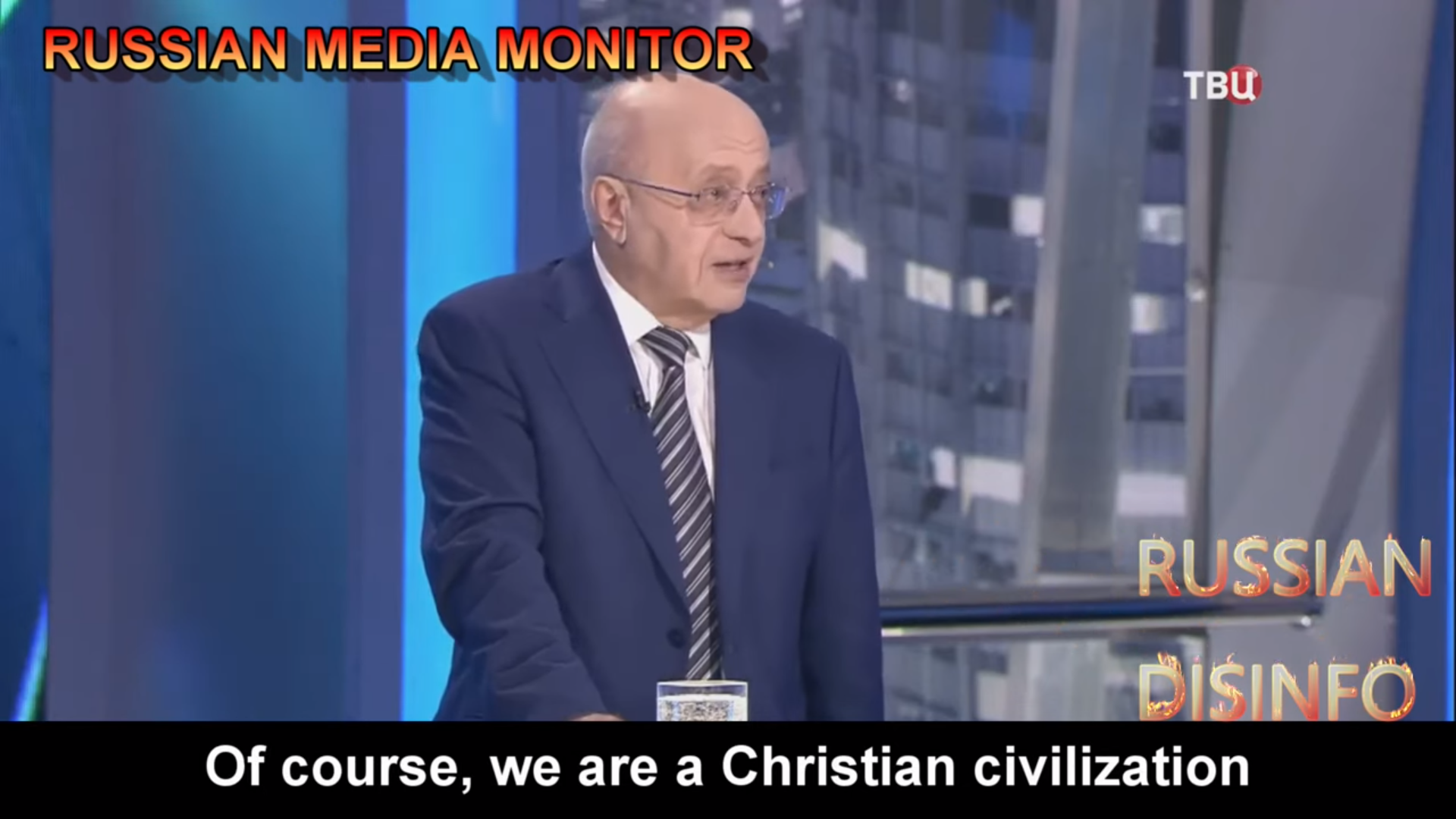
The state of Russia claims to be the last line of defense for Christian civilization. Before it became a compliant government chaplaincy, the ancient Russian Orthodox Church differentiated itself from western Christianity by its so-called capacity for mercy

In both cases, the leaders ought to be made to tremble, and many of their people will have to answer for their meek conformity. (Do some of us also fit this description?)

So, we ourselves ought to be quaking, and warning others to quake at the word of God—while seeking with passion and creativity to make actual contact with those we want to reach instead of just self-indulgently preaching to the wind.

Now, what about that word that early Quakers loaded with so much affection: Friend? It seems to me that the more people we can evangelize and bring into loving communities of Friends, the fewer will remain to conduct war. I'm not joking: each new person who experiences the power of God to form communities that do not depend on coercion, wealth, or social distinction, but on God's grace, is one person closer to tipping the balance. Our affection for each other is an internal and an external witness: there is another way to live. 

We Quakers are of course far from being the only Christians who have a heritage of nonviolence and mutual love. It's not a competition—as in the days of the New Call to Peacemaking, let's encourage and support each other. Let's keep building ties to other faith communities who are also refusing to support governments and cultures dependent on violence. The affection represented by the word "friend" does not depend on whether we capitalize it.


As I showed last week, almost three-quarters of the survey respondents said they use both terms, Friend and Quaker. Here's how some responded to the follow-up question about what occasions or contexts their choice depends upon. Most of these responses (as well as the ones I didn't quote) seem to be in broad agreement.

I prefer “Friend” if it will be understood by everyone being spoken to. “Quaker” if that is clearer because some people might not recognize “Friend” as an address.

I use them relatively interchangeably. Personally, I would probably lean towards "Quaker" because I think it's more distinctive. In Evangelical Friends contexts (where I currently am most of the time) I will mix in "Friend" more since that a part of the official idiom, but I am still comfortable using "Quaker."

I use Friends in the description of my church and when pressed to ask what that means I say we are a Quaker church, because there is some knowledge of what that means but most people I have encountered are not aware of what "Friends" means as a denomination or movement.

Who I’m speaking to—Quaker has more ‘brand recognition’ for people who may not know much about us; Friend is friendlier to people I know are fFriends! (unless it’s being used as a form of admonishment!). (Notice the double fF—I've seen others use a similar device.) 

Both are interchangeable for me, but I'm more likely to use 'Friend' with people that are more Christ-centered theologically and 'Quaker' with Liberals.

On the blog post itself, Kevin Camp commented as follows:

The term "Friend" seems convivial and affectionate to me. I've applied it to others with whom I regularly worship and have fond feelings. Most people I have encountered outside of the Society of Friends know us as "Quakers" first and foremost. 

I don't prefer one over the other. Sometimes I use them interchangably.


I asked whether respondents used church or meeting in referring to their current congregation. Almost 62% said meeting and 23.5% said both; it depends. (Note: I'm dividing up 34 respondents in total for this question, so I can't claim scientific precision among all English-speaking Friends!) About 12% said church. Some of the reasons for their choices seem parallel to the responses for the Quaker/Friend choices. Examples of the responses:

Church: I'd like to use "meeting" more instead of "church," but I think this could just be weird and counterproductive to most of my fellow congregants.

Church: I prefer "church" because it marks us as a Christian body and is less sectarian.

Meeting: The word "meeting covers so many things, I do not know where to start: the act of meeting God; the act of meeting Friends; the collection of people who make up a meeting; the session in which worship takes place; the session in which business is conducted; etc. I suppose the words "congregation" or "assembly" could be used in some of these ways, but they come to mind less often.

This same Friend made another interesting observation in the "here's a place to comment..." section of the survey:

The individuals in my conservative meeting who at least part of the time use the word "church" are people whose families have been Friends for hundreds of years and tend to see the meeting as another religious group such as the Methodists or Baptists. Those who have made a break with other denominations are more consistent in saying "meeting".

Meeting: Church carries too much negative baggage for many people (in UK).

It depends: I generally say "my Quaker Meeting" when speaking about something where the phrase "my church" would be appropriate. I learned not to say just "my meeting" when I found out that a co-worker thought I was a very open alcoholic talking about my AA meeting!

It depends: I attend both Friends churches and Quaker meetings. But for me personally the word 'Church' refers to the congregation and not the church building.


There were several other interesting mini-essays that I plan to quote next week, but my main focus in part three will be responses from people who are not now Friends.

If you would like a spreadsheet with all the questions and responses (slightly anonymized where needed), write to me at johan@canyoubelieve.me.


Last week I linked to an article on the New Apostolic Reformation. Martin Kelley commented with another link to illustrate that "some of the New Apostolic folks have this bizzarro obsession with William Penn and use him to justify their Christian nationalism." Here's the link he provided: www.motherjones.com/politics/2023/08/abby-abildness-lobbyist/.

This brought back memories of the Bicentennial Conference on Religious Liberty, held in April 1976 at Arch Street Meetinghouse in Philadelphia. I had come down from Ottawa to serve on the Friendly Presence nonviolent security team for the conference. One of the security factors we were briefed on was the presence of the famous fundamentalist leader Rev. Carl McIntire and his supporters, who planned to (and did) picket this conference. Part of their message was that modern Quakers had betrayed the spiritual legacy of William Penn.

Alireza Doostdar on witnessing genocide—and specifically the self-giving of journalists.

It is difficult to square this hopeless situation with the radical hope required to continue the deadly work of journalism in an unfolding genocide. There is an excess, a surplus, in the hopefulness and urgency of Dahdouh and his colleagues’ daily reporting that cannot be explained through our ordinary secular sensibilities. The only way to account for this surplus, I think, is through faith: the journalists’ conviction that even if their witnessing does not stop the war, even if it does not end the genocide, even if it does not liberate Palestine, it is worth doing—on pain of death—as an act of shahāda, truthful witnessing before God and humanity.

And Joshua Frank on making Gaza unliveable.

When someone reports experiencing abusive religion, here's what not to say.

Elder chaplain Greg Morgan encounters loneliness, and responds.

On the way to movie screens, a "less mean" Mean Girls—and critics have mixed reactions. (There's a potential plot spoiler in this BBC article.) Back in 2007, as I reported here, I showed the first Mean Girls film to my American studies class in Elektrostal, Russia, observing that the campus depicted in the film was based on my own high school. After we viewed the film, we listed all the features of high school life that they saw in the film, and then in a second column, features of their own high school experiences. It was interesting that there were more similarities than differences.


Speaking of being scorned, here is a meditation on "I've Been Buked and I've Been Scorned (You're Going to Need Somebody on your Bond)." The audio-only YouTube link at the end of the article is also below, featuring Lightnin' Hopkins, Sonny Terry, Brownie McGhee, Big Joe Williams, and Jimmy Bond.

"Yeah, you're going to need him."

18 May 2023

Canceling Russia

Dmitri Bykov, interviewed on "To Be Continued" (Youtube).
Screenshot; 
source; originally used on this post from last July.
Sergey Kurginyan. Screenshot from source.

It is clear that Russia crossed many red lines.... The world will no longer see [in Russia] a place of spirituality, a place of great culture, a place representing victory over fascism.

— Dmitri Bykov, Russian literary critic and commentator.

Russia is the savior of humanity. It is a totally messianic country.

— Sergey Kurginyan, Russian politician and founder of Essence of Time.


A couple of days ago, Masha Gessen resigned as a vice president and trustee of the organization PEN America. The reasons for their resignation have been widely reported:

It may seem to some observers that coverage of this incident is very Russian-centric. What made headlines, after all, was not the Ukrainian participation in the PEN America event, but the response of a prominent Russian American writer. Whether or not that's fair, I see this whole affair as an example of what Dmitri Bykov predicted following the revelations of what happened in Bucha, Ukraine, under Russian occupation. "The world will no longer see [in Russia] a place of spirituality, a place of great culture, a place representing victory over fascism."

The rejection of even long-standing ties with Russia, Russian language, Russian culture, among the people of Ukraine and beyond, has been documented many times over these painful months. It's a complicated rejection; Ukrainians themselves differ on whether it is still possible to relate to "good Russians" when they and their children are under attack by a nation that officially denies Ukraine's right to exist.

I cannot possibly know every nuance of those complications. I've spent 54 years of my life studying Russia, its language, history, culture, and politics. Almost twenty percent of that time I lived in a Russian city with practically no Western expatriate presence. I cannot deny my common humanity with the people among whom I lived and worked, regardless of the powers and principalities and systems that tried to hold us all in bondage.

Postsurgery, a week ago and today.
Now that I am back in the USA, still in frequent contact with many I knew in our Russian home, I find that I cannot withhold my care and friendship in this crisis—especially from those who feel utterly without voice or recourse, as well as those who have made their own stand for peace as clear as they could. However, I also understand the anger and frustration of observers (including many Russians!) who decry the moral captivity and passivity they see. Why does only a small fraction of the population rise up and resist?

This isn't a rhetorical question. There are actual answers. I will not lay down my urgent curiosity about how a nation, any nation, can combine extraordinary achievements of culture and spirituality with a capacity for cruelty on a mass scale, generation after generation. Russia is by no means unique in combining these features; they are part of the variety of the ways we humans cope with our demons, and how we collaborate with and hide from our Creator. In trying to thread through the specific war-related dilemmas facing all those who love Russia and (or) love Ukraine, I'm sure that I'll make awkward mistakes. I hope that I can err on the side of grace, not harsh judgment, whatever the provocation.

And if I can't do anything else, I'll grieve daily for all the relationships ruptured by this cruel war.


A few related posts: To Russia with love; Russia: beautiful future or dead end?; Ukraine and the dilemmas of pacifism.


Public Orthodoxy: Lidiya Lozova writes on the application of nonviolence, as some in the Orthodox Church understand it, to the present war.

However, when the same close-to-pacifist rhetoric of non-violence and peace, with very little attention to the question of defense, is addressed to the reality of Ukraine now, to me (and many Ukrainians) it feels somewhat uncomfortable and even painful—just as it does when people think that Ukrainians should easily find common language with anti-war Russians.

Masha Gessen on the arrests of Zhenya Berkovich and Svetlana Petriychuk:

For the first time in the post-Soviet era, Russia has explicitly arrested people for creating art. They are not charged with high treason, like Kara-Murza, or espionage, like Gershkovich, or “discrediting the armed forces” or “spreading false information about the special military operation”—the charges created to punish journalists for covering the war—or for “hooliganism,” as the protest group Pussy Riot was, but for the content of a play they wrote and staged. And also, of course, in Berkovich’s case, for acting as though she could keep expressing her thoughts and feelings out in the open. On the other hand, even as I write this, I understand that the novelty is subtle, if it exists at all: parsing the distinctions in how the Putin regime eradicates difference is a fool’s errand.

Traitors and Heroes: Nina Belyaeva's protest on
the floor of the Voronezh city council. Screenshot.
I recommend this BBC documentary on life in Russia today: Traitors and Heroes.

Jeremy Morris on cultural activity (theaters, orchestras, and other cultural production) in Russia's regional capitals as activism in today's Russia.

Beth Allison Barr on Hebrews 11:1-12:2 ... and why she almost turned down the opportunity to preach.

Nathan Perrin, the Friendly Mennonite. (With thanks to Martin Kelley for the link.)

Nancy Thomas experiences Mother's Day, and remembers, among other things, the beauty of her mother's hands.


The Blues Preachers with their version of "You're Going to Need Somebody on your Bond."

02 February 2023

The Gospel according to Al Sharpton

(Al Sharpton, part one)

Source.  

One of the things ... that I’ve always had to deal with is, critics would say, “All Al Sharpton wants is publicity.” Well, that’s exactly what I want. Because nobody calls me to keep a secret. — Rev. Al Sharpton, 2020 (from the 2022 film Loudmouth).

Before the summer of 2004, as I hinted in my 2004 post about Al Sharpton, my impressions of him as a preacher and public figure reflected what those critics were saying. Probably most (but not all) of those critics were White people, perhaps feeling the heat of his rhetoric. Until Sharpton's speech to the 2004 Democratic National Convention, I think I lazily assumed that this conventional criticism was more or less correct.

Yesterday, I watched much of Tyre Nichols's funeral in Memphis. It made a deep impression on me for a number of reasons: It was the expression of a community's grief over a full-on tragedy. Its cultural context was the Black church in the USA, with all the modes of expression available in this culture. (It was also a political event, with speakers giving explicit support for the George Floyd Justice in Policing Act, which seemed utterly appropriate in that setting and in that situation.) But what kept me from feeling an outsider/voyeur was that the funeral was, above all, a Christian celebration of life and faith.

Therefore, I listened to Al Sharpton's eulogy as a fellow minister. I wanted to follow his spiritual and scriptural grounding as well as his words of comfort to Tyre's family (and relatives of others killed by police actions, also in attendance), the connections he made with Memphis history and Martin Luther King, and, finally, his prophetic message yesterday to all his audiences.

Three central themes emerged in his sermon, all tied to Genesis 37, the story of Joseph left by his brothers to die in the pit: 

First, the sacrifices made by King and others to end segregation in Memphis law enforcement and politics, and the betrayal of those sacrifices by the police who fatally wounded Tyre Nichols;

Second, the desire of Tyre, of George Floyd, of perhaps all of us to "go home," to be back in our mothers' care, to be safe, to question the forces that make us unsafe;

Third, the perspective of Martin Luther King's last speech in Memphis, April 3, 1968, when King said he had been to the mountain top. Sharpton called us all to be mountain climbers. "Don't stop 'til we get to the top."


Yesterday's funeral, and Al Sharpton's eulogy, reminded me that I'd heard about a recent film about Al Sharpton. I downloaded and watched it today: Loudmouth.

All the preacher does is take biblical stories and use the story to therefore get to the moral message, or the ethical message they’re projecting. I transfer that into social justice, whether it is Michael Griffith being killed in Howard Beach, or whether it’s somebody choked to death by a cop in Staten Island years later, Eric Garner. It is the story, but the issue is racial violence. But you need the story to make the issue live. — Rev. Al Sharpton, 2022 (from Loudmouth)

As critics have pointed out, Loudmouth is not a journalistic documentary. It makes no claim to be objective. I would call it a video memoir, with lots of archival footage from Sharpton's emergence as a teenage youth leader through George Floyd's funeral and a bit beyond. Woven into the historical segments are commentaries from Sharpton, which he delivers directly into the camera for this film, and which form the framework of the film.

Tom Snyder (Tomorrow Coast to Coast, 1981): Are you in any way predicting a long hot summer? You’re not predicting urban strife, you’re not predicting disorder, anything like that?

Al Sharpton: Well, what I’m saying is, you know, at home you have an oven. There are flames on top of the oven, and there’s heat in the oven. We always discuss whether there’d be a flame on the top, and don’t discuss that it’s already 600 degrees inside. 

The film is undeniably a setup for a positive presentation by Sharpton of his own legacy as an activist, and doesn't pretend to inventory all his pluses and minuses as a human being, minister, or celebrity. There's a brief confrontation with a critic who points out his wealthy lifestyle, to which he replies that he and his movement worked hard to open up access to those things. The film does pay significant attention to the Tawana Brawley controversy, and in a comment to the camera he addresses the controversy directly, if (to my mind) very incompletely.

Another important point of self-revelation was the contrast between his early rhetoric and the course he followed after getting some important advice from Coretta Scott King, Martin Luther King's widow. As he tells the camera, she said:

“Al, do you realize that words have power? So you ought to be careful with that.” She says, “You can either go for the crown” (that we talk about in Christianity) “or you can go for the crowd.” 

However much he softened his rhetoric, some things did not change.

The question that I always hear from Whites: “Reverend Al, why do you make everything about race?” And the Black question that’s just as troubling is: “Why are you doing that? Ain’t nothing going to change.” It’s somewhere between these two questions that I’ve had to do a lot of my work in activism … to explain to Whites that every Black born in America is born into “it’s all about race.” (2022)

That things do change is part of Sharpton's testimony in the aftermath of the killing of George Floyd:

But I’m more hopeful today than ever. Why? Well, let me go back—Reverend Jackson always taught me, “stay on your text.” Going back to my text, Ecclesiastes. There is a time and a season. And when I looked this time and saw marches where in some cases Whites outnumbered the Blacks marching, I know that it’s a different time and a different season. When I looked and saw people in Germany marching for George Floyd, it’s a different time and a different season. When they went in front of the Parliament in London, England, and said it’s a different time and a different season, we need to go back to Washington and stand up in the shadows of Lincoln, and tell them, this is the time of building accountability in the criminal justice system. (2020)

Yesterday, Sharpton told the mourners at Tyre Nichols's funeral to keep climbing the mountain, as he himself intends to do. At the end of Loudmouth, he thinks about what he will have left behind when he reaches the end of his own path on earth.

… And when I see my mentors in Heaven, I can tell them, I got some stuff done.

After nearly six decades of activism, Rev. Al Sharpton has lots of admirers, and also many critics. The comments on the YouTube page with the trailer for Loudmouth include a sampling of typical reactions to this divisive figure. The Internet has an ample stash of harsh criticisms of Sharpton, some of them probably justified, but I see Loudmouth as a fascinating, coherent, very worthwhile presentation of his own side of the ledger—in the context of a country where racism, though weakened, remains embedded as a satanic stronghold. As a Christian minister in the Quaker tradition, struggling to reach the mountain top, I see Sharpton—with all his complications—as a mutual ally. His errors and excesses may be partly his own, but (for example, in the Brawley case), I see them also as an aspect of the smoke and chaos that racism continues to generate, that obscures the view and frustrates the designs of activists and observers alike. I'd rather have imperfect prophets than none at all.

Those that oppress us had the nerve to try and advise us on how we ought to try to get free from them. We are intelligent enough not to let you tell us what tactics that you are comfortable with…. (1986)

Related: Here on YouTube is the interview Tom Snyder did in 1981 with Rev. Al Sharpton, Muhammad Ali, and James Brown, from which Loudmouth took the clip about the 600-degree oven.

Melissa Harris-Perry interviews Al Sharpton and Loudmouth director Josh Alexander.

... And Ed Pilkington (of The Guardian) interviews Al Sharpton about the (then) upcoming film.


More sad and difficult revelations about abuses connected to Jean Vanier and the cult he participated in. Today's L’Arche movement as a whole seems not to have been compromised.

Yet another venerable human rights institution in Russia may be falling victim to repression. The Sakharov Center, already designated a "foreign agent," has been asked to vacate its premises.

John Kinney's take on the parable of the talents.

Greg Morgan on dying and unfinished business.


Mavis Staples with Rick Holmstrom's band: "I'll Take You There."

28 July 2022

Neutrality revisited

The Middle East Dialogue Quilt at Ramallah Friends Meeting, Palestine.

Dialogue Quilt Description:

In 2006, Jimmy Carter may have been the first prominent American politician to use the word apartheid in connection with Israel's relationship with Palestinians. He faced accusations of antisemitism and was criticized for supposedly abandoning the neutrality he displayed by hosting the Camp David negotiations in 1978.

Since then, this word, apartheid, has often been regarded as an incendiary charge intended to attack Israel. Is this fair? Mark Braverman of Kairos USA defends the term in its literal and legal meanings, and says that its importance goes beyond the particular case of Israel.

The argument extends beyond the case of Palestine. To denounce apartheid affirms Palestinian experience and motivates the international community to explore, embrace and strengthen the framework of international law in a time when it is being eroded though systems of racism, authoritarianism, and other oppressions based on economic, patriarchal, political, and military power—including antisemitism.

Braverman's article marks the publication of A Dossier on Israeli Apartheid, which seeks to reinforce the use of that word as technically and theologically appropriate to the Israeli/Palestinian case. The "dossier" then goes on to confront the various reasons that churches (and here I would include Friends) give for not actively opposing Israel's apartheid policies. It's an effective list; I've heard many of these excuses myself over the years.

Perhaps the most frequent excuses for not participating in Palestinians' search for justice can be grouped under the heading of "preserving neutrality." Here's what the dossier says about neutrality:

How will your church, council, conference, region or synod respond? The biblical answer is clear. The theological answer is clear. Neutrality is not a faithful response. Denying or ignoring the reality of Israel as an Apartheid State according to the definitions of international law and ethical discernment is not a faithful response. Complicity with a situation of systemic oppression in the name of interfaith solidarity is not a faithful response. Theological and or biblical justification of oppression and injustice is both sin and heresy.

One of the reasons that some Christians have been reluctant to abandon neutrality is the cost in relationships. The Kairos dossier frankly admits this risk:

“Burns bridges and stops dialogue with partners”

It’s true. By taking a clearly expressed stand against systemic injustice, bridges will be burned. Treasured ecumenical and interfaith relations may be broken, especially with those who benefit from the status quo. But to seek to be more “diplomatic,” to seek conciliatory approaches in a situation grounded in asymmetrical power imposed economically and militarily, is to avoid the harsh reality of Palestinians. We can expect that taking a prophetic stance will be disruptive to the dynamic of traditional dialogues. Yet, it is faithful: “Justice, and only justice, you shall pursue… (Deuteronomy 16:20).” Churches are called to trust, in times like this, that new dialogue partners will emerge, that former partners may be fruitfully challenged, and that conversations—rooted in truth, compassion, humility and integrity—will realize the promise in Psalm 85:10 “Steadfast love and faithfulness will meet; righteousness and peace will kiss each other.”

I very much appreciate this paragraph, especially the prospect of fruitfully challenging former partners.  Some aspects of neutrality would have to be abandoned as we acknowledge asymmetrical power and the asymmetrical suffering that results; but other principles of neutrality would not be abandoned. For me, those continuing principles would include:

  • No objectification or demonization of those whom we disagree with; no flattery or romanticizing of those whose just cause we seek to advance; no assertions that anyone involved is without flaw;
  • No use of inflammatory rhetoric whose main utility is to gratify those on "our side" rather than advance justice and genuine dialogue;
  • A recognition that the deeper context of any conflict may involve principalities and powers that seek to dominate both sides. Antisemitism has been—and continues to be—a blot on human history. What would happen if the forces opposing antisemitism and the forces opposing all apartheid everywhere joined hands?

It has been fifteen years since Jimmy Carter tried to use the term apartheid to break open the stalled conversations on justice in the Israeli/Palestinian context. Could the Kairos dossier help us make new efforts?


In 2009, I published these two posts on Quakers and neutrality. I'm linking them here rather than repeating all the points that came up at the time.... 

Please tell me what you think, in the comment window below, or on Facebook or Twitter. I hope that we can distinguish the features of genuine neutrality that are worth guarding, and learn when faithfulness is more important than neutrality. Also: how do you feel about the Kairos document?

Finally: Three years ago this summer, I was preparing for my September departure to serve with Christian Peacemaker Teams in Hebron, Palestine. Here's a summary: Praying without ceasing in Hebron. And here's how Ramallah Friends Meeting—and a pair of kittens—helped me keep my balance.


Elena Marttila; source.
Jennifer Wilson on Alexander Pushkin, "the first Russian."

Being Black mattered to Pushkin—his own words attest to it. As another contributor, the Pushkin scholar David M. Bethea, put it: “Blackness was for Pushkin both something real, given (he cared about surfaces), and something styled, something to be worked with.”

Ira Rifkin on his seven years with the GetReligion project.

Viktor Orban and more evidence on the spreading popularity of christian nationalism and its variants. This relatively "neutral" Web site, RFE/RL, doesn't mention Orban's popularity among some in the USA's right wing. (PS: Orban is still coming to Texas. Dana Milbank on Orban's "true colors.")

A closed poll measures Russians' views of the war.

Artist Elena Marttila, eternal memory.


Here's a fascinating (to me, at any rate) time capsule gem, 27 minutes of The Johnny Otis Show from 1959, with wonderful performances by Lionel Hampton among others. I remember when television looked like this; even the cheesy ads felt familiar.

03 March 2022

Information

"Dear viewers, we will not let you down." Source.
"It's not the end. It's just the end of Season One."
"As they say, the last one who leaves turns out the lights."

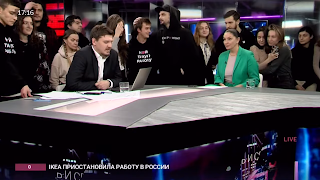
This evening, Moscow time, Natalya Sindeyeva and her team at Russia's "optimistic channel," Dozhd' (Rain) suspended its work and went into hibernation after a final, very emotional goodbye broadcast. I defy anyone to watch this program (in Russian, or through the auto-generated subtitles in your language) without tears.

Among those who spoke at this final broadcast was Vera Krichevskaya, co-founder of Dozhd' with Sindeyeva and director of the new film F@ck This Job (based on the history of Dozhd'). She summed up in three sentences why the channel had to stop: "In the last several days, the Russian Federation adopted new laws. These laws obligate us to tell falsehoods. If we have to choose between telling falsehoods and temporarily turning off our signal, we choose to turn it off...."

I have been a Dozhd' viewer and subscriber practically from its beginning. My current subscription supposedly runs for another 632 days. I've even gotten used to the legally required disclaimer, in big letters, that for the last half-year has described the channel as a "foreign agent."

Among the new laws and regulations are a requirement that all statements about the "special operation" launched in Ukraine last week must come from the Russian military, and that the word "war" must not be used. All words and images that the government designates "fake" are outlawed on threat of fifteen years' imprisonment.  This is a dramatic escalation of a process that began with the new century and its new Russian president, gradually squeezing the air out of Russia's independent mass media and causing an impressive stream of Russian journalists and commentators to flee the country, including Dozhd's own editor-in-chief Tikhon Dzyadko just yesterday. Almost every prominent independent voice in Russia's mass media has now been driven off its normal channels, forced to use such platforms as Youtube, Twitter, Telegram, and Instagram, which themselves, to varying degrees, are under threat of suppression.

I remember sitting in our car back in Richmond, Indiana, around 1987, listening to the news, when I heard a startling story: The USSR's KGB had come in for public criticism in the Soviet press. I was genuinely amazed; this was my first concrete evidence that Gorbachev's policy of glasnost' (transparency; openness) was real. When I began my regular visits to Russia a few years later, the difference in journalistic freedom was evident everywhere I looked. (Here's a sample.) That era has emphatically come to an end.

President Putin has claimed that all media worldwide dance to the tune that the pipers (those who finance the media) are playing, so why point the finger at Russia? Of course there is a lot of truth in this, but he was not arguing for a reform of this reality. He was simply deflecting the attention being paid to the fresh waves of repression in Russia. Rather than do a case-by-case comparison of the reality in Russia with the reality elsewhere, I think it is fair to compare today's reality in Russia to the era of glasnost', to 2000, or even to 2014.

Of course there are many informal channels of information that operate in Russia, as everywhere else. Frank face-to-face conversations, especially in kitchens, went on even during Stalin's repressions. We had plenty of those conversations in our own kitchen in Elektrostal! Telephones and the Internet serve ordinary people as before, subject to the constant awareness that someone might be listening or recording us. The government cannot suppress all individual dissent; its main priority is to suppress effective mass dissent. Those who post or repost anti-war or anti-leadership texts and memes within their own social-network circles will usually get away with it; the government will arrest a few to discourage the rest, but most of the repression is reserved for those the authorities believe have wider influence. 

UPDATE: It looks like more people are getting police attention for signing petitions, so my optimistic comment that most protesters "will usually get away with it" may now be out of date.

No mass media or Internet channel delivers a perfect stream of pure information -- defined as objective facts or fact-based recommendations that any member of the audience can rely on to make judgments and decisions. For me, there is another form of valid information: finding out what others believe to be facts, and what they believe to be persuasive arguments, along with enough context that I can make my own evaluation of those assertions. I want to hear the Russian government officials' points of view. I want to hear their opponents' points of view, and the evidence of ordinary people who must endure the consequences of all those decisions.

For example, these days I'm following news from Ukraine on a variety of channels on Telegram. Much of what I hear seems unlikely to be the whole picture, and most of it is obviously intended to influence rather than simply inform me. Often the various channels are simply quoting each other rather than each delivering fresh news from their own sources. However, taken cumulatively, I can form a reasonable, if tentative, impression of what's going on -- good enough to help shape my prayers.

There's also another form of information that is extremely valuable to me: what are the relationships and interdependencies among all these actors? Who treats whom with kindness or cruelty? Who keeps their promises, who breaks them, and what are the consequences? I want the evidence of these relationships and interdependencies to be sufficiently visible for me that I can consider how to fulfill my own obligations as a citizen of the world and of the Kingdom of God.

In any case, I believe I can tell the difference between "information" and "instruction." Russia's leaders have chosen the latter. Hence the very sad reality of today's last (for now) studio program from Dozhd'.


Update: Here's the Washington Post's summary of the media situation in Russia.

(Also see this post from July 2022, in which Dozhd' returns to the air—but in exile.)


Source: Ebay.  

When I was growing up, our family had a shortwave radio, a Hallicrafters S-120 receiver, which my sister Ellen and I listened to frequently, trying our best to search out faraway stations with unfamiliar languages and accents. We knew that, during World War II, my father's family had a radio that they used (at great risk of discovery by the German occupiers of Norway) to hear what was going on beyond the Nazi curtain. 

I was a shortwave radio user right up until the early 1990's. Toward the end I had a small shortwave receiver that I used to carry around the streets of Richmond, Indiana, and Wilmington, Ohio, listening to the BBC World Service through earphones on my evening walks. That's how I followed the day-to-day drama of the end of the Soviet era and the birth of today's Russia.

For all but the community of shortwave enthusiasts, the Internet has replaced radio as a way to listen to faraway broadcasters. If the Internet ends up, in some places, becoming a gated resource for those who prefer to instruct and control rather than inform, I wonder whether we'll see a rebirth of shortwave.


Do you remember ambassador Marie Yovanovitch? David Remnick interviews her.

Sergei Chapnin on Russian Orthodox Patriarch Kirill and Vladimir Putin's "two wars."

Tomorrow, March 4, is the World Day of Prayer. Many years ago, I participated in planning an ecumenical service for this occasion. I was one of the two Quakers, and the only male, in this group in Ottawa. I was delighted to see an article by British Quaker Stephanie Grant, who wrote for this year's event.

Micah Bales on seeing the face of Christ.

Roger E. Olson on becoming Anabaptist.


Eric Bibb and Michael Jerome Browne, "Needed Time."

I'm down on my bended knees....

24 February 2022

On regarding Russia "vs" Ukraine; first principles

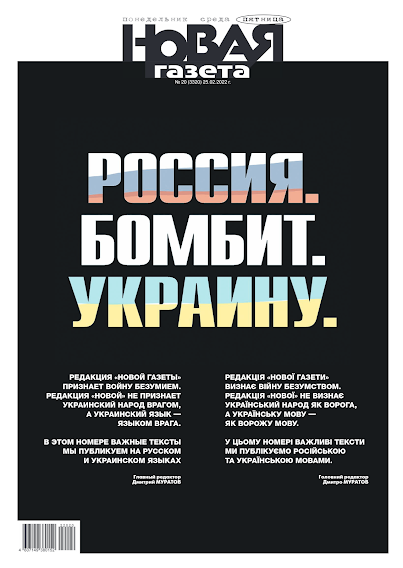
"RUSSIA. BOMBS. UKRAINE.
"The editors of Novaya gazeta consider the war insane. The editors of Novaya do not consider the Ukrainian people as an enemy, or the Ukrainian language as an enemy language.
"In this issue, we are publishing important copy in Russian and Ukrainian." Editor-in-chief Dmitri MURATOV. Source.

For most of the last 24 hours I have been keeping an Internet vigil using livecams in Kyiv and near Kharkiv. Right now morning is arriving in Kyiv, and the birds are loud! Every few minutes there are explosions. When I hear the sound of airplanes I assume that they are almost certainly Russian. A building on the Maidan square is flying the Ukrainian flag on its rooftop. I am trying to use these feeds as a prompt to pray without ceasing: let the birds continue, but let the violence stop. It helps a great deal that I remain in touch with people who are in the region and whose perspectives (among the Russians) are similar to the newspaper Novaya gazeta and who are also praying without ceasing.

Another explosion. Another.

If you are reading this blog, you certainly have as much access as I do to sources of information on what is going on in Ukraine, and on the scramble of international players to adopt positions that will benefit Ukraine and themselves. Also, your predictions of short- and long-term outcomes are as good as mine. I just want to take a rest from my Internet vigil over Ukraine's cities long enough to propose a few first principles to help me stay centered in a moment where evil seems again on the march.

7:07 a.m. in Kyiv. Air raid sirens. Once again I'm reminded of Edward R. Murrow in London, even as my blood freezes, today, in 2022.


  1. Put prayer first. Let news feeds and social interactions be filtered through prayer. Let's try not to take in more than can fit through that filter.
  2. As the mind of Christ and the newspaper Novaya gazeta remind us, let's not permit others to define our enemies for us. And even if they really are enemies, we are commanded to love them, not as an exercise in self-brainwashing but through the power of prayer. In this present situation, it appears that the real configuration could be summarized, not as Russia vs Ukraine, but as Putin and a small circle around him vs Russia and Ukraine, but let's not get too fond of glib summaries!
  3. Remember to be cautious and discreet in online conversations with people on all sides of this awful conflict.  Let's balance our (and their) need for solidarity with awareness that others may be monitoring our Internet traffic, looking for evidence of treason as in the height of the previous Russian-Ukrainian conflict. Whatsapp and Telegram may be secure for most routine purposes, but not now.
  4. The information wars, combined with the normal fog of war, make it nearly impossible to rely on any commentary or any photos/videos we get from any source, including those we sympathize with. We should report and repeat facts intelligently, labeling sources and adding our own cautions. Beware of the temptation to say now that there will certainly be tens of thousands of deaths, as some commentators on the "correct" side of things (i.e., the side I usually agree with) have been saying online and in mass media. Those kinds of predictions may have rhetorical power -- massive losses are a real and awful possibility and we should warn about them passionately -- but they are not certain.
  5. As in all conflicts, let's retain some humility about our behavior as humans. All mammals, at least, seem to have behaviors that involve group identity, group mobilization, and defense of territory. Human animals are no different, even though our fancy uniforms and equipment, our mobilizations, and our defense behaviors are impressively elaborate. We don't need to be swayed overmuch by uniforms, anthems, flags, military technology, lines on maps, or stern-faced politicians telling us what our duty is. Our duty is to heed our Creator, who loved us into being, along with all those other animals, and who has been our dwelling place in all generations.
  6. I've been encouraged by how many Russians have expressed a rejection of war and a plea for peace. Let's uphold and amplify the voices of peace; don't grant those who assume the logic of power politics a monopoly of public attention.
  7. Suggest your own additions or deletions in the comments below or wherever you found this post.

Judy in Kyiv. October 2011.
Early today I saw that the Russian Quaker Web site, quakers.ru, published a commentary entitled "This morning" by Boris Fedyukin, a Friend I know through the online Russian-speaking meetings for worship. Here it is in Russian and in English.

Online meetings for worship with a concern for this war will be held under the care of Friends World Committee for Consultation this weekend, for Russian-speakers on Saturday and for English-speakers on Sunday. Information here.

Now: frequent explosions. 

According to Alexei Venediktov, Ukrainian Orthodox metropolitan Onuphry of the Orthodox Church (Moscow Patriarchate) stated,

The Ukrainian and Russian peoples came out of the baptismal font of the Dnieper. War between these peoples is a repetition of the sin of Cain, who killed his own brother out of envy. Such a war has no justification either with God or with people.

To quote Edward R. Murrow, "Good night, and good luck." To quote Jesus (emphasis mine!),

Peace I leave with you, my friends. Peace the world cannot give.

09 December 2021

Truth, reality, and peace

Please help me evaluate and improve this site! My readers' survey is here--answer as many or as few questions as you like. Thank you!


Yesterday, "irreverent billionaire" and peace advocate Yusaku Maezawa arrived at the International Space Station, together with his assistant Yozo Hirano. Source.

Last Sunday, our pastor, Matt Boswell, gave us a sermon on peace as one of the core themes of Advent. (You can hear the full sermon here.) He asked us to distinguish true peace from the deceptive peacefulness imposed by oppression. He read from Zechariah's prophecy in Luke 1:68-75 ... [Here I'm using the New International Version]

Praise be to the Lord, the God of Israel, because he has come to his people and redeemed them. He has raised up a horn [a strong king] of salvation for us in the house of his servant David (as he said through his holy prophets of long ago), salvation from our enemies and from the hand of all who hate us— to show mercy to our ancestors and to remember his holy covenant, the oath he swore to our father Abraham: to rescue us from the hand of our enemies, and to enable us to serve him without fear in holiness and righteousness before him all our days.

Matt then comments: "This is not a wish for a salvation from reality but a salvation of reality."

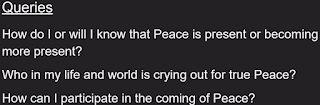
Last Sunday's queries.
At Camas Friends Church our sermons often end with a set of queries. The query that struck me this time was "How can I participate in the coming of Peace?" Here are some reflections that came to me since Sunday. 

Before I go further: I would love for you to add to or improve this list. I have been asked to speak on peace at Spokane Friends Meeting next month, and I need all the help I can get.

Another slide from last Sunday.
Living in truth and reality. Years ago, I was given the advice to "live in truth and reality." The person who said this to me wasn't making some abstract philosophical distinction between "truth" and "reality"; she was saying that I should be aware of the actual situation around me, using criteria I myself claimed to believe in; and be aware of my own participation and impact in that situation. If I am seemingly at peace because I'm insulated from the world's pain by affluence and privilege, or because I have become numb to the conflicts and griefs within me, or because I am trying to rationalize the fleeting ecstasies of an addiction, can I really call that peace?

Disarming the enemies of my soul. Whatever is telling me that I'm unloveable, that my many mistakes are irredeemable, or that I am an imposter -- those demons must be shown the door. Illusions of grandiosity, the sense that everything depends on me -- they too must go. You and I have the authority to order them out.

Many of us oscillate between these states -- between imposter syndrome and indispensability, or between a sense of helplessness and a determination to be in control, but we are all entitled to a balanced sense of healthy personal authority and mutual accountability to our community. 

(We're also entitled to ask for help when we lose that confidence! Sooner or later our help will be needed by someone else; healthy confidence is shared confidence.)

Giving Caesar what's Caesar's. We are to give God what is God's and Caesar what is Caesars; and these guidelines are not necessarily in conflict. Paying taxes so that our Caesars can keep their promises to us is completely acceptable. (To make things more interesting, in the so-called democracies, we are supposed to be Caesar. To retreat into cynical passivity is an abdication of office.)

Caesar, unfortunately, often steps over the line and wants to tell us who our enemies are and what cruelties we should inflict on them, whereas Jesus has told us to love our enemies and pray for those who persecute us. News flash: Jesus outranks Caesar. We are always entitled to evaluate the authorities' definitions of "enemy," "alien," "patriot," and every other term in the propagandist's playbook.

Giving God what is God's. The meaning of this is deceptively simple. Caesar is entitled to my participation in the stewardship and mutual care of our communities -- locally, nationally, and internationally. But only God is entitled to me. This is why I try to center myself constantly with the short prayer "I want to dwell in You," because I know from long experience that this is where I find peace. But I'm not going to lie; there are days when even this simple prayer is a challenge to remember.

Being available to others seeking and finding peace. In a blog post on short prayers, I described how I posted the prayer of St. Francis ("Make me an instrument of your peace...") on my workstation at the Western Electric telephone factory. I would like to think that some of the conversations it provoked had an encouraging effect, although most of my fellow workers seemed either a bit puzzled or indifferent. Since then I've often looked for the company of others who work for peace, or want to do so -- but I couldn't do that if nobody revealed this interest to the world. Let people know that you care about peace, and, together, let's take some territory away from the spirits of violence and cynicism.


Related: my "evangelism and the Quaker testimonies" project, Woodbrooke Quaker Study Center, 2003-04; and Signs, part three.

José Santos Woss: Who are violence interrupters, what do they do, how are they funded?

Toward living in truth: peace and the vital role of journalism. Nobel Peace Prize ceremony is a few hours away.

Journalism's vital role extends to the religion beat, as two journalists demonstrate.

Randy Woodley: the mutual influences of indigenous heritage and Christian identity.

Have I mentioned that I'd love to have your feedback on my readers' survey?


John Lee Hooker and Ry Cooder on the BBC, 1992.