Showing posts with label mideast. Show all posts

19 March 2026

Bewildered and confounded

Sarah and James Polk; Donald Trump
Sources: left, right.

He is a bewildered, confounded, and miserably perplexed man.

—Congressman Abraham Lincoln on President James K. Polk.

Unlike the 2026-? war with Iran, the Mexican-American War (1846-48) actually included a U.S. congressional declaration of war, but one that was arguably obtained under false pretenses. Essentially, the U.S. army had to lure Mexican soldiers into a fight in order to obtain a pretext for war. 

Abraham Lincoln consistently opposed this war, and he bluntly gave his reasons in, among other occasions, this powerful speech in the House of Representatives in January 1848.

His arguments seem to me to apply pretty well to the war that we and Israel are in now, against Iran. The war with Mexico was an unconstitutional war, based on fiction; it was supposed to be a short war; the supposed gains of the war should have outweighed the losses in combat, but didn't; in any event, the object was to steal from Mexico, which Lincoln judged an offense to the honor of the USA. Lincoln memorably referred to the way that war's romantic propaganda distracts from the shameful reality: ...

... [Polk aims] to involve the two countries in a war, and trusting to escape scrutiny, by fixing the public gaze upon the exceeding brightness of military glory—that attractive rainbow that rises in showers of blood—that serpent’s eye that charms to destroy, he plunged into it, and has swept, on and on, till, disappointed in his calculation of the ease with which Mexico might be subdued, he now finds himself, he knows not where.

I do my fair share of following war news on the Internet. So much of the coverage features analysts and commentators doing their best to make sense of an insane war. I see them sitting behind impressive desks or standing in front of charts and digital displays covering whole walls, but mostly what they are doing is trying to guess what this or that inarticulate soundbite might mean.

The reality, which they are not really equipped to analyze in terms of dignified commentary is this: the war was initiated by two corrupt men, one of whom is a completely rogue U.S. president. The news programs are reduced to providing us endless scenes of smoke rising from the impacts of missiles, drones, and the remains of midair interceptions, punctuated by excerpts from bombastic, factually irrelevant statements and press conferences. Donald Trump's contribution to this scene is his constant referral to himself. Everything is about him and what he feels in his bones. Even Stalin pretended to be answerable to structures and committees! This is not a scene that lends itself to rational commentary, but those analysts have jobs to do, cameras pointing at them, and three minutes and fifteen seconds to fill before it's the next well-meaning analyst's turn.

And they're certainly not entirely useless. Today I heard Jon Stewart say, "War is how Americans learn about geography."

I appreciated Anne Applebaum's blunt description of this unprecedented dependence of a whole country, and its fateful global consequences, on an incompetent and thoroughly corrupt individual. 

Donald Trump does not think strategically. Nor does he think historically, geographically, or even rationally. He does not connect actions he takes on one day to events that occur weeks later. He does not think about how his behavior in one place will change the behavior of other people in other places.

He does not consider the wider implications of his decisions. He does not take responsibility when these decisions go wrong. Instead, he acts on whim and impulse, and when he changes his mind—when he feels new whims and new impulses—he simply lies about whatever he said or did before.

Applebaum's full article is here: Everyone but Trump Understands What He’s Done.


Back in our own communities here in the USA, are we living life as usual, or are we in one or another form of the chaos the people at the top have unleashed? Our "dual reality" was well illustrated in an illustration on Vox by cartoonist Pete Gamlen:


Sigal Samuel's accompanying article: Your friends are still acting like everything is normal in America. What do you do? She describes this dual reality in the terms proposed by a German Jewish political scientist and labor lawyer, Ernst Fraenkel, who observed the pre-WWII Germany becoming divided into a compliant, passive, and comfortable "Normative State" and its terrifying parallel "Prerogative State" under direct, arbitrary, and repressive state power. Remain passive and compliant and maybe you won't someday find yourself abruptly transferred from normalcy to repression, a transfer that is entirely at the discretion of those in power.

As Samuel's article acknowledges, we're not yet quite at that point in the USA, but that may be small comfort to Renee Nicole Good of Minneapolis, Minnesota, and her family ... and all those on the left side of Pete Gamlen's graphic.

Sigal Samuel's article ends with several suggestions of how we can avoid fatal passivity and regain connection across these divides for the sake of justice. Here are a few of mine; please add yours! As always, the best-fit involvement takes into account your own spiritual gifts, your temperament, and the mutual obligations you have with your own community.

  • Keep observing the realities around you to the best of your capacity, and don't let propaganda from any side or camp  (including your own!) do your thinking for you.
  • Send blessings and prayers to the individuals you become aware of as you follow the news. (Even though the USA's news channels tend to show Arabs as faceless masses, for example, look for the human beings as best you can, and pay attention to their credible spokespeople.)
  • Join ethically-organized and ethically-led protests. The more local protests and movements may be just as important as the mass downtown events.
  • Following the principles of evangelism with integrity (for example, "permission evangelism"), tell people about Jesus. Help differentiate his tender leadership from the misrepresentations promoted by white Christian nationalism, but do it from intimacy with the Prince of Peace rather than a sly motivation to one-up those whom you oppose.
  • Cultivate good relationships with your legislators and local media. Take wise steps to become known as a reliable source of helpful quotations for journalists.
  • Grieve with those who grieve, rejoice with those who rejoice; be kind to each other and to yourself. It's a race—an urgent one—but not a competition.

Pete Gamlen's cartoon really caught me in a deep place. Sometimes I've been feeling so far from either of the dual realities. And for some reason, around the time I found myself resisting this sense of alienation, I watched a couple of those smoking cityscape videos as Israeli bombs fell on Lebanon. I began meditating on the dead people lined up at Heaven's gate, and praying for them to be at peace.

"Rank Strangers" in our classroom in Elektrostal, Russia.

We Quakers are not known for speculating about life after death, or about what heaven is like. But I couldn't help wondering what was happening to those whose bodies and souls were being violently separated by high-tech munitions, some of which were paid for by our taxes. In this swirl of alienation and distress, I remembered a recording made by one of my favorite blues musicians, harpist Charlie Musselwhite. It was a track from his album One Night in America, "Rank Strangers to Me," originally created by the gospel writer Albert E. Brumley, Sr. It's a song we used as one of the gapfill exercises in our listening comprehension classes at the New Humanities Institute in Elektrostal.

I don't know many songs that combine grief and hope as well as this one:

I wandered alone to my home by the river
Where in youth's early dawn I was happy and free
I looked for my friends, but I never could find them
I found they were all rank strangers to me

Everybody I met seemed to be a rank stranger
No mother or dad, not a friend could I see
They knew not my name and I knew not their faces
I found they were all rank strangers to me

"They've all moved away", said the voice of a stranger
"To a beautiful home by the bright, crystal sea"
Some beautiful day, I'll meet 'em in heaven
Where no one will be a stranger to me

Everybody I met seemed to be a rank stranger
No mother or dad, not a friend could I see
They knew not my name and I knew not their faces
I found they were all rank strangers to me

05 March 2026

Convergence in the Trump era

Back when I was first interested in Russia and the Soviet Union, in my mid-teens, physicist Andrei Sakharov proposed a new twist on Marxist determinism: that, among other factors, the demands of industrial management, the rise of consumer demand, and the danger of nuclear annihilation would cause the great rival superpowers to take on each other's better traits and eventually converge. The resulting societies would feature both rational economic planning and freedom of thought.

Sakharov did not live to see much of the "end of history" phase and the idealists' disappointments in both superpower camps—both with their individual fragilities and their discontented peripheries. The year 2000 featured secret bargains, manipulations, dangerous theatrics, and general confusion in both Russia and the USA, with Vladimir Putin and George Bush ending up on top. Not exactly the convergence that Sakharov had in mind.

In both systems, the neocons (creatively defined for my purposes!) relatively quickly demanded the right to define reality for the rest of us. Putin arguably was ahead in this development, as he and his allies slowly but surely extinguished independent media and built the cult of the indispensable leader. "Putin is Russia, and Russia is Putin," proclaimed Vyacheslav Volodin, currently speaker of the State Duma, in 2014. And since that year, just in terms of government process (setting aside the ultra-nationalist intellectuals and church leaders who are his favorite influencers), Putin alone is the stubborn owner/driver of the war in Ukraine.

The USA's equivalent developments, although far less linear and absolute (we did elect two Democrats in those years), have reached the point where Donald Trump can assert to a journalist that "MAGA is Trump" and that, in starting yet another war, he faces no opposition in true MAGA.

In this Russian bookstore, someone put the Constitution
in the fantasy section. (Originally used here.)

Both of these countries' constitutions nominally have power distributed among several branches. In Russia, the legislators and judiciaries go through the motions of their jobs but, when the stakes involve the interests of those at the top, they see no point in resisting.

Our situation may be less bleak: the judiciary still displays some independence, but the president's party's majorities in both houses of the U.S. Congress mostly continue to fall in line. In the present case of Iran (and Israel and most of the Persian Gulf states), what the president wants is what he gets. Iran is, of course, just the most recent target of U.S. bombs and artillery in the past 13-1/2 months, after Somalia, Iraq, Yemen, Iran (June 2025), the Caribbean Sea and Pacific Ocean, Syria, Nigeria, and Venezuela. In almost every case, Trump gave the orders personally and did not deign to invite Congressional consent. And now he supposedly gets to decide personally who will be the next leader of Iran.

One of the lonely critical Republican voices in Congress, representative Warren Davidson of Ohio, points straight to the constitutional illegality of Trump's process, as reported in The Guardian:

Make no mistake, Iran is an enemy of the United States. As our military engages them, they do so justly. [sic] Unfortunately, they are not yet doing so constitutionally.

For some, this debate will be about whether we should even be fighting in Iran. For me, the debate is more fundamental: is the president of the United States, regardless of the person holding the office, empowered to do whatever he wants? That’s not what our constitution says.

In fact, the U.S. Constitution, and most Republicans' unwillingness to defend it, is at the heart of several of today's crises as we transition from a republican democracy to a personalist authoritarianism. Due process and equal protection of the law came into the Constitution after a terrible Civil War, but today's legislative timidity in the service of throwing out immigrants is shameful. So is the attempt to organize a permanent governing majority through federal legislation, when the Constitution makes it clear that the states are to make election rules.

In 1967, a group of anthropologists contributed papers on war at a conference of the American Anthropological Association. The resulting book, War: the Anthropology of Armed Conflict and Aggression, opened my eyes to the possibility of studying war as a human behavior just like many others, subject to the same disciplines of observation and analysis totally apart from the myths, justifications, and deference it usually gets in real life. One of the contributors proposed that societies are usually either in a "relaxed" state or a "mobilized" state, and anthropologists should study the process by which a society goes from one state to the other. A respondent pointed out that, in modern conditions, most of society can remain in a "relaxed" state while specialists conduct wars on our (supposed) behalf, often without ever seeing their opponents, not to mention the collateral damage. To me this raises a question that I hope you can help me answer: how do we mobilize, not in favor of war, but in favor of our Constitution, before our "relaxation" becomes utter and permanent passivity?

Or, as one of our Moscow friends used to say to us, ironically, "Welcome to Russia!"


Related: "The Cult of Personality and its Consequences."

Living without lying.

A special brand of patriot.

The Bible, MAGA, and a new mission field.


OK, so Kristin Du Mez has some evidence we've not all fallen into a complete stupor.

Conor Friedersdorf wants to know who the USA is at war with right now.

Sojourners Faith and Practice Forum ... a forum for "civic discipleship."

George Lakey on the relationship between prayer, aging, and getting arrested. (Part of a wonderful series on "Aging and Quaker Spirituality.")

Nigel Biggar proposes nine intellectual virtues, and the costs of neglecting them. Thanks to Faith on View for the link.

Please read this lovely tribute to Bishop Seraphim Sigrist, whose passing I noted with great regret on February 12.

Ukraine's Pacifists in a Country at War. (One of them is a faithful participant in this weekly meeting to pray for peace, whether or not his electricity is working.) I encourage you to include them in your prayers.

Speaking of Friends World Committee (previous link), the Section of the Americas has opened up registration for its annual sessions on Saturday, March 21. This year the sessions will be 100% online.


Once again, another version of "Scratch My Back." I've presented this one at least twice before, but it takes me back to Chicago like no other.... Illinois Slim does the chicken scratch.

14 August 2025

"The moral case for harming civilians is always dubious..."

... even when such violence serves a strategic purpose. When that strategic purpose does not exist, however, the moral case evaporates altogether. Israel now finds itself in a morally untenable situation. Rather than incur the world’s growing wrath, increased economic pressure, and the greater likelihood of future violence, Israel must reverse course and pursue alternatives to its campaign of mass death in Gaza.

 —Robert A. Pape, "The Unparalleled Devastation of Gaza: Why Punishing Civilians Has Not Yielded Strategic Success." Foreign Affairs, August 7, 2025.

Robert Pape's article is behind a paywall, unfortunately. (It might almost be worth subscribing to Foreign Affairs for just this article, but I've seen consistently good argumentation in this periodical, even when I disagree.) Briefly, the author draws on his studies of previous wars that included mass destruction of civilian populations to conclude that, even setting morality aside (which he doesn't), such destruction rarely serves the claimed strategic goals.

Nagasaki before and after; source.
Gaza, July 17, 2025; source.


I thought to myself, "Robert Pape...why does that name sound familiar?" Here's why: I'd just come across a reference to his book, Bombing to Win: Air Power and Coercion in War, in an article that was very timely in a completely different way, because it referred to the bombing of Hiroshima 80 years ago this past week.

(A personal aside: I've written before on this blog about how the Grinch stole Hiroshima, so I don't intend to repeat those points here. But Judy and I just celebrated our 45th wedding anniversary, and, not by coincidence, our wedding took place on August 9, the anniversary of the bombing of Nagasaki. Several of the guests at our wedding had been taking part in the annual Hiroshima-Nagasaki peace vigil in Boston. I now reflect that we were married on the 35th anniversary of the atomic bombing of Nagasaki, and our latest wedding anniversary last week coincided with the 80th anniversary of that bombing. At the actual time of those bombings, my mother was a resident of Kobe, Japan.)

Pape's book was cited in an article by Graham Parsons on the Lawfare site, "The World Learned the Wrong Lesson from Hiroshima." Parsons takes on the arguments for the strategic usefulness of bombing civilian populations, in the face of the popularity of such arguments.

Teaching ethics at West Point for 13 years, I faced this view on a daily basis. Many of my students assumed that ethics is a kind of luxury. It helps service members defend their actions to themselves and to others. But it doesn’t help them win. I remember one student concluding, “Just war theory is a great way to lose a war.”

Parsons refers to the USA's current secretary of defense Pete Hegseth as an extreme proponent of the utter irrelevance of ethics in warfare. So, in the context of the atomic bombings, "Hegseth has chosen his side in the conflict between strategy and morality that Hiroshima supposedly reveals."

Parsons continues,

But Hiroshima reveals no such conflict. Contrary to the conventional discourse, many historians have concluded that the bombings of Hiroshima and Nagasaki did not cause Japan to surrender.

...

What was most consequential in the eyes of Japanese authorities was not the vulnerability of the civilian population to U.S. bombs, but the entrance of the Soviet Union into the war against them. The Soviets surprised the Japanese by declaring war and invading Manchuria on the same day as the bombing of Nagasaki. The Japanese leadership, who knew that their war was unwinnable for some time, was hoping the Soviets would act as a neutral arbiter of negotiations between Japan and the U.S. so that Japan could end the war while avoiding unconditional surrender. When the Soviets declared war, that possibility was off the table and Japanese leaders saw no better option than unconditional surrender.

Honestly, I've never thought about the similarities between the atomic bombings of Japan and the rubbishing of the Gaza Strip. Whether we can draw a parallel between Japanese motives and those of Hamas in the Gaza Strip, I'm struck by a very telling similarity: the apparent assumption that the greatest possible amount of death and destruction serves any kind of defensible goal, even within the logic of warfare. Graham Parsons is right, we've not learned the lessons of Hiroshima, and we're certainly not applying them to today's daily slaughter of Palestinians.

Reality check: drawing from research published in The Lancet, Robert Pape writes,

In sum, the authors of the study suggested that Israel’s campaign has caused at least an additional 26,000 Palestinian deaths and perhaps over 120,000 additional deaths, with the true death toll possibly exceeding 186,000. Taking that into account, as of late July 2025, Israel’s war in Gaza has led to the deaths of between five to ten percent of the prewar population of about 2.2 million. This represents an unprecedented slaughter. Israel’s campaign in Gaza is the most lethal case of a Western democracy using the punishment of civilians as a tactic of war.

Present tense: yesterday's compiled "impact snapshot" from the Gaza Strip.

Omer Bartov: Genocide is the only term that fits.

Another case study of refusals to learn: Timothy Snyder on "Ultima Thule" in Anchorage, Alaska.

The 80th anniversary and Nagasaki's twin bells. (Also see my Nagasaki shorts post.)

While on the trail of my mother's life in Japan, we made a brief visit to Hiroshima.

The Friends Incubator for Public Ministry and Tom Hamm on John Woolman and the "ministry of making uncomfortable connections...."

Elderchaplain Greg Morgan and the unmet needs of caregivers.


The Bullet Blues Band, Dnipro, Ukraine. "Telephone Blues."

19 June 2025

Belonging to Friends

Speaking with my mentor, Deborah Haight, at
Canadian Yearly Meeting 1976. Also in the frame,
Duncan Wood (at right), Katharine Wood (behind
Deborah). St. Thomas, Ontario.

My very first experience of a Quaker meeting took place in Ottawa, Ontario, on August 11, 1974. In my diary entry for that day, the headline was "My first visit!!!" There were 24 of us altogether in that four-sided meeting space, including two relatives I brought along for safety, since I was very nervous about this unfamiliar thing called "church." (If you've been following this blog for a while, you know that I grew up in an anti-church family.)

I needn't have worried. By the time the hour of silence (during which there were four spontaneous messages arising from various participants) came to an end, I knew I belonged.

As I got more and more acquainted with Quaker ways, I learned that the process of realizing that one "belonged" had various names, especially "convincement" and "conversion." In my own life, conversion came first, earlier that same year, when my reading of the Sermon the Mount, Matthew's version, led me to trust Jesus. I concluded for myself that conversion was a matter of opening my eyes and heart to an inward light that could illuminate a path through life. Becoming convinced, on the other hand, meant that, at least in my specific case, the companionship of Quakers provided the best, most direct guides along that path.

All this was no random accident, I realized. My family's chaos (combined, ironically, with its cult of obedience) and the public agonies of the Viet Nam War era, had already led me to nonviolence and a rejection of authoritarianism. I couldn't say where worldly contingencies and the Holy Spirit's guidance merged in my case. But once I realized that I didn't want to practice my newfound faith all alone, a peace church with almost zero hierarchy was bound to appeal. I wanted to go public. I wanted to belong officially!—whatever that meant.


Despite my inherited suspicion of the religion industry, I came to realize how important a concrete sense of belonging was to me. As I found out, that led to another term in Quaker culture: "membership." With indecent speed, I applied for membership in Ottawa Meeting. I was interviewed and accepted into membership in less than ten months after that first visit. My fiftieth anniversary as a member of Friends was June 5 of this year.

The following summer, July 26-31, 1976, I attended my first ever Quaker yearly meeting sessions, at Alma College, St. Thomas, Ontario. There I found out that perhaps my yearning for membership was not universal for Canadian Friends. The subject of membership was one of the hot topics of the yearly meeting sessions—specifically, should committee service be limited to members?

Although it was clear that Friends were split on the issue, I was impressed by the civility with which Friends on both sides put their cases, and by presiding clerk Philip Martin's care in guiding the process without putting his own thumb on the scale. Friends eventually approved a decision not to limit committee service to members in most cases. After the decision had been adopted, Philip spoke personally of his deep concern that weakening the concept of membership was a dangerous precedent.

Much more recently, during my academic year in Birmingham, England, I attended a monthly meeting in which an application for membership was approved for a long-time attender who was 85 years old. He stood up and, with a twinkle in his eye, conceded that his application was a bit late in the day.... To which I can only add that temperaments vary! For me, at age 21, ten months to seal the deal seemed like forever. But those dear Ottawa Friends, almost before the ink was dry on my membership certificate, put me on a Yearly Meeting committee and sent me as a representative to what was for me a life-changing experience, a triennial conference of the Friends World Committee for Consultation.


A link to the Kindle version.

I found a somewhat different but very fertile understanding of convincement, conversion, and membership in a recent Pendle Hill Pamphlet, Matt Rosen's Awakening the Witness: Convincement and Belonging in Quaker Community. In particular, he suggests putting convincement first, something like an inward baptism, or as he suggests with a phrase sometimes used by early Friends, they "received the Truth in the love of it."

(Unfamiliar with Pendle Hill Pamphlets? Here's an introduction.) 

Rosen's description of convincement has, indeed, the fragrance of conversion already in it, as if it would be unnecessary or unhelpful to make too fine a distinction between the two. Convincement can also have an element of conviction, a realization that God's grace has been denied or resisted up to that point.

In Rosen's exploration of convincement stories from Quaker history, we see that it might also involve decisions that will involve commitment and sacrifice. To embark on the Quaker path in the early years of persecution certainly did involve personal risk. Even now, risks are there, ranging from mystics facing ridicule among the militantly secular, to financial sacrifices for war tax refusers, and jail time for prophets engaged in civil disobedience or evangelists in closed societies.

What distinguishes conversion in Matt Rosen's pamphlet is its progression beyond the point of convincement. 

As convincement leads into lifelong conversion of the heart, and as the heart is turned around, one slowly becomes “established in the Truth.” One learns to recognize and follow the voice of the inward Teacher and learns to hear this Teacher speaking in the experience of others. Convincement is an initial step. Some early seekers were convinced of the Truth by itinerant preachers but did not “grow up in the Truth” once those preachers left town. They were not settled on the foundation they had been pointed to. So, part of the work of publishing Truth was helping to establish the newly convinced. This meant encouraging and supporting community, grounded on the promise of Christ’s presence in the midst as gatherer, leader, priest, prophet, and friend.

As powerful as my initial conversion seemed to be (and its precedence in my own life, having happened before I began attending Friends meeting), I cannot say that I'm still just riding the momentum of that experience. Learning to pray without ceasing is still the aim of my life, and, fifty years later, success still varies. So, for me, Matt Rosen's reflections ring true.

His observations on membership are equally interesting.

Historically, Quakers have understood membership to be a covenant relationship between an individual and a meeting community. Membership is a little like a marriage. The member commits to supporting the community, to growing in fellowship, and to being accountable for their gifts, and the meeting commits to supporting the Friend in ways both pastoral and practical. The process of applying for and being welcomed into membership recognizes that someone already belongs to a community, just as a Quaker marriage recognizes what God has already done in the life of a relationship.

My suggestion, then, is that membership and convincement can come apart. It could be possible to be a member who is not a convinced Friend ... and it is possible to be a convinced Friend not in membership....

Rosen notes that the earliest generations of Friends did not have formal membership at all. (And in the context of persecution, there would hardly be an incentive to claim to be a Friend except on the basis of actual convincement.)

The structure and significance of meetings and membership may change, as they have before, but convinced Friends will recognize their Guide in the experience of others and seek each other out. Truth doesn’t stand or fall with our current structures. I experience this as a liberating realization. As Sydney Carter reminds us in the “George Fox” song, “the Light will be shining at the end of it all.” And if that is true—if, like Fox, we are not building one more religion—then we have time to stop and listen, to experiment and re-imagine, trusting that the Light does and always will shine in the darkness, and that come what may, even if we are pressed on every side as the early Friends were, the Light will not be overcome. The foundation will stand. And all people will be drawn to God in God’s good time— rescued, guided, and knit together by the Divine hand.

I recommend Matt Rosen's pamphlet as a good resource for looking at the interplay between conversion, convincement, and membership in your own faith community and in the full variety of experiences and temperaments among you.


Screenshot from source.  

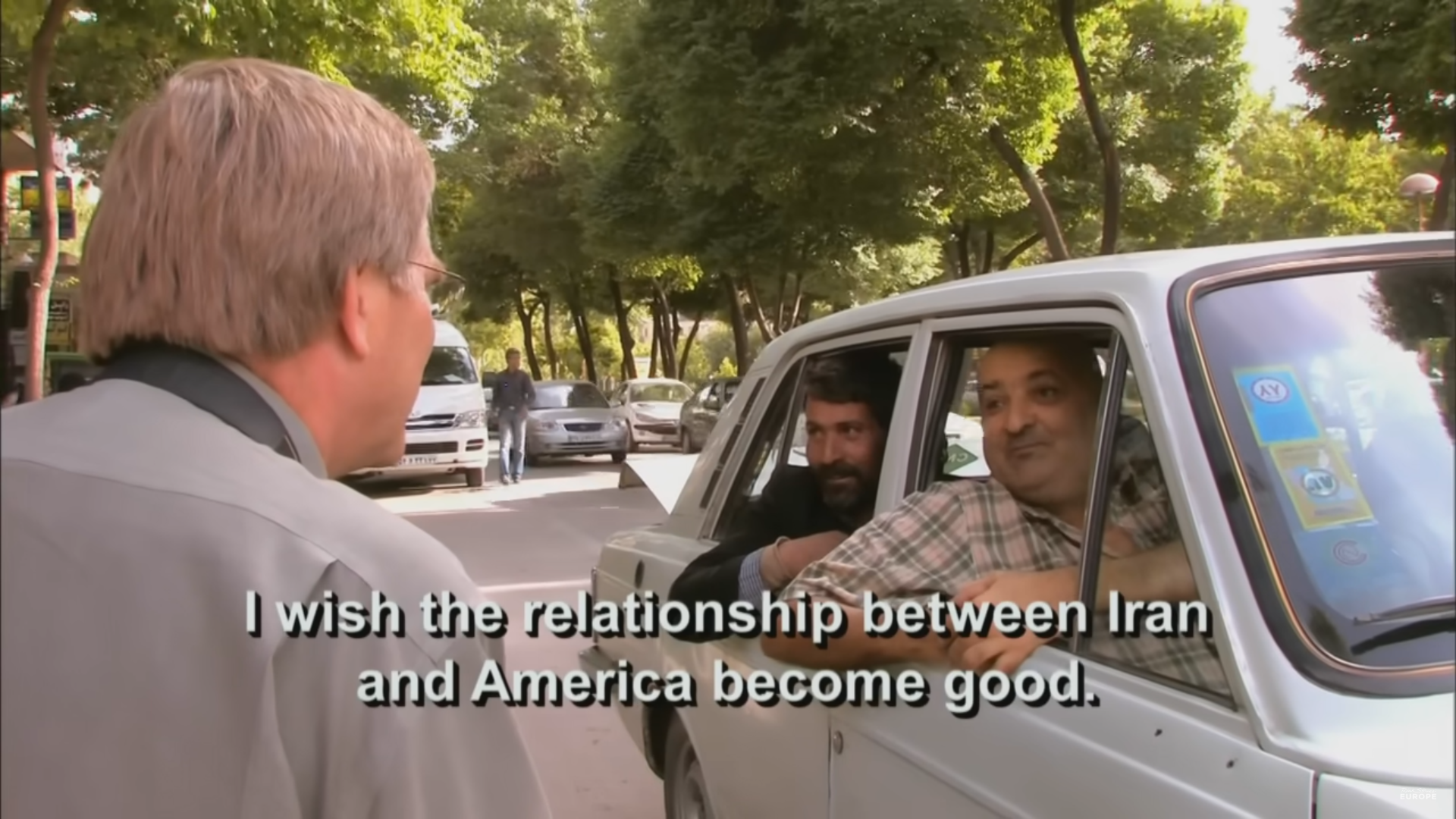
Next in the USA's bombsites? Rick Steves wants to help Americans get to know Iran.

Matt Fitzpatrick seems to think that you can't assassinate your way to peace.

Dana A. Williams on what it was like to be a writer whose editor was Toni Morrison. (And here's an article I linked to in an earlier post, Toni Morrison's rejection letters.)

Steve Curwood interviews Rev. Mariama White-Hammond: Juneteenth Plays a Role in Environmental Justice for All.

A Yougov survey tells us what we already suspected: men are more likely than women to rate themselves as above average in their sense of humor, intelligence, confidence, and self-awareness. (!) (However, most people I know personally seem to be above average in not claiming to be above average.)


Blues from Denmark. Michelle Birkballe, "Cry to Me."

29 May 2025

Nancy French ... on not bearing false witness

Source.  
Eiffel Tower, Paris, Tennessee
Nancy French's home town. Source.
Nancy French, Instagram, 2024. Source.

This high praise for Nancy French's book Ghosted: An American Story from Christianity Today editor Russell Moore will save me a lot of words:

I didn't know writing could be this haunting and hilarious, heartbreaking and exhilarating all at the same time. I did not want it to end. This tour de force of storytelling and sense-making is one of the most gripping and beautiful memoirs in a generation.

Nancy French was born and raised in the Appalachian foothills, a grandchild of the mountain culture, and grew up in a church community that nurtured her faith and gave her love and care ... until the devastating day that it didn't. She attended a Church of Christ college ... until she couldn't stomach the chapel's lazy positivity and stopped attending, even though chapel attendance was compulsory.

As a result, at age twenty, "by now my affection for Rush Limbaugh and church had disappeared and I considered myself a feminist, atheist, liberal." That was the moment when she encountered David French, a Republican Christian law student, an encounter that resulted in a restoration of faith (well, not the exact same faith), a marriage that has lasted three decades and counting—and a career in ghostwriting for Republicans that didn't last quite as long.

Obviously, there's nothing terribly linear about French's story, with each swoop and dive reflecting something of the wrenching spiritual, political, and cultural turmoil of her country in those decades. Her story includes betrayal, giddy hope, predators protected by churches, miracles, allies lost and found—it's a good thing she's an excellent storyteller! Take a look at these reviews for more of what I mean:

Ghosted has many important messages, including powerful testimony against the shame of being a childhood target of sexual assault in the church. I hope everyone who needs these messages will read this book. But there's something else that intrigued me as a lifelong lefty: the passing references to the way conservatives see us. I'm not necessarily talking now about who is objectively more correct about policy and morality; it's the cultural assumptions and conclusions that seemingly entitle them to dismiss us (and us them).

For example, here French is commenting on the reactions to the book she co-authored with Sarah Palin's daughter Bristol:

I’d thought that people of both parties would rally around Bristol and show her compassion. That’s not what happened. It slowly dawned on me that when the Democrats loudly proclaimed “believe all women,” they really meant “the right kind of women”—meaning not “right” on the political spectrum at all. I shouldn’t have been surprised. They had embraced Ted Kennedy, even though he flipped his car, sent his female passenger careening into a pond, and left her there to die. They revered Bill Clinton, even though he was credibly accused of rape by multiple women.

Bristol was well spoken and the book was clear. However, a nuanced, trauma-informed conversation did not arise from her revelations. Bristol told the truth, and Democrats laughed. After seeing how people mocked this young mother, I was fully confident the Democrats were not only wrong on the issue of women, they were callously wrong. They harbored and protected abusers of women, and Republicans alone would stand against sexual injustice.

In spite of my certainty, the truth turned out to be much more complicated than I thought.

Soon a major turning point for French came: the acclamation Donald Trump received from the very people whose ostensible values she cherished and represented in her writing, and who, as it turned out, turned against her and her husband when they found that contradiction intolerable. As those contradictions mounted up with every Trumpian assault on rhetorical decency, she lost many clients, and kept the few that agreed to her condition that she would not write pieces in favor of Trump.

In my mind, however, I made a vow: I would not bear false witness against my liberal neighbor.

That one decision was the beginning of the end of my political ghostwriting career.

I hope that progressives, even in the shadow of Donald Trump's devastating attacks on political and ethical norms, are willing to make the same commitment against bearing false witness against their (our) opponents.


On the "conservative" label.

A grievously neglected commandment.


Here's a podcast in which Julie Roys, a Christian investigative journalist who often focuses on church-related corruption and abuse, interviews Nancy French.

Back on March 27, Medardo Gómez, Lutheran bishop of El Salvador, died. He made a deep impression on me during a visit back in the time of the civil war and death squads. Rest in peace!

Christine Patterson on the importance of cultural intelligence for service in a divided world.

A poll suggests that Israelis increasingly hold genocidal views concerning Palestinians. Not coincidentally, the Israeli government announces the creation or "legalization" of 22 new settlements on the West Bank. Britain Yearly Meeting minutes its discernment that genocide is occurring in Gaza.


Sue Foley, the "Ice Queen" of blues guitarists, gives us an extended solo....

07 May 2025

Speaking of speaking

Source.  

My heart is pounding, words are lining up impatiently at the tip of my tongue, the silent room suddenly feels as if it's holding its breath, I'm starting to tremble.... Should I speak? 

The first time I had this experience in a Quaker meeting for worship was around Christmas 1974, at Uwchlan Meeting in Downingtown, Pennsylvania. I knew the theoretical answer to my urgent question. In the words of Ruth M. Pitman in the Canadian Friend magazine (later published as "On the Vocal Ministry"): 

It is understood in such a Meeting that any messages that are spoken strive to be God’s word for these people at this time; that is, no one will speak unless he has prayerfully considered two questions: whether the message is God’s or his own, and whether it should be given to these people now, or is for the individual alone.

But I had been among Friends for only a few months, and furthermore, this particular group was not my home meeting.  Who was I to say whether God was the source of my thoughts in this time and place? What business did I have interrupting this peaceful assembly?

I did overcome my self-doubts, and spoke a message on spiritual power in the context of the recent oil embargo. I make no claims as to the merits of this first message, but the experience felt like a sort of baptism.

These were the memories that came back to me as as I began to read Rhiannon Grant's new book in the "Quaker Quicks" series: Speaking in Quaker Meeting for Worship: what, when, how, and why? I wish a guide like hers had been available to me five decades ago!

Confession: I approached the book with some initial skepticism, which may say more about my prejudices than anything about the book or author. First of all, Rhiannon Grant's Quaker community is Britain Yearly Meeting, which despite its variety is typically described as liberal. Its meetings for worship are, except for special occasions, unprogrammed (see this post for a bit about "programmed" and "unprogrammed"). Although I spent my first eight years as a Friend in similar cultures in Canadian, New England, and Baltimore Yearly Meetings, the rest of my Quaker experience of forty-plus years have mainly been among programmed Friends served by pastors. Would any of her observations apply where I live?

My second apprehension: would a book-length (even a Quaker Quicks-length) treatment come across as an attempt to groom the aesthetically perfect unprogrammed meeting, pitched to the comfort level of Atlantic-culture demographics in terms of class, education, verbal fluency, and long attention spans, or would there be room for Holy Spirit spontaneity, of grief, ecstasy, confession, prophecy, song, all that potentially attaches to Quakers quaking? 

My apprehensions were unfounded.

First of all, Rhiannon Grant is clear about her own Quaker context, but is aware of the range of worship styles among Friends, including programmed worship. More importantly, her practical guidance on speaking in worship seems to me to apply to any Friends meeting in which time is set aside for what programmed Friends often call "open worship." As she says early on, "The understanding of this book is that when we are open and willing in the stillness of meeting for worship, any of us can be moved to speak." That's why "any of us" can benefit from her observations.

She doesn't address the specific situation of a Friends pastor or regular speaker preparing a sermon, but even here many of her suggestions would be useful. It's clear that in her culture, advance preparation of a message is usually inappropriate—but there is no hint of taboo. (My own belief is that the work of worship-planning and sermon-writing should be surrounded by the same level of sensitivity that we expect in meeting for worship. I'm sometimes startled by how similar sermon-writing can be to giving spontaneous messages in unprogrammed worship.)

Another feature of Grant's book: its kind, unpretentious, open-ended tone, often grounded in personal experience, with touches of humor. Examples:

Contrasting ordinary speech with ministry during worship: (Link added.)

In ministry, by contrast, the majority of the source is inspiration: even if I have done a little bit of planning, like being asked to read from Advices & Queries, I wait to be led to speak and to feel what would be right to read. Usually, I don't speak at all unless that strong inspiration arrives. There will still be a little bit of me in there—including whatever I feel about having to speak in front of others—but ego is in the minority and the promptings of love and truth are in the lead.

There can be times when it is hard to tell which element is strongest. Am I really inspired to say this, or do I want to say it? Am I sharing this story about having a wonderful spiritual experience on holiday because it's brought me insight, or because I want other people to know about my holiday and my spirituality?

When you have finished saying what you have been given to say:

After giving ministry, there can be a sense of relief. If you experience physical sensations like shaking, they might either stop or briefly get worse. Sometimes I experience a wave of anxiety about the mundane social side of the situation—in my discernment process, I focussed on the message, and it's only afterwards that I ask myself whether I said something ridiculous and whether everyone hates me now.

What about theology? Rhiannon Grant explicitly says that theology is a secondary concern for this book, and refers readers to her books that focus more directly on theology. As a self-described evangelical Quaker (sometimes in despair that the word "evangelical" doesn't communicate what I stubbornly think it ought to!), I'm guessing that she and I are probably not in the exact same place. This book, however, communicates a warm theological hospitality that enhances rather than weakens the practical guidance she gives for speaking in worship.

One of her book's great virtues is that it simultaneously honors and demythologizes the ministry of speaking in worship. Grant recognizes its high value as a way God shapes us as a community and guides us toward other ways of ministering to our world. At the same time, she considers all the various temperaments we find among us, including those who speak too readily, and those who feel totally unready to speak at all. She describes various ways that spoken ministry can derail a meeting for worship—and how Friends might respond—but also points out that disruption might at times be God's actual intent! She holds up the precious service of elders or other experienced Friends who can encourage the budding minister or help those whose ministry can be unhelpful. She considers the practice of "afterword" or "afterwords," a time after the end of the worship when thoughts that did not seem to rise to the level of ministry during worship—perhaps less than prophecy but more than casual discussion—can be shared with the group. She describes a variety of ways to organize this supplementary opportunity, and outlines their advantages and disadvantages.

Grant's book is well-organized. Her first few chapters define her terms and concepts, and would be helpful to anyone mystified by how we Friends use terms that mean different things among us than they do in the wider world. After some basic observations on worship among Friends, she describes the ways that speaking contributes to the depth and power of worship, and the general patterns that often prevail when things are going well.

Then: when things are not going so well, what might be happening, and how might we respond? Her list of possible dysfunctions is telling...

  • Popcorn ministry (too many messages too quickly, without enough time in between to absorb them or to discern one's own participation)
  • A message is too long
  • Predictable ministry
  • Absent ministry
  • Inappropriate ministry, and
  • Is it really wrong?

On that last point, it's worth quoting her directly:

It isn't always clear about how to draw a boundary about what's acceptable or not, and being told to trust your discernment might only make things worse if discernment is not already a strong and regular practice in your life. Add in issues of politeness, status, insecurity about belonging to the community, challenges around the role of authority without hierarchy, along with some questions about theology, which touch on very personal religious matters, and the situation is undoubtedly sometimes very difficult.

...

If my community is also a body, I have to expect that the painful will come with the pleasurable and that things I don't notice and can't control will be happening alongside the things where I have some choice. It's part of the gift of being together.

The following sections of the book help us apply all these insights to ourselves, our own discernment on whether or not to speak, how we speak, and how we then return to the quiet center from which our ministry arose. Finally, Grant addresses questions of assistive technology, online and hybrid worship, and the sometimes awkward questions arising from these newer modes of worship. She ends her book with a list of print and online resources.

If your Friends meeting or church uses this book in a discussion group or a class for newcomers, I think you'll be delighted with its scope. Rhiannon Grant succeeds in linking her central topic—speaking in meeting for worship—with just about all aspects of our life as a worshipping community. Her approach is grounded but not rigid, and should lead to many fertile conversations.


Here is an older guide to "Open Worship" including whether and when to speak during worship. It was adapted from a pamphlet written by the late Stan Thornburg, who served Friends churches in Mid-America and Northwest Yearly Meetings. His chart has been used and adapted to various formats in several Friends meetings and churches.

And here again is the link to Ruth M. Pitman's "On the Vocal Ministry." Ruth Pitman identifies with Conservative Friends and has been a frequent contributor to Quaker Religious Thought. In this post from 2017, I said more about Pitman's tract and my first experience of speaking in meeting.

Patrick Nugent's article (1996) "On Speaking in Meeting for Worship" appeared in this issue of Friends Journal, starting on page seven.

Here are Friends' opinions on the use of queries as framing for open worship, part one, part two.


Mass Observation, May 12. Are you in the UK? Are you planning to participate in this national diary? (With thanks to Rebecca Rosewarne for the link.) Does your country have a similar archive project?

Revoking international students' visas "makes America smaller, not stronger." I have a Palestinian friend, a young doctor who is scheduled to arrive soon for a residency in the USA, so these days I'm very alert to this concern.

Mondoweiss on Gaza: Israeli forces are working toward making Gaza uninhabitable for its current population, but they are running low on soldiers.

May's theme at the Daily Quaker Message is peace and nonviolence. I continue to appreciate these daily posts. Here's Tuesday's post, with a quote from Duncan Wood.

Sarah Thomas Baldwin: When we "spiritually amphibious creatures" can't quite find our souls.

Beth Woolsey's Irrational Joy Project. (Also: "...wallowing is an underrated stage of grief.")


Here (audio only) is the late Joe Louis Walker's version of "Wade in the Water." Rest in peace.

27 February 2025

In crisis and conflict, "the church is like a ..."

Memories of Elektrostal, Russia, in winter, thanks to Sergey Kadyrov (composer and videographer). (Not related to tonight's post.)


The president of the United States is vigorously putting his authoritarian stamp on all aspects of federal government. With the help of technocratic lieutenants, he is cutting ties with past practices and norms as quickly as possible, hoping to carve and cut as much as possible before (if ever) the courts, the Congress, or the people slow him down.

A crucial part of his core support is a network of charismatic Christians who believe that Christian authoritarianism is actually better than democracy, that their leaders are apostles and prophets in the biblical mode, and that their opponents are in the service of Satan. How might those of us Christians who value democracy, and are emphatically not in the service of Satan, organize our responses?

Last week I summarized at least one school of interpretation of all these developments. This week, I want to consider how we in the Church (capital C) might be responding. My ideal is a mutually respectful division of labor according to our spiritual gifts, temperaments, and leadings. And I'm organizing these tentative thoughts using the metaphors in my post from May of 2021, "The church is like a ...." As always, your additions, improvements, and personal stories are very welcome.

My overall point is this: each of us can do, and is called to do, only so much. Our strength is in Jesus, not in anxious overwork, and the church can be our point of coordination and mutual support.


"The church is like an incubator."

  • Are you a pastor or elder, a member of the meeting of ministry and counsel? Whatever your title, perhaps you have a calling as one who cares for souls. You can hold open space for grief, for lament, for the recognition of our losses, for our disillusionment and discouragement, and also for those whose idealism flares up in the face of all this.
  • You can watch for the new growth of leadership and prophecy for our times among young and old alike, and let them know you've noticed and are ready to connect them with mentors.
  • You will see who among you, and who in your broader community, has lost jobs as a result of the administration's slashing of the federal workforce and its contractors, and the cost of the MAGA war against the hard-won gains of the civil rights movement, and connect those people with aid.
  • Your role in the church might be to administer the funds or shepherd the connections that respond in practical ways to these challenges.
  • If you have the gift of prayer or healing, you will certainly be needed to uphold all of these ministries, and to pray protection over the community and its places of work and worship.
  • Consider how to bring children and newcomers into conversations that might come more naturally to some than to others.
  • How can our worship faithfully reflect the joy, grief, and commitment that we honestly feel as we put ourselves and our situation into God's hands? As Larry Norman asked fifty years ago, "Why should the devil have all the good music?"

"The church is like an observatory."

  • Not everyone can cope with the constant stream of news, rumors, and social-network posts that reflect the administration's actions and their consequences. But if you can do so, your careful work in discerning truth from exaggeration (from whatever side), urban legends, and outright false witness will be an important contribution to the whole community.
  • If you are an observer, part of your role might be to identify reliable sources of information, as well as predictable sources of misinformation (inaccuracies and exaggerations) and disinformation (deliberate deceptions and false narratives, no matter how persuasive).
  • Are you a legal expert or lawyer? In collaboration with other observers, you may see opportunities to initiate or join legal challenges to unlawful, unethical, or unconstitutional acts.
  • The prophets among you will be needed to give voice to God's leadings, and confirm them through consultation and mutual accountability among each other. Remind the community that, whatever other business the faith community may have, agenda item number one remains, "What does God want us to say and do at this time and place?"
  • Prophets can help us know when the time has come for civil disobedience.
  • You and other observers in your own community can be in frequent touch with other communities that have similar commitments to faith and trustworthiness.

"The church is like a laboratory."

  • Be curious! The Christians who choose authoritarianism over democracy have their reasons, and their own version of idealism. If you are feeling led, and are equipped and prayed-for in your community, reach out to our opponents and ask questions, supply accurate information, build relationships, pray for them, and bring your insights back to the rest of us.
  • Do you have the gift of evangelism? Pray for opportunities to open up a more complete witness of grace than the opposition offers. Be ready to explain concepts of spiritual warfare that that are not politically manipulative. For those who have never seen what spiritual unity looks like when nobody is excluded, be sure your community is ready to demonstrate what we preach, and don't conceal our failures!
  • When civil disobedience is called for, be prayerful and creative. Look to the past for inspiration (for example, in George Lakey's books) but also innovate. Build coalitions with trustworthy allies. Consider tax protests and boycotts, and be prepared to explain your actions to the public without resorting to activist jargon. Accept failure and learn from it, without losing heart. Stay in constant touch with pastors, elders, stewards, and prophets, cherishing your unity with those who may be called to prayer and stewardship but not to disobedience.
  • Does your community have divisions between mystics and activists, between cynics and idealists, conservatives and radicals, between those who rage and those who mourn? This is the time to experiment with new commitments to love and learn from each other, and use our differences to keep each other sharp and honest. There's nothing wrong with conflict, conducted ethically among those who love each other.

This list is just a start. Its biggest weakness: no stories. I could tell a few ... and make this post far too long. Better idea: please tell some stories of your own, and add some ideas and color to this list. Also, I'd love for us to know who else is working on church-based responses to the threat of Christian-sponsored authoritarianism. Let's build the network.

(Note: See the items from Beacon Hill Friends House in the link list below, under "Coming in March.")


Related:

Gospel order revisited

Living without lying

Worship and protest

Dining across the divide


Coming in March:

Kelly Kellum at Friends United Meeting writes to Donald Trump.

Today's OCHA report on the situation in the West Bank.

Since OCHA began systematically documenting demolition incidents and displacement in the West Bank, including East Jerusalem, in 2009 until recently, the main direct driver of displacement of Palestinians was the demolition of homes for lacking building permits issued by the Israeli authorities, due to restrictive and discriminatory planning regimes applied in Area C and East Jerusalem. However, in the past two years, displacement patterns have shifted, reflecting broader changes in the protection environment for Palestinian communities, particularly herding and Bedouin communities in Area C. In 2023, settler violence became a leading cause of displacement with more than 1,600 people displaced due to settler violence and access restrictions (mainly in Bedouin and herding communities), compared with about 300 people displaced by lack-of-permit demolitions in these communities. Between 2020 and 2024, settler-related incidents targeting Bedouin and herding communities that resulted in casualties, property damage or both increased nearly sevenfold, rising from about 50 incidents in 2020 to approximately 330 incidents in 2024.

Online presentations and conversations with Mark Russ (Britain Yearly Meeting) this year. Mark is the author of Quaker Shaped Christianity and The Spirit of Freedom.

A Friends Peace Teams story from Indonesia: Building a Children's Library with Heart.

Tom Gates posts the prologue to his study, Turning Toward the Victim: The Bible, Sacred Violence, and the End of Scapegoating in Quaker Perspective.


I vividly remember my first encounters, over fifty years ago, with the music of Lightnin' Hopkins, the subject of this affectionate tribute.

02 January 2025

A haunting dream

Waffen-SS recruitment poster (detail).
See full graphic below.

The young man walked toward me with a smile, shook my hand, and said, "I'm on your side."

His next statement, however, was not reassuring: "Hitler has seen some of your letters."

For an instant, I felt flattered that someone as high up as the Fuehrer had taken notice of me. The next moment I felt the full flush of horror. Wasn't this young man supposed to be part of the Resistance? And what year was this, anyway!?

This dream (in my first night of dreams in 2025) had started innocuously enough. I was on a train, expecting to see a familiar face when I got to my destination, Stuttgart. It was a familiar context: I often have dreams in which my grandparents appear—my father's parents or my mother's parents, depending on whether I'm dreaming of Norway or Germany.

I stepped off the train and went into the waiting room, looking around for my grandmother. She wasn't there. Once again, I scanned the people on the wooden benches, looking for anyone familiar, and that's when the young man approached me.

It was confusing. I had the strong impression that he was indeed an ally, a part of the resistance against fascism, but why did he mention the chief fascist himself? And why did that young man look so strikingly like a stereotypical "master race" poster child?

Before I could untangle my confusion, the dream came to an end. However, unlike most of my dreams, I remembered this one with crystal clarity, so I continued to try sorting it out.

Source.  
My first question: where did that young man come from? I think the image came from a recruiting placard for the German occupation forces in Norway, specifically for their SS forces and their "Norwegian Legion."I had seen this placard before, most recently at the impressive Norwegian Resistance Museum in Oslo last July. The invitation to join the common fight against Bolshevism is based on a blatant visual appeal to a myth of racial solidarity. The explicit identification of their mutual enemy was "Bolshevism," but, in Nazi usage, that political term often signified "the Jews."

Here are some other influences that probably went into the creation of my confusing dream:

As the 80th anniversary of World War II's end approaches, I've kept up my usual reading habits, which have always included a proportion of books about that war, its roots and its aftermath. After all, that war and its associated deportations and migrations resulted in my hybrid Norwegian-German family. Last week, for example, I read Eight Days in May: The Final Collapse of the Third Reich, by Volker Ullrich, the most detailed account I've seen of this period.

My recent reading also included the powerful story of Daniel Finkelstein's mother and father, Two Roads Home: Hitler, Stalin, and the Miraculous Survival of My Family. Finkelstein's mother Mirjam and her family were caught in Nazi Germany's mass brutality and the Holocaust, all of which the author describes in heart-stopping detail. This amazing story is interwoven with the equally miraculous survival of the author's Polish-born father Ludvik, who somehow survived Stalin's mass savagery. I cannot recommend this book highly enough, even though it puts us face to face with the reality of our human capacity for mass cruelty committed by leaders and followers and whole societies who all seemingly could have chosen differently.

Among the factors that seem to have reliably fueled this cruelty is racism in all its demonic forms, of which antisemitism has played a persistent and outsized role for many generations. All of these forms are rooted in the primordial sin of objectification, which to my sorrow and distress as a follower of Jesus, seems to have found expressions in today's white Christian nationalism, and not just in the USA.

The other sources for the "resistance" theme of my dream are no doubt the stabbing heartaches of the daily news: the genocide (as Amnesty International names it ... and I'm persuaded) in the Gaza Strip, committed by the armed forces of a nation that acts with near-total impunity; and then there's the ongoing "special military operation" in Ukraine, committed in the lethal service of a "great power," its leadership, and its "Russian World" mythology; in short, a gang whose other organizing principle seems to be to embezzle money and natural resources from its own population while suppressing most means of protest.

Add to all that: the uncertainties of our post-January 20 USA, with a new administration whose saving feature so far seems to be its own internal contradictions.

I have a feeling that there are going to be some more interesting dreams in my future. I'll keep looking for my grandmother ... and for the resistance.


Latest United Nations reports on the humanitarian situation in the Gaza Strip and the West Bank. Your tax dollars at work. And since that last OCHA report: Israeli air strikes hit "safe zone."

What are the odds that artificial intelligence will wipe out the human race in the next 30 years? Ask Geoffrey Hinton.

Taylor Hansen on the night of the birth of Jesus: "Break the Silence"—it's the first item in this newsletter.

What's "too political" for a church? One congregation with a vision of unity is trying to find out.

Nancy Thomas's favorite books of 2024.


Rerunning a sweet favorite: the late Little Arthur Duncan with Illinois Slim, "Scratch My Back."

05 December 2024

Twitter and its rivals

From top: home screens from Threads, Mastodon, Telegram.

Back in 2018, when data harvesting and the manipulative use of social networks were attracting lots of attention, I wrote this blog post about Facebook and Vkontakte. I described and defended my use of these services, and listed some of their virtues and hazards. I still use them in more or less the same ways.

A year or two earlier, while we were still living in Russia, I had joined another service, Twitter, where I expressed political opinions I usually didn't post on Facebook and Vkontakte, the services that I relied on for news of family and friends. Part of the thrill of Twitter was seeing news stories and opinions fresh from journalists' and commentators' keyboards, before they had been sanitized and published (or sometimes even verified!). I abandoned Twitter shortly after it became X, not because my own feed had become appreciably more toxic, but because of the way its new owner treated employees and critics. Still, I admit that I missed that outlet, and still do.

Some of that craving is taken up by Telegram, which I joined shortly after leaving Russia. Telegram combines elements of instant messaging, microblogging, interest groups, and news feeds. Those news feeds include such users as The New York Times, Washington Post, TVRain (Дождь), the BBC (and its Russian service), and numerous Russian-language and Ukrainian channels—media outlets and individual journalists and commentators. 

Telegram is also a platform for personal messaging, but so are many other platforms. I'd just as soon stick with the reliable (so far) channels for that kind of communication (e-mail, Facebook and FB Messenger, Vkontakte, and phone-based texting) and, less often, Whatsapp (important for overseas contacts), and not have to cover every possible channel. There are some apps and clients that promise to combine personal messages from a number of sources, but I've never found that covers all of them, and most are not Web-based. (If you have suggestions for cross-platform message handlers that are browser-based or Linux-compatible, please comment! I prefer desktop platforms, not services that are exclusively phone-based.)

Back to news and opinion: Threads, Mastodon, and Bluesky are among the services that may take over Twitter's place in my search for fresh news and opinions. So far I've found a number of my favorite authors on all three of them. In a promising development, all three services are finding ways to become mutually accessible. For example, here's the way to bridge Mastodon and Bluesky; and you can authorize Threads to share posts in the larger fediverse.

The days are not long enough to camp out at all of these various sources, and it remains to be seen whether their cultures remain as mellow as they mostly are now. (Well, Telegram can't exactly be called mellow, but in my chosen feeds, it's not snarly!) How well might they resist external predators and internal exploiters? In the meantime, dipping around in each of them for brief visits seems more productive than developing a premature loyalty to any one in particular. However, if you've become committed to one or two platforms out of all these choices, and would like to tell me why, I'd love to know.


Here are a few other overviews of these various platforms, their similarities and differences:


The latest Humanitarian Situation Updates for Palestine from the United Nations:  Gaza Strip; West Bank.

Chimène Keitner of Lawfare on the Netanyahu/Gallant arrest warrants.

The Haaretz newspaper’s editorial board described the ICC’s decision as an “unprecedented moral nadir” for Israel. (Netanyahu responded to Haaretz’s coverage of the war by sanctioning the newspaper.) Hungary’s Victor Orban greeted news of the ICC warrant with an invitation for Netanyahu to visit, deepening cleavages between European countries committed to the rule of law and those challenging the “liberal international order.” Absent a change in leadership, Israel’s international isolation from that order will continue to deepen. Even if the Israeli government changes course (which is highly unlikely, especially given the results of the recent U.S. presidential election), the damage to Israel’s standing and reputation—with ripple effects on Jews in the diaspora—will take decades to repair. Meanwhile, the human toll is irreversible, and rebuilding Gaza will take decades, if not centuries.

John Crace of The Guardian on the UK House of Commons debate on assisted dying: "...ultra-rare Commons sight: intelligent debate." You can see the debate itself on parliamentlive.tv.

Human rights defender Olga Karach doesn't want to "disappoint" Lukashenko.

William Barber on CNN: here's what Trump's second coming tells us about the country and the future.

But what you saw election night is not the whole of America. It’s a part of America in a particular moment around the election. You have to stop and say, wait a minute, this is the same America that I went to sleep in the night before. It’s not some strange America. This is part of America. America has always had multiple stories running at the same time.

Austin John and McKinley James perform B.B. King's "Ruby Lee." Enjoy the whole set; they're fine musicians.