Showing posts with label curmudgeon. Show all posts

02 March 2023

Vanity of vanities: partly a repost

'Your post titled "Vanity of vanities" has been unpublished.' 

About a week ago, I was startled to get this notice from blogger.com. It went on to explain that "Your post titled 'Vanity of vanities' was flagged to us for review. We have determined that it violates our guidelines and have unpublished the URL http://blog.canyoubelieve.me/2008/01/vanity-of-vanities.html, making it unavailable to blog readers."

The letter went on to explain how I could edit the post and submit it for reconsideration. Naturally, being a spiritually mature, even-tempered Quaker, I was ... INCENSED! I looked back at this fifteen-year-old post (archive.org version) which I'd revisited a couple of years ago to edit dead links, photos, and video, and tried to figure out what could have caused the blogger platform to blow the whistle.

After a day or two of calming down, I made a couple more changes—one or two more dead links eliminated, and a newer version of a video subbed in—and republished. Only then did I notice that I had received another notice from blogger.com, from the same date as the previous notice. Subject line: "Your post titled 'Vanity of vanities" has been reinstated." Well!


It just happens that this "Vanity" post's theme, class issues among Friends, has been popping up again.

For one thing, I've had a long-standing concern that I've sometimes shared in this blog, that the ways we Quakers talk about our faith is often too wordy. According to Elizabeth Gray Vining's biography of Rufus Jones, he once gave an address after which he was gently criticized with these words: "Our dear Lord said,'Feed my lambs.' He did not say, 'Feed my giraffes.'"

I've had a couple of chances to help edit text on Quaker Web sites, and I've looked for chances to use language that doesn't imply "if you don't have an advanced education, you're not welcome among Friends." I also remember a Methodist writer who pointed out, rightly or wrongly, that most devotional literature is written by intuitive introverts for intuitive introverts.

And for another thing, Quaker writer and activist George Lakey is coming to our town and to our church this month (information below), and that reminded me of something I've always appreciated about him: his advice that successful movements united people across class lines, rather than dividing them. See the links section below for a couple of samples of Lakey's thinking on class.

Here's an edited and shortened version of my "Vanity of vanities" post. (You can read the comments on the original post through this link.)
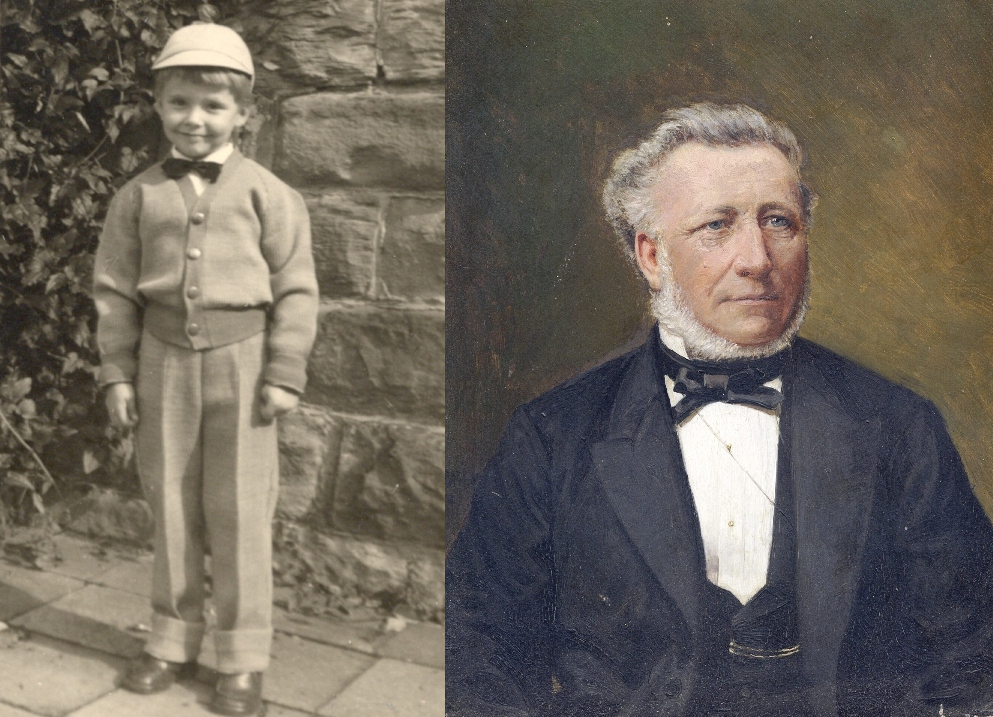

Two Johan Fredrik Maurers, both nattily dressed. (At right, my great-great grandfather, 1817-1887.)

Vanity of Vanities [January 2008] 

Questions about Friends and social class have been prominent again in recent weeks in the Friends blogging community.

For examples, go here, if you haven't already:

The Friendly Funnel, "22 Class Steps Forward" [archived]
Susanne Kromberg, "Poll on Class and Faith"
Social Class and Quakers, "Questions, Questions"

Some of these questions came up a couple of years ago, when Brooklyn Quaker wrote his "Thoughts on the New York City Transit Strike--and Quaker Class Narrowness."

I'm happy about this development, in part because of my visceral dislike of elitism and of the spiritual violence that we do when we objectify others. (We "objectify" when we look at people coldly, forgetting their equal status with us as made in the image of God; when we reduce people to categories; when we see them as objects of our agendas, or as irrelevant to those agendas.)

Some of my intense feelings no doubt come from growing up with my mother who believed in the superiority of her German "master race"—to the point that she displayed a swastika on her Skokie, Illinois, front lawn during the controversy over Nazis' wanting to march in Skokie. (Did she ever see the irony later on when she moved north to, of all places, Zion?)

For reasons that relate to our family's own violent history, we straddle classes, which gives me insights that I sometimes would rather not have. No doubt this also adds to my blind spots.

But, turning to Friends, I also share a concern that elitism in any form is a dangerous heresy. It is a betrayal of Friends theology, which is radically hospitable because it respects no categories that are not directly tied to God. You (every possible "you") and I are, first of all, created and loved by God—we have no license to create a category outside that compass. The only relevant remaining categories are (1) presently in community with God (converted and convinced, in Christian Quakerese) or (2) potentially in community with God!

The big issue in my mind is: what is the nature of the border between those two categories? From God's all-encompassing perspective, I'm sure the answer is far more interesting and gracious than anything we can conceive. But descending to our Quaker perspectives for a moment, I can imagine how personal biases affect our answers. I want to defend the importance of conscious personal decision, of saying "yes" to God, so I see a definite boundary there, although one for which that "yes" is the only, and I mean only, requirement to pass. Universalists inside and outside Christianity would see that boundary differently, or not at all. A strict Calvinist would have a different understanding, too.

Whether or not you agree with me about the importance of that conscious and personal "yes," we probably all agree theoretically that nothing else should obstruct the threshold into the community. If there is anyone not living in the glorious freedom of the children of God, we should invite them in. We should certainly think carefully and creatively about what it would take to connect both honestly and persuasively with that person, and what aspects of our corner of the community would undercut our message of hospitality.

Back when Brooklyn Quaker first posted his "class narrowness" thoughts, I responded on his blog as follows:

... I won't take the space here to enumerate the number of class-related snubs I've seen or heard about among Friends.

One such snub deprived us of a working-class smoker (*gasp!* - yes, he smoked, but many of the nonsmokers drank like fish). [Fifteen years later, I am inclined to soften this last judgment.]

A working-class woman struggling with Catholicism was another brief visitor, snubbed in part because of her enthusiasm. [Let me add, however, that one of the weightiest members of that meeting said that this visitor was more like George Fox than anyone he knew.]

A husband and wife who wanted to do door-to-door evangelism were told, "Perhaps you'd be happier elsewhere." This, in a meeting that had shrunk to one-third of its size in fifteen years!!

A meeting made its bathroom off-limits to those coming to get boxes of food.

More pet peeves. (Sure feels good to get these off my chest.) ... Meetings whose rhetoric, however well-intentioned, makes it clear that poor people, low-income people, people of "other" races, addicts and members of addiction recovery groups, are not part of THIS fellowship, even when they actually are. [I'm referring to Friends who regard such people as not necessarily worse than us, but as OBJECTS of our goodness.]

I do have a hypothesis: a group that has integrity and spiritual power can attract people from any race and social class. (Unfortunately, so can groups that fake it well: there's never a time when discernment isn't required.) I remember one very dear Friends fellowship that was pretty homogenous but yearned for diversity; half a block away was a Pentecostal church where there was ACTUAL diversity—racial, social, class, temperament, language. Spiritual power does NOT necessarily mean emotional contortions, but it does mean crossing a threshold of conversion and self-abandonment not typically found among the self-satisfied or terminally autonomous.

For the nnnnth time, this sort of meditation has led me to the question: If I see so much incompleteness, why do I stay among Friends? Because I'm deeply convinced that Quaker discipleship is the most authentic way of being Christian that I've been led to. And the inhibitions and compromises that keep this authenticity under wraps are wearisomely familiar to me because ... I share them! Finally, every meeting for worship is a new opportunity to confront those inhibitions and take another step toward greater faithfulness for myself and my community.

Several of the above-referenced blogs refer in one way or another to cultural screens that may or may not play a role in our being inclusive or exclusive. For example, are we too intellectual? Does our comfort with ambiguity repel those who prefer certainty? Are our activist folkways too full of "inessential weirdnesses"? (Thanks to Jeanne/Social Class & Quakers for this link.)

I resist making these class issues—there are intellectuals in every discernible social class, and certainly self-regarding elites can be addicted to certainty. (How else did we get into Iraq despite the misgivings of ordinary people of every class?)

And I'm not at all worried about our having weirdnesses, since every social group has them, and nobody of any class is so stupid as to think that a new place they're visiting will have no peculiar features at all. My question is, are we willing to do the hard, worthwhile work of figuring out which of our behaviors is just our particular wallpaper, and which actually undercut our theology of radical hospitality?

Some additional thoughts, in no particular order:

  • I continue to believe that the most important pathology underneath Quaker elitism is a defective understanding of God's role in our community. I wrote about this at excessive length here: "Nancy's question" (What are we so afraid of?)
  • I've visited more than two hundred Friends meetings over the years, and we're in the middle of a ceaseless round of visitations within Northwest Yearly Meeting right now. Some Friends meetings have a very truncated social spectrum; others have an amazing range of people. The wider-range meetings seem to have at least a couple of characteristics in common: First, they are places where talking about one's faith is very easy and natural, where people speak openly about what God is doing in their lives. Second, they're places where it is possible to confess doubt, problems, failures, addictions, fear.

    Just one verbal picture: At Melba Friends Church in Idaho, a few weeks ago, a meeting for healing prayer was announced to take place at the rise of meeting for worship. Those who wanted healing prayer were to gather at the front of the meetingroom, while the rest of us got ready for the potluck dinner. There was no mistaking the intense spiritual work that was going on among those gathered at that meeting—but everything about the atmosphere of that community told us that this was completely normal.
  • When I was a Friends denominational bureaucrat, I noticed (and wrote about) the divide between those who were temperamental skeptics and those who were temperamental proclaimers. The seminary, specifically Earlham School of Religion, was a perennial arena for collisions among those two groups. One group was there to explore their spiritual issues; the other was there to refine their existing commitments and prepare to deploy them in pastoral or other forms of service. What I longed for was a depth of love and accountability in the community that would allow both groups to be themselves and still contribute to building up a faithful, hospitable body.
  • No group will grow in numbers or faithfulness through guilt or shame. When Judy and I were young adults, we were at a meeting for business at which someone said, "What our church needs is more young couples." No, not so fast! ... what they needed was more confidence in their own identity as people of God. Anxiety about their defects was useful only if it led to positive, creative work on tearing down barriers, not to a negative tearing down of themselves. This was a meeting full of people who'd done amazing things in their (mostly) long lifetimes; they needed to reveal more of themselves, not obsess on their shortcomings.
  • But on the other hand, maybe that meeting I just mentioned did need to enter a season of self-doubt. They'd been a prestigious Main Street church for so long that perhaps it was important to face at least a few unpleasant realities. My point is to use those doubts creatively, let them break the power of respectability and denial, but then move on to build a more solid foundation of group identity. Recover your dear early love! (Revelation 2:4-5)
  • This same meeting had young people who once challenged the meeting, through a Sunday School teacher, "Some of you have been Quakers for 60 years—why can't you tell us more about why you became Friends and what you've learned about God in those years?" Well, part of the answer was: "Our generational culture is very private." That privacy is not something to be ashamed of, but it needs to be worked on.

Details on George Lakey's upcoming visit, and a few links:

Lakey on "the middle-class capture of Quakerism...."

... and on "coming out as a working class man."

... "How progressives can win."


Source.  

Dining across the divide: Can these two Utah grandmothers have a civil conversation?

Sergei Chapnin's open letter to the bishops of the Russian Orthodox Church.

Last Sunday at Camas Friends Church, Leann Williams spoke on trauma and "conduits of healing." Recommended!

A couple more links on the Asbury revival: Nadia Bolz-Weber, "On Longing and the Asbury Revival"; and Zach Meerkreebs thought his sermon had bombed.

Greg Morgan: When is it ok to greet a death happily?


Yesterday Portland's Waterfront Blues Festival announced that Buddy Guy was scheduled for this July's Festival program as part of Guy's "Damn Right Farewell Tour." You guessed it: I have my pass.

Back to 1969: "My Time After Awhile."

06 August 2015

How the Grinch stole Hiroshima (repost)

Source: Twitter  
These are my reflections from ten years ago on the atomic bombing of Hiroshima. For comments at the time, see the original post.

It is the season for Hiroshima and Nagasaki observances, and once again I will not take part.

Not that I approve of the bombings or of atomic weapons. In the case of Hiroshima, August 6, 1945, my mother told me when I was a child that she had been on a train at the time. She was close enough to see the flash. I have childhood memories of her leukemia check-ups (at least that's my grown-up interpretation of her need to have her "atomic blood" checked). She was always sure that the whole Pacific war was at least half the USA's fault, since (in her mind) Roosevelt had deliberately ignored warnings of the Pearl Harbor attack in the hopes that it would justify his already-planned entry into World War II. I do not personally agree with her interpretation, but I've always been fascinated by how different those events looked from her family's viewpoint in Japan.

In 1976, I was a participant in the Friends World Committee for Consultation triennial sessions in Hamilton, Ontario. One of the high points of that event was T. Canby Jones speaking on Psalm 126, "Those who sow in tears shall reap with sounds of joy." In the course of his talk he meditated on the Japan of his childhood and on his recent visit to Hiroshima. His presentation was modest and uplifting.

In 1985, I was again at an FWCC triennial, this time in Oaxtepec, Mexico. August 6 rolled around during those sessions. I think we all went to the Hiroshima-Nagasaki memorial meeting. For some reason that is surely nobody's fault at those sessions, I was overwhelmed to the point of nausea by the public self-flagellation, the undifferentiated denunciations, the lack of any spiritual diagnosis comparable to that provided nine years earlier by Canby. I walked out.

That was my last Hiroshima memorial meeting. I now prefer to keep my mourning private (excepting, maybe, this weblog entry).

Years ago, Dale Aukerman wrote an amazing book, Darkening Valley: A Biblical Perspective on Nuclear War. If I remember correctly, he described nuclear weapons as, very simply, extension of the human fist and the impulse to say "thou fool."

I don't want to get in the way of anyone who feels that their fist and their mouth are likely to be more humane and Godly if they attend a Hiroshima/Nagasaki observance. (Or do some of us actually feel that only others need to change?) My priority is the Lamb's War. If we do not fight this noncarnal war against evil in high places, we will continue to respond too late to the buildups of earthly evil that put our Churchills and Trumans into such unbearably ambiguous dilemmas—apparently having to choose between one massacre or another.


It is legitimate to ask Christian pacifists what we would have done in the face of the fascist threat. (Substitute your favorite representative of mass evil.) I welcome the challenge of countering the implication that our nonviolence is useless, but it IS to some degree useless at the hypothetical point of this challenge (although obedience to the Prince of Peace can never be ultimately useless).

Instead of being required to answer why pacifists would withhold the scalpel of righteous violence, I want to know why the question is always framed at the point where the patient is dying of advanced cancer. I want the Church's response to the cancer of militarism and fascism to begin long before the forces are arrayed and the bullets begin spraying. With the worldwide network of believers engaged in the Lamb's War against evil in all forms, couldn't we do better preventive medicine? Couldn't we do more to infiltrate the world's camps and divisions, subvert all official definitions of enemy, raise the alarm when flows of weapons, illicit funding, wicked and inhumane ideologies begin creeping here and there across our far-more-alert radar screens?

Unless we put more of an effort into prayerful "peacetime" vigilance, persistent and winsome evangelism, and divine subversion, we will always be caught with too little, too late when the superpatriots and the power politicians finally reveal their hand. In fact, they too are legitimate subjects of prayer and evangelism, because they are not the enemy, they are prisoners of the Enemy.


Advice to prudent preachers.
There may be any number of ways in which the individual human life can flourish if it is disinterested in how it inhibits a flourishing community life. Contributing to a flourishing community life may limit some ways of maximizing a flourishing individual life. You can see how complicated this can get. Who can count the number of career gallows or opportunities for congregational disintegration? The prudent preacher is well advised to steer clear.
Northwest Yearly Meeting and human sexuality: to remember or to forget?

Melinda Gates says she is living out her faith in action.

Benjamin L. Corey claims to know what people mean when they say "But I believe the WHOLE Bible." Is he right?

Israeli and Palestinian women meet despite the checkpoints.


I thought I knew what "blues harp" meant!


Elena Manja » Catch this blues! from Elena Manja on Vimeo.
Composed and performed by Elena Manja … with an electric harp in an old bodega in southern Spain. Check it out!
Komponiert und gespielt von Elena Manja … mit E-Harfe in einer alten Bodega in Südspanien. Check it out!
http://www.elenamanja.com

16 July 2015

Quakers' best-fit market

I've always resisted the idea that Friends faith and practice are for special people. Since we welcome anyone who yearns to live with Jesus at the center of the community and learn with the rest of us how to live that way (including its ethical consequences), there is no limit on what "kinds" of people -- sophisticated or unsophisticated (who's to say!?), calm or emotional, of whatever race or nation or culture or even religion -- could potentially feel at home among us.

But I also like the challenge of marketing, or to put it another way, the challenge of communicating our welcome and making sure that there is actual fair access to our community. Ethical marketing communicates its invitations in the form of honest presentations of the host community's deepest values in ways that help those who find those values attractive to try out our community. Creativity in marketing involves making those values shine in the midst of the world's noise, but it never involves pretending something that isn't true. Why set our audience up for disillusionment or regret -- and furthermore, wasting our valuable time and resources to do so?

Furthermore, the marketing process -- if it is to be truly ethical -- also involves self-examination, to see whether we actually hold and manifest the values we claim. Are we making promises that we can't fulfill? On the other hand, does our marketing mainly consist of "mating calls" designed to attract only those already just like us in social/cultural/ethnic terms, or are we genuinely accessible to all who identify with our values and seek a trustworthy community that practices them? Are we centered on Jesus, or are we simply parroting someone else's scripts? Do we treat each other peacefully, and deal peacefully and honestly with those who disagree with us, or do we gossip and mock with the rest of the world? (In the USA, how do we treat the visitor who dresses up -- or down -- for church, or who clearly doesn't share the majority's politics?) Do we truly govern ourselves through the Holy Spirit's leading, learned through prayer-driven group discernment, or does persuasive offstage politicking play a role?

When conflict arises, do we fight fair, remembering that we love those we're in conflict with, and desire their well-being just as much as our own? Do we remember that not every conflict needs to be settled immediately, but must always be described honestly in terms that all would recognize? (Anything else is false witness.) Or is it easiest just to settle into the world's tired and boring old ways of polarization and false heroism?

My idealistic definition of church -- people who yearn to live with Jesus at the center of the community -- could theoretically describe any Christian body, so ... what are the likely values that shape Quaker marketing? Here are my suggestions ... what would you add or subtract?
  • We love honesty and therefore take care not to exaggerate or slander.
  • We present the Gospel to all with honesty and urgency, hiding neither its challenge nor its loving invitation: "Repent and believe the good news!"
  • We also believe people should make sober and thoughtful faith decisions, therefore we avoid manipulation, theatricality, or pressure.
  • We cherish the Bible, and therefore treat it with integrity, rather than using it to proof-text for political advantage or ascribe to it magical powers that the Bible itself never claims.
  • We base our leadership on spiritual gifts rather than social status. We love to see the spiritual gifts of men, women, and children flourish, and to emerge in powerful service to the community.
  • We know that the dialogue between faithful liberals and faithful conservatives, while sometimes contentious, is a precious resource for community discernment, and we will not cut it off, however attractive the prospect of a false peace might be. Likewise for the dialogue between generations.
  • Our worship services never marginalize the rank-and-file participant, and we ensure that there is space for the spirit of prophecy or interpretation to be expressed through anyone present.
  • We reject any principality or power that tries to tell us who our enemies are, or to prevent us from praying for our actual enemies.
  • We remember the difference between hosts and guests, and explain transparently how a newcomer can eventually move into the host role.
If you're reading this on your way to Northwest Yearly Meeting sessions starting this weekend, and you suspect that I have my own beloved community in mind, you might be right.


Benigno Sanchez-Eppler explains (video) why he worships with other kinds of Quakers.

Metropolitan Kallistos gives a candid and fascinating appreciation of Anthony Bloom: "...no other Orthodox has had that extent of influence on the popular level. Somehow his particular message spoke to people’s hearts." (Thanks to Jim Forest for the link.)

The most important thing that Benjamin L. Corey thinks we can learn from Christian agitator Bree Newsome.

Frederica Mathewes-Green considers the verse, "God desires all to be saved." (1 Timothy 2:4.) Do you agree with her that nowadays "God's mercy is emphasized to the near exclusion of any other characteristic"?

Speaking of mercy, journalist Natalia Antonova (reminding us that, by its very nature, mercy is not "deserved") advocates that mercy be shown to singer Iosif Kobzon.


Mercy may not be the central theme in Rick Estrin's "You Can't Come Back," one of the songs he and the Nightcats included in their too-short set at the Waterfront Blues Festival earlier this month. Toward the end you can see his rather hands-off approach to harp-playing.

29 April 2008

Cynics gone wild

As a recovering politics addict, I've managed to stay surprisingly serene during the U.S. presidential nominations season. But the bizarre artificial controversy around the retiring pastor of Obama's church, Jeremiah Wright, is too much to bear.

The first question anyone with common sense ought to ask about this noise is, "What's the agenda?" If people are genuinely puzzled by the Jeremiah Wright soundbites, there's lots of ways to fill in the context. Two examples:

(Damning excerpt and context)

(Bill Moyers' interview; full interview available here)

If someone isn't willing to exercise elementary fairness in assessing the controversy, then there's plenty to get hot about in favor of whatever prejudice already exists, or whatever fear one cares to exploit. Barack Obama's task is clear: he needs to keep remembering what he knows, responding directly to direct questions, and constantly pointing to the larger perspective. Politics is hard work; there's no getting around the need to connect meaningfully with every undecided voter, while reinforcing the commitment he's already made to those of us who share many of his values. But what do we do in response to the controversy; what's our responsibility when the cynics go wild? How do we respond when nationally-read commentators say things like this?--
Now it turns out that Mr. Wright doesn’t hate America, he loves the sound of his own voice. He is not out of touch with the American culture, he is the avatar of the American celebrity principle: he grabbed his 30-second spots of infamy and turned them into 15 minutes of fame.
(Alessandra Stanley, "Not Speaking for Obama, Pastor Speaks for Himself, at Length," New York Times.) 

After treating us to constant replays of carefully-selected expressions of Wright's angriest messages, accompanied by many hours and many pages of speculation about the effect on Obama's campaign, the country and its mass media can't grant this man his fifteen minutes of response?? What in the name of justice are they thinking? What could Obama's campaign even be thinking? Why couldn't someone just stand up and say, "You media trashed the man up one side and down the other; isn't it only fair that he now gets his day in the court of public opinion?" The Bill Moyers interview was a wonderful treat: two Christian gentlemen sit down for an intelligent and respectful, even affectionate, conversation. Yes, Moyers is probably biased; as Stanley put it,
Bill Moyers, the host who knows and obviously admires Mr. Wright, gave the pastor every chance to elaborate on his bona fides, including two years in the Marine Corps and four as a Navy cardiopulmonary technician. Mr. Moyers showed old footage of Mr. Wright in surgical scrubs monitoring President Lyndon B. Johnson’s heart after his gall bladder surgery at Bethesda Naval Hospital in 1965.... He showed Mr. Wright’s service to his community throughout the years — tutoring programs, women’s groups, H.I.V. ministries. And he also gave Mr. Wright a chance to deconstruct the fiery sermon that seemed to blame America for the Sept. 11 attacks and clarify that he was quoting a former ambassador and intended to condemn the American government, not the nation itself. Mostly, he gave his guest a chance to show his softer side: in a dark suit and gray tie, Mr. Wright was courtly, genial, and something of an egghead, tossing out academic citations, literary references and words like "hermeneutics."
But of all the condescending (in some cases, tinged with racism) commentaries on Wright, that last sentence really got me--so Wright affected an "egghead" pose and used the word "hermeneutics" to impress and deceive viewers? Could it just be that "hermeneutics" is a word that comes up naturally when explaining the context for a sermon? When cynics go wild, natural and unforced explanations simply don't occur to them. It's our job to interrupt the self-reinforcing idiocy with some interventions of our own. Since we're unlikely to get air time on Fox "News," it's up to us to reframe this amazing spectacle for our own families and neighbors:
  • "Who decided precisely what few seconds of Wright's sermons we'd get to hear? Why not try listening to the whole sermon before judging the preacher so harshly?"
  • "What would you do if, day after day, the media treated you as a rhetorical terrorist simply for preaching the awkward truths of the Bible? Wouldn't you want a chance to correct the record?"
  • "Don't you sometimes wonder whose interests are being served by constantly whipping up these controversies without any calm opportunities for all sides to be heard? Do you think it might be possible that somebody is trying to influence you?"
I'm not saying we should fight cynicism with cynicism, but it is time to get real.

31 January 2008

Vanity of vanities

Questions about Friends and social class have been prominent again in recent weeks in the Friends blogging community.

For examples, go here, if you haven't already:

The Friendly Funnel, "22 Class Steps Forward" [archived]
Susanne Kromberg, "Poll on Class and Faith"
Social Class and Quakers, "Questions, Questions"
The Friendly Funnel, "Class and Quakerism" [unavailable]
The Friendly Funnel, "Diversity" [unavailable]

Some of these questions came up a couple of years ago, when Brooklyn Quaker wrote his "Thoughts on the New York City Transit Strike--and Quaker Class Narrowness."

I'm happy about this development, in part because of my visceral dislike of elitism and of the spiritual violence that we do when we objectify others. (We "objectify" when we look at people coldly, forgetting their equal status with us as made in the image of God; when we reduce people to categories; when we see them as objects of our agendas, or as irrelevant to those agendas.)

Some of my intense feelings no doubt come from growing up with my mother who believed in the superiority of her German "master race"--to the point that she displayed a swastika on her Skokie, Illinois, front lawn during the controversy over Nazis' wanting to march in Skokie. (Did she ever see the irony later on when she moved north to, of all places, Zion?)

For reasons that relate to our family's own violent history, we straddle classes, which gives me insights that I sometimes would rather not have. No doubt this also adds to my blind spots.

But, turning to Friends, I also share a concern that elitism in any form is a dangerous heresy. It is a betrayal of Friends theology, which is radically hospitable because it respects no categories that are not directly tied to God. You (every possible "you") and I are, first of all, created and loved by God--we have no license to create a category outside that compass. The only relevant remaining categories are (1) presently in community with God (converted and convinced, in Christian Quakerese) or (2) potentially in community with God!

The big issue in my mind is: what is the nature of the border between those two categories? From God's all-encompassing perspective, I'm sure the answer is far more interesting and gracious than anything we can conceive. But descending to our Quaker perspectives for a moment, I can imagine how personal biases affect our answers. I want to defend the importance of conscious personal decision, of saying "yes" to God, so I see a definite boundary there, although one for which that "yes" is the only, and I mean only, requirement to pass. Universalists inside and outside Christianity would see that boundary differently, or not at all. A strict Calvinist would have a different understanding, too.


Whether or not you agree with me about the importance of that conscious and personal "yes," we probably all agree theoretically that nothing else should obstruct the threshold into the community. If there is anyone not living in the glorious freedom of the children of God, we should invite them in. We should certainly think carefully and creatively about what it would take to connect both honestly and persuasively with that person, and what aspects of our corner of the community would undercut our message of hospitality.

Back when Brooklyn Quaker first posted his "class narrowness" thoughts, I responded on his blog as follows:
... I won't take the space here to enumerate the number of class-related snubs I've seen or heard about among Friends.

One such snub deprived us of a working-class smoker (*gasp!* - yes, he smoked, but many of the nonsmokers drank like fish).

A working-class woman struggling with Catholicism was another brief visitor, snubbed in part because of her enthusiasm. [Let me add, however, that one of the weightiest members of that meeting said that this visitor was more like George Fox than anyone he knew.]

A husband and wife who wanted to do door-to-door evangelism were told, "Perhaps you'd be happier elsewhere." This, in a meeting that had shrunk to one-third of its size in fifteen years!!

A meeting made its bathroom off-limits to those coming to get boxes of food.

More pet peeves. (Sure feels good to get these off my chest.) ... Meetings whose rhetoric, however well-intentioned, makes it clear that poor people, low-income people, people of "other" races, addicts and members of addiction recovery groups, are not part of THIS fellowship, even when they actually are. [I'm referring to Friends who regard such people as not necessarily worse than us, but as OBJECTS of our goodness.]

I do have a hypothesis: a group that has integrity and spiritual power can attract people from any race and social class. (Unfortunately, so can groups that fake it well: there's never a time when discernment isn't required.) I remember one very dear Friends fellowship that was pretty homogenous but yearned for diversity; half a block away was a ... Pentecostal church where there was ACTUAL diversity--racial, social, class, temperament, language. Spiritual power does NOT necessarily mean emotional contortions, but it does mean crossing a threshold of conversion and self-abandonment not typically found among the self-satisfied or terminally autonomous.

For the nnnnth time, this sort of meditation has led me to the question: If I see so much incompleteness, why do I stay among Friends? Because I'm deeply convinced that Quaker discipleship is the most authentic way of being Christian that I've been led to. And the inhibitions and compromises that keep this authenticity under wraps are wearisomely familiar to me because ... I share them! Finally, every meeting for worship is a new opportunity to confront those inhibitions and take another step toward greater faithfulness for myself and my community.
Several of the above-referenced blogs refer in one way or another to cultural screens that may or may not play a role in our being inclusive or exclusive. For example, are we too intellectual? Does our comfort with ambiguity repel those who prefer certainty? Are our activist folkways too full of "inessential weirdnesses"? (Thanks to Jeanne/Social Class & Quakers for this link.)

I resist making these class issues--there are intellectuals in every discernible social class, and certainly self-regarding elites can be addicted to certainty. (How else did we get into Iraq despite the misgivings of ordinary people of every class?) And I'm not at all worried about our having weirdnesses, since every social group has them, and nobody of any class is so stupid as to think that a new place they're visiting will have no peculiar features at all. My question is, are we willing to do the hard, worthwhile work of figuring out which of our behaviors is just our particular wallpaper, and which actually undercut our theology of radical hospitality?

Some additional thoughts, in no particular order:
  • I continue to believe that the most important pathology underneath Quaker elitism is a defective understanding of God's role in our community. I wrote about this at excessive length here: "Nancy's question" (What are we so afraid of?)
  • I've visited more than two hundred Friends meetings over the years, and we're in the middle of a ceaseless round of visitations within Northwest Yearly Meeting right now. Some Friends meetings have a very truncated social spectrum; others have an amazing range of people. The wider-range meetings seem to have at least a couple of characteristics in common: First, they are places where talking about one's faith is very easy and natural, where people speak openly about what God is doing in their lives. Second, they're places where it is possible to confess doubt, problems, failures, addictions, fear. Just one verbal picture: At Melba Friends Church in Idaho, a few weeks ago, a meeting for healing prayer was announced to take place at the rise of meeting for worship. Those who wanted healing prayer were to gather at the front of the meetingroom, while the rest of us got ready for the potluck dinner. There was no mistaking the intense spiritual work that was going on among those gathered at that meeting--but everything about the atmosphere of that community told us that this was completely normal.
  • When I was a Friends denominational bureaucrat, I noticed (and wrote about) the divide between those who were temperamental skeptics and those who were temperamental proclaimers. The seminary, specifically Earlham School of Religion, was a perennial arena for collisions among those two groups. One group was there to explore their spiritual issues; the other was there to refine their existing commitments and prepare to deploy them in pastoral or other forms of service. What I longed for was a depth of love and accountability in the community that would allow both groups to be themselves and still contribute to building up a faithful, hospitable body.
  • No group will grow in numbers or faithfulness through guilt or shame. When Judy and I were young adults, we were at a meeting for business at which someone said, "What our church needs is more young couples." No, not so fast! ... what they needed was more confidence in their own identity as people of God. Anxiety about their defects was useful only if it led to positive, creative work on tearing down barriers, not to a negative tearing down of themselves. This was a meeting full of people who'd done amazing things in their (mostly) long lifetimes; they needed to reveal more of themselves, not obsess on their shortcomings.
  • But on the other hand, maybe that meeting I just mentioned did need to enter a season of self-doubt. They'd been a prestigious Main Street church for so long that perhaps it was important to face at least a few unpleasant realities. My point is to use those doubts creatively, let them break the power of respectability and denial, but then move on to build a more solid foundation of group identity. Recover your dear early love! (Revelation 2:4-5)
  • This same meeting had young people who once challenged the meeting, through a Sunday School teacher, "Some of you have been Quakers for 60 years--why can't you tell us more about why you became Friends and what you've learned about God in those years?" Well, part of the answer was: "Our generational culture is very private." That privacy is not something to be ashamed of, but it needs to be worked on.


One of the reason Barack Obama's current political campaign is so attractive to me is that a deep yearning for social and racial reconciliation has been one of the governing values of my whole adult life. I've never seen a more direct manifestation of this yearning in political life than I have in Obama's speeches and in the reactions of the crowds to his messages. If he and his Executive Branch colleagues have sufficient policy and leadership competence to exercise stewardship of the regular, ongoing obligations of the presidency, it seems to me that this reconciling spirit is an incredible treasure for the USA, one we should think very carefully before turning down.

The "victory" speech Obama gave in South Carolina almost a week ago is a great example of what I mean by this reconciling spirit. He was not above criticizing his principal opponent(s), but went on to say,
And what we've seen in these last weeks is that we're also up against forces that are not the fault of any one campaign, but feed the habits that prevent us from being who we want to be as a nation. It's the politics that uses religion as a wedge, and patriotism as a bludgeon. A politics that tells us that we have to think, act, and even vote within the confines of the categories that supposedly define us. The assumption that young people are apathetic. The assumption that Republicans won't cross over. The assumption that the wealthy care nothing for the poor, and that the poor don't vote. The assumption that African-Americans can't support the white candidate; whites can't support the African-American candidate; blacks and Latinos can't come together.
While we political observers are never wrong to remain skeptical and observant, it's also important to remember that cynicism is spiritual poison. For right now, I'm going to let down my armor a bit and watch Obama with more than my usual amount of sympathy for a politician ... because if I can't suspend cynicism for a candidate who so directly and passionately confronts cynicism, whom am I waiting for?


Righteous links: Friend Richard Foster is retiring this year from staff leadership of the Renovare movement. Here is [was; now unavailable] a schedule of the retreats and conferences he's involved with during 2008. ~/~ Blues acoustic guitar and banjo player Lauren Sheehan is playing a concert with master guitarist Terry Robb on February 16. Details here. The Oregon Public Broadcasting site has a profile of Lauren here. ~/~ I'm going to the Bagdad Theater on Hawthorn Blvd this evening to hear Jim Wallis talk about his new book, The Great Awakening: Reviving Faith & Politics in a Post-Religious Right America. ~/~ Kenya is continuing its daily Calvary walk. Mary Kay Rehard continues to keep us informed with Kenya News. Please read and pray.


Sheer pleasure: a young Buddy Guy channels James Brown.

28 December 2006

"Please don't go"

James Brown. Kan ‘t me nog goed herinneren. Hij was net ontslagen uit de gevangenis en trad op bij North Sea Jazz. Om nooit meer te vergeten... (38935862101).jpg
Source.  

The Christmas morning news that James Brown had died immediately brought back his voice to my mental jukebox. I almost sang out loud, "Please please please ... please don't go!!" but it was, of course, too late. The Godfather of Soul was already gone. This time he couldn't shrug off that overcoat and defiantly haul himself back for one more pleading moment at the microphone; he would no longer step and spin with the snapping guitars and percussive horns; he couldn't command his band to "take it to the bridge" because he's already crossed. According to the track I'm listening to right now, he's on the "night train," but not, this time, to Florida, or Georgia, or North Carolina. Cold sweat, indeed, and suddenly there's a huge hole in the culture.

I remember from my high school years the incredible electricity of "Say It Loud (I'm Black and I'm Proud)"--the one song that was instantly recognizable from its first tiny fraction of a second. No fading in, no DJ talkover! And above all, no vapid formula lyrics to fit the demographic. I ponder those words, "We're people, we like the birds and the bees, but we'd rather die on our feet than keep living on our knees." The record climbs the charts as we dust ourselves off from the disastrous Democratic national convention in Chicago and the Soviet leaders plan their violent smothering of the Prague Spring.

The death of James Brown seems to overshadow that of former U.S. president Gerald Ford. Listening to the coverage of Ford's presidency and funeral plans over the last few days, I wondered why I have almost no memories of his presidency, until I remembered: in those years, I wasn't living in the USA. Pierre Elliott Trudeau and his political woes (including his supposed "fuddle duddle" arrogance, anticipating Dick Cheney by decades) dominated the news in Ottawa. By the time I returned to the USA, Carleton University diploma in hand, Jimmy Carter was president.


Am I becoming a Quaker curmudgeon? Here comes another newsletter from an international Friends organization I care about. Let's see ... four pages of tiny print, with God mentioned once (in the mission statement) and absolutely no reference to Christ or Christianity. And how are we asked to support the organization? By sending money and getting our meetings to send money; evidently no prayer is needed. In contrast to the lack of divinity, the words "Quaker" and "Quakerism" are used at least a dozen times. But the overwhelming tone is that of a secular nongovernmental organization.

Years ago, when my job required me to read lots of these sorts of Quaker newsletters, I had a similar experience. A newsletter from the Quaker Council for European Affairs sent me over the edge when I realized that there was not a word in it about the spiritual motivation behind the excellent work it described. Being an experienced Quaker bureaucrat myself, after cooling off I had to admit that I knew the temptation to publicize what was on my desk rather than visualize and speak to a human audience about what was in my heart. Furthermore, as Right Sharing of World Resources staff (which I was at the time), I was aware that most of my daily reading and much of my advocacy work was in a context and culture set by large and competent secular organizations, and I began to recognize that I probably had a subconscious desire to be credible in that community.

I also realized that many Friends activists assume that their readers already understand the motivations undergirding their work, or can pick them up between the lines. But that's not how communication actually works, except perhaps among others already in the activist culture. So we think that our newsletters are spreading the word about our valuable work, but they're actually giving a cold shoulder to anyone who doesn't already share that culture. Everyone else can actually be forgiven for thinking that what we DON'T say must not be important.

I wrote a letter to QCEA at the time, but I can't remember getting a response.

Our income doesn't increase, because we're not connecting with new people, not communicating a motivation they can identify with. We communicate our programs, not our passion. We speak in the language of budgets and proposals and policies and the latest "thinking" about how to make lives better, but the common-sense reader needs to see how their own response can confront oppression, not how clever we are in using their money. And it may be natural to us to say "Quaker" and "Quakerism" over and over and over in our literature and Web sites, but without any reference to a living spirituality or the wider Christian context, we begin to give off a very cultish smell, as if we were representatives of some kind of rarified independent religion.

The newsletter that set me off this time (not from the QCEA) shows no ability to connect with any audience other than one primed to salute at the word "Quaker" and at listings of activities combating social ills. There's not even a symbolic, token linguistic nod at the majority of Friends who are at least nominally evangelical. My first, most ornery response: I guess our Christian faith must either be inconsequential or an embarrassment; it is certainly not a source of motivation worth mentioning. The intended audience obviously doesn't include me or people like me. But I know the writers, who are wonderful people, and I know that the reality cannot be that bleak: perhaps it is just that common tendency to forget the audience in favor of the desk, to emphasize the quantifiable and familiar "whats" and "hows," and leave out the why.

Why do I fear that I'm becoming a curmudgeon? Because a day earlier I received a mailing from an evangelical Christian organization, for yet another curriculum to train counselors in the church. Why must I always immediately scan such material to see if there's any evidence of women and of racial diversity in leadership? (Often not, even in 2006, soon to be 2007!!!) Why do I immediately check for evidence of at least minimal gender sensitivity in language? Why do I get so discouraged when there's no mention of systemic violence or societal sin? Why do I bristle at bouncy happy-talk that includes no serious analysis or self-criticism, and treats me like a naive idiot?

So, honestly, when was the last time I got a newsletter or appeal letter from a Quaker or other Christian source that actually satisfied me?

. . . See why I worry?


Friday PS: See this item in Eric Muhr's Daily Journal at barclaypress.com.


Update on Kaimosi Friends University: There is no update. My requests from over a month ago for information on financial procedures and reporting have received no response.


Righteous links:

Can you become a Christian at Earlham College? (Slap that curmudgeon down!) Apparently you can, judging by this fascinating article in the New York Times, "Consultant helps Democrats Embrace Faith, and Some Are Not Pleased."

Sean's Russia Blog continues its coverage of the gang warfare between young fascists and anti-fascists, with contributor Daut writing on "A Gross Violation of the Public Order."

In the "At least somebody is doing something right" department, hooray for our great Multnomah County Library system. Last month, voters signaled their approval by passing a new five-year levy by a wide margin. For the fourth year in a row, our library had the highest circulation of all libraries in the USA, more than 28 books for every man, woman, and child in the county.

04 August 2005

How the Grinch stole Hiroshima

It is the season for Hiroshima and Nagasaki observances, and once again I will not take part.

Not that I approve of the bombings or of atomic weapons. In the case of Hiroshima, August 6, 1945, my mother told me when I was a child that she had been on a train at the time. She was close enough to see the flash. I have childhood memories of her leukemia check-ups (at least that's my grown-up interpretation of her need to have her "atomic blood" checked). She was always sure that the whole Pacific war was at least half the USA's fault, since (in her mind) Roosevelt had deliberately ignored warnings of the Pearl Harbor attack in the hopes that it would justify his already-planned entry into World War II. I do not personally agree with her interpretation, but I've always been fascinated by how different those events looked from her family's viewpoint in Japan.

In 1976, I was a participant in the Friends World Committee for Consultation triennial sessions in Hamilton, Ontario. One of the high points of that event was T. Canby Jones speaking on Psalm 126, "Those who sow in tears shall reap with sounds of joy." In the course of his talk he meditated on the Japan of his childhood and on his recent visit to Hiroshima. His presentation was modest and uplifting.

In 1985, I was again at an FWCC triennial, this time in Oaxtepec, Mexico. August 6 rolled around during those sessions. I think we all went to the Hiroshima-Nagasaki memorial meeting. For some reason that is surely nobody's fault at those sessions, I was overwhelmed to the point of nausea by the public self-flagellation, the undifferentiated denunciations, the lack of any spiritual diagnosis comparable to that provided nine years earlier by Canby. I walked out.

That was my last Hiroshima memorial meeting. I now prefer to keep my mourning private (excepting, maybe, this weblog entry).

Years ago, Dale Aukerman wrote an amazing book, Darkening Valley: A Biblical Perspective on Nuclear War. If I remember correctly, he described nuclear weapons as, very simply, extension of the human fist and the impulse to say "thou fool."

I don't want to get in the way of anyone who feels that their fist and their mouth are likely to be more humane and Godly if they attend a Hiroshima/Nagasaki observance. (Or do some of us actually feel that only others need to change?) My priority is the Lamb's War. If we do not fight this noncarnal war against evil in high places, we will continue to respond too late to the buildups of earthly evil that put our Churchills and Trumans into such unbearably ambiguous dilemmas—apparently having to choose between one massacre or another.


It is legitimate to ask Christian pacifists what we would have done in the face of the fascist threat. (Substitute your favorite representative of mass evil.) I welcome the challenge of countering the implication that our nonviolence is useless, but it IS to some degree useless at the hypothetical point of this challenge (although obedience to the Prince of Peace can never be ultimately useless).

Instead of being required to answer why pacifists would withhold the scalpel of righteous violence, I want to know why the question is always framed at the point where the patient is dying of advanced cancer. I want the Church's response to the cancer of militarism and fascism to begin long before the forces are arrayed and the bullets begin spraying. With the worldwide network of believers engaged in the Lamb's War against evil in all forms, couldn't we do better preventive medicine? Couldn't we do more to infiltrate the world's camps and divisions, subvert all official definitions of enemy, raise the alarm when flows of weapons, illicit funding, wicked and inhumane ideologies begin creeping here and there across our far-more-alert radar screens?

Unless we put more of an effort into prayerful "peacetime" vigilance, persistent and winsome evangelism, and divine subversion, we will always be caught with too little, too late when the superpatriots and the power politicians finally reveal their hand. In fact, they too are legitimate subjects of prayer and evangelism, because they are not the enemy, they are prisoners of the Enemy.