Showing posts with label perkins. Show all posts

30 April 2026

Remembering John Perkins (1930-2026)

Source.  

The apostle Paul, before his conversion, knew all about fighting. He condoned extreme violence—and maybe even participated in it. After his encounter with Jesus, though, he became the kind of man who would endure violence at the hands of others without returning blow for blow. When Paul wrote to his disciple Timothy, “I have fought the good fight” (2 Tim. 4:7 NKJV), he was not referring to anything he had accomplished with his fists. My prayer is that as I approach the end of my days, I too will be able to say that I have come to understand what the “good fight” is and that I have persevered in that battle.

John M. Perkins, Dream with Me: Race, Love, and the Struggle We Must Win.

John Perkins reached the end of his days among us on March 13 of this year, in a new season of privilege, xenophobia, racism, and Christian nationalist heresy. Just yesterday, the U.S. Supreme Court's reframing of partisan gerrymandering took the remaining teeth out of the Voting Rights Act (under the guise of strengthening that act's constitutionality).

In this new environment of enthusiastic racism whipped up by national leadership and expressed in near-daily waves of social media noise, it is easy to feel very discouraged or just plain numb. This is why I've wanted to return to the words and vision of John Perkins, to be reminded and reassured that his immense legacy is still ours.

The book that I've been re-reading, Dream with Me: Race, Love, and the Struggle We Must Win, was one I first read just months before our time in Russia came to an end. When Donald Trump won the 2016 U.S. presidential election (the result announced in full view of our students in our Mass Media class at the institute in Elektrostal) and began his xenophobic administration the following January, we knew we were in for a rough time. Reading John Perkins' book was encouragement we needed.

Today his words are even more important to keep before people of goodwill. In his book he doesn't just explain his central principles (such as relocation, reconciliation, redistribution), he candidly talks about the costs and heartaches of a life lived by those principles, the lingering regrets he had and mistakes he made, and above all, the central role of love. He makes it clear again and again that he does not want to be the hero of his own story; and to illustrate his point, he gives many case studies of churches and leaders who have embodied the vision of a multicultural church.

As he reinforces throughout his book, he's not opposed to parachurch agencies, but his vision is intensely focused on the local church. He wrote, "I want worship and justice to be done in the same building"—and his stories often make that point.

I first met John Perkins in 1975, in Jackson and Mendenhall, Mississippi, and I tell that story here and here. The next time I had a chance to talk to him was during his visit to Charlottesville, Virginia, in 1981. Our final visit came in 2007 not far from where we live in Portland, Oregon.

Here are a few more samples of his vision for our churches and our discipleship:

I think one of the most beautiful passages in the Bible is found in Revelation 7:9–12. It says, 

After these things I looked, and behold, a great multitude which no one could number, of all nations, tribes, peoples, and tongues, standing before the throne and before the Lamb, clothed with white robes, with palm branches in their hands, and crying out with a loud voice, saying, “Salvation belongs to our God who sits on the throne, and to the Lamb!” All the angels stood around the throne and the elders and the four living creatures, and fell on their faces before the throne and worshiped God, saying: “Amen! Blessing and glory and wisdom, Thanksgiving and honor and power and might, Be to our God forever and ever. Amen.” (NKJV) 

All nations, tribes, peoples, and tongues will be together, praising and worshiping God in unity. I long for the day when this vision becomes reality. I long for a kingdom in which we aren’t divided over issues of culture or hatred of the past. I hear people arguing about everything from church pews to worship songs to old cultural traditions, but we need to start getting beyond this stuff. 

Acts 17:26 declares that the people from every nation are “made from one blood” (NKJV), so we are all one race. Issues related to ethnicity and tribalism may divide us, but we have to start recognizing that we are one race—the human race. The problems that divide us are surmountable. We have been given a clear picture of what this kingdom is to look like—multiethnic, multicultural, multigenerational, multiclass—and we need to be on the side of that coming kingdom now. 

No, we are no longer in a society in which white church councils have meetings about whether to even let black people enter the doors, but we still live in a time when the majority of churches today do not look anything like John’s vision in Revelation. But people like Bryan and Eugene [two of his case studies] give me hope that we might become one as Jesus prayed we would. Their thriving congregations and the many people catching hold of their visions remind me that there is a cloud coming up over the lake, even if it is only the size of a man’s hand. The people who gather together and worship at CCDA [Christian Community Development Association] and the energetic church planters who are part of these other conferences show me that the rain is coming. And be prepared for when it does, because if it is anything like what happened in Elijah’s day, this little cloud is about to take over the entire sky—and the heavy rain will come.


Part of the reason the church in America faces some of its current challenges is because of where we live and how we see the gospel message. The fullness and adequacy of the gospel is a message of togetherness and love across ethnic barriers. Churches that understand the fullness of the gospel and the greatness of God will serve people best. It’s also important to understand that our problems are always multifaceted. Areas such as economics, behavior, family, and customs all stop us at the door to truth, when in reality, we should view these in light of God’s justice. 
We need to create an environment where truth can be told. Of course, we need the Holy Spirit to guide us in this task, but I think that can happen. This is really what our worship should be all about—seeking and telling the truth. Ideally, both the preacher and the congregation are there for this purpose. They should hope to hear and discover truths about themselves, about society, and about doing life together. And then, in the midst of seeking and telling truth, we find God’s presence.


"This is really what our worship should be all about—seeking and telling the truth." Thank you, John Perkins, for this vision!


Polls, war, corruption, and gerrymandering: Heather Cox Richardson sums it up.

More from Heather Cox Richardson: her comparison of Donald Trump's speech on the occasion of the British king's visit, and Charles III's own speech.

Ukrainian journalist Nataliya Gumenyuk's own country "has been under occupation, dogged by corruption and war. Yet even I’ve been bewildered by the way the US seems to be fracturing.... What I see now in the US is a profound inability to discuss seriously how the state can serve the public good."

Among the places in the USA she visited as a journalist is Wilmington, Ohio, where we lived during Judy's time as financial aid director at Wilmington College.

This coming Sunday at Reedwood Friends Church and online: "The Bible and the Blues: a comparison of biblical laments with African-American blues," with Daniel Smith-Christopher, LaRhonda Steele, and Ed Snyder. 9:30 a.m. Available later on Reedwood's YouTube channel.

LaRhonda Steele, a Blues and gospel singer and songwriter, is recognized as one the region's best rhythm and blues vocalists. She has been dubbed "The First Lady of Portland Blues"—a title of leadership that she lives up to as she shares songs that carry forth directly from her soul and spiritual life-force.

She currently fronts the LaRhonda Steele band, is music director of the nonprofit Portland Interfaith Gospel Choir, and is music director of Portland Center for Spiritual Living. LaRhonda regularly lights up the stage at the Waterfront Blues Festival, Alberta Rose Theatre, and clubs around town.

LaRhonda’s voice can be enjoyed on recordings of national and international artists including Gino Vannelli, Curtis Salgado, Lloyd Jones, Mary Flower, and Norman Sylvester, to name a few.

—Reedwood Friends Weekly

More from Rick Holmstrom:

17 August 2017

Racism, hidden screens, and heresy

Source.  
In his new book, Dream with Me: Race, Love, and the Struggle We Must Win, John Perkins talks about the contradiction between Jesus's prayer for unity in John 17 and the actual behavior of much of the church. For example:
Reporters Alex Alston and James Dickerson tell a sad story about a church that sought to integrate its ranks:

The Mississippi Delta was in a tizzy over rumors that blacks might show up at white churches to worship. Some white churches hired armed guards to keep them out. Other white churches considered allowing them to attend services. One Delta congregation, a Presbyterian church with deep cultural roots, was split right down the middle. Half of the deacons voted no; the other half voted yes. After a contentious meeting to resolve the stalemate, one of the church elders hurriedly left the meeting to deliver the news to his mother, a firm believer in old-time segregation.

"Well, what did you decide?" she demanded.

"We decided to let them attend services."

"You know I'm very much opposed to that!"

"I know, Mother -- but think about it this way. What would Jesus do?"

"I know good and well what He'd do," she huffed. "He'd say, let 'em in!"

She paused a moment, pondering the implications, then added, "But He'd be wrong!"

Even though most Christians wouldn't make a statement as bold as the elder's mother, I don't think many Christians believe reconciliation and integrated worship are central to the gospel and to our lives as Christians. But it is. We need God's Word to help purge us of these sins that keep us apart. And it grieves and frightens me to the core to hear a Christian declare that maintaining racial separation is a higher value than imitating Christ.
White people writing about racism often tend to cycle unhelpfully between defensiveness and self-flagellation, and I've written plenty about my own birth family's struggle with master-race mentality (example), so I only want to make one point here:

Racism is heresy. It is a lie in the face of the gospel.

No presentation of the Christian invitation, and no community claiming to embody that invitation, can proclaim "Come to me, all who who are weary and burdened," all the while prepared to impose a hidden screen on anyone who might respond to the invitation. Exclusion = fraud.

Once you've arrived, you may find that the community may not match your needs. You may not agree with their doctrines or their understanding of discipleship; you might find that you or they aren't ready to be mutually accountable according to their own public definitions -- or yours. But your path into the family of faith cannot be blocked by any implication that God's full invitation doesn't apply to you.

So far so good, but can we put these nice theories into practice?

In the American South described by John Perkins -- the place I first got to know in 1975, when I spent a summer with his colleagues at Voice of Calvary in Mendenhall, Mississippi -- the implications were clear and dramatic, as (no doubt) countless church fights along the lines described above by Alston and Dickerson took place.

But exposing racism and all false barriers affects all churches -- even the little village church here in Maine where we prayed for Charlottesville last Sunday. False barriers affect the reputation of the whole Christian community and the universality of its invitation. And, when torch-bearing racists are on the march, some claiming Christian motives, that reputation is understandably under worldwide scrutiny.

Speaking as a white believer ... our own well-meaning desires to be individual heroes of our racial reconciliation dreams are somewhat beside the point. Sometimes we'll succeed, sometimes we'll screw up. Sometimes we'll diagnose the factors influencing us, sometimes the territorial demons of racial injustice will continue to fog our vision and tie our tongues. We do what we can, in alliance with prophets of all races. But it's crucial for all of us to resist publicly the luscious lie that, in God's eyes, we're special.


Hacker's Hill (also known as Quaker Hill), Casco, Maine.
How Satan wins in Charlottesville and elsewhere.

Before you punch a Nazi ... (read comments, too).

How can Micah Bales follow Jesus in this time of hate?

An interview with Propaganda.

Russian activist fined over GULag memorial plaque.

Daniel Judt on his father Tony's love of trains. (Thanks to 3quarksdaily.)


Moscow: Maja Zavedia sings her version of "Stand By Me." (Judy and I had the pleasure of getting acquainted with Maja Zavedia last April.)

19 April 2007

New wineskins

We spent most of last Saturday at Central Bible Church, down the street from Multnomah Biblical Seminary, for a conference entitled "Freeing the Captive: Removing the Offense from the Ex-Offender." I was impressed by the energy, eloquence, and passion that participants were pouring into social justice concerns from an undefensive, noncranky evangelical foundation. I wish more Friends had been there!
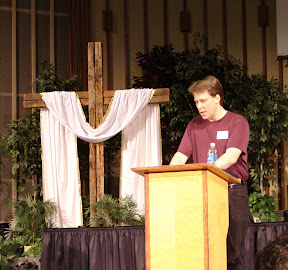
Paul Louis Metzger; Perkins 4-14-07

Intriguingly, one of the opening presentations was a sermon whose text was the recent Johnny Cash life-story film, Walk the Line, which we had coincidentally seen just a few days earlier. The presenter was Paul Louis Metzger, director of the Institute for the Theology of Culture: New Wine, New Wineskins (which sponsored the conference), and a professor at the nearby seminary. His call to all of us was to move "from solitary confinement to solidarity with others." Several times he explicitly called for evangelicals and liberals to work together in mutual respect.

The main draw for me was the keynote speaker, John Perkins, founder of Voice of Calvary Ministries and a number of other organizations dedicated to black Christian leadership and community development and racial reconciliation. As I wrote a couple of years ago, I spent the summer of 1975 at Voice of Calvary's original location, Mendenhall, Mississippi, and have seen John Perkins only once since, so this was a reunion I was really looking forward to.

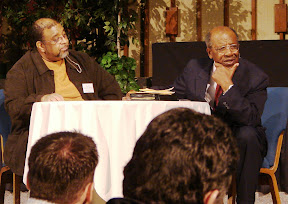
Henry Greenidge (moderator) and John Perkins;
Perkins 4-14-07
Perkins had several urgent things to tell us:

"Talk about 'Free the Captives'--we're talking about freeing ourselves. Prisons are a reflection of our captivity to the culture."

"We have to go beyond symptoms. Churches that only deal with symptoms and don't go beyond to the culture, the cause, become co-victims. Read Psalm 11--We are caulking the cracks--we're putting all our energy into caulking the cracks--but the foundation continues to weaken.... The foundation of society is family and the community. The greatest Christian value is not individualism but community."

"The prodigal son is the righteous one, not the boy who stayed home. The prodigal found out that his life was messed up."

"So, what can the righteous do?" (reconstructed from hasty scribbles; not verbatim!)
  • Find the truth--you'll find it in the Word of God. You need to have faith, and faith comes from the Word of God; faith comes from hearing. Islam has power because they're operating by a book; we're operating by folklore....
  • We need to relearn prayer. Real prayer is 'Lord, what do you want me to do?' The 'name it and claim it' people have hijacked prayer.
  • Decolonize the gospel. ... White folks had black folks looking up at heaven while white folks colonized the earth. But that's not how it is in heaven. The church on earth ought to reflect heaven. Some say we don't like the same music: black folks like loud music, white folks like quiet music. So now we're worshipping music?! We have to get rid of these superficial excuses.
  • The church has to become missional. ... The prison that rehabilitates is the prison where the church has been established. The church is where we're nurtured and equipped to do ministry. If your church isn't doing anything, start another church that is. Get yourself six other people and start a church right in the midst of the problem.
  • You have to develop a philosophy of ministry. The first person your church ought to have fulltime is a youth worker ... Let the pastor be half-time until you have a full-time youth worker.
In the question and answer period, John Perkins also had some interesting things to say. On the recent elections, he said, "Evangelicals were told, 'We have to out and find conservative judges. We need more conservative judges.' The Republicans wasted a lot of money on judges. Thank goodness, in this country, when the Republicans go crazy we can elect the Democrats. Eventually, they'll go crazy, too, and we can elect the Republicans." He also told the story of the evangelical leader who told an assembly, "We need to return to the faith of our forefathers." He reported his own response at that event (by my imperfect memory): "I told them, 'That's the last thing we need to do. If we went back to their faith, we black folks would be back in slavery. Are you crazy?'"

Finally, in response to an other question, he observed that white people in mission and ministry are sometimes too caught up with plans and success. (My own observation is that this may culturally be a "white" style, but it is certainly not limited to those of European origin.) His point: if you go into a situation with five-year plans and ministry goals, you're just going to recolonize the place. First priority is to relocate, and only then, after relationships are established, do you make plans--collaboratively.

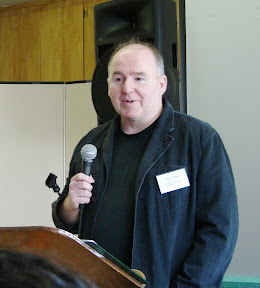
Ron Pate; Perkins 4-14-07
Ron Pate of SCUPE (Seminary Consortium for Urban Pastoral Education) presented a workshop entitled "Releasing Abundance in the Beloved Community." His presentation echoed one of John Perkins' imperatives: "releasing the creativity of the people at the bottom." The key to this release, according to Pate, lies in releasing the church from its cultural captivity to individualism, turning instead to an approach he called "coproduction."

"We typically look at the church outside of culture--whether that is valid or not. But that culture continues to shape everything we do as a church. ... When individualism controls our helping of other people, that help falls short in a number of ways:
  • it's self referential, relying on our judgment of their needs rather than their actual needs [what Perkins would call another form of colonization];
  • our actions are about us, not the person; we fall into the 'self-validation sydrome,' perpetuating the differences between us, demoralizing and depersonalizing ; perpetuates the differences, demoralizes, depersonalizes everyone;
  • it facilitates a therapeutic culture of one-way service delivery to meet the needs of people as we've projected those needs on them."
Pate pointed out that a true PERSON is much more than a clinically regarded "individual," and (to my delight) recommended the work of Eastern Orthodox theologian Kallistos Ware in making the crucial distinction between the individual and the person.

Even a so-called "community" can be shaped by a spirit of individualism. Individualistic communitarianism is a closed system that becomes triumphalistic and defensive, ascribing to itself a self-perpetuating savior role, perceiving people as problems with legs rather that the way a true community sees whole people and invites them in. (Pate recommended the books Becoming a Theologian of the Cross by Gerhard Forde and The Call to Personhood: A Christian Theory of the Individual in Social Relationships by Alistair Iain McFadyen.)

The antidote to individualistic communitarianism is to become persons in community in the spirit of the Triune God. This personhood is
  • dialogical, formed through personal interaction;
  • dialectical, never coming to rest in a final unity and not propped up with static identities.
These are just brief samples of a very rewarding and thought-provoking session. If this is typical of the quality of the work done by the members of the SCUPE team, I am sure that Friends would benefit from engaging with their programs.

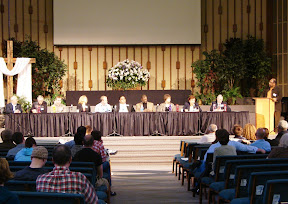
Community panel; Perkins 4-14-07
After the workshop period, we heard from a large panel on community outreach to ex-offenders, a panel that included leaders from churches, nonprofits, and government.

As fascinating as the panel itself was, I was especially pleased to see many people becoming aware of the full extent of the community's resources for those who were in prison, approaching the end of their term, and recently released. Example: one person in the audience was a small businessman who wanted to hire ex-offenders but didn't know what support was available to integrate them into a work culture. Even as he was still speaking, a staff member for Better People was handing him their contact information. At the end of the day, a follow-up conference for local practitioners to organize and support each other was already being planned, to take place at Irvington Covenant Church.


The day wasn't over. At 7:00 I went over to Reedwood Friends Church. The fellowship hall had been transformed from the nice Quakerly dining hall where we hold monthly meeting for business, to a music hall with sophisticated sound equipment. The Russian-language Christian fellowship that normally meets there on Sunday afternoons had organized a CD release party for the band Sons of Day, and two other Russian Christian rock bands had also been invited, Record of Life, and Paperrings.

The hall was full of teens and young adults, and some children, enjoying the music and each other. It was delightful. All of the bands were good, but I was particularly impressed by both the musicianship and the electronics of Paperrings. (Listen to their tracks "Insecure" and "Fake it All." The Web sites all have sample tracks; judge for yourself!) Interestingly, all of the young musicians sang their songs in English.


A glimpse of Virginia Tech through the eyes of Intervarsity Christian Fellowship. (Thanks to IVCF at Reed College.)

"Evangelicals on the Left? How Shocking! How Awful!"

Liberty, equality, fraternity, and arid emptiness: Danny Kruger on "The Right Dialectic." Does anyone else see an affinity with Jim Wallis's God's Politics? Thanks to Andrew Sullivan, who set the context here; he quotes a longer version of Kruger's essay, including a fascinating summary of Benedict XVI's concern about "the arid emptiness in Western culture."

While I'm thanking Andrew Sullivan, look at this hard-to-put-down graphic novel. (l followed Sullivan's link from here.)

The U.S. embassy in Moscow presents an online exhibit commemorating 200 years of U.S.-Russian diplomatic relations. (Thanks to Johnson's Russia List.)

A little over two years ago I described my conversion from a "too nice for me" skeptic to a Derek Trucks fan. I'm glad to see a few Youtube clips to help explain what persuaded me, among them this delicious version of "Key to the Highway." [Update: the original video embedded here is now unavailable, so here in its place is a newer version by the Tedeschi Trucks Band.]

15 March 2007

Quaker shorts

Last month the weblog Brooklyn Quaker included a brief and moving essay, "The Religious Society of Friends has been very very good to me." As I commented there, his story and his sentiment are mine except for personal details. Along with several recent Friendly listings ("10 things I love about Friends," "10 things that drive me crazy about Friends," "My commitment to Friends faith and values in 250 words or less," and so on), that essay inspired the following items.


As an antidote to my recent grumblings about Quaker quarrels and self-absorption (yes, I'm aware that I'm not helping with the latter!), here's a very partial list of things I'm grateful for among Friends.
  • When Jesus finally reached me shortly after I turned 21, and I realized that that he is alive and trustworthy, I was able to believe him but not able to shuck 21 years of anti-religious programming from my parents. Friends (specifically Ottawa Meeting) were there to receive me with what I needed--a low-overhead alternative to the religion industry.
  • Ottawa Friends mentored me in specific ways. For example, they accepted my application for membership after a scandalously short waiting period. (I knew on day one--August 11, 1974--that I wanted to join, but waited for what seemed to me a decent interval to apply. By the standards of others, I later found out, I was in a bit of a hurry.) They put me on their outreach committee, sent me as one of Canadian Yearly Meeting's thirty observers to the Friends World Committee for Consultation's triennial sessions in Hamilton, Ontario, nominated me to a yearly meeting board, supported my summer service with Voice of Calvary in Mississippi in 1975, gave me temporary gigs as warden of the meetinghouse and business manager of The Canadian Friend, and more.
  • I gradually realized that the Ottawa meeting was not entirely in unity on matters of incredible importance to me--such as the important role of the Bible in discernment, and the importance of personal conversion--but no Ottawa Friend ever poured cold water on my story or my beliefs. (Others tried to do so later, but that's another list!) Instead, several Friends in Ottawa gave me precious instruction and encouragement for my growth as a Christian. I almost don't dare start listing them for fear of leaving someone out--but I will mention a few who are no longer alive: Deborah Haight, Betty and Len Huggard, and Susan Pepper.
  • My parents responded to my conversion and my choice of Christian fellowship with incomprehension. The more time I spent with Friends, the more they became my new family. Thankfully, my Canadian relatives, who at that time were in the Anglican charismatic movement, were supportive of my choices. I know that I'm part of the much larger Body of Christ, but it's Quakers who really provided my mothers, fathers, brothers, and sisters in the faith.
  • Four different Friends employers harnessed my passion to communicate Christian faith and practice, supporting me financially for most of my working life to this point.
  • Judy and I met and married within the Boston-area Friends community. Words are totally inadequate even to summarize this blessing, so forgive me if I move on.
  • Friends also provided a funeral for my sister Ellen, twenty years after she was murdered. (My parents buried her with great sorrow but without any ceremony or observance. I didn't know she was buried until I saw the mortuary bill.)


The one thing that drives me crazy about Friends: Our false dichotomies over Quaker identity, which thankfully our little community of bloggers seems to be helping overcome. We do not need to choose between passionate, prophetic, whole-wheat Christianity, with all that this implies (to me) about personal discipleship and evangelism, and being fully Quaker. To me, the relationship between conversion and convincement is this: Conversion is when I crossed the threshold into conscious relationship with Christ, and decided to believe his promises and rely on his company until death. Convincement refers to my decision that Friends discipleship was, for me, the best possible way to implement the commitments that resulted from my conversion.

I remember the late Fred Boots (Quaker librarian, bookseller, and pastor, graduate of Malone College) saying with his inimitable laugh, "Evangelical Friends--that's redundant."


Altar envy: Last week I attended a convocation for adult converts to Roman Catholicism, which took place at St. Mary's Cathedral in Lafayette, Indiana. A dear friend of mine is moving from Quakers to Catholics. We've been corresponding for some time about this decision, and the issues reminded me of another friend of mine who went on the same path almost thirty years ago.

Sometimes I find myself in awe over the cumulative spiritual resources and wisdom of Catholicism--and the sheer density of those resources. With 1.1 billion adherents, there's a richness, a stability, an incredible variety, a racial and ethnic near-universality, that makes Friends sometimes seem mighty thin and whiny and petty. Of course I do not believe that obsessive comparisons are helpful; I believe that God raised up Friends with a particular vocation that makes us neither inferior nor superior, just a different (and tiny) part of the larger Body. If Friends were to abandon our charism, the loss would not only be ours, but other Christians' too. But when we are tempted to compare, we can see that, for our part, there's clearly no place for arrogance!


So what is our vocation among the larger body of Christians? We are called to shape a community around the simplicity of New Testament Christianity. Our central testimony is trust in the promises and power of God, freeing us from the endless searches for control, security, and wealth. Trust is our central testimony; all the others spring from it. With trust in the promises and mandates that Jesus made in person to our family 2000 years ago and confirms daily, we can lay down our dependence on weapons, false social distinctions, and affluence.

Three factors (at least) weaken us in our contemporary realization of this calling: not enough of us know our own spiritual gifts and how they mesh together in the community; we pay far too little attention to making our communities accessible to those who would find spiritual liberation among us; and too often we cover up the weaknesses caused by these failures by the usual counterfeits: legalism (either a Christian legalism or an absurdly thorough mastery of Quaker trivia); lame imitation of "successful" models outside Friends; uncritical sentimentality; a social quakerism devoid of belief in the power of God--what Parker Palmer called functional atheism.


More proof that we are family: I'm very grateful for the prayers that surrounded me when I want to Zion, Illinois, for my mother's memorial meeting at the Arbor View nursing home.

My mother taught German language and literature for many years, and one of my earliest childhood memories is of looking at the spines of volume after volume of books of German literature in her library. One of the readings I chose for the service was this poem by Rainer Maria Rilke (Cliff Crego's translation from this site):
Ich bin auf der Welt zu allein und doch nicht allein genug,
um jede Stunde zu weihen.
Ich bin auf der Welt zu gering und doch nicht klein genug,
um vor dir zu sein wie ein Ding,
dunkel und klug.
Ich will meinen Willen und will meinen Willen begleiten
die Wege zur Tat;
und will in stillen, irgendwie zörgernden Zeiten,
wenn etwas naht,
unter den Wissenden sein
oder allein.
Ich will dich immer spiegeln in ganzer Gestalt,
und will niemals blind sein oder zu alt,
um dein schweres schwankendes Bild zu halten.
Ich will mich entfalten.
Nirgends will ich gebogen bleiben,
denn dort bin ich gelogen, wo ich gebogen bin.
Und ich will meinen Sinn
wahr vor dir. Ich will mich beschreiben
wie ein Bild, das ich sah,
lange und nah,
wie ein Wort, das ich begriff,
wie meinen täglichen Krug,
wie meiner Mutter Gesicht,
wie ein Schiff,
das mich trug
durch den tödlichsten Sturm.

I am too alone in the world, and yet not alone enough
to make every hour holy.
I am too small in the world, and yet not tiny enough
just to stand before you like a thing,
dark and shrewd.
I want my will, and I want to be with my will
as it moves towards deed;
and in those quiet, somehow hesitating times,
when something is approaching,
I want to be with those who are wise
or else alone.
I want always to be a mirror that reflects your whole being,
and never to be too blind or too old
to hold your heavy, swaying image.
I want to unfold.
Nowhere do I want to remain folded,
because where I am bent and folded, there I am lie.
And I want my meaning
true for you. I want to describe myself
like a painting that I studied
closely for a long, long time,
like a word I finally understood,
like the pitcher of water I use every day,
like the face of my mother,
like a ship
that carried me
through the deadliest storm of all.


Among this week's righteous links, this just in: Rebecca Solnit on "Not forgetting New Orleans."

T. Vail Palmer, the Friend who first told me about my present meeting, Reedwood Friends Church, about three decades ago, has been writing about "Friends, God, and the Bible." He has set up a new Web site to make his work available.

The Mobtown Blues entry, "All paths don't lead to the top of the same mountain," provided a lot of food for thought for me this week.

I was delighted to see a Northwest Yearly Meeting Friend blogging recently about John Perkins, whose Voice of Calvary organization provided the Mississippi experience I mentioned above and wrote about here at greater length. The Christianity Today Web site has this appreciation of "Grandpa" John and Vera Mae Perkins.

I consume these "Hello I'm a Mac"/"And I'm a PC" ads like candy (my favorite is "the counselor"), but as effective as these ads are, I realize that I don't see myself switching to the Mac side. I still miss DOS!

If a theologically conservative Baptist preacher and radio talk show host can raise the subject of impeaching George Bush, is it really such a fringe idea? The motivation for impeachment should not arise from venom or a mean spirit, but the possibility should not be avoided simply out of undue awe at its radical nature, nor out of fear of a Cheney presidency. A free and democratic people, whose constitution has made available this mechanism for dealing with high crimes and misdemeanors, should use the mechanism when it is appropriate--not casually, but there is nothing casual about the corruption, deception, and centralization of power in the White House that is the record of Bush's leadership. To advocate impeachment, it is also not necessary to determine in advance whether Bush is a nice person or has decent and honorable motives. The simple object of impeachment is to remove from this powerful office, the U.S. presidency, a man who is not fit to occupy that office. [Thanks to John Sugg of creativeloafing.com for the reference.]


Howlin' Wolf, back on that German sound stage, performs "I'll Be Back Someday":


02 February 2006

I Googled myself ...

Google's Chinese site... but not the way you think—I didn't put my name into the search engine. (I did do that a few years ago and found out from several sites that I was on my way to hell because I'd signed some ecumenical anti-war statements as general secretary of Friends United Meeting.)

No, this time I'm referring to something else. The story began a week ago on Monday, when my beloved laptop computer's hard disk lost its drive. No amount of motivational urging seemed to bring Cranespoon's drive back. (That's its name.)

I phoned my computer's HMO (I'd paid in advance for its health care when I bought the computer), and in a couple of days a padded box arrived to transport my shiny paperweight to what I was assured would be a clean room, where its drive would be restored. In the meantime, I used our old desktop computer, affectionately named the Amethystspoon, using files stored on a yet older computer, Titaniumspoon. Its ancestor, Woodenspoon, a first-generation Pentium computer, left us less than a year ago, after years of honorable retirement as a Linux box serving our family network.

Cranespoon returned yesterday after its hard-disk transplant. My work files had all been safe—backed up on the Titaniumspoon, and as attachments sent to gmail, and on a distant vpn server—but my idiosyncratic set of programs needed to be reassembled. That's where Google came in: when looking for Google Desktop for indexing and new-mail announcements, I saw they had assembled a big bunch of useful programs all into one download—Desktop, Picasa photohandling, Firefox browser, Realplayer, Adobe Reader, Ad-Aware. After that one-stop Google site, I only had a few more places to visit for downloads: openoffice.org for my word processing, and sourceforge.net for GAIM instant messaging, Audacity audio file handling, and Juice podcast receiver. After a day of downloading, and a few more traditional CD installations—Corel WordPerfect, Palm Desktop, Olympus DSS Player—my computer had regained its drive.

Letting Google have so much of my hard drive gave me pause. I enjoyed John C. Dvorak's defense of Google in light of the China controversy (and his account of the dubious antiquity of their supposed motto "Do no evil"). I enjoy the whimsy of a search engine that offers Klingon and Pig Latin versions of their home page. I'm even slightly glad that they may actually represent a civilian entity with more intelligence capacity than the National Security Agency. I just hope that this whimsy and the moral transparency that characterized their agonizing over the Chinese restrictions will prevent them from becoming the information-utility equivalent of Enron.


From out of the mouths of non-Quakers comes the essence of Quaker evangelism: "Fresh Ministry" interviews Erwin McManus:

EM: "Every human has God placed evidences within their soul. Postmodern evangelism is extracting those evidences from the soul and show them to them. I say, 'Inside you is a craving you need to listen to.'"

FM: How has postmodernism affected the church?

EM: "The churches that will cease to exist are not those who are doctrinally errant, but are spiritually errant. You can't get away with it anymore. You can't just talk about what the bible says, you better flesh it out or you are dead."

"That's what's exciting about the world in which we live. Only the viable church of Jesus Christ will survive, the inauthentic need not apply. I want to live in the world that if the church is not the revolution that Jesus died to establish 2000 years ago it ceases to exist. I want to live in a world where the church has no more crutches, or buffers to guard her from injury. I want a church where a culture no longer protects her. Whenever the gospel enters an environment, it prevails."

"Its not about structures, strategies, programs or patterns. If you don't rediscover the apostolic, you'll die!"

I am wholeheartedly in unity with these sentiments, but too often they strike me, upon reflection, as a sort of evangelical machismo. Does it eventually mean more than having digital projection confessionals, or having Starbucks in church (or even vice versa)? Is it just another version of entrepreneurial church-building by and for personality-driven "highly effective" males? (Well, usually males.) Those nun books are looking better! (Reading Rumer Godden's In This House of Brede reminds me of how radical "enclosure" can be, how defiant of the world's values.)

Or is something else, something new, going on when we hear such brave statements as "I want to live in a world where a culture no longer protects [the church]"? I posted on another weblog my sense that there is a deep mutual reinforcement between the concepts of evangelism and civil disobedience, or, to use the tagline of Christian Peacemaker Teams, between the concepts of evangelism and "getting in the way."

PS: What makes it all so complicated is that even the alpha males of evangelicalism sometimes get it right (let me think: have I ever had mixed motives??) and anyway, they no longer have a monopoly on airtime. What gives me hope are little evidences here and there, such as the prayer letters from the InterVarsity workers at Reed College, of Jesus himself showing up without warning or authorization. These letters are just too tender for me to post here, but miracles happen. (NOTE: The husband in this InterVarsity team, Michael Havens, is the grandson of the late beloved Friends Joe and Teresina Havens.)

And I can't do better than to get an eyeful of the stories at 24-7prayer.com.


What does 'carnal' mean?—a preface: For some time, I've been wanting to reflect on the word "carnal"—for example, as it was used in the letter from a Friends meeting in Indiana to Quaker Life, protesting one of our articles. An interesting weblog entry from Peter Blood anticipated some of the subject, and I've been thinking a lot about both the cheer and the distress I feel reading his words. (Thanks to quakerquaker.org for the reference.)

Not a moment too soon, there's growing evidence of a willingness to discuss these tender subjects of physicality, sexuality, and holiness. Twice recently, the Barclay Press Web site has also opened a forum, via book discussions on Real Sex and Sexuality and Holy Longing, to address sexuality in a helpful way. Further back, I remember Herb Lape raising concerns in the context of New York Yearly Meeting's rewriting of its discipline; and I vividly remember Friends United Meeting's struggles to survive the clashes of angry Friends on both "sides" of sexual-ethics debates who sometimes seemed to feel no regret about nearly destroying the community in whose arenas they fought.

At the 1991 World Conference of Friends in Honduras, some Latin American Friends were deeply distressed by the spectacle of English-speaking Friends dancing one evening after a Garifuna cultural presentation; I wish many more Friends could have been present the next day as small groups processed the clash in understandings of holiness and culture. Some Friends seem predisposed to see corrupting carnality everywhere they look, to be warded off by strict behavioral guidelines; others seem amazingly casual, even clueless, about the psychic realities underlying the ways we dress, dance, consume, and—too often—abdicate our responsibilities as parents and elders in community, to the point where it begins to look as if those cautious Holiness types sometimes have a slightly better grip on reality. Maybe some of the recent discussions of plain dress and varying interpretations of modesty have contributed to the more tender climate that we seem to be enjoying. Plain Friends may be contributing to a healthy dialogue among those who formerly would too quickly dismiss each other as "holiness" or "liberal."


Timing is everything. I apparently missed my chance to go back to the city of my birth without going bankrupt. Reuters (via Yahoo) tells me that my beloved Oslo has become the world's most expensive city. I've been wondering when to use my frequent flyer miles to visit my relatives again, but it seems that the air fare would be the least of my expenses.


FRIDAY PS: ChristianityToday.com on Black History Month. Christianity Today's holiday portal for Black History Month includes links to articles by two of the Voice of Calvary leaders under whom I was privileged to work 31 years ago in Jackson and Mendenhall, Mississippi—Dolphus Weary and John Perkins. (Thanks to Northwest Yearly Meeting's peace education coordinator, Kayla Walker Edin, for this reference.)

23 June 2005

Mississippi mellowing?

I have been following the coverage of the trial of former KKK-man Edgar Ray Killen for his involvement in the deaths of Michael Schwerner, Andrew Goodman and James Chaney, the three Freedom Summer civil rights campaigners murdered in Philadelphia, Mississippi, in 1964.

I spent most of the summer of 1975 in Mendenhall, Mississippi, working with Voice of Calvary, founded by John Perkins to promote "Black Christian leadership development" and alternative economic structures. Back then it seemed as if the era of civil rights violence was in the distant past; from my current time horizon, of course, things look different. Eleven years between the Freedom Summer campaign and my first visit to Mississippi doesn't seem long now.

Downtown Mendenhall, 1975
House on our side of Mendenhall
John Perkins
Dolphus Weary (right) and 1975 version of me

Mendenhall looked like many of the stereotypes I'd received of small-town Mississippi—right down to the railroad tracks dividing the races. We summer volunteers (all but one were white) were not popular downtown, with the exception of the Post Office, where we were treated with almost startling courtesy.

Three of us volunteers were from Friends, recruited through the American Friends Service Committee's Community Relations Division. Almost all the others were from evangelical colleges; one was from Circle Church in Chicago. The full group of about twenty volunteers were divided into two teams; some of us stayed in the state capital of Jackson, working directly with John and Vera Mae Perkins in the new Voice of Calvary headquarters. The rest of us went to Mendenhall and worked under Dolphus Weary in two programs; some with the downtown medical outreach, some with a Christian version of Head Start, helping young people get ready for the new school year. That was my assignment.

That was such an amazing summer. VOC's Berea Bible Church pastor Artis Fletcher led us through a study of the epistle to the Hebrews, my first exposure to a really careful Bible study, simultaneously devotional and scholarly. As a Friend, one my most vivid memories of Dolphus and Artis was a conversation in which I was asked, "Why are there so few black Quakers? After the Underground Railroad and the Civil War, you could have had us all." I know some of the scholarly answers to that question, but I can't give a decent heart-level answer, and that remains a source of grief.

We worked hard that summer. I was so shy about helping with the cooking that I offered to be a permanent dishwasher to get out of the cooking rotation. Our meal budget was 35c/person/meal. Needless to say, we shopped and cooked very carefully (and looking back on it, probably very health-fully). The local kids looked at our meals with open disbelief. The community compensated us for our spartan ways with their all-out Sunday after-church community dinners, which in quality and quantity simply defied description. We probably didn't really need to eat again that week.

I remember that it was at Voice of Calvary in Mendenhall that I first heard, in one of John Perkins' lectures, about the book Pedagogy of the Oppressed by Paulo Freire. (When I learned that Billy Graham helped fund John Perkins' work, I realized that the evangelical world was a lot more complex than its stereotypes implied.) Some of the evangelical college students had also brought with them copies of an odd magazine called the Post-American, since renamed Sojourners. And it was there that I first heard that Friends had a seminary, Earlham School of Religion, where I enrolled as a student eight years later.

Other good memories include a field trip to New Orleans. We broke our journey at Gulfport, Mississippi, where we spent the night in a park, under the stars. (Actually, I slept under a park bench.) Any discomfort was made up for by the next day's music and gumbo.

As soon as the summer ended, I was on my way to Russia for the first time, for two weeks in Moscow and Leningrad. I remember comparing those two great experiences of my 23rd year on planet earth, and reflecting that the months in Mississippi were the larger culture shock.


Back to 2005. I was fascinated by an interview on yesterday's edition of the radio program The World. Here was another Norwegian talking about his experiences of Mississippi, television reporter Gerhard Helskog. He told Lisa Mullins that many European journalists were being encouraged to see the trial of Edgar Ray Killen as a chance to exhibit the USA's primitive side, its racism and intellectual underdevelopment, perhaps as a reaction to current international politics. What he found in his travels, was a very different Mississippi from what the old stereotypes might have led him to believe. (Listen to the interview. [dead link])

Never having returned to Mississippi after my memorable summer, I'm not qualified to comment.

PS: Last summer, I posted an admittedly cranky piece about, among other things, the media's ignorance in covering Al Sharpton's speech, particularly at the point where he referred to the "good men [inaudible]," Chaney, Goodman, and Schwerner.


PS #2: For more historical perspective, take a look at Martin Kelley's post on "the early blogging days," including what might be a screen shot for the first weblog.

Martin inspired me to go into my (paper) files and look again at the reams of continuous-form paper containing some of my first e-mail archives, from back when I was CompuServe subscriber no. 72763,366, using a 1200 bps modem that came with a bonus diskette containing the game Wheel of Fortune. Unfortunately we couldn't use that game until we got a graphics card, which we did.

Until 1990, I could only communicate with other CompuServe subscribers, and, theoretically, those with MCIMail. And we were able to send and receive Telex messages, and CompuServe offered some fax and paper-mail output services. In those days, CompuServe held aloof from the wider Internet.

In 1990, we moved from Richmond, Indiana, to Wilmington, Ohio. CompuServe did not have a local number there, so I switched to PeaceNet (I think my address was fwccoh@igc.apc.org) and got involved with my first e-mail list, gen.quaker, under the thoughtful coordination of Joel Gazis-Sax. By that time, our first modem had been fried by lightning, so I was up to a blazing 2400 bps. In 1993, we moved back to Richmond and returned to CompuServe, which by then had joined the Internet.

Re-reading all this stuff has a humbling effect as I realize how many times I basically beat the same drum. Here's one of my more economical summaries, at the end of a long rant I sent out on October 30, 1993:
In considering the ways Friends obsess on either quakerishness or doctrinal purity instead of the living God, I've been pondering two scriptures -- John 5:39-40 and Romans 10:1-3.