Showing posts with label development. Show all posts

31 August 2023

A Right Sharing reunion, part two

Phanice Kenyorwa, Keyo Friends Women Group, Kenya (Right Sharing partners). Photo courtesy RSWR.

Of Phanice Kenyorwa's eight children, four are still living at home. She has 6 grandchildren also under her care. Phanice has a husband who is older and cannot work. He once worked as a butcher, but he became diabetic and can't work anymore. Reasons why she chose goat rearing for her business: Phanice ventured into goat rearing and selling because of advice from her husband as well as high demand of goat meat at the butchery where her husband once worked. Together with that, she does some farming of indigenous vegetables. She is so confident of her business because her own children help her to graze the goats and therefore it saves on labor.The business has helped Phanice to renovate their house which was leaking and also to put food on the table.


Grace Akaranga, chair lady of Keyo Friends
Women Group, in her village shop. Photo
courtesy RSWR.
Anne Jahenda at Kapkereri local market.
Photo courtesy RSWR.
Jackie Stillwell, general secretary, RSWR
(right), with Judy and me at Britain Yearly
Meeting 2023. Photo courtesy Jackie Stillwell.

It's very hard for me to believe it, but it has been thirty years since I ended my service with Right Sharing of World Resources. To all appearances, the program is flourishing. I can't help wanting to know, how has it changed over the decades?

This may not be the most important answer, but for one thing, it's an independent Quaker program. My service with Right Sharing (1986-1993) was part of my responsibilities as a field staffer with Friends World Committee for Consultation, Section of the Americas. 

When Right Sharing was a new vision for global economic justice via "right sharing" of our resources (at least "one percent more" from individuals and nations alike), that affiliation with FWCC provided a trustworthy anchor in the Quaker constellation of organizations, open to participation by all Friends of whatever location or theology. It was also an economical way of managing a program of its small size. However, as it grew to become one of the largest units of FWCC in terms of finances, it threatened to pull resources from the wider FWCC mission.

It was also a bit of a category mismatch. As Indianapolis First Friends pastor Lorton Heusel pointed out to me at the start of my service, Right Sharing was an action-oriented program devoted to development and economic justice, while FWCC as a whole was devoted to communication and consultation across the Quaker world. Wouldn't that confuse some audiences?

As the program became larger, some Right Sharing donors resented paying a small percentage toward FWCC's administrative costs, although without that administration, there would have been no program. All in all, when Right Sharing became independent a few years after my departure, the new arrangement made a lot of sense, and I very much enjoyed my term on the new trustees, with the late, much-missed Roland Kreager as the Right Sharing coordinator.


A couple of years ago, I reported on a reunion of Right Sharing trustees. That meeting answered a lot of my questions about what had changed and what had remained of the "old" Right Sharing. 

A few months ago Right Sharing held another such meeting of current and former trustees. Among the highlights this time was the addition of a fourth country—Guatemala—to the three countries where Right Sharing's partners were then located: India, Sierra Leone, Kenya. In each of these four countries there are Right Sharing coordinators and trainers. One of them, I'm delighted to say, was a familiar face from my time on the staff: Dr. R. Kannan. His work with local nongovernmental organizations and grassroots groups may have been Right Sharing's very first experiences with what is now standard practice: providing local assistance, training, and evaluation services for new and potential partner groups.

One of our romantic notions in the early years of Right Sharing was that somehow we could form meaningful partnerships simply based on informal visitations by Quaker travelers and Quaker volunteers in the Peace Corps, and similar improvisations. Also, somehow the groups we worked with would already know how to write an attractive proposal (without paying to copy someone else's successful proposal, and without feeling forced to parrot the jargon already proven to be attractive to Western donors), and would also, without further help, be able to receive and account for a chunk of new money. Kannan began to show how these relationships could be made more meaningful and secure, to the benefit of everyone involved.


What does all this look like in practice? I'm very thankful to Sarah Northrop, RSWR's program director, for telling me about one specific community partner, the Keyo Friends Women Group in Vihiga county, Kenya, as a case study of today's Right Sharing. Sarah writes:

Development of Keyo Friends Women Group and its partnership with Right Sharing of World Resources

In Kenya, it is common for women to come together as a group. There are church groups, groups of women who work together, community groups, groups formed around an interest, etc. In many of these groups, women practice “merry-go-round”. At each meeting, each woman puts a specified amount of money into a pot and it is given to one woman - usually the woman who is hosting the meeting that day. The person who receives the pot rotates through all of the members and then it starts over again. This practice of merry-go-round binds the women together and the money itself is useful to pay for big expenses such as school fees or holiday celebrations.

Keyo Friends Women Group was started as a United Society of Friends Women group of Keyo Friends Church in 2015. It was established as a prayer and support group, but they practiced merry-go-round banking also. As in much of rural Kenya, all of the women of Keyo Friends were struggling economically. Their main source of livelihood came from their small farming plots, but over the years, the plots had gotten smaller and smaller as they were divided among all the male heirs in a family, and much of land was sold to large tea and sugarcane farming enterprises. By 2015, the farm plots were no longer able to feed the families and women all over rural Kenya were looking for another way to support their families.

The Keyo group decided to invite a government Social Services officer to teach them how to do table banking so that they could establish a group revolving loan fund to support personal small businesses. Table Banking is similar to merry-go-round, but the money the women put in is not returned to them. It is kept in the group treasury and women who want to start a business can take a loan from the treasury to have capital for the businesses. When the loans are repaid with interest, the group table banking fund is further augmented. The government of Kenya, through their Social Service department, has a program that encourages women groups to start table banking and small-scale enterprises.

Sometime in 2016 or 2017, some of the women from the Keyo group went to a USFW conference where Samson Ababu made a presentation about Right Sharing of World Resources. The Right Sharing program offers women groups a much larger capital fund than they can save on their own and also provides training and support to the groups. The Keyo women asked Samson to come and speak more about RSWR to their group. Afterwards, they decided to become part of the Right Sharing program. They received training in group dynamics and were assisted to register their group and put into place procedures to ensure that the group was run fairly and democratically.

When they sent their application for a grant in the fall of 2018, the RSWR Country Coordinators ranked them highly and commented that the group was a mixture of many different tribes who were working well together and that they were actively trying to overcome the poverty that they found themselves in. Their grant was approved by the RSWR board and they received the funds in January of 2019. Since that time, the group has gone through many hardships and struggles, including Covid-19 and extremely high inflation in Kenya. However, they have stuck together and are still working hard to improve their lives. Their RSWR revolving loan fund is still intact and it continues to help them keep their businesses going and even grow the businesses which are now their main source of livelihood. All 30 of the original women are still active members and 5 new women have joined the group.

Source.  
Sarah Northrop is the Program Director for Right Sharing of World Resources. A graduate of Earlham College and a member of West Richmond Friends in Richmond, Indiana, Sarah has worked at RSWR since 2007, first as Assistant to the Program Director and as Program Director since 2013. Sarah’s job includes liaising with RSWR Country Coordinators in our four countries, preparing information on projects and overseas partners for board, staff and donors, receiving and processing reports and other communications from our partner NGOs and women groups, and maintaining the database of RSWR past and present projects. Sarah works from her home in Chelem, in the state of Yucatán, Mexico.


When I was the Right Sharing coordinator, working from home in Richmond, Indiana, and then Wilmington, Ohio, with at most one part-time staffer working alongside me, and no permanent staff anywhere else, it was a point of pride (and of our fundraising!) that we operated a lean organization and could plow most income directly into grants to partners.

Actually, it was misplaced pride. A significant part of Right Sharing's budget now pays for training and preparation to make the partnerships more sustainable in the long run, and to make the relationships far more real. In my own time, I might have worried that donors wouldn't understand how important it was that this intermediary role be funded, but it seems as if donors do understand. Not only do those coordinators and trainers add integrity to the relationships, they also serve the goal of shifting the emphasis of Right Sharing from funders' decisionmaking in favor of partners' experience and initiative.


A selection of links to Right Sharing history (some of these were also in part one).

And for more recent history, Right Sharing newsletter archives back to 2016.


Jacob Meador on why Americans really stopped going to church.

The theologian Stanley Hauerwas captured the problem well when he said that “pastoral care has become obsessed with the personal wounds of people in advanced industrial societies who have discovered that their lives lack meaning.” The difficulty is that many of the wounds and aches provoked by our current order aren’t of a sort that can be managed or life-hacked away. They are resolved only by changing one’s life, by becoming a radically different sort of person belonging to a radically different sort of community.

Are churchgoers more likely to see life as exciting?

Pastor Sean Muldowny on pastoring in the Trump era. (Via Kristin Du Mez.)

Jeremy Morris considers what we're learning from the death of Yevgeny Prigozhin. "...[A]mbiguity over the sources and reasons for violence are useful to the Putin regime."

Beth Felker Jones offers a prayer for back to school.

Frida Berrigan on facing a world that has become an oven. In large ways and small, we need to reinvent ourselves.

Micah Bales on what happens when the Holy Spirit tweaks a sermon.


For blues dessert, here's a rerun especially sent out to our former students. Hans Theessink, "Walking the Dog."

20 May 2021

Who wants to "teach lessons"? Who wants to learn?

Source.  
The Israeli government will not stop its operation against the militant Hamas group anytime soon unless two specific goals are reached, Israeli Ambassador to the United States and to the United Nations Gilad Erdan warned Thursday. "First of all, [we want] to teach the Hamas a lesson that they cannot continue to try, to indiscriminately try to murder our people," Erdan said on Newsmax TV's "Wake Up America."

"Teaching lessons" is a popular cliche. A spokesman from Hamas, the party in power in the Gaza Strip, used it after a previous clash with Israel:

"We taught Israel a serious lesson. This is a message to Israel," said Abu Zuhri. "The attitude of the resistance groups will be determined according to the behavior of Israel."

Many want to teach lessons; few want to learn. What lessons might be on offer from these nearly two weeks of hell in Gaza, and tragic disorders all over Israel and Palestine?

Yes, the destruction in Gaza probably was costly for Hamas, who fired around 4000 short-range unguided missiles toward Israeli towns during this conflict. With its bombs and artillery, Israel claims to have set Hamas infrastructure back by years. Did Israel succeed in teaching Hamas a lesson?

Think about it. Launching those missiles and provoking Israel's response brought destruction to Gaza City ... and long-overdue attention to the Palestinian cause.

Memorial Meeting for Misha Roshchin:
this Saturday, 19.00 Moscow time.
(For Skype link, contact me directly.)

Israelis (quite rightly) grieved the loss of life caused by those missiles, and were understandably angered by the psychological terror and physical inconvenience of Hamas attacks. The Israeli response to those missiles was loud and dramatic and terribly destructive, but its duration was relatively short. In contrast, the deprivation and desperation of those trapped in the Gaza Strip is constant. This deprivation and desperation is usually invisible to the world -- except during clashes with Israel. Lesson: The risks involved with attacking Israel might be outweighed by the benefit of letting the world see the harsh realities of living in an Israeli-controlled prison camp (and not to be too cynical, also gaining for Hamas the political benefit of looking like heroes in the fight against Israel ... and Fatah).

The biggest lesson of all might relate to the term that Israel and all its allies use to justify Israeli "lessons": 

Israel has the right to defend its people.

Yes, it does. Few dispute that Israel has the same right as any country to ensure the safety of its people, and by the established custom of this violent and unredeemed world, it has the right to use violence if necessary.

  • Question 1 of this lesson: Is violence necessary? Are there other means to ensure the safety of its people, making the deaths of innocent children avoidable? Are there ways to address the actual grievances and desperation of those Palestinian people in whose name the Hamas forces launch their rockets? As I asked last week, are there law enforcement methods that are far more appropriate than full-scale military combat for confronting urban terrorism when it does arise? By such humane and proportional means, might Hamas even become reduced, isolated, irrelevant? How many resources should go into solving these baseline problems in Gaza, in comparison to the fabulous amounts that Israeli and USA taxpayers spend on "teaching lessons" with high-tech brutality?
  • Question 2: Who are "Israel's people" -- that is, the people whose safety Israel is bound to ensure? Those who rest their case on Israel's right to self-defense may hope that we don't ask this question, but the answer is simple: "Israel's people" include all those who are under Israel's control, who are trapped by Israeli walls and forces, unable to come and go freely. A trivial example: in the present crisis, some Israelis chose to spend time with relatives living outside Hamas missiles' range. How many civilians of Gaza could make an equivalent decision? What Israeli citizen has to worry about access to jobs, food, electricity, water, land, good standards of health care, not to mention international travel and education, in the way residents of Gaza and the rest of Palestine must worry? Yet, Israel has ultimate control over most of these resources, with little or no possibility of appeal by Palestinians and their Israeli allies.

Israel asks the community of democratic nations: what country would tolerate missile attacks on its people? The rest of the world's democracies should be replying: good point! And, given the way you treat millions of people who are under your military control, and whose welfare therefore depends on you, are you honestly surprised that the relatively few among them who rig up those pathetic missiles might be seen as heroes? Aside from suffering meekly and invisibly and indefinitely, what other options have you left them?


Lesson: "I will never lose my optimism. There are people on both sides who want peace. The real battle is not between Israel and Palestine, but between those who want to coexist and those who dream of expelling or killing the other side." -- Palestinian educator Khalil Bashir, in Yousef Bashir's The Words of My Father: Love and Pain in Palestine.


Jayson Casper, Christianity Today: Ten Christian views on the conflict in Gaza and Israel.

World reaction to Israeli-Hamas ceasefire.

Materials from the blocked (why??) Andrei Sakharov exhibition.

Luna Reyes "showing the world what humanity looks like."

After reading Kate Bowler's previous book, I've preordered her new one, No Cure for Being Human.

The Poor People's Campaign and U.S. congresswomen Jayapal and Lee announce a Third Reconstruction resolution to confront poverty.


"More love, more love, ... O Zion, more love." Thanks to riseupandsing.org for the link to this video. Lyrics here. (Blues will be back next week.)

15 April 2021

A Right Sharing reunion

Right Sharing of World Resources newsletters 2021 and 1987. Sources: 1987 and 2021.

A month ago, the Quaker organization Right Sharing of World Resources gathered a group of former Right Sharing trustees for an online reunion, inviting input on visions for the future of the organization. The following observations are mine alone, not approved by staff or trustees, and subject to comment and improvement by any of them!

As both a former staffer and a former trustee, I loved the idea of hearing first-hand what was going on in the world of Right Sharing, a program for which I cannot pretend to be objective. Although I've been a contributor for years, I was only vaguely aware of some of the developments since my time of direct involvement, and this March 2021 reunion-by-videoconference seemed like a great way for me to get caught up. Despite its obvious growth in scale and sophistication, was Right Sharing still the human-scale development aid and development education program, relying heavily on relationships, that I'd known and loved?

Link to excerpt on Right Sharing.
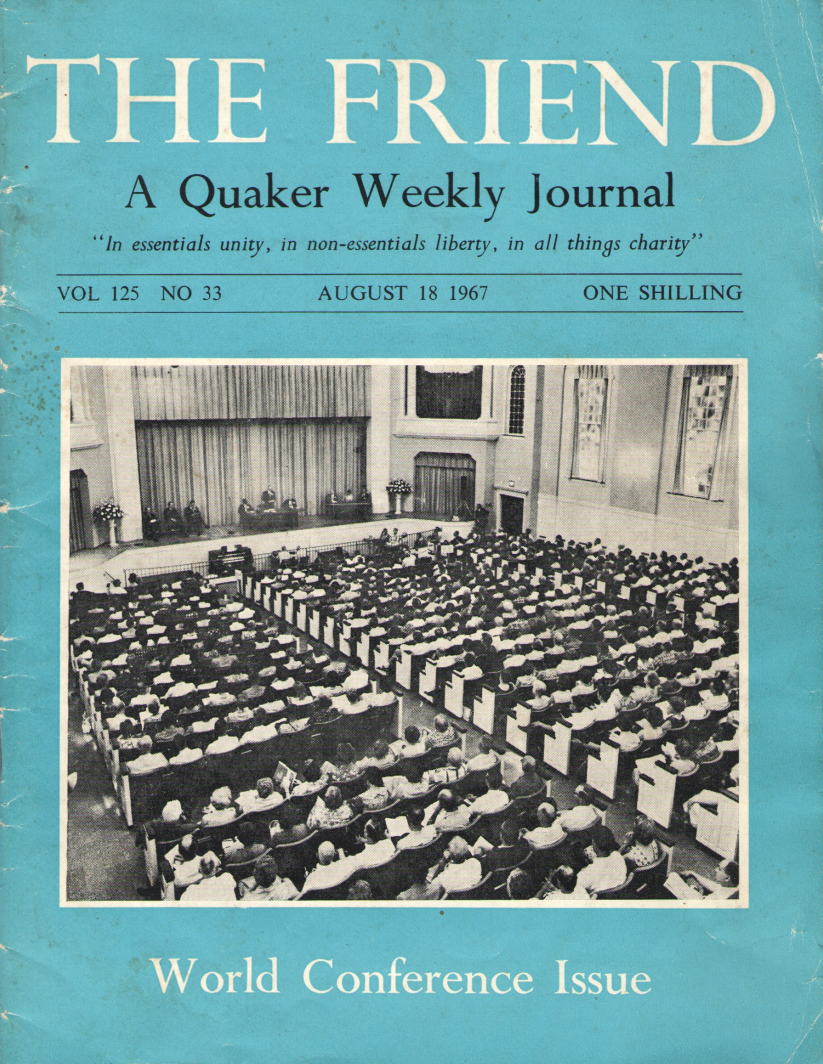
(Some background: Right Sharing emerged as a concern at the World Conference of Friends in Greensboro, North Carolina, in 1967, where the words "right sharing of world resources" were first used as part of that gathering's concern to confront poverty and economic injustice. [See these pages from The Friend's coverage of that conference.] In the European yearly meetings, the implementation of this vision mostly devolved to the individual yearly meetings. In London Yearly Meeting, for example, a One Percent Fund was established, to be managed by a Sharing World Resources committee that carried the program on for the next twenty years.

(For the Friends World Committee for Consultation's American Section -- now Section of the Americas -- a One Percent More fund was set up in 1969, and a Right Sharing Committee was set up in 1974 to work alongside Right Sharing Committees in five USA yearly meetings and with interested Friends in other yearly meetings. Interestingly, the money generated by the Right Sharing vision started coming into FWCC before any Right Sharing program was established; the Section had to scramble to organize good stewardship for this burst of support. For this background, I've drawn on Herbert Hadley's history of FWCC, Quakers World Wide, as well as my own memories.

(I began as staff for Right Sharing in January 1986 -- following Sharli Powers Land, who also edited FWCC Section of the Americas publications -- and I left the staff in March 1993. The late Roland Kreager followed me as staff; during his tenure, Right Sharing of World Resources left the Friends World Committee umbrella and became a separate organization with its own trustees. I was very glad to serve on this group in those early years. In this interview, current general secretary Jackie Stillwell gives a very helpful summary of today's Right Sharing. In recent newsletters, you can see vivid examples of both similarities and differences between the "old" Right Sharing and today's program.)

In the last year of my service, Betsy Mathiot (known to many of us as Betsy Moen during her years of active involvement with Right Sharing) was guest editor for an issue of Hunger Notes, and asked me to write an article about my experiences with the program. In the resulting article, I tried to summarize what I'd learned over the seven years I served -- including a growing appreciation of the limits of development doctrine, the importance of relationship, the temptations to corruption that we ourselves can allow through ignorance, and the pitfalls of project-oriented management. 

One of the biggest differences between then and now, I feel, is that the lessons that I was barely able to put words to, have now become embodied in a thoughtful and well-balanced way. Relationships are still encouraged, but field representatives in each country now provide reliable links between the support community and the local groups whom we're privileged to encourage and learn from -- links that seem more conducive to stability, trust, and practical mentorship than our older reliance on almost random volunteers. Instead of spreading ourselves across ten or more countries, today's Right Sharing focuses on three -- India, Sierra Leone, and Kenya. 

Another important program focus is support for women's groups, which represents (to me) the conscious adoption of an insight that was just part of the gradual learning process in my time: aid to women supports the whole family, whereas, too often, resources acquired by men are spent by those men on themselves. The World Bank and others documented this reality already in the early 1970's (if not before), but an organization with limited resources and a human-scale vision does well to turn insight into program. Men are not shunned -- a couple of the the field representatives are men -- but the community-level participants and leaders are women.

There's also definite continuity with the Right Sharing of the 1980's and 1990's. Most of the groups in partnership with Right Sharing consist of women learning how to create and manage their own small businesses and getting loans for their businesses, which when repaid will in turn enable others in their communities to get similar loans. The majority of the groups we worked with did exactly the same -- and I'm sure met some of the same challenges, whether they were operating street food stands in Cairo, weaving in Dhaka, or tending water buffalo in Madurai District.

These are some of the things I learned during our Right Sharing videoconference last month. In small groups, we were also invited to contribute our own ideas of what Right Sharing might look like, what directions it might take, in the next twenty years. Surveying the results, among the important points raised in our small groups were these: (this list is edited by me alone, and I bear sole responsibility for the emphases and omissions!) 

  • Continue to acknowledge and encourage the shift in power that occurs when funding decisions are made in the field, by people in touch with local realities, rather than by a central North America-based structure composed of people who are often racially and culturally disconnected from the "beneficiaries." 
  • By emphasizing partnerships with women, we reflect the often-documented reality mentioned above, that when resources go to women, the whole family benefits….  However, as Betsy Moen said years ago in her Right Sharing talk at the University of the West Indies (mentioned somewhere in the middle of this blog post), where does that leave men? Betsy's question may lead to fruitful conversations and partnerships in the next generation, but, in our small group, we all agreed that we want such conversations to multiply, not divide, our strengths. They should not divert attention from our primary focus.
  • A huge benefit of transferring power to our locations of service: great sensitivity to local culture, and cultural appropriateness of our activities and ideas. One participant in our small group gave an example: she had thought it would be great for women in a program in Sierra Leone to have motorcycles but was cautioned by local partners that this would be incompatible with local expectations and patterns. However, this leads to another query: what do we do when local patterns support oppressive systems, as early Friends encountered in advocating the equality of women, and, later, in rejecting slavery? (Here's an example from 1985.) How do we have the courage, humility, and spiritual authenticity to raise these concerns without making things worse?
  • Two related concerns that were raised in small groups: let's work to increase the diversity of our own trustees and staff; and let's include domestic violence as one of the realities faced in our work.
  • As Right Sharing grows, do we go wider (partnerships in more countries) or do we go deeper where we already work? Everyone seemed to agree that, unless God gives us a specific leading to expand, confirmed by prayerful discernment, we ought to stay focused on our current locations and the networks we've built there; and in any case, we ought not to let those existing commitments be weakened for the sake of geographic diversity.
  • How should the climate crisis figure into strategic planning -- in both our organizational operations and our partnerships?

In sum, I found the whole videoconference encouraging and inspiring. May Right Sharing of World Resources continue to thrive, blessing participants at every point in this extraordinary international network of relationships.

(Link to part two.)


My article on Right Sharing of World Resources for the October 1989 issue of Quaker Life.

Right Sharing continues to be represented in the most recent Faith and Practice of Britain Yearly Meeting.

Vorkuta. I find this photo almost unbearable.
From RFE/RL's Matthew Luxmoore: The costly history and sad decline of one of Russia's most remote Arctic cities, Vorkuta.

From a city I love (the city where my own sister died of a gunshot wound at age 14), another police-shooting horror story.

... as another horror story unfolds in Indianapolis.

Another story from Luxmoore: controversy around a priest's relatively mild defense of Aleksei Navalny.

Beth Woolsey tells us where all her words have gone.


"Come Go With Me" -- Mavis Staples. (No hatred will be tolerated.)


26 November 2020

Giving Tuesday (and a repost of "Criticizing aid...")

Judy's cornucopia for Thanksgiving Day 2010 at the New Humanities Institute, Elektrostal, Russia.

Thanksgiving blessings to you! 


Source.  

The "Giving Tuesday" movement has been going on for most of a decade, but I only began learning about it last year. I guess that's how far I've drifted from the world of nonprofits and fundraising that used to dominate my life.

The "Tuesday" of Giving Tuesday is linked to the U.S. Thanksgiving holiday -- it's in the week after Thanksgiving Thursday and the consumer binge labeled "Black Friday." In contrast to the consumer emphasis that is associated with the opening of the Christmas shopping season, Giving Tuesday seeks to inspire people to "give, collaborate, and celebrate generosity."

My introduction to Giving Tuesday began in Hebron, Palestine, where I spent last fall with Christian Peacemaker Teams' Palestinian program. The CPT office in Chicago asked us to contribute video to CPT's own Giving Tuesday campaign. We made several videos; I operated one of the cameras for this one.

The organization and board members behind Giving Tuesday appear to exemplify safe corporate philanthropy, which at first made me wonder why I'd want to link up with it. However, there doesn't seem to be any attempt to claim exclusive ownership of Giving Tuesday, or censor or limit the scope of activists and organizations who are encouraging participation in their programs by using that tag. To the extent that it's a genuine campaign to encourage generosity, I see no need to get all cynical about it.

But I'm not above giving it a test. Facebook is one of the corporate participants, so I'm carrying on my own Facebook-based Giving Tuesday campaign. I chose Christian Peacemaker Teams as the beneficiary of my little effort. For gifts that come in on December 1, Facebook has a formula to determine how it will match gifts that day from its US$ 7 million Giving Tuesday fund. For my CPT campaign, I set a goal of $1764, a dollar for every person on my friends' list on Facebook. Seems a bit ambitious to me, but why not?

In case you're in Russia, there's a #ЩедрыйВторник site.


Another organization I considered for my first attempt at Giving Tuesday fundraising was the program I served as staff for seven years, Right Sharing of World Resources. If this first Facebook/Giving Tuesday experience turns out not to be too embarrassing, I'll work with RSWR next. In the meantime, I'm glad to report that the Friends meeting I attend, Camas Friends Church, has taken on 100% sponsorship of one of the community groups supported by RSWR, and our prayer commitment and correspondence have begun, in what we expect will be an experience of mutual blessing.

My time with Right Sharing helped shape the following article I originally posted here back in 2013. The context at the time was the post-Arab Spring troubles in Egypt, but I hope that some of my observations and questions are still helpful.


Criticizing aid for fun and (non)profit 

As Egyptians seek ways to resolve their current violent clash of values, the USA's foreign policy establishment is caught in a familiar dilemma: how to influence events to our "advantage" by finessing our foreign aid commitments to the country. So often, aid policy seems to put the needs of distressed people in last place. Does it do any good at all?

To show that you, too, are intelligent
Smugly ask, “Is it really development?”
Ross Coggins, source.
There are probably few fields of human activity as rife with possibilities for righteous one-upping than foreign aid--oops, I mean international development assistance. Just think! -- intensely cerebral idealists and shameless opportunists alike (not to mention semi-disillusioned former practitioners like me) can question:
... while actual people living in bondage don't get a word in edgewise. And, just as with theology and doctrinal disputes whose urgency is linked to our concepts of salvation, the whole debate is electrified by the high stakes involved. According to UNICEF, 29,000 children are dying each day from preventable causes.

Having seen development philosophies cycle in and out over the last forty years, I now assume that any development doctrine, no matter how progressive or fashionable, will eventually be denounced as wasteful or imperialistic or self-serving or somehow fatally inadequate with the passage of time. And these devastating critiques will be undergirded by horror stories of failures (like the Norwegian fish-freezing plant on the receding shoreline of Lake Turkana). And our own local church-based attempts to confront poverty will be equally vulnerable to unintended consequences. See these posts by Jamie, the very worst missionary, for examples relating to short-term missions.

Is abandoning international aid the answer? I'd argue that it isn't, because any such decision is just as corrupt and self-serving as the various doctrines and channels of foreign aid have turned out to be. It turns out that we give money to panhandlers in part to stay human, not necessarily to feel virtuous or provide durable help to the panhandler. Nations are no different; if the USA were to indulge itself in an attitude of economic and spiritual isolationism in a world plagued by chronic economic distress, one of its core values--unaffected generosity--would die completely. Indifference is fatal. To struggle to find our way among admittedly imperfect solutions is far better than doing nothing.

Some critics of USA's aid might argue that "unaffected generosity" is already a myth. That may be what the American public thinks it values, but that's because most people are unaware of (1) how microscopic the USA budget for non-military overseas direct assistance is, proportionally; (2) how much of it goes (and in terms of official assistance, MUST go) to USA-based suppliers, carriers, and agencies. This argues, not for less aid, but for more honesty.

I remember a conversation with a USAID representative in Jamaica after one of the hurricanes devastated a part of the island. He said, in effect, that one of the priorities of the aid effort was, by way of the various emergency projects, simply to flood the affected area with money. They knew full well that the money would not necessarily be spent efficiently or 100% honestly, but at least it would begin circulating in areas that had been bled dry by the disaster. Somehow I appreciated both the honesty and the pragmatism of his explanation.

Development aid will always be a messy business, because we're humans, and we can't help getting our narrow worldviews and multiple agendas mixed into the process. Arguing about which channels and methods are best reminds me of endless Quaker debates on evangelism: do we emphasize the Quaker stuff or stress the need for (unbranded) salvation and conversion? I know I'm right about my own viewpoint, but the reality is that different approaches can work together in partnership, and when they irritate each other, it's not the end of the world. So here are some ideas on development aid that seem sensible to me, at least today:
  • systemic and palliative approaches are forever one-upping each other, but both are needed, ... just swallow your damn pride and keep each other informed!
  • waste is inevitable; keep things transparent, but don't get stingy just because not every penny of your own precious dollar is spent exactly the way you'd like (and don't take advantage of "convenient alienation," which is when individuals or churches are happy to find flaws in a denomination or charity so that they can cut their contributions and save money!)
  • fund the aid bureaucracy--competency in transmitting and monitoring resources is worth paying for!--but demand transparency, accountability, and participatory approaches at every point of the chain
  • relationship is supreme; beware of the "project" mentality that relies on forms and procedures instead of waiting for relationships to mature; remember John Perkins' three imperatives and the order they're in: relocation, reconciliation, and (gulp) redistribution
  • instead of blasting your fellow practitioners who are somehow less sophisticated than you or I, focus your withering rhetoric on government policies that can, in one stroke, neutralize all the good you're doing by increasing tariffs or holding aid hostage to favorable U.N. votes
  • always keep God at the center, and if you need a bit of a theological scare to stay focused, remember Emmanuel Charles McCarthy's words: "Apathy in the face of relievable human misery is radical evil."
This is a list that I hope you'll add to or correct! In the meantime, here are some related posts:

"If you know what's good for you"
Intentions and results
Give a man a cliché...
On giving and receiving


Back to 2020....

Two of my friends in the Friends of Jesus network, Micah Bales and Adria Gulizia, are part of the "God Squad" whose discussions form the new podcast, "For God and Country." Enjoy!

Margaret Benefiel: How do we discover the New Song?

Natasha Zhuravenkova and Sergei Grushko on translating Quaker texts into Russian. (I've been involved with several of these texts, including Katharine Evans and Sarah Chevers.)

Mike Farley on normalcy and change, digitalnun and Alexander Parker.

A film about two actual love bugs!


Igor Prado's first visit to Russia. The Roadhouse Blues Club in Moscow.

15 August 2013

Criticizing aid for fun and (non)profit

As Egyptians seek ways to resolve their current violent clash of values, the USA's foreign policy establishment is caught in a familiar dilemma: how to influence events to our "advantage" by finessing our foreign aid commitments to the country. So often, aid policy seems to put the needs of distressed people in last place. Does it do any good at all?
To show that you, too, are intelligent
Smugly ask, “Is it really development?”
Ross Coggins, source.
There are probably few fields of human activity as rife with possibilities for righteous one-upping than foreign aid--oops, I mean international development assistance. Just think!--intensely cerebral idealists and shameless opportunists alike (not to mention semi-disillusioned former practitioners like me) can question:
... while actual people living in bondage don't get a word in edgewise. And, just as with theology and doctrinal disputes whose urgency is linked to our concepts of salvation, the whole debate is electrified by the high stakes involved. According to UNICEF, 29,000 children are dying each day from preventable causes.

Having seen development philosophies cycle in and out over the last forty years, I now assume that any development doctrine, no matter how progressive or fashionable, will eventually be denounced as wasteful or imperialistic or self-serving or somehow fatally inadequate with the passage of time. And these devastating critiques will be undergirded by horror stories of failures (like the Norwegian fish-freezing plant on the receding shoreline of Lake Turkana). And our own local church-based attempts to confront poverty will be equally vulnerable to unintended consequences. See these posts by Jamie, the very worst missionary, for examples relating to short-term missions.

Is abandoning international aid the answer? I'd argue that it isn't, because any such decision is just as corrupt and self-serving as the various doctrines and channels of foreign aid have turned out to be. It turns out that we give money to panhandlers in part to stay human, not necessarily to feel virtuous or provide durable help to the panhandler. Nations are no different; if the USA were to indulge itself in an attitude of economic and spiritual isolationism in a world plagued by chronic economic distress, one of its core values--unaffected generosity--would die completely. Indifference is fatal. To struggle to find our way among admittedly imperfect solutions is far better than doing nothing.

Some critics of USA's aid might argue that "unaffected generosity" is already a myth. That may be what the American public thinks it values, but that's because most people are unaware of (1) how microscopic the USA budget for non-military overseas direct assistance is, proportionally; (2) how much of it goes (and in terms of official assistance, MUST go) to USA-based suppliers, carriers, and agencies. This argues, not for less aid, but for more honesty.

I remember a conversation with a USAID representative in Jamaica after one of the hurricanes devastated a part of the island. He said, in effect, that one of the priorities of the aid effort was, by way of the various emergency projects, simply to flood the affected area with money. They knew full well that the money would not necessarily be spent efficiently or 100% honestly, but at least it would begin circulating in areas that had been bled dry by the disaster. Somehow I appreciated both the honesty and the pragmatism of his explanation.

Development aid will always be a messy business, because we're humans, and we can't help getting our narrow worldviews and multiple agendas mixed into the process. Arguing about which channels and methods are best reminds me of endless Quaker debates on evangelism: do we emphasize the Quaker stuff or stress the need for (unbranded) salvation and conversion? I know I'm right about my own viewpoint, but the reality is that different approaches can work together in partnership, and when they irritate each other, it's not the end of the world. So here are some ideas on development aid that seem sensible to me, at least today:
  • systemic and palliative approaches are forever one-upping each other, but both are needed, ... just swallow your damn pride and keep each other informed!
  • waste is inevitable; keep things transparent, but don't get stingy just because not every penny of your own precious dollar is spent exactly the way you'd like (and don't take advantage of "convenient alienation," which is when individuals or churches are happy to find flaws in a denomination or charity so that they can cut their contributions and save money!)
  • fund the aid bureaucracy--competency in transmitting and monitoring resources is worth paying for!--but demand transparency, accountability, and participatory approaches at every point of the chain
  • relationship is supreme; beware of the "project" mentality that relies on forms and procedures instead of waiting for relationships to mature; remember John Perkins' three imperatives and the order they're in: relocation, reconciliation, and (gulp) redistribution
  • instead of blasting your fellow practitioners who are somehow less sophisticated than you or I, focus your withering rhetoric on government policies that can, in one stroke, neutralize all the good you're doing by increasing tariffs or holding aid hostage to favorable U.N. votes
  • always keep God at the center, and if you need a bit of a theological scare to stay focused, remember Emmanuel Charles McCarthy's words: "Apathy in the face of relievable human misery is radical evil."
This is a list that I hope you'll add to or correct! In the meantime, here are some related posts:

"If you know what's good for you"
Intentions and results
Give a man a cliché...
On giving and receiving
How will you distribute your 2010 donations?


Here are a couple of samples of the conversations that have gone on in development circles: "From Poverty to Power"; "Is Aid Working?"

Right Sharing of World Resources has always operated on a human scale, placing a high priority on relationships. Relationship-building is also at the very heart of Marafiki, founded for "collaboration in development" by Retha McCutchen.

Get involved in "Helping Without Hurting."


"Public Prayer Places": "So I ask myself are we missing a trick here in our evangelistic practice."

"The Public Listener: A conversation with radio host Krista Tippett."

"Christians & Hollywood: Twenty moments of tension."

"U.S. drone strikes must comply with international law."

"Putting War Back in Children's Culture." An excerpt from an important book.


"Hound Dog" comes to Moscow, with Olga Lisikova.


06 September 2012

More on 'the special nature of women'

Vitalii Vorobyov, "Portrait of Tanya with her
friend." (More from the current exhibition of
Elektrostal's artists here.)
Last week I posted almost all of a talk given by Patriarch Kirill on the "special nature of women."

As I was re-reading the talk a couple of days ago, my mind went back to the hours I spent talking with my late friend Betsy Moen (Elizabeth Moen Mathiot of Boulder Friends Meeting and the University of Colorado) on the subject of women's divine nature.

Betsy served on the Right Sharing of World Resources committee for most of the years I was its staff member. We talked many times about many subjects. We even co-led a Right Sharing study tour in Jamaica, along with Jamaican Friend Oswald Murray. But the specific conversations I'm remembering now took place back in 1990 at the guesthouse of the Gandhi Memorial Museum in Madurai, India.

(It was there, in her room at that guesthouse, that she unexpectedly died on March 11, 1993, about two weeks after I left the Right Sharing staff.)

I was in India to visit the human-scale development projects that Right Sharing was funding, or considering funding, in Tamil Nadu and Kerala states. My visit was far too short, but Betsy had been studying local patterns of development for years by then, and she did her best to educate me on the cultural and spiritual context of those patterns as she saw them. (A sample of her work—and her voice—is online here.) In the process, she also introduced me to many local activists and scholars, and she gave me a tour of the Meenakshi Amman Temple in Madurai, where we witnessed the nightly procession of goddess Meenakshi's consort Sundareswarar to Meenakshi's bedroom. He spends the night there but processes back to his own place at dawn.

As in many other cultures and religions, Hinduism ascribes huge importance to feminine aspects of divinity and to the crucial divine feminine principle, without which the masculine aspects of divinity are ineffective. In the daily life of ordinary people, this principle is transmuted into expectations that women are responsible for fertility and for maintaining the respectability of the household. The powerful, dynamic image of divine sexual equilibrium isn't reflected in political patterns among us mortals. This was Betsy's concern and fascination, and the subject of our conversations: why is femininity cherished in the abstract but without concrete consequences for the division of labor and resources?

Grassroots development organizations in southern India had long since realized that Western funders liked funding "women's projects." Many studies showed that when women had more resources, they devoted them to the family, whereas men tended to use them to make their own lives more enjoyable. As a result of this funding trend, we found several organizations with very capable women in charge—and others, where a wife or junior staffer was the figurehead leader for the sake of attracting funds, while all decisions were made by men.

Christians also ascribe great importance to female expressions of divinity and discipleship, starting with Mary the Mother of God. Pope John Paul II's personal motto was "totally yours," expressing total devotion to Mary. Kirill credits women with (in general) preserving sacred values and transmitting them from generation to generation, and (concretely) preserving the Russian church during the years of Communist repression. But both men are utterly opposed to the ordination of women or their participation in the hierarchy. Christianity, cumulatively and often inarticulately, has been a huge force for women's social advancement, but I'm convinced that this happened because human liberation is at the very heart of the Gospel—not because most of its practitioners actually knew through the centuries that this would happen.

I have heard most of the excuses for the subordination of women in the church, including those based on Scripture and those based on elaborate theories of complementarity—that we're all equal, but our roles are different (and of course we men alone are qualified to police those roles). What I would love to hear is the defenders of these theories and interpretations confronting their own self-interest in the positions they defend:
  • Have you examined honestly whether you yourself would tolerate the restrictions that you are prepared to impose wholesale on others?
  • How much does your own convenience, your power, or the mystique of your identity depend on denying freedom to others? How does this state of affairs affect the way you interpret Scripture?
  • When do you interpret Scripture to say "no" to others, and when do you interpret it to say "yes" (or "it doesn't speak decisively here") to yourself and your buddies?
  • Even if we granted that, in a traditional society, a particular gender-role pattern seems to prevail 90% of the time, does that justify requiring it 100% of the time?
  • Leaving aside for a moment all the evidence from Scripture and tradition that you might bring to bear, how afraid are you of the consequences of not toeing the party line among your peers, supervisors, mentors, and followers? Would you lose friendships, credibility, salary?
We Quakers, with our functional theology, got this matter right because we trust the Holy Spirit to distribute spiritual gifts by God's wisdom rather than human formulas or human convenience. Here's what bothers me, however.... I cannot claim that we are better people, that I am a better person, than Kirill, John Paul II, or others whose traditions and practices have a scandalous blind spot when it comes to women in leadership. What is our blind spot? What is mine?

Related: Straw feminists.


A Web page devoted to the memory of Betsy Moen.

And in honor of Jeremy Mott, who died four days ago, I'm posting this link to his important lecture on the peace testimony and the war in Viet Nam, a talk I had the pleasure of hearing in person. Jeremy commented frequently on this blog, most recently here. [Update: Jeremy's lecture is no longer available either on the original site or on archive.org. The book Friends and the Vietnam War, which contains this lecture, is still available from Pendle Hill.]

Jeremy's comments on my blog often reminded me of his frequent letters to me and to Quaker Life when I was at Friends United Meeting. His letters were always on postal cards; if he needed more space, he'd simply continue on another card, and another. We grew accustomed to his missives arriving piecemeal over a period of several days.

Far more important than the method of delivery was his wonderful ability to stay in touch with the worldwide Quaker community and trace commonalities among people who themselves were not aware of them. He was almost a one-man Quaker intelligence service in more than one sense of the term—but his careful listening, tracking, and correspondence had a more than informational point to them. It was his unique form of pastoral care for his far-flung Quaker family.

"Confessions of an accidental feminist."

Kirk Wattles preserves Web access to Edward Grubb's George Fox and Christian Theology.

... and in case you've not seen this landmark essay by Margaret Fell, "Women's Speaking Justified..."

"The Conversion of Joel Kovel  (Part 1)"

"The Blessing of a Quilt."

From Friends Committee on National Legislation: "Three Things You Need to Know about the IAEA Report on Iran."

"Hugh Laurie Sings the Blues"—an interview by Sophie Harris.


Big Daddy Wilson, "I heard the angels singing."

26 April 2012

If you know what's good for you...

But first: Today was an extraordinary day in Oslo. Just a couple of days ago, in open court, Anders Behring Breivik denigrated the beloved song "Barn av Regnbuen" ("Children of the Rainbow"), Lillebjørn Nilsen's Norwegian adaptation of Pete Seeger's "My Rainbow Race." Breivik is on trial for the July 22 massacre of 77 young people and others, in Oslo and at the Labor Party youth camp; he asserted that Nilsen's song is an example of the Marxist-inspired multicultural poison that is endangering Norway and that justified his violent intervention.

Two Oslo women, Christine Bar and Lili Hjønnevåg, decided that Breivik's charges could not go unanswered, and in just two days they managed to catalyze an event that drew over 40,000 people into downtown Oslo, in the rain, to sing this song within the hearing of the courthouse. Just yesterday, Lillebjørn Nilsen himself agreed to lead the singing. And there he was as I sat in front of my computer screen here in Elektrostal and watched the crowds singing, sometimes wiping away tears, and waving roses.


Similar sing-alongs took place in several other cities and towns of Norway. As one participant in Oslo said, "This song represents the opposite of everything he [Breivik] stands for...." It represents the determination of millions not to let implacable violence have the last word. Love is kind, patient, longsuffering ... and sometimes assertive, too.

"Thousands gather in Oslo to sing song Anders Breivik hates."
"Thousands sing song of peace to protest Norway killer Breivik."
"Norwegians sing out against Breivik" (with lyrics).


Years ago, I read about Garrett Hardin's concept of the "tragedy of the commons," the choice between apparent individual benefit and the good of the community. Hardin's context was demographic growth and "the freedom to breed," but the context I remember from college economics class was commodity prices. The individual farmer needs income, but putting his or her crops on the market lowers the prices for all.

I was reminded again of the dilemmas of individual choice and common good (though not necessarily the math of Hardin's  "tragedy") when I read this fascinating interview with Abhijit Banerjee, co-author of the intriguingly-titled Poor Economics: Barefoot Hedge-fund Managers, DIY Doctors and the Surprising Truth about Life on less than $1 a Day.

To the constant frustration of idealistic donors and activists, people just don't do what it seems starkly obvious (to us) they should do for their own good. Banerjee points out that most of us, poor and wealthy alike, often don't do what seems sensible, for all sorts of reasons, including the fascinating concept of "time inconsistency," as Banerjee explains:
It means there are lots of decisions that you think today you'd like to implement and stick to, but which – once you get to the sticking-to part – you don't want to stick to any more. I think most of your readers, and certainly including me, have the problem with candy. I'm very convinced that I should not have as many sweet things as I do, but then when it comes down to when I see one, I really feel like having one. There's an inconsistency in time between your self in repose and your self in action, and that's a permanent tension we live in all the time.
The interview touches on the fruitlessness of the conventional debate about development aid (progressives aiming at the "poverty trap" and conservatives aiming at "dependency"). Once we've established that we actually care enough about people trapped in poverty to want to take action, whatever our politics and theology and acknowledged or unacknowledged vested interests, then the practical data gathered by Banerjee and his coworkers provide very important lessons. There is no magic formula, but "when aid is carefully designed to navigate the specific socio-cultural landscape of its recipients' lives, it begins to deliver the sort of results [interventionist Jeffrey] Sachs claims."

I'm definitely going to get hold of this book. In the meantime, I am thinking about one criticism of the book as mentioned by interviewer Decca Aitkenhead, namely that Banerjee and co-author Esther Duflo take insufficient account of politics and power as factors. Part of the Poor Economics message seems to be that repression and corruption do not need to be 100% solved before economic progress can be made (except in those cases where there's truly outrageous tyranny). In fact, by the logic of this interview, politics are in fact part of the "socio-cultural landscape" that must be patiently examined and incorporated into development design, as frustrating and sometimes distasteful as that might be to the Western expert. This reminded me of Lawrence Rosen's article, "Understanding Corruption"--the part where his friend Hussein says to him, "You know, bribery is our form of democracy." No, no, no, I want to say--if you only knew what's good for you!--but if I actually care about solving problems, I have to keep tracking with the conversation as it really is.

My mind also went back to another book, one that influenced me a lot when I worked for Right Sharing of World Resources: Charles Elliott's Comfortable Compassion? Poverty, Power and the Church. Among other touchy subjects, Elliott writes about the power imbalance between donors and recipients--and the resulting distortions in aid. I remember one moving example--the Ugandan church that wanted the aid organization to provide them hymnbooks. What a ridiculous request; honestly, don't they know what they really need? First things first: it may feel more righteous to point fingers at corrupt governments, but we might get some good practice in combating corruption, racism, insensitivity, and so on, if we start with our own organizations.

One of the tragic splits in church history mentioned in Charles Elliott's book is the split within various Christian confessions between mission and service bodies. Particularly in the post-colonialist era, it seemed expedient to divide those functions, but when they stopped informing each other, each function arguably became weaker. (Can we imagine a more dramatic example than the differences between the American Friends Service Committee and Evangelical Friends Mission?) Maybe we could draw from Banerjee's argument to say that, after this split, both sides had fewer resources to navigate the full political and spiritual and cultural realities of people's lives, to find out how they experienced "time inconsistency" and other factors that tended to defeat change.

We Friends used to hold "Mission and Service" consultations. Maybe they're needed again for a new generation of Friends evangelists and activists. After all, from a "Lamb's war" perspective, political and economic bondages are always linked to spiritual bondages.


Another case of "if you only knew..."? "Why educated Republicans are in denial about climate change." (Thanks to Marshall Massey for the link.) I stumbled a little at these sentences early in the article: "It is not surprising that the uneducated core of the Right's supporters are readily swayed by this campaign. Lacking scientific literacy, they do not have the tools to resist manipulation by media masters, and they hold a set of political and religious beliefs that is challenged by climate disorder." To my mind, a bigger stumbling block for less educated people than their beliefs is the way they're sometimes treated by educated people, which provides fertile soil for the anti-intellectualism of unscrupulous politicians. But the article itself is helpful and I'm looking forward to the next installment.


From Nancy Thomas: "Some simple thoughts on grace." (Judy has just sent in her own essay on grace for the Northwest Quaker Women's Theology Conference.)

John Wilson interviews Jonathan Wilson-Hartgrove on Jim Douglass's book Gandhi and the Unspeakable. "What if Gandhi lived his whole life knowing that he would face an assassin and that the truth of his entire philosophy would be tested by his response? What if when he prayed to die with the name of God on his lips he meant that to be a prayer of grace for his assassin?"

More on Breivik in Foreign Policy: "He's Not Alone. The trial of Norway's alleged mass murderer Anders Behring Breivik is only the tip of the iceberg in a rising sea of radical Islamophobia in Europe."

On a more cheerful (Norwegian) note: "99 Minutes. Listen to Norway" podcasts.

In this week's Linux department: "Linus Thorvalds wins the tech equivalent of a Nobel Prize" and "Ubuntu 12.04 arrives and it's great." (I agree.)


Oscar's first jam! Admire ...

18 February 2010

Intentions and results

Today: Back to the Moscow district after our brief trip to Klaipeda and Riga. On the train to Elektrostal, we look out the window and see station after snowy station, each neatly swept, surrounded by a seemingly permanent glistening white carpet of snow. Home again! And in the evening, we enjoy a fresh snowfall. Photo: Judy Maurer.


Back in 1990, when I was working for Right Sharing of World Resources, I toured our partner organizations in south India. On one of my first stops, I visited a non-governmental organization outside Chennai (then Madras), and got some valuable lessons from the organization's director.

He was blunt and honest about the pitfalls of doing development through transfers of money. Some examples: (1) Transparency is vital—money can get siphoned off at all levels; or even if it is being spent honestly, local participants can suspect that it is being siphoned off, especially when the funding seems fitful and capricious. (2) Funders must get to know the "target" communities in depth, not relying on intermediaries, who can become power-brokers, even selling "successful" applications for others to copy. (3) Never believe (or allow people to convince you) that you are indispensable. The communities were there before you ever showed up and will be there after you leave.

He said a lot more—and hopefully it's all preserved in the Right Sharing archives, along with more recent learnings. That session, and the 30 subsequent meetings that followed during my time in India provided lessons that no book could have supplied—especially not the books of nearly impenetrable prose that I was struggling to read in order to stay abreast, if that were possible, of the changing fashions in economic development.

One of the reasons that I enjoyed reading Brian Fikkert's and Steve Corbett's book When Helping Hurts: Alleviating Poverty Without Hurting the Poor...and Ourselves was its refreshing lack of jargon. It wasn't written for the guild, it was written for the church as a whole—and especially for those whose desire to help exceeds their exposure to the real-life results of such well-intentioned "help" in the past.

Along with keeping their writing crisp and simple, Fikkert and Corbett accomplish a great balancing act: they tell the awkward truths about harmful help ... while avoiding shaming the reader, who may have (or whose church may have) done exactly the sorts of things that the book advises not to do. As the authors candidly admit, they themselves made these same errors!

This balancing act is important, because the very thesis of the book is that poverty is a disruption of right relationships—so, presumably, the authors should keep a right relationship with us, the readers! Part of their balancing act is avoiding categorical rules—for example, their conclusions about the limits and dangers of short-term missions might give many of us pause after all the white elephants and pancake breakfasts we've paid for, to help raise money for such missions, and all the sentimental slideshows we've seen afterwards. But the authors don't totally lower the boom on short-term missions; instead, they list concrete ways to make them as productive as possible. This non-categorical, non-shaming approach (so different from the high-stakes games sometimes played in politicized development circles and their one-upping theoreticians) is reinforced by the exercises and discussion questions carefully placed throughout the book.

Some teasers:
[Bryant] Myers notes that the Triune God is inherently a relational being .... Being made in God's image, human beings are inherently relational as well. Myers explains that before the fall, God established four foundational relationships for each person: a relationship with God, with self, with others, and with the rest of creation....

One of the biggest problems in many poverty-alleviation efforts is that their design and implementation exacerbates the poverty of being of the economically richtheir god-complexesand the poverty of being of the ecoomically poortheir feelings of inferiority and shame. The way that we act toward the economically poor often communicates—albeit unintentionally—that we are superior and they are inferior. In the process we hurt the poor and ourselves. And here is the clincher: this dynamic is likely to be particularly strong whenever middle-to-upper-class, North American Christians try to help the poor, given these Christians' tendencies toward a Western, materialistic perspective of the nature of poverty. [Emphasis in original.]

[Commenting on an inner-city case study:] The fall [i.e., Genesis 3] really happened, affecting both Alisa and the systems into which she was born. Unfortunately, as recent research has demonstrated, Caucasian evangelicals in the United States, for whom the systems have worked well, are particularly blind to the systemic causes of poverty and are quick to blame the poor for their plight.

When considering bringing in outside resources, we must always ask two questions: (1) Is it too much? (2) Is it too early? It would be far better to let a nonemergency need go unmet than to meet that need with outside resources and cripple local initiative in the process. Again, poverty alleviation is about reconciling people's relationships, not about putting bandages over particular manifestations of the underlying brokenness.

Unfortunately, while public policy has historically encouraged wealth accumulation for middle-to-upper-class people, it has often discouraged wealth accumulation for the poor. Middle-to-upper-class people are encouraged to accumulate wealth through such things as tax-deferred (and often employer-matched) retirement savings (IRAs, 401Ks, 403bs [these are USA-specific examples]), and mortgage-interest tax deductions. At the same time, poor people have been forced to deplete their assets before qualifying for welfare assistance and have been penalized with the loss of benefits if they somehow manage to save and invest too much! The end result is that many poor families are highly vulnerable to economic shocks and unable to even think about their financial futures.
For those who want to examine and critique the authors' underlying homework, there are numerous footnotes, but the book itself never drags. I'm grateful that this book has the potential to open up deeper conversations about poverty, justice, and discipleship within a much wider audience than the experts who too often stay at footnote level.


Righteous links:

Here's the online dot.org supplement to the book: When Helping Hurts.

Friends World Committee for Consultation publicizes a worthwhile appeal for a mental health project in Russia. I heard details about this project at the Friends House Moscow board meeting last fall—it sounds exciting.

Radio Free Europe on "Defending Disabled Children in Russia."

OpenDemocracy presents a level-headed analysis of the Ukrainian elections.

What's behind the decline in religious observance in the USA? New atheists, or "everydayishness"?

Could "Love your enemies" become the new trend in mission? At least it's a major theme in the latest (March-April 2010) issue of Mission Frontiers. (If you see this link after a couple of months, you may have to look in the archive listing here—something you should do anyway if you're not familiar with this fascinating and category-bending publication.)

Jim Wallis will be in Beaverton, Oregon, in a few days. His book-tour dates are here.

Jonathan Edwards, "Great Divider"—a controversial American theologian gets another look.

In the permanent-war-watch department: Tom Engelhardt addresses "Fear Inc."


The Winter Olympics are a great season for all of us with Norwegian roots. The rest of the time we can pretend to be global citizens, but every four years, for a brief couple of weeks, we can bask in the reflected glory of these amazing athletes who, on a medals-per-capita basis, leave the rest of the planet in the dust.

Tora Berger, biathlon gold medalist, wins Norway's 100th gold medal in the history of the Winter Games. Source.


And here's a story combining Norway, ice, and ... music.


A belated Valentine's Day card for all blues lovers: